Arrivals at the Port of San Francisco: 1800s
Steamships
SS Alexander Duncan
Los Angeles Herald, November 13, 1883
Marine News.
. . . The steamer Alexander Duncan, which has been running on the northern coast to Eureka, Humboldt county, arrived at San Pedro yesterday, and transferred ber freight for Newport, which left for that place at high tide. The steamer Alexander Duncan leaves for the north again to-day, with freight from San Pedro, and will also receive plenty of consignments from shippers between San Pedro and San Francisco. She is one of the best freight steamers on the Coast.
Daily Alta California, September 9, 1885
ANOTHER DISASTER
The Steamer Alexander Duncan Goes Ashore Last Night.
The steamer Alexander Duncan went ashore last night on Mile Rock, at the entrance of this harbor. The accident occurred at too late as hour to make it possible to get details for this morning's paper. At the present writing the steamer is a mile below Fort Point.
Sacramento Daily Union, September 10, 1885
The steamer Alexander Duncan, from Hueneme, with a cargo of hogs consigned to Goodall, Perkins j& Co., went ashore late Tuesday night near Mile Rock and is now near Fort Point, filled with water.
Daily Alta California, September 15, 1885
The Wreck of the Duncan.
In consequence of the calm weather and smooth sea, hope has been expressed that Whitelaw's divers would succeed in securing the machinery of the wrecked steamer Alexander Duncan, ashore near Fort Point. Only the cylinders have yet been taken out, the boilers, crank shaft, etc., remaining under water. The wreck was still holding together yesterday afternoon, but the weather last night was not so favorable. Whitelaw's wrecking boat will continue the work until either the Duncan breaks up or the machinery is secured.
San Francisco Call, May 26, 1891
Struck a Snag
The steamer Alexander Duncan will have to go on the dry-dock to repair a hole punched through her bottom by a bar of railroad iron. The iron had been dropped overboard some time ago and stuck in the mud end up, but completely submerged. The steamer was tied up to the wharf right over the snag, and when the tide went out the iron ran up through her bottom.
Daily Alta California, September 17, 1885
Captain Nicholson's Statement.
Captain Nicholson, late master of the steamer Alexander Duncan, has filed a statement with the local Inspectors of Hulls and Boilers. He says that when the steamer struck the rocks no lights could be seen and the fog was very dense. He and the second officer were on deck when she struck. As soon as this officer returns from Portland his testimony will be taken.
Daily Alta California, October 29, 1885
SUSPENDED FOR A SHIPWRECK.
Captain Nicolson Failed to Exercise Vigilance — Another Investigation.
Click to read the story.
Daily Alta California, January 21, 1886
At one time during the day a rumor prevailed that the Alexander Duncan, with sixty passengers, had been wrecked at Pigeon Point, but the vessel arrived safely in this port at 2:30 P.M.
SS America
Builder/Owner: William H. Brown, New York. Launched: April 1853. Wooden side-wheel steamer. 2 decks, 3 masts, round stern, no head. 922 tons. 201 feet. Sailed from New York for Aspinwall with passengers on October 20, 1853. Continued to San Francisco, where she entered the coastwise service northward to Humboldt Bay, Crescent City, Port Orford, and the Umpqua River. Burned at Crescent City, June 1855.
SS America
Built at Niagara-on-the-Lake, Ontario, 1854-55. Original Owner: Great Western RR Company. Rebuilt by Samuel Sneeden, Greenpoint, 1858. New Owner: Peter A. Hargous. Name changed to Coatzocoalcos in 1859. Sold
Chartered to the Quartermaster’s Department, War Department in 1861 and 1862 from $1200 to $1400 per day. Name changed to America in 1862. Operated from New York to San Juan del Sur, Nicaragua for the Central American Transit Company. Her last sailing from San Francisco for the Transit Company was on February 15, 1868. The America burned at San Juan del Sur on April 11, 1869.
SS America
1880: Liverpool to San Francisco July 14, 1854: The steamship America was sold, under a judgment of the United States Court, to Messrs. Lucas, Turner & Co., for $95,000 (not sure if this is the same vessel).
SS Antelope
Builder: Bishop and Simonson, New York. Launched: June 17, 1847. Sailed form New York for San Juan del Sur on May 18, 1850. She operated between Panama and San Francisco for George Law between October 1850 and March 1851, when she was sold to the Pacific Mail Steamship Company for $92,000 to become one of fourteen steamers comprising Pacific Mail's fleet during the early 1850s. The Antelope was a smaller steamers of the line and ran routinely between Panama and San Francisco, and to Northern ports such as Astoria, Oregon.
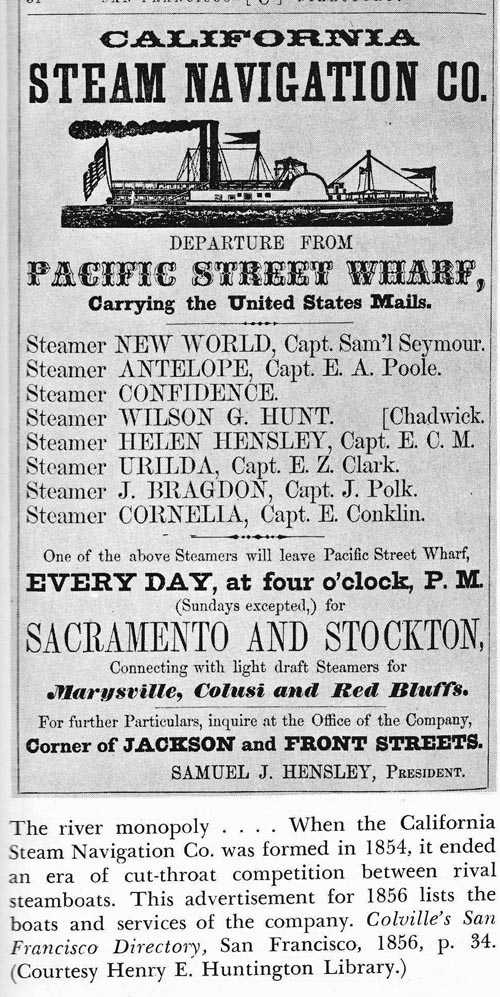
Ad from San Francisco Bay: A Pictorial Maritime History by John Haskell Kemble
SS Ariel
1,290 tons burthen
Daily Alta California, January 31,1863
Before the return of the Ariel to New York, one of the reporters of the N.Y. Tribune visited Commodore Vanderbilt to obtain for publication any suggestions he might choose to make respecting his line of California steamers and the capture of the Ariel. He said he knew nothing of the capture and detention (for three days) of the Ariel, except what he learned from the newspapers. In his judgment, one strong and swift war steamer would be sufficient to guard the California gold. Let such a steamer be sent to Aspinwall and be employed as a convey to accompany each California vessel two days into the Carribbean Sea and within a short distance of Cuba, where we have ample protection. Months ago, he made a suggestion to the Government that such a vessel, making ten or twelve miles an hour, could follow each California steamer two or three days through the dangerous passanges, and not be occupied more than half the time. Such a steamer could go from Aspinwall to the north end of Cuba in three days, return in three days more, and have four days to spare before the arriaval of another vessel from California; since the California steamers sail ten days apart. The Commodore said the Ariel was sufficiently well armed to have protected herself. She is a steamer of 1,290 tons burthen, and had on board 120 marines for the Pacific squadron. There is no doubt, she could have run down the Alabama. We have over 400 vessels in our Navy, and the Commodore thinks it is passing strange that we have not yet captured that pest of the seas, the rebel Alabama. When her commander (Semmes) proclaims his intention to steer toward Europe, we have every reason to believe he will take a different course.
SS Australia
Daily Alta California, July 15, 1889
AFLOAT AND ASHORE.
Trial Trip of the Australia— Lost an Anchor and Cable.
The trial trip of the Oceanic steamer Australia (Captain Houdlette) took place yesterday. The steamer left the Oceanic Dock at 10:30 o'clock in the morning, with a large party on board, and went outeide the heads. Point Bonita was passed at 11:20. The Australia went out about five miles, making a speed of 14 knots with 62 revolutions. She turned back on account of the increasing thick weather and strong head wind. On the way back a speed of 17 Knots with 67 revolutions was attained. Near Point Bonita she was headed out again, and, after proceeding the same distance, was put about and came into harbor, reaching the dock a little after three o'clock. The engines worked very smoothly, and the trial was a very satisfactory one, the speed being far beyond expectations. A substantial lunch was served on the steamer, of which the guests partook with an appetite whetted by the exhilarating sea air. Among those on board were John D. Spreckels and Adolph Spreckels, Theodore Cramp, of the Cramps, of Philadelphia, Judge Joachimsen, Chris Dunker, Capt. George F. Smith, Thomas Wallace, Captain Charles Potter, George Fritch, George Ross, Captain Douglass, Charles Hug, Cornelius O'Connor, A. Carpenter, Captain Miner Goodall, Captain J. H. Freeman, Captain Thayer, Captain Bruce, Charles A. Wetmoro, Robert S. Moore of the Risdon Iron Works, Robert Moore, Jr. The Australia, during the time she has been laid up, has received new boilers, new triple expansion engines, and been generally repaired and cleaned within and without. Altogether $225,000 has been expended on the work, and the result is a vessel of greater accommodations and increased speed. She has been lighted throughout by electricity. There are 300 lights fed by a dynamo with a capacity for 250 lights. A patent brine refrigerator has also been placed in the Australia. Captain Houdlette was in command yesterday, while the engines were worked by Engineer F. F. Kennedy of the Risdon Iron Works, by which firm the boilers aud engines were furnished. It is announced that the Australia will sail on the 19th inst. for Honolulu.
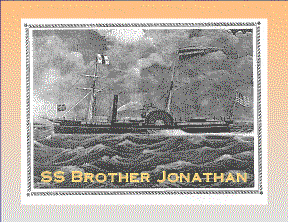
SS Brother Jonathan

Builder: Perine, Patterson and Stack at Williamsburg, New York, 1850-51. Engines: Morgan Iron Works. Original Owner: Edward Mills, who was also superintendent of construction. Launch: November 2, 1850. 1181 tons, 221 feet. (Note: One source cites her as 230 feet over all, and 1360 tons.) Hull: White oak, live, oak, locust and cedar. She had two decks, two masts, round stern, and a sharp bow with a short bowsprit. Her main salon was 70 feet long with 12 staterooms on each side, and she had berths for 365 passengers.
The following article from the Daily Alta California was located and transcribed by John Ireland:
Daily Alta California, March 3, 1851
New Steamship Brother Jonathan--A private letter from Edward Mills, Esq., of New York, speaking of the new and magnificent steamship Brother Jonathan, which is now preparing to sail for this port, says: She is one of the finest steamers ever built here and is equal to any other in point of speed - she has fine lines and great power - no boat has so much in proportion to her size. Her dimensions are 220 feet keel, 36 feet beam, 21 feet deep - solid floors, iron diagonal braces from coaged and kelson. In fact, she is as strong as wood, iron and copper can make her, and will only draw on the river 8 1/2 feet. Her cabins are well ventilated for warm climates, and the saloons finished with white enamel gold. The engine is 72 inch cylinder, 11 feet stroke, flue boiler 12 feet schell and 28 long; wheel 33 feet in diameter, 9 feet face, 30 inch bucket and 4 feet dip. She is the same power as the celebrated steamers Oregon, Vanderbilt and Bay State, and I know no reason why she should not have nearly even speed. I think she is worthy of the regards of the Californians.
The Brother Jonathan, from all we can learn, is superior in point of comfort to any vessel yet launched for this trade, and was built under the direction of E. Mills, Esq., her owner.
She sailed between New York and Chagres in 1851 and 1852. In 1852 she was sold to Cornelius Vanderbilt who rebuilt her, extending her capacity to 750 passengers, then cleared New York for San Francisco on May 14, 1852 to become one of Vanderbilt’s San Francisco--San Juan del Sur ships. She was under the command of Captain James Henry Blethen, Sr. during part of this time.
January 3, 1856, Daily Alta California.
STEAMER FOR NICARAGUA.
We understand that the representatives of the Nicaragua Republic have decided to make the purchase of the Brother Jonathan, provided she will ear the inspection to which she will be submitted by a competent committee upon her arrival from the upper coast whither she went a few days since. We learn from Col. Kewen that he has had ten thousand applications from persons anxious to join the expedition, but are deterred from going for want of a suitable means of transportation. If the Government can succeed in obtaining a steamer the desires of these applicants can be gratified.
On April 22, 1858, the big side-wheeler Commodore steamed out through the Golden Gate bound for Victoria on Vancouver Island. Crowding Blacks in Gold Rush California, Rudolph M. Lapp wrote: On this voyage one group of passengers had mixed reasons for leaving California. Two hundred and fifty African American men, women and children had booked passage that April 22nd, anticipating the economic opportunities the latest Western mining rush had to offer, and leaving behind what they regarded as a state with a troubled racial climate. California's state legislature seemed to be moving rapidly toward passage of a law restricting Negro immigration. The more congenial racial climate of British Columbia, along with economic opportunities associated with the Fraser River gold rush, swayed opinion in favor of Canada. The majority of the 250 voyagers on the Commodore came from San Francisco, but a fair number came from Sacramento and other Central Valley communities as well. Other African-Americans followed in the Commodore's wake, despite the fact that the anti-immigration bill failed. The Brother Jonathan was subsequently sold to Captain John T. Wright and the California Steam Navigation Company and extensively rebuilt at San Francisco in 1861. Captain Wright renamed her the Commodore and sailed her between San Francisco and Seattle.
Sailors say it is bad luck to rename a ship, and indeed, even though her name was changed back to Brother Jonathan soon after that voyage, her sailing days ended in one of the worst disasters in California Maritime history when the 1,359 ton steamship sunk on July 30, 1865 under Captain Samuel de Wolf's command. Ignoring Captain de Wolf's desires, shipping agents severely overloaded the vessel. Enroute to Portland from San Francisco she struck St. George Reef (near Crescent City) and sunk, taking at least 166 persons with her to the bottom. This was one of the worst disasters in Maritime history. At least 166 people went with her to the bottom.
The following was received June 1, 1999 from Bob Smith, author: Maritime Museums of North America Including Canada and of the amazing website: World Wide Maritime Museum Websites.
I was particularly interested to see if you may have included the ill-fated Brother Jonathan in your listings. And, of course, you have. My interest stems from a little article I wrote a few years ago about one Victor Smith who, in 1865, "stole" the customs house in Port Townsend (WA) and transferred to the community he created 40-or-so miles west called Port Angeles. There's more to the story but suffice to say, Victor and his arch enemy in Port Angeles were both aboard the Brother Jonathan when she sank -- and died. And now, Deep Sea Research (DSR) has successfully prevailed in legal actions started by the State of California claiming that the State owned the wreck found by DSR. Not so, says the Supreme Court. So the salvage has begun including the sale, just last week (5/20/99) of one artifact for $100,000 which will be displayed by the new owner. But more important, DSR is making it possible for all to become much more familiar with this shipwreck, its passengers where only about 19 survived of the over 200 on board, and all about the vessel itself. So, you might want to update your Brother Jonathan item with a bit of information on the discovery and salvage.
SS California
Builder: William H. Webb, New York, 1848. Original Owner: Pacific Mail Steamship Company. Launch: May 19, 1848. 199 feet, 1,057 tons, 2 decks, 3 masts, round stern, 1057 tons, with a capacity of 210 passengers. She cost $200,082 to build.
The first of three Pacific Mail steamers to depart for the newly acquired Pacific Coast of the United States. She was equipped to accommodate 60 saloon passengers and 150 in steerage. The side-wheeler cleared New York on October 6, 1848 almost empty for lack of business.
However, On December 5, 1848, President James Polk officially acknowledged to Congress that gold had been discovered on California's American River. By the time the California reached Panama on January 17, 1849, she "was greeted by a mob of gold-seekers, mostly Americans, demanding passage north."
The vessel, which was built to carry cargo, not passengers, was pressed into service and immediately overcrowded to "utmost capacity" with passengers trying to get off the Isthmus to California. She was the first steamship to arrive in San Francisco Bay (February 28, 1849), and was followed by Pacific Mail's Oregon and Panama, both of which were also filled beyond capacity at Panama with gold seekers. On April 24, 1852, off the Island of Santa Cruz in the Santa Barbara Channel, enroute from Panama to San Francisco, and crowded with 500 passengers, the California had a a complete breakdown of her machinery. The weather and sea were calm, so she was able to enter San Pedro under sail.
The California was soon dwarfed by much larger ships built to carry passengers to the gold fields and was converted into a sailing ship, but she operated regularly between San Francisco and Panama from 1849 to 1854, then was put to use as a spare steamer in 1856. She made voyages from San Francisco to Panama in 1860, 61 and 66. The California was then sold to Holladay and Brenham’s California, Oregon and Mexico Steamship Company, but returned to the ownership of Pacific Mail in 1872. In 1874, she was sold to Goodall, Nelson and Perkins, who operated her in local coastwise service from San Francisco until the end of 1875, when her engines were removed and her hull sold to N. Bichard. Rigged as a bark, she was engaged in the coal-and-lumber trade until she wrecked near Pacasmayo, Peru in 1895.
SS Carolina
Builder: Charles and William Cramp, Philadelphia, 1849. Original Owner: S.H. Reynolds.
The Pacific Mail Steamship company bought her immediately and she was put into dry dock to be coppered and have her upper cabin extended for the San Francisco-Panama route. She sailed from New York for San Francisco on January
9, 1850, arriving in San Francisco on May 7, 1850. On her May 7, 1850 sailing to San Francisco from Panama via Acapulco, Mazatlan, San Diego and Monterey, she established the quickest time on record as of that date for any class of vessel on the same route, either steamer or sail. She operated on the San Francisco-Panama line until the end of 1851 and was sold for service in China in 1854.
SS Chesapeake
By mid-1863, the steamship Chesapeake was part of the Civil War fleet. In June, she left Brown's wharf armed with two rifled six pounder guns, about 30 men from the 7th Maine regiment and about 30 civilian volunteers. As the wind was "a meerest puff of a south wind" about 50 sailing ships were becalmed in the harbor. During the Civil War, the Chesapeake was seized by privateers who used a forged Confederate letter of marque. Although privateering was legal, because of the forged document the raiders were tried in Halifax.
SS City of New York
Several ships and a few steamships were named City of New York; one was a packet launched in 1854 for the D. & A. Kingsland line. Another, the ship City of New York of 1811 tons of Train's Line (Enoch Train of Boston).
In 1851, Mailler & Lord, had the little steamship City of New York, registering 574 tons, ready to put into their Boston-Richmond line to supplement their sailing service when it was decided to send her to Chagres instead. In 1853, this City of New York was taken off the Chagres line to sail between Boston and Philadelphia. Boston agent Phineas Sprague assured the public that the steamers would leave T Wharf every Saturday, "full or not full." (Source: Queens Of The Western Ocean, The Story Of American's Mail And Passenger Sailing Lines. Carl C. Cutler. 1961)
The Inman Line operated three steamers named "City of New York" from 1850 until 1893. The owner of the company, William Inman was born in England 1825 and died in his home in Cheshire in July 1881, just after the launching of the SS City of Rome. Inman was thus spared the disappointment regarding the low performance of the ship, which was returned to her builders after only 6 round voyages for the company.They were three different vessels; each was added to the line after its predecessory was wrecked.
- 1861. Launched in Glasgow April 12. 336 feet. Sailed September 11 1861 from Liverpool to Queenstown, Ireland, and then to New York in September 1861.
New York Times, June 23, 1863: The steamship City of New York, which arrived here yesterday, (Sunday) will, on account of her rapid passage and at the request of the Post-office authorities, be dispatched from here on Saturday next, 27th inst., carrying the mails.
New York Times, November 6, 1861
It is scarcely more than a month ago that we had occasion to speak in terms of merited compliment of the trial trip of the City of New-York, belonging to the Liverpool, New-York, and Philadelphia Steamship Company. In a few hours' run down the Bay, she displayed qualities of speed which seemed to place her at the head of the screw steam fleet belonging to the commercial world. In every other respect she seemed to be the equal of any vessel that leaves our port to cross the Atlantic. Since then the City of New-York has made an eastern and a western passage, both of so remarkable a character that the best expectations excited on the occasion we have referred to were more than realized. She left her dock at Pier No. 44 North River on the 5th of August, and after being detained several hours by the tide, crossed the bar at 4 1/2 o'clock, P.M. Nine days and fourteen hours afterwards she was in the harbor of Queenstown, beating the Persia, which followed three days later, by several hours. During this passage, and the one just completed, the vessel was not allowed to run at her full pressure of steam, owing to the newness of the engines, which might easily have become heated. Hence it is reasonable to expect that in a more favorable period of the year, and when the motive power can be used to its fullest capacity, the vessel will exceed her best running this season. And yet it will be seen by the following extract from the log that the western trip was one of the most remarkable ever made, having been accomplished in the space of nine days and four hours. The storm prevented the vessel from reaching her dock on Saturday, and, indeed, she was compelled to put to sea during the most violent portion of it. The following is the official account of the run westward:
The British steamship City of New-York, Capt. PETRIE, from Liverpool Oct. 23, via Queenstown 24th, at twenty-five minutes past four P.M. arrived at Sandy Hook at half-past eight P.M. on the 2d of November. Oct. 30, at 7 P.M., Cape Race light bore north, distant six miles, but she could not approach, in consequence of the heavy southeast sea.
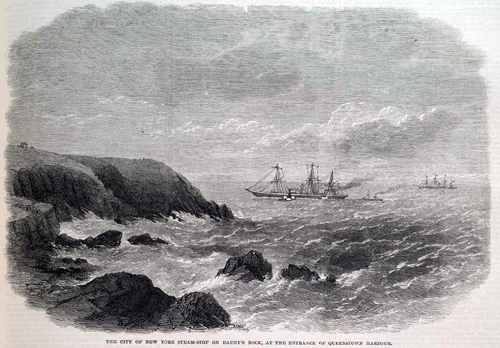
- The Illustrated London News, vol. 44, no. 1252, p. 349. April 9, 1864 The steam-ship City of New York, one of the ships belonging to the Liverpool, New York, and Philadelphia Steam-ship Company, usually called the Inman line, remains still fixed upon Daunt's Rock, at the entrance of Cork or Queenstown harbour, where she struck on the morning of Tuesday week. The first of the two Engravings, from sketches taken expressly for this Journal, shows the position of the ship last Saturday, when she presented no external appearance of injury; the tug-boats were alongside removing her cargo, and there was another large steamer, which is seen on the right. (Images below from The Illustrated London News, April 9, 1864.)
- 1865: Launched at Glasgow in 1865 as the Delaware for owners Richardson, Spence & Co. of Liverpool. Purchased in 1865 by the Inman Line and renamed City of New York. Her maiden voyage from Liverpool to Queenstown, Ireland, thence to New York in June 1865. Ran between Liverpool and New York until 1873 when she was chartered by the American Line and renamed the City of Bristol.
- Liverpool and Queenstown to New York 26 June 1866 DISTRICT OF NEW YORK – PORT OF NEW YORK I, Robert Leitch, master of the S. S. "City of New York" do solemnly, sincerely, and truly (missing word) that the following List or Manifest, subscribed by me, and now delivered by me to the Collector of Customs of the Collection District of New York, is a full and perfect List of all the passengers taken on board the said City of New York Liverpool and Queenstown from which ports the said City of New York has now arrived; and that on said list is truly designated the age, the sex, and the occupation of each of said pasengers, the part of the vessel occupied by each during the passage, the country to which each belongs, and also the country of which it is intended by each to become an inhabitant; and that said List or Manifest truly sets forth the number of said Passengers who have died on said Voyage, and the names and ages of those who died. (Passengers are noted on the Immigrant Ships List.)
- 1888: Inman's final City of New York was launched at Clydebank, Scotland. This 560-foot-long twin-screw express steamship became the first ship apart from the Great Eastern to exceed 10,000 tons. It had a capacity of just under 2000 passengers and from August 1892 to May 1893 it held the eastbound Atlantic speed record with an average speed of just over 20 kts. It was large for its day checking in at 17,240 tons and it and its sister ship, SS City of Paris, were the first express ocean liners to feature twin screws. In February 1893, the Inman Line was folded into the American Line with the ship becoming American flagged and renamed the SS New York. The ship was used by the US government during the Spanish American war and returned to transatlantic service in January 1899.
On May 22, 1874, the Lebanon Daily News, Lebanon Pennsylvania reported:
CHEAP TRANSPORTATION -- The New York Herald, commenting on the successful trip of the City of New York up the Erie Canal says: Success has at last attended the efforts to apply steam to canal transportation. It would be difficuilt to overrate the value of this new achievement of science, and yet it leaves very much to be accomplished before the transport question can be looked upon as solved. It will considerably shorten the time between the terminal on the lakes and New York, but the main question of cheap and rapid transport for Western produce remains unsolved.
And tliis question of cheap transportation for the produce of the great West is essentially a popular question. It means cheap food for the East and cheap goods for the West. Every section of the country is interested ii it.
(Editor's Note: It is unclear as to which City of New York this might be. Given the number of steamers named City of New York, it could be a smaller steamer designated as a river steamer and not others mentioned herein.)
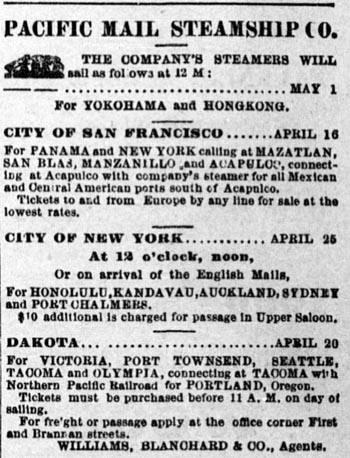
In 1875, Roach in Chester, PA built The SS City of New York, an iron, 3,019 gross ton, screw propulsion steamer with a speed of 14 knots. She was built for the Pacific Mail Steamship Co. and sailed on her first voyage from San Francisco to Kandavau (Fiji) and Sydney on 24th April 1876. On 26th October 1893 she was wrecked on Point Bonita, San Francisco Bay.
(Ad right: Daily Alta California, April 13, 1877)
The company ran a service between San Francisco, Fiji, Honolulu and Australia, New Zealand ports, and from 1879, advertised in the London Times "An overland route from Britain to Australia, New Zealand, China, etc, via New York and San Francisco in connection with the Anchor Line from London or Glasgow to New York. Through tickets are available."
SS City of Pittsburg
Daily Alta California, December 7, 1852
THE STEAMSHIP CITY OF PITTSBURG
DESTROYED BY FIRE
The steam propeller, City of Pittsburg, from New York for this Port was entirely destroyed by fire in the harbor of Valparaiso on the night of the 24th of October. She was a fine new steamer of 3,368 tons measurement, and cost $300,000.00, for which amount we understand she was insured in New York and England, but which is less than the owner's loss, as she had a large supply of provisions and stores on board and outfits in Rio and Valparaiso to the extent of $100,000.00 uninsured. The following extract of a letter from Mr. Thompson, chief engineer, gives the particulars of the disaster.
Valparaiso, October 28, 1852
We arrived here on Sunday night from Coronel and Talcahuano, having about 1400 tons of coal on board. Having lost an anchor at Coronel, I deemed it most advisable to bank our fires and keep them in readiness for an emergency, having the regular fireman on watch, raising steam from the midship boiler to pump ships, wash decks, etc.
About 10 P.M. Saturday night, I, as usual, before turning in, took a look through the engine and fire-rooms, and around the steam chimney casing the steerage, which latter place was, and had bene, regularly inspected every two hours.
About 20 minutes after 2 P.M. Sunday morning, I was awakened by two of the sailors conversing outside my window relative to a smoke in the forecastle; turned out and ran forward, followed by the chief officer. The crew were turning out of their bunks; all the smoke I could see was from their hatch. (Missing pages . . . will add when located.)
SS City of Rio De Janeiro
Click to read the story of the City of Rio de Janeiro and Captain William Ward
SS City of San Francisco
Steamship of 3400 tons, a sistership to the City of New York. Pacific Mail Steamship Mail carrier with some passengers on service between San Francisco, Honolulu, Fiji, Sydney and New Zealand under contract to Governments of NSW, Australia and New Zealand. She was a mail carrier until the company ran into financial difficulties after 1876 and the company ceased operations.
The Press, June 19, 1876 Arrival of the City of San Francisco at Auckland
Auckland June 17th: The City of San Francisco arrived this morning. She connects with the Zealandia at Kandavau on the 13th. The latter left San Francisco on 25th May.Passengers - C Ferguson, W Crake, Hendle and Manning. Third class- Messrs Ross, Elliott, Michael, Casey. For Wellington-Captain Bower and wife; third class Mr Burke wife and sister. For Lyttleton -second class : Miss McCadam. For Port Chalmers- Cabin: Rev Coleman Creigh and Messrs Clows, Hall and Cuff.
Cargo-For Wellington, 100 cases goods 25 bales hops; for Lyttleton, 2 samples, 25 bales hops; for Port Chalmers 25 pieces redwood timber, 50 cases salmon, 1 sample.
Arrival of The City of San Francisco at Napier The Evening Post June 19, 1876: The R M S S City of San Francisco arrived at Napier last evening at six o'clock, making a very quick run of 31 hours from Auckland. She left again at 9 p m for the port, and should arrive here before dark this evening. We understand she will not be brought along-side. She proceeds South two hours after arrival.
Arrival of The City of San Francisco at Wellington
The Evening Post June 20, 1876: The R M S S City of San Francisco delivered the inward English Mail (from London, May 4) in this port at 8.30 p m yesterday, having been delayed by head winds on the run down from Napier, which occupied 23½ hours, averaging only 8¼ knots per hour. Her previous run from Auckland to Napier, 31 hours (not 19 as stated in error by our morning contemporary, which would have involved a continued sped of 20 knots per hour) was, however, a very good one, averaging 12½ knots. We may remark here that the new boats will have their work cut out to beat the performance of the ill-fated Mongol while employed on the temporary service. That steamer nmade the run from Wellington to napier in 14 hours, 20 minutes, averaging 14 knots, and from Auckland to Kandavu in 3 days, 17 hours, or at the rate of 13 knots per hour.Arrival of The City of San Francisco at Lyttleton
The Press, June 21 1876: This magnificent steamer arrived yesterday (20th June 1876) at 2:30pm. The SS Moa was waiting with steam up and directly the signal was made that the mail boat was inside the heads , she started to meet her with agents , reporters and visitors on board. The Customs steam launch was first to reach the vessel and with commendable promptitude the mails were at once placed in that vessel , in order that the 3:20pm train might be caught to carry up the Christchurch portion to town. In spite however of the efforts used , the launch arrived a minute late but the mails were forwarded by the 3:30pm goods train, so that few minutes were lost. After discharging her inward cargo and taking on board a few passengers, The City of San Francisco sailed for her destination at 4 pm. The steamer was beautifully clean throughout, and as on her first visit was much admired. We append a report of the trip from Sydney furnished us by the purser.
The SS City of San Francisco, J.S. Waddell, commander, left Sydney June 2nd 3.5 pm, fine weather up to 9th, when heavy squall, accompanied with rain, lightning and thunder set in, lasting three hours; 8am anchored in Kandavau; 2pm SS Australia came in, and left at 12 midnight; 12th frigate H B M Pearl came in ; 4 pm Zealandia came in transferred mails, freight and passengers ; 5:30 pm Pearl left for Sydney ; 13th 1:45am sailed from Kandavau in company with Zealandia; 16th strong breeze, very heavy sea; 17th at 3:15am arrived Auckland; left same day at 11am, arrived off Napier 18th at 6pm; left at 9:30pm after delivering receiving mails and passengers; 19th very heavy weather, strong head winds, squally , very high sea; arrived Wellington at 9pm; did not leave until 11pm owing to our being detained forty minutes by pilot, arrived Lyttleton, at 2;30pm.
The City of San Francisco
The Press, June 30, 1876: This fine steamer was signalled at 2:30pm yesterday and arrived at 3pm. Quite a crowd of people went off to her in the SS Moa. The outward San Francisco mail consisted of twenty-two bags, an usually large one. The City of San Francisco left Port Chalmers at 8:30pm on Wednesday, and had strong NE gale in her teeth during the run up, arriving as above. She sailed north at 5:30pm last night.
On 16 May 1877 the City of San Francisco was wrecked on Tartar Shoal, near Acapulco, Mexico, but without any loss of life.
SS Colima
Passenger lists and the sinking of the Colima
SS Colorado
Builder: William H. Webb, New York, 1863. Engine: Novelty Iron Works. Cost: $1 million. Owner: Pacific Mail Steamship Company. Launch: May 21, 1864. Wooden side-wheel steamer with 3 decks, 3 masts, round stern, 314 feet, 3,728 tons. She had 52 staterooms on the main deck and berths for 1500 in steerage.
The Colorado was the largest San Francisco-Panama route liner to ever ply the Pacific. In 1865 she was armed with two 20-pound field pieces on her quarters, two 30-pounders forward. She sailed from New York for San Francisco via Rio de Janeiro, Callao, and Panama on April 1, 1865. She was originally brig-rigged, but was altered in San Francisco in 1866 to enter the China service. At that time a mizzen-mast was added, and she was ship-rigged. In 1867 the Pacific Mail founded the first regular steamship service across the Pacific Ocean. The Colorado was retrofitted for the maiden voyage while Pacific Mail constructed four new ships specifically for that route. Those four ships were the China, Japan, Great Republic and America, and they were the largest and last of the great sidewheelers. In 1873 the first iron, screw steamer entered the trade and by 1879 the life of the trans-Pacific sidewheelers came to a close. In 1867, the Colorado became the first American liner to carry mail across the Pacific to the Orient, which helped pave the way for a rapid expansion of trade between California and the Orient. The Colorado was one of the ships that brought Chinese immigrants to San Francisco. In 1876 was laying in the stream with 800 Chinese in steerage. Soon after leaving Hong Kong four of the Chinese passengers were attacked with small-pox and left in the hospital at Yokohama. San Francisco's Quarantine Officer did not want to risk introducing small pox to the City. The steamer was anchored off Mission Bay, passengers unloaded, and she was inspected and fumigated. The Colorado was scrapped in 1879.
SS Columbia
Builder: Westervelt and Mackay, New York. Engine: Novelty Iron Works. Original Owner: Pacific Mail Steamship Company. Cost: $169,0443. Wooden side-wheel steamer, 3 decks, 3 masts, round stern. 777 tons, 193 feet. She had a light deck above the main for promenading and a 70 foot-long dining saloon flanked by staterooms along each side. Lower cabins accommodated 150 passengers.
She was one of the fourteen steamers comprising the Pacific Mail Steamship Company's fleet during the early 1850s, and was originally intended for mail service between San Francisco and Astoria, Oregon. However, because of the Gold Rush crush, she was occasionally pulled into service between 1851 and 1854 for the run between San Francisco and Panama. She was sold to Chinese owners in March 11, 1862. She sailed from San Francisco to Shanghai under British colors on April 17, 1862.
Daily Alta California, May 15, 1852
THE COLUMBIA.--The P.M.S. Company's steamer Columbia, Captain Dall, will leave Long Wharf for Panama this morning at 7 o'clock, having on board 120 passengers, $1,836,845 on freight, and the U.S. Mails.
| Adams & Co. | $506,707 |
| Page, Bacon & Co. | 378,000 |
| B. Davison | 177,280 |
| Burgoyne & Co. | 100,000 |
| Drexel, Sather & Church | 25,600 |
| Argenti & Co. | 10,491 |
| E. Delessert, Ligeron & Co. | 9,730 |
| Jos. A. Haines | 10,000 |
| Flint, Peabody & Co. | 25,000 |
| D.L. Ross & Co. | 15,067 |
| J. Seligman & Co. | 24,000 |
| Statz & Newhouse | 10,000 |
| Cunningham & Brumajin | 10,000 |
| Alsop & Co. | 14,790 |
| J.B. Thomas | 17,360 |
| Wyckoff & Co. | 14,000 |
| Case, Heiser & Co. | 35,000 |
| Macondray & Co. | 24,000 |
| Gildemester, De Fremery & Co. | 32,485 |
| D. Gibbs & Co. | 39,500 |
| Godefroy, Sillem & Co. | 21,200 |
| Collins, Cushman & Co. | 10,308 |
| Beck & Elam | 27,570 |
| D.O. Mills & Co. | 15,300 |
| Rhodes, Purdy & McNulty | 12,800 |
| Reynolds & Co. | 10,000 |
| TOTAL AMOUNT | $1,836,845 |
SS Columbus
Builder: Reeves and Brothers, Allowaystown, New Jersey, 1848. Engine: Rainey, Neafie and Company, Philadelphia. Wooden screw steamer, 2 decks, 3 masts, scroll figurehead, 460 tons, 148.8 feet.
She was sent to the Pacific by George Law for San Francisco-Panama service. She sailed from New York February 12, 1850, arrived at Rio de Janeiro, March 11, 1850 and in San Francisco on June 6, 1850. In early 1851, the Pacific Mail Steamship Company bought her for $120,000 and ran her on the San Francisco-Panama run until 1854. She was chartered for a short time by the US Navy, then sold to the Panama Railroad Company and operated along the west coast of Central America. She was lost at Punta Remedios, Central America, December 9, 1861.
SS Commodore Stockson
Builder: Davis and Burton, Philadelphia, 1850. Original Owner: R.F. Loper. Wooden side-wheel steamer, 2 decks, 3 masts, carved eagle on stern, scroll head. 435 tons, 153.7 feet.
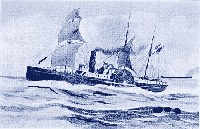
She went from Philadelphia to San Francisco in 171 days. She was advertised to sail from San Francisco for Panama on June 12, 1851 for J. Howard and Son’s Empire City Line to connect with Vanderbilt’s steamers on the Atlantic. She sailed from Panama for San Francisco on June 30, 1851 with over 100 passengers. Two days later she was back at Panama, having sprung a leak. In 1852, when operating for the Independent Line, she was condemned, then purchased by Valparaiso owners in February 1853. She was placed under the Chilean flag and her name changed to Coupolican.
SS Constitution
Paddle steamship Built 1850 in New York, funded by Sam Ward (the famous lobbyist) and Rodman Price (later Governor of New Jersey). She sailed to San Francisco for service.
he SS Constitution also sailed Hawaiian waters before returning to the West Coast to become part of the Empire City Line, when she regularly sailed between San Francisco and the Puget Sound area, and from Panama via Acapulco, Mexico and San Diego to San Francisco. Like many steamships of the era, it was also built with masts for sails as the steam boilers of the time were notoriously unreliable. Many Captains pushed the boilers to the limit in order to make speed records or beat other ships to port, only to have the boiler break down or even blow up. In this event, they relied on the sails.
On January 15th, 1863, the Secretary of War gave permission to enlist Californians for the Civil War. The next day a notice appeared in the Alta California requesting enlistees for
". . . three years or the war, under the Massachusetts Quota, and will leave for New York on the 11th of February next. Transportation has now been provided for and sufficient funds are now under the control of hon. Ira P. Rankin to pay all necessary expenses of the organization. Uniforms, quarters, substinence and necessary outfit will be furnished to the men as soon as accepted."
Fifty applicants signed up by the 19th and by February 10th, the day before sailing, 185 enlistees were on hand. The departure date was postponed and additional recruiting offices opened. The enlistees bunked at Platt's Music Hall and drilled daily in addition to making an impressive showing at a few parade and reviews. On March 20th and 21st, the volunteers were mustered into service. There were only three complete companies ready to sail on the S.S.Constitution on March 23rd. Captain David A. De Merritt stayed behind to complete recruiting his company and did not reach Boston until mid May. Those that sailed that beautiful clear March day were treated to the "traditional" parade, speeches, and salutes. Throngs cheering from the shore and boats must have offset, temporarily at least, the trepidations one should feel when going to war. It was another wonderful send-off for the patriots from California even though it belied what waited ahead. The voyage aboard the S.S. Constitution was miserable and a stop had to be made in Mexico to take on fresh provisions to quell insurrection. Guard duty caused the Battalions first casualty: Hiram Townsend of Walnut Grove fell overboard while on guard duty one evening leaning on a rail while seasick.
In 1860, the S.S. Constitution was rebuilt as a barque.
Another S.S. Constitution was launched in 1861 for the Pacific Mail Steamship Line, which on February 12, 1864 carried $1,620,421.81 in treasure shipment out of San Francisco.
SS Cortes
Builder: Westervelt and Mackay, New York. Engines: Double walking-beam engines by Morgan Iron Works. Original Owners: Davis, Brooks and Company. Launch: March 28, 1852. Wooden side-wheel steamer, 3 decks, 2 masts. 1,117 tons, 220 feet.
The Cortes was originally christened Saratoga and intended to run from New York to Richmond. However, she sailed from New York for San Francisco on July 10, 1852 and operated between San Francisco and Panama by the New York and San Francisco Steamship Line through 1853 when she was purchased by Cornelius Vanderbilt for his San Francisco-San Juan del Sur, Nicaragua run. In August of 1854, an attempt was made to sink the Cortes, "by some persons who secretly climbed on board of her as she lay at the Jackson Street Wharf. They succeeded in getting below, without being discovered, when they turned off the blower cock attached to the boilers, and the water rushed in rapidly. Before her condition was discovered, she had filled to the second deck. The ship's pumps being inadequate, the great steam pump of the Saucelito Water Company was brought into requisition, which, after working all day long, towards evening pumped her dry. The bedding and furniture was much injured, but the vessel received no serious damage." (Annals of San Francisco, August 1854) In 1860, the Cortes was purchased by the Pacific Mail Steamship Company and entered its Panama service. In February 1861, she was sold to Flint and Holladay and left San Francisco for Shanghai on April 14, 1862. She burned in Shanghai in 1865.
SS Crescent City
The Crescent City, first of the new U.S. Mail Line between New York and New Orleans, made 16 knots on her trial trip, May 30, 1848. On her first voyage to New Orleans, she was credited with reducing the running time to six days, which seems probably in view of the fact that she made the round trip in 20 days, including stopovers, arriving back in New York with 180 passengers. On the day before Christmas, 1848, to the cheers of thousands assembled on the docks to see them off, the Crescent City, with the Isthmus, were cleared for Chagres to deliver gold seekers to the Atlantic side of Panama. On December 14, the New York Herald reported: "four large steamships cast off their lines along West Street and proceeded to sea in stately procession, the Cherokee, Crescent City, Ohio for Chagres and the Great Western for Bermuda.
The Crescent City's voyage was ill-fated.
Daily Alta California, Wednesday Morning, February 6, 1850
ACCIDENT TO STEAMER CRESCENT CITY!
The schooner Sarah A. Smith, from Belfast, Maine, arrived at Chagres, on Sunday evening last, (30th of Dec.). She brought 32 passengers from the unfortunate steamship Crescent City, which vessel she encountered at sea on the 16th ult. We are indebted to Mr. W. W. Leland, brother to the editor of the Pacific News for the following narrative of the disaster on the Crescent City, and the events which transpired down to the arrival at Chagres.
Gentlemen,-- Knowing that there is a great deal of anxiety felt in relation to the disaster which attended the noble steamship Crescent City, I am happy to impart through the Echo a brief account of the accident, and our trip here. We left New York on the 13th ult., precisely at 3 o’clock. The Cherokee left a few moments before us – the Ohio shortly after. At about 10 o’clock that evening, we lost sight of the Cherokee, two points off our starboard bow and the Ohio, two points off our larboard quarter. It was at this time snowy and squally. We came on at the ship’s usual rate, 10 to 12 knots per hour, until Sunday evening, the 16th ult., it being a smooth sea, and the passengers, as usual after tea, had gathered on deck, and were making calculations on reaching Panama in 11 days. All at once there was a tremendous crash; of course it made a great stir. We soon found that the cross tail, and other parts of the engine was completely used up. Capt. Stoddard gave orders at once to make sail, but as there was scarcely any wind, and she had but small sails, we did not scarcely move. The cannon was fired, and rockets, at intervals, until morning – when we heard the glorious news from the mast head," sail ahoy!," "where away?" "off our weather bow!" All hands were looking with intense anxiety but to appearance the vessel bore away. The Capt. Gave orders, and manned the small boat – put provisions aboard for the men, and sent them to bring her to our relief. There was no wind, and they pulled the oars to good effect. They reached the schooner on Monday, the 17th utl. About three o’clock. The Captain called a meeting of the passengers. About one-half determined if he would charter her, they would embark on hr for Chagres. Some wished to remain on board, and have the steamer got to Nassau, as we were only 600 miles from that port. The accident happened in lat. 28:9, and long. 72:56. The Schooner reached us only on the morning of the 18th and proved to be on a voyage to Key West from Belfast, Maine, loaded with lumber and provisions. Her name was Sarah A. Smith, 94 tons burthen. Captain Stoddard purchased the cargo at 100 per cent over cost, and threw overboard lumber enough to make sufficient room for the passengers to sleep in the hold. The passengers who did not choose to come aboard the schooner, the Captain paid back one-half of their fare, and they went aboard of two brigs loaded with lumber, and bound for Havana. We left the Crescent City, on the evening of the 18th ult., and reached Jamaica on the 16th, and Chagres on the 30th. We were all glad to get a release from the hard fare of the country schooner. We arrived in this city on the evening of the 3d January, twenty-one days from New York.
Yours, respectfully
In late February 1850 she was purchased by George Law for operation on the New York-Chagres run.

SS Farallon
The SS Farallon was a wooden steam schooner (named after the Farallon Islands, located 26 miles from the coast of San Francisco). The SS Farallon was constructed on Sixth Street in San Francisco in 1888 by Alexander Hay with construction supervised by I. E. Thayer. She was 171 feet long with a beam of nearly 34 feet and a cargo hold more than 10 feet deep. This deep hold allowed the ship to transport over 400,000 board feet of lumber, including Pacific Coast fir, pine, redwood and cedar. (Note that the Daily Alta California of September 9, 1888 reports her at 71 feet long).
In the 1890s she worked out of ports in Northern California, Oregon, and Washington. By 1899 it she was making runs from Seattle to Alaska ferrying passengers and mail with the Alaska Steamship Company.
Following are a few notices of the Farallon voyages through to her demise after the turn of the century.
- Daily Alta California, September 9, 1888: The new steam schooner Farallon made her trial trip around the bay yesterday. She left Berry and Third streets at 10 o'clock, and steamed over the measured mile to Hunter's Point. A speed of eleven knots was developed on the mile. From Hunter's Point the steamer went to Fort Point, then back to Hunter's Point, landing some passengers at Mission No. 1 on the way, and then up the bay, as far as Benicia, returning to Mission street at 4 p.m. There were quite 250 people on the Farallon, who enjoyed the trip immensely. Captain Bonnifield (also spelled Bonifeld, Bonnifeld) was in charge and will retain command. The Farallon is 71-1/2 feet long, 33 feet beam and 10-1/2 of hold. She is fitted with triple expansion engines with 14.22 and 36-inch cylinders and 24-inch stroke. Dolbeer & Carson are the principal owners, and she will run in their trade to the Humboldt mills. (Note that this indicates that she was 71-1/2 feet long, not 171-1/2 feet long; additional information is needed.)
- October 14, 1888: San Francisco and Humboldt under Captain Bonifeld
- San Francisco Call: between San Francisco and Puget Sound in 1895
- Daily Alta California, June 1, 1890: Steamer Farallon, Bonifeld, 45 hours from Yaquina Bay; pass and 5056 sks wheat, 1518 sks oats to C. H. Haswell, Jr. Consignees: Moore, Ferguson & Co; H. Dutard
- San Francisco Call, March 28, 1895
A SMALL VESSEL BREEDS A PANICOne little steamer of less than 600 tons burden has been instrumental in causing a reduction in fares and freights, to Sound and Alaska points that enables passengers and shippers to save from three-quarters to two-thirds of what was paid less than two months ago, and makes traveling cheaper than remaining at home. And her advent will also effect a cut in the rates to Portland in the very near future. About two years ago the West Coast Steam Navigation Company chartered the steamship Farallon and placed her on the route between this city and Puget Sound ports. The passenger rate was placed at $15, a reduction of $5 from that charged by the regular steamers of the Pacific Coast Steamship Company, and a slight reduction was also made in freight rates. Business continued to gradually increase for the Farallon, and soon she had all she could carry. Her success, however, materially interfered with the revenue of the old steamship company, which had previously had a complete monopoly of the trade.
She Has Made Traveling Cheaper than Staying At Home
CUT RATES TO THE NORTH First-Class Fares to Sound Ports Reduced to Five Dollars
- San Francisco Call, January 30, 1897: Steamer Farallon, Roberts, 60 hours from Yaquina Bay and way ports; pass and mdse to Meyer & Ackmann. Importations: 236 tons stone, 4144 qr sks 1162 hf sks 589 bales flour, 7 cords stavebolts, 250 sks oats, 13 coops poultry, 24 pkgs chairs, 13 coops poultry, 6 coops chickens, 2 bbls salmon, 250 sks oats, 16 cs eggs, 29 sks oysters, 1 cs chimneys, 1 cs furs. Consignees: Wells, Fargo & Co; W. C. Ramsey; McDonough & Runyon; Marshall, Tegger & Co; J. McMillan; Thomas Loughran; Chas Harley & Col;Standard Oil Co; Cunningham, Crutiss & Welch; H Levi & Co; Russ, Sanders & Co; Morgan Oyster Co; J. H. Newbauer & Co; Moore, Ferguson & Co; Cal Chemical Works; A. Paladini; C. E. Whitney & Co; Russ, Early & Co; Labor Exchange; J. P. Thomas; W. C. Price & Co; Miller, Sless & Scott; McPhee & Co. Anspacher Bros.; C. J. Leist & Co; Pacific W.W. and Co; Allen & Lewis; Jonas Erianger & Co; J. D. McGilvray; C. Jacobson & Co; Pacific Commercial Co.
- San Francisco Call, November 24, 1901
ALASKAN STEAMSHIP FARALLON DISABLED
Loses Two Blades of Her Propeller and Puts Into Skeena River.
Vancouver, B.C. Nov. 23 - The steamship City of Seattle, which arrived here this morning from Skagway, brought news of a serious accident to the Alaskan liner Farallon, Captain Ord. The Farallon was found lying in shelter under the lee of Kennedy Island, at the mouth of the Skeena River, and will remain there until some steamship comes along to tow her to Seattle. The City of Seattle took the Farallon's mails and several passengers aboard and the rest of the passengers will come on the Dolphin. The Farallon was passing through driftwood just south of Wrangel Narrows on Wednesday when her propeller struck a log and two blades were stripped off befere the machinery could be stopped. Then the engines raced and the steamship had to be stopped altogether. Later in the afternoon the engines were started again at half-speed, but with only a quarter of a propeller they could not be controlled, and the jarring of the ship caused her to spring a leak. The longer the machinery was kept running the more the water came into the hold, and to prevent the boat sinking, steam has to be shut off entirely. In the meantime sails were- rigged up and the vessel was held on her course to the south. She sailed all that night and next morning, and by noon had anchored off Kennedy Island. - San Francisco Call, November 22, 1904: Damaged Ship Reaches Port. SEATTLE. Nov 21 -- The steamship Farallon arrived in port this morning from Skagway with part of the port and starboard carried away. The vessel encountered one of the most severe storms in years en route south. Part of the vessel's deck cargo was also washed overboard. The steamships Cottage City and Humboldt were in the same gales.
- Los Angeles Herald, February 10, 1910: TAHOMA SAILS ON SEARCH. Seattle. Feb 9 - The revenue cutter Tahoma sailed for the north today to search for the missing lifeboat of the steamer Farallonn. The Tahoma will take a pilot at Seward and then proceed to Iliama bay. The steamship Victoria with most of the Farallon castaways will reach Seattle Saturday night.
- Los Angeles Herald, March 23, 1910
STEAMER GOES TO PIECES. BUT CREW IS ALL SAVED
Valdez, Alaska, March 22.—The Alaska Steamship oompany's steamer Farallon, which went on the reef at Iliamma bay, Cook's Inlet, January 5 has gone to pieces. The engines, covered with ice, are still perched on the reef. The five men who were standing by the wreck reached the shore in small boats, built huts of driftwood and waited until taken off by the mall steamer Dora, which conveyed them to Kodiak, whence they were brought to Valdez by the steamer Portland. The men sailed for Seattle on the Victoria today.
- San Francisco Call, April 2, 1910
CASTAWAY REACHES HOME AFTER SEVERE SUFFERINGVALDEZ, Alaska, April 1.— The mail steamship Dora arrived from Unalaska today, bringing Charles Burns, the last member of the boat crew that left the camp of the castaways of the steamship Farallon at Illamna bay, Cookinlet, after the Farallon had gone on the rocks January 5. Burns refused to accompany the remainder of the crew when they left Kadguyak bay to cross Shellkkof strait to Kodiak island, saying that he would try to reach Cold bay, on the Aleutian peninsula, and catch the Dora there. Burns set out alone in a little open dory, with a small quantity of dried salmon, which soon became exhausted, and he rowed a whole day without food. Finally Burns sighted a prospector's cabin, where he found a shotgun and ammunition. "While shooting ducks the gun, was accidentally discharged, tearing off a finger arid otherwise mutilating his hand. The tide carried away his boat, and the cooked ducks that were in it.
Member of Farallon's Crew Has Finger Blown Off
Weak and hungry, Burns started on foot through the snow for Katmal, where his wounds were treated and the census enumerator carried him to Cold bay where, they arrived just in time to catch Dora At Unalaska a physician treated Burns, hand and the Dora landed him at Kodiak, his home. Burns will recover.
About two months ago the latter company inaugurated a rate war, but its cuts were each time promptly met by its plucky and daring rival with the result that passengers can now travel by water to Seattle and other sound ports in first-class style for $5 and $2.50 in the steerage whenever the Farallon sails, which is twice a month. On the sailing dates of the Farallon the old the old line puts its fare down to the same figures, but on the intermediate sailing dates of its steamers it exacts all the traffic will bear ranging from $10 to $15 for first-class accommodations to $5 to $7.50 for second class. Of late freight rates, too, have been slashed into unmercifully. Where a few months ago not a pound of merchandise was carried for less than $6 a ton, and as high as $8 was paid, shipments can now be made at the rate of $2 a ton. This is the rate on the Farallon and on the steamers of the Pacific Coast line which sail on the dates approximating these departures of the Farallon. At all other times the old rates are charged.
The direct result of this warfare has been to create an unprecedented current of travel, both to the north and to this city, as these rates hold good in either direction. The Farallon is taxed to her utmost capacity on each trip, as are also the vessels of the other line. The Farallon people, however, refuse to sell tickets to more passengers than can be accommodated with berths, while the rival company refuses no application for passage, allowing the late comers to find sleeping accommodations where best they can. The resulting reduced freights have greatly stimulated trade between this city and the sound, more particularly in lines of goods that it did not pay to ship under the old rates. Among other things coal is being brought here for $1 less per ton than usual. A connection has also been formed by the West Coast Steam Navigation Company with the Alaska Steamship Company, which operates the steamer Willapa between Port Townsend and Alaska, whereby they have forced a reduction in the passenger rates to Alaskan points from $70 to $40 in the cabin and from $17.50 to $10 in the steerage. The great rush that is now being made for the Alaska gold fields is, no doubt, in great part induced by these low fares. On next Saturday a new combatant will enter the field, the third participant being the Oregon Railway and Navigation Company, which operates a line of steamers between this port and Portland.
On the day mentioned this company will adopt a reduced schedule for fares, making cabin passage $12 instad of $16, and steerage $6 in plce of $8. They were unwillingly forced into the light, as many people were taking advantage of the cheap fares to sound points to go to Portland, via Seattle and Tacoma, thereby affecting a paving on the rate charged direct to Portland. If the combat is maintained much longer even the Southern Pacilic may be drawn into it, on the ground of self-protection, against the reduced rates of the Oregon Railway and Navigation. On and after Saturday intending passengers for Portland will have trie chance of traveling to that city at a cost qi $20, exclusive of berth and meals, on the Southern Pacific's trains, or for $12, including both berth and meals, by steamer, the latter being a virtual reduction of more than one-half.
SS Fremont
Builder: T. Birely, Philadelphia, 1850. Original Owner: Pacific Mail Steamship Company. Cost: $98,424. Wooden side-wheel steamer, 2 decks, 3 masts, carved head. 559 tons, 162 feet.
She was sent from New York to San Francisco in 1851, where she arrived on July 29, 1851. She ran between San Francisco and Panama until the Spring of 1851 when she entered Pacific Mail’s coastal service between San Francisco and the Columbia River. In 1853, she was noted as ringing 150 tons of freight along the Umpqua River in Southern Oregon. There, settlers had occupied many of the valleys and were putting in crops, placer mining in Jackson County and nearby Northern California was successful. Trade increased and the Fremont was billed for semi-monthly trips. In February, 1861, she was sold to Flint and Holladay for their coastal service.
SS Georgia
Daily Alta California, October 11 and 13, 1853
The steamship Georgia, which sailed from New York on the 5th of September, encountered a heavy gale soon after getting to sea, and sprung a leak. The hands and passengers assisted in bailing her out, and she was with difficulty enabled to reach Norfolk, Va., the nearest port, on the 9th. About the time of reaching here, the leak increased so rapidly that the fires were extinguished before she could be got into shoal water, and she went down in 20 feet of water. The passengers were brought to Aspinwall by the Crescent City.
We are informed by a passenger who was on board the Georgia, that of the packages of express matter on board, sixteen packages of Wells, Fargo & Co., and twenty of Adams & Co., were thrown overboard. Had it not been for the unnecessary excitement of the passengers this loss would not have occurred, as much heavier material was on board, which would have relieved the ship much more without causing one half the loss.
From later accounts, we learn that the Georgia had not sunk, but would leave Norfolk for New York soon after the departure of the Crescent City.
Particulars of the Loss of the Steamship Georgia.
In our issue yesterday, we announced the loss of the steamer Georgia, but want of space in our columns prevented us giving the full particulars.
As already published, the Georgia sailed from New York on the 5th inst. for Aspinwall, with the mails, passengers, and express goods for California. Shortly after getting to sea she encountered a heavy gale, which lasted several days, during which time the vessel sprung a leak.
For some time the hands were able to keep her clear of water, but the leak gaining on them, the passengers were obliged to assist in bailing out the water with buckets, and the captain deemed it necessry to make for the nearest port, Norfolk, Va., which he reached with great difficulty on the 9th. About the time of reaching this port, the leak increased so rapidly as to extinguish the fires before the vessel could be got into shoal water, and almost immediately after disembarking the passengers and mails, she went down in twenty feet of water. We learn that Adams & Co.'s Express good were saved, but the majority, if not all of the other expresses, were lost. A telegraphic despatch was at once forwarded to New York, and on the 11th inst., the Crescent City was despatched thence to embark the mails and passengers at Norfolk, and bring them down to Aspinwall.
SS Gold Hunter
By 1852, she had been renamed Active and was running as a United States Survey steamer.
SS Golden Age
Builder: William H. Brown, New York, 1853. Engine: Vertical beam by Morgan Iron Works. Cost: $400,000.
The Golden Age had quite a history before joining the Pacific Mail Steamship Company’s fleet in August 1864. She was originally named the San Francisco and slated for service between Australia and Panama. She sailed from New York on September 30, 1853 and went via Liverpool, the Cape of Good Hope, King George’s Sound (Australia), and Melbourne to Sydney. She operated coastal service in Australia until sailing for Panama on May 12, 1854. Pacific Mail purchased her at Panama in August 1854 and used her on their San Francisco-Panama run through 1869. She was later transferred to the Yokohama-Shanghai branch of Pacific Mail. The Golden Age was sold to the Mitsubishi Mail Steamship Company in 1875 and renamed Hiroshima Maru.
SS Golden Gate

Builder: William H. Webb, New York. Keel laid July 1, 1850. Engine: Two oscillating engines by Novelty Iron Works. Wooden side-wheel steamer, 3 decks, 3 masts, round stern, spread-eagle head. 2,067 tons, 269 feet x 40 feet x 30 feet 6 inches. Her wheel diameter was 33 feet 6 inches and she had a draft of 10 feet 2 inches or 13 feet 8 inches loaded.
Her first run to San Francisco left New York in September 1851 and arrived in the City on November 19, 1851. (Note: A second source has her leaving New York on August 2, 1851 via Rio de Janeiro, Valparaiso, and Panama and arriving in San Francisco on November 19, 1851. San Francisco press hailed her as "the largest and swiftest steamer in our waters," and she was called the "finest specimen of naval architecture on the Pacific." She was seized on September 2, 1852 for taking taking on too many passengers. Apparently, along with the Columbia and SS Lewis, they had been placing more than two tiers of berths in their cabins and steerage. Her passage from Panama to San Francisco of eleven days, four hours, stood as a record until 1855. Unfortunately, like SS Brother Jonathan, even though she was fast, she was plagued with problems, including an outbreak of cholera in 1852, which resulted in 29 deaths (a second source reports 84 deaths). In 1853, she nearly collided with the Vanderbilt steamship Sierra Nevada off the coast of Mexico, her shaft cracked twice, and she went aground at Point Loma in 1854.
January 3, 1856, Daily Alta California TWO STEAMERS--Rates of Passage--Number of Passengers.--The Golden Gate, of the Panama Line, and the Uncle Sam, of the Nicaragua Line, are advertised to sail this morning at 9 o'clock, and will probably got off about noon. The Golden Gate will take between four and five hundred passengers, and her rates of fare are in the First Cabin, $250; Second Cabin, $175; Steerage, $100. The Uncle Sam will have about four hundred passengers, and her rates are in the First Cabin, $225; Second Cabin, $150; and in Steerage, $95. There are a large number desiring to go down to Nicaragua, but up to a late hour yesterday, only twelve tickets had been sold. The parties were holding back for a reduction in the price of passage, which has been fixed for this steamer at $75. The Cortes carried down for $60. Most of these who are negotiating for tickets to Nicaragua are from the interior. The sad news received yesterday of the death of three well know young men from this city has cast a gloom over the wide circle of their bereaved friends, and this intelligence will have a tendency to dampen the zeal for those who may have been longing for the charms of Central America.
January 3, 1856, Daily Alta California DEPARTURE OF THE STEAMERS.--The Steamer Golden Gate sailed yesterday, at half past 2 P.M., carrying about 400 passengers and $1,276,928 treasure.
July 27, 1862: Between San Francisco and Panama, about 15 miles from Manzanillo, Mexico, fire was discovered in the engine room, and the vessel was headed for what is now called Playa de Oro to beach. Many of the passengers sought refuge in the stern, but the flames spread in that direction, and when boats were launched in the heavy surf the occupants were crushed against the ship or drowned; the ship broke up in the surf. Reports of between 175 and 223 passengers and crew lost their lives, together with the baggage, mail, and nearly all the cargo of $1.4 million in specie. Survivors arrived in San Francisco in August, and the Daily Alta California published reports of the disaster from those survivors and from Capt. W.W. Hudson and Capt. R.H. Pearson. August 6, 1862, Received August 7, 1862, 11:45 a.m. W.L. Halssy, care of Geo. K. Otis, 88 Wall Street:, New York
I was saved from the burning ship by lashing myself to the forecastle ladder. I then jumped overboard; passing under the port wheel while the vessel was still underway. Fortunately I sustained no serious injury, and was picked up by the ship's boat. We were in the boat fully 20 hours before reaching Manzanilla. Poor Flint was lost. -- BEN J. HOLLADAY
Holladay's injuries weren't severe, but references by others make it clear that he didn't pass under the wheel uninjured. Mrs. Thomas Gough, rescued in one of the lifeboats, was dining with Capt. Hudson when the word came to his table of a fire aboardships. "Oh, nonsense! I don't believe it," he responded to the sailor with the news, but immediately left the table to investigate. She was in one of the first boats launched, which tossed all aboard into the sea during the failed lowering. A sailor jumped into the water, then righted the boat, after which the boat reloaded. The boat eventually began to take water, but encountering the boat of Mathew Nolan, first mate, he ordered the survivor to use a portion of Mrs. Gough's dress and handkerchiefs to top the leak.
Nolan also organized the boats together, as several were launched while the Golden Gate was still about two miles from shore. "The first mate then ordered one of the boats to go back and taken the surplus boats in tow, and follow in the wake of the ship, which was headed for the shore," another account in the Daily Alta California relates. "All the after part of the ship was now one sheet of flame, and her passengers were all crowded into the bow."
By the time we had reached the ship, many were ashore. After rowing about the ship until we could find no more floating there, we then went back, still searching for those who had left the ship before she struck, and found some five or six who were floating upon boards and timbers, among whome were Ben Hollday and Mr. Storms." There were a number of men floating in life preservers; Mrs. Gough's boat was full with 28 people, so those swimming to the boat were told to hang onto the sides. They rowed through the night for Manzanillo, encountering a thunderstorm around midnight. Finally the boat reached harbor around 1:30 p.m. on Monday. Other lifeboats continued to arrive through the afternoon.
Gold valued at $300,000 was recovered from the wreck and brought to San Francisco by the Pacific Mail steamship Constitution in February 1863.
Daily Alta California, January 23, 1863
Mazatlan Cosmopolitan, Jan 1st Daily Alta California, Sunday, February 8, 1863From the Wreck of the Golden Gate
The pilot boat Potter, of San Francisco, arrived here on Sunday last from Manzanillo, having recently visited the wreck of the steamship Golden Gate. T.J.L. Smiley, of San Francisco, who was one of the party accompanying the the pilot boat on her expedition to the wrecked steamer, has given us some interesting particulars of the excursion. Mr. Smiley says portions of the wreck are still visible, but from observations made around and about it, he is of opinion that the sides of the vessel must have given way since the wreck, and that the treasure aboard the ill-fated steamer has drifted out, and been buried in the sand. The New York and foreign underwriters had been to the wreck endeavoring to obtain the treasure, but had abandoned the enterprise before the Potter reached the ground.Mr. Smiley also gave us an interesting account of a man names Yates, an old resident of Manzanillo, who has been near the wreck a greater part of the time since the steamer was burned. About ten days after the disaster, Yates, prompted by a desire to recover the steamer's treasure, went to the beach near where the wreck occurred, and there erected a tenement, in which he now lives. His hopes of obtaining the treasure not having been realized, he has devoted himself to the humane occupation of interring much of the lost by the sad disaster as he might chance to fall in with. Yates keeps a careful record of each body interred by him, taking from each an article of clothing or other mark of identification, to which he gives a number corresponding to the number of the grave in which the body is buried, and thus is enabled to assist materially such parties as may be in search of the remains of lost kindred or friends.
One instance only of the efficacy of Yates' plan of procedure we will mention in detail: Mr. Isaac Josephi, of San Francisco, had a brother who was among the lost by the Golden Gate disaster. Immediately after learning the sad intelligence of his brother's death, Mr. Josephi telegraphed New York to ascertain if there was any particular mark about the deceased which would aid in identifying the body. In reply he was told that his brother had had some teeth inserted by a dentist, who had placed a certain number upon the gold plate used by him. With this information, Mr. Josephi started for the wrecked steamer, and on his arrival at the scene of the disaster, he sought and obtained an interview with Mr. Yates, and ascertained that the latter had taken the gold plate from the mouth of the deceased, and had numbered it correspondingly with the number of the grave in which he had placed the remains. This enabled Mr. Josephi to recover his brother's body without further difficulty. Such humane conduct as Yates has displayed is certainly commendable in a high degree, and we trust that for the troubles and privations he has sustained in his no less singular than humane undertaking, he may meet with a commensurate rewards.
CITY ITEMS
Recovery of part of the Golden Gate's Treasure
The steamer Constitution, which arrived yesterday, touched at Manzanillo on her upward trip, where she took aboard a large amount of specie, consisting of Mexican dollars. After leaving that harbor, the steamer ran down to the scene of the wreck of the Golden Gate. Here fifteen boxes, containing the sum of $820,000, being a portion of the treasure sunken on that ill-fated vessel, were taken on board. This unexpected recover was effected by the party which sailed from this port two month since, on the clipper schooner William Irelan. The gentlemen of that name was the superintendent of the enterprise, and with him a party of ten assistants. The dumb agent, which took the most active part in the securement of the money, was Commodore Allen's steam engine, called the Andrew Jackson. This being fastened on a scow, was run into the breakers and secured. The water here is about twelve feet deep. The dredger was then set in motion and the dredging process began. The engine worked so quickly and powerfully that twenty-eight hundred pounds of sand or other materials were raised per minute by the dredger. This work was done over the supposed locality of the treasure vault, which, although broken up, the boxes would, of course remain in a narrow compass. The sand being partially removed, the diver would descend; and finding a box, fasten it ot the lines, when the machinery would hoist it aboard. A steam pump and hose were also used in cleaning off the sand from the submerged boxes. The weather was fine, sea calm, and everything favorable for continued successful operations. After seven days labor the sum of $820,000 was secured, and when the Constitution left, the work was progressing so favorably as to justify the sanguine expectations of the Company, who believe that a million of treasure will be saved. We have been informed that a number of the boxes as soon as hoisted, were seized by a bank of prowling Mexicans and bore off. The amount thus stolen, as represented to us, was $200,000. The Constitution passed within two or three ships' length from the wreck. The schooner lay at anchor some fifty or sixty yards from the shore. It is not impossible that the entire amount of treasure still buried will be recovered within the 60 days next ensuing. The sum brought up on the steamer, and which belongs to the enterprising experimentists of the city was duly deposited in the banking house of Parrott & Co. We are not surprised that other unsuccessful parties, who had embarked heavily in a similar expedition, feel somewhat chagrined that they came so near reaping the first fruits of their pioneer efforts in endeavoring to draw up the drowned dollars.
SS Goliah
Builder: William H. Webb, New York, 1848. Walking beam steamer with large paddle wheels. She was the second American vessel built expressly as a tug, she was generally used as a passenger steamer. She rounded the Horn from New York to California in 1851, and ferried passengers up and down the Sacramento River and along the Pacific Coast, undergoing reconstruction and enlargement in the process. In 1864, Captain Millen Griffith purchased her and placed her in service as a tug. In 1871 she was sold for service in Puget Sound where she operated until 1899.
SS Granada
From Hutchings California Magazine, Vol. IV, No. 12 June 1860.
The ill-fated Steamer Granada, wrecked upon the rocks at Fort Point on the night of October 13, 1860. The Granada was a vessel of about 1400 tons, six years old, and had been running in teh line between Aspinwall and Havana. She was one of the two vessels, the Moses Taylor being the other, purchased by Marshall O. Roberts and intended for the Pacific side of the new line between San Frnacisco and the Atlantic States by way of Tehuantepec. She left New York on her way to San Francisco on July 14, 1860, came thorugh the Straits of Magellan, and after 14,000 miles of ocean voyage, without an accident, was wrecked upon endeavoring to enter her habor of destination.
She had taken on board a pilot before passing Point Lobos, and it was doubtless owing to his rashness that the vessel was lost. He attempted to bring her in at evening and during a very heavy fog. A short time before the vessel struck, he had ordered a full head of steam to be turned on; and the ship was going at full speed when breakers were observed at her bow. The order was given to reverse the engines, but it was too late; she was already firmly inbedded in the sand and on the rocks -- and there she remained.
There was no freight and no passengers on board but a son of Mr. Roberts. There was no loss of life. Strenuous attempts with steam-tugs and by pumping were made to save the steamer, but all failed and the wreck was dis-masted. It was sold at auction "for the benefit of whom it might concern" on October 18th for $9,400; ad measures were immediately taken to remove the engines, boilers and other valuable parts.
The rocky shore where the wreck lies has become famous for wrecks. It is the same where several previous ones took place, among them the Jenny Lind and Golden Fleece, the Chateau Palmer only a few years ago, and the General Cushing. The ship Euterpe went ashore there a few months since, but was fortunately recovered.
SS Hermann
Builder: Jacob A. Westervelt & William Mackey, New York, the second of two steamships for the Ocean Steam Navigation Co., at a cost exceeding $360,000. Launched September 30, 1847. Three-decked, side-wheel steamer at 1,734 tons, 234 feet, 3 mast bark rigged. She was named for a German hero. Accommodations for approximately 180 passengers in 1st class. Her grand saloon was over 85 feet long. She originally was to carry mail between New York and Europe. Because of construction problems, including insufficiently sized boilers, she suffered mechanical difficulties on her initial sailings, which included Bremen, and Southampton. She was sold, together with her sister ship the SS Washington, in July of 1857. In 1853, she left New York for San Francisco under the command of Edward Cavendy, with over 500 passengers and only $300 to finance the voyage. Enroute, the Hermann was turned over to command of first officer Mr. Patterson, and arrived in San Francisco on November 27, 1858. In February of 1859, she was seized at San Francisco to cover debts and sold to Captain George Wright for $40,000. The Pacific Mail Steamship Company purchased her and in August 1866 and commissioned her for Yokohama coastal service. In 1869, she wrecked on Point Kawatzu, with a loss of over half the 350 Japanese troops aboard.
SS Independence
Builder: William H. Brown, New York. Launch: December 25, 1850. Owner Cornelius Vanderbilt. Wooden side-wheel steamer, 2 decks, 2 masts. 613 tons, 211.6 feet.
Sailed from New York for San Francisco on January 13, 1851. She reached San Francisco with passengers from San Juan del Sur, Nicaragua on September 17, 1851. She remained on the San Francisco-San Juan del Sur run until wrecked on Margarita Island near Baja, California.
Daily Alta California, April 2, 1853
(Click on the headline below to read the full story.)
LOSS OF THE STEAMER INDEPENDENCE
300 OF THE PASSENGERS AND CREW LOST!!
CAUSES OF THE CATASTROPHE
SS John L. Stephens
Builder: Smith and Dimon, New York. Engine: Oscillating engine by Novelty Iron Works. Launch: September 21, 1852. Owner: Pacific Mail Steamship Company. Wooden side-wheel steamer, 3 decks, 2 masts. 2,182 tons, 274.3 feet. Two stacks: one forward and one aft of the walking beam engine. Fitted with Pierson’s Patent Steam Condenser to supply fresh water for the boilers. 250 berths were on the upper deck and 550 single berths on a lower deck. The John L. Stephens was brigantine-rigged, and carried eight large lifeboats.
She cleared New York for San Francisco on December 17, 1852, and arrived in the City with passengers from Panama on April 3, 1853.
Daily Alta California, May 10, 1853
The P.M.S. Co's. Steamship John L. Stephens--The above steamer will come down from Benecia, and be open for inspection at Long wharf Thursday, 12th inst. at 3 P.M. Since her arrival from new York she has received extensive alterations and is now the best ventilated and most comfortable vessel afloat, and combined with speed, will no doubt be the boat of the Pacific. It is expected that passengers leaving in her on the 16th inst., will connect at Aspinwall with the new steamship Geoerege Law, and be landed in New York in a shorter time than passengers by any previous steamer. The public are invited to visit and examine her accommodations.
Daily Alta California, May 15, 1853
STEAMSHIP JOHN L. STEPHENS.--The members of the press of this city, by special invitation, dined on board this splendid vessel yesterday, after having been shown the various improvements, accommodations and superiority evident in every part of her. It would be impossible in a paragraph to notice every admirable arrangement on board, or to mention many as they deserve. Comencing with her model, little or nothing is left to be desired throughout. For ventilation she has no equal on the Pacific or Atlantic. Her ports are large windows, and all her cabins are decks must be as well purified, if wind can do it, as is the human blood in the lungs which breathe. Her machinery has all the improvements which other ships have proved such, and besides, many which cannot be found on any other. Her state-rooms are superior to any on this side of the continent, while comfort seems stamped upon all the preparations made for the steerage.
The culinary department is superior to anything afloat. She has four decks, with an awning to extend over the entire extent of the upper one, which reaches her whole length from stern to stern, scarcely interrupted in its immense area by anything save the chimneys. If comfort and health and safety can be condifently predicted for passengers at sea, this most majestic and perfect specimen of ocean beauty may be trusted. Nothing seems to have been left undone about her, which being done would increase her claim upon the just confidence of the pubic.
The dinner was all that could be desired. Wine was abundant, and the politeness of the agent, Capt. Knight, was only equalled by the hearty cordiality of Capt. Pierson and the perfection of the ship he commands. It may be safety predicted that no one will complain of the John L. Stephens, except those who are never satisfied. She will undoubtedly prove a favorite and safe ship.
Daily Alta California, December 21, 1853:
Compliment to the J.L. Stephens and Capt. Pearson. It affords me much pleasure to express to you not only my own gratification, but also that of my fellow travelers, at your selection of state rooms on board this fine ship. We are now -- at noon 20th instant -- ten days out, and off San Juan, so that you will see the Stephens is not a slow boat. All the arrangements on board are capital; ship well found, manned by sailors, officered by gentlemen, and commanded by Capt. Pearson, which expresses all I can say upon that point. In truth, he is the man to perform his duty without making a "fuss" about it, and sure to see that all on board attend to theirs. As you know I travel with some invalids, I have had many opportunities to judge of the excellent qualities of the Surgeon of the ship, Dr. McNaughton, and would, with much pleasure, recommend him, as well for skill as for his kind attentions. We have seen nothing of the Pacific since we left the Gate, and at the rate we were then leaving her, suppose her to be far behind.
At our present rate, we shall be in Panama on Monday next, probably inside of twelve days, notwithstanding we met with some detention by some San Francisco "Fillibusters," and heavy head wind on the 23d and 24th . . .
The John L. Stephens operated between San Francisco and Panama for Pacific Mail until October 1860. In 1864 she began the San Francisco-Columbia River run, and was still in that service for the Oregon Steamship Company in 1876. Sisson, Wallace and Co. bought her in 1878 and sent her to Karluk, Alaska, for use as a floating cannery. She was scrapped in 1879.
SS Lewis
SS Liverpool
Builder: Brown & Bell, New York. Engine: Novelty Iron Works. Launch: Spring 1843. Owner: New Line: Woodhull & Minturn. 1,077 tons (which was considered an underestimate as the surveyor eliminated the third deck in his estimate -- her tonnage was revised to 1,364). 3 decks (the first 3-deck liner to be built), with a full length figure of Lord Liverpool carved by Dodge on her bows and the cote d'armes of the City of Liverpool on her stern. This square-rigged 3-masted sailing ship, measured 175' 6" x 36' 6" x 22' 3" (length x beam x depth of hold). She had the longest continuous line service of any sailing packet: 1843-1849 in the Liverpool New Line, 1849-1855 in the Liverpool Blue Swallowtail Line, and 1855-1880 in the London Red Swallowtail Line.
Lengthy newspaper articles greeted her launch. The Liverpool had cabins for smokers, bathing houses, apartments for cuisine, houses for cows, sheep, swine and poultry, pantries for making pastry. The main saloon was large enough for forty cabin passengers and "high enough for any man under eight feet in his booths." Second class passengers had their own dining room, shower baths, with "pure salt water dipped from the ocean." The third deck was noted as being able to hold 1500 bales of cotton and 500 steerage passengers. Papers reported that six thousand iron bolts, ninety tons of iron, and twelve tons of copper fastenings were used in building this grand lady. Captain James Blethen was master of the SS Liverpool in 1848 from Liverpool to New York. Presumably this was one of the ships which brought thousands of Irish to the East Coast of the Americas during Ireland's potato famine. The plight of Ireland was so great that few captains ever sailed one of these ships more than once or twice. Captain James H. Blethen is listed as having made two sailings.
SS Major Tompkins
Daily Alta California, March 16, 1853
The steamer Major Tompkins is running regularly between Monterey and San Francisco. Wrecked January 23, 1851 when she exploded on the Sacramento River, California.
SS Montana
Builder: Webb and Bell, Greenpoint, Long Island. Engine: Vertical beam by Novelty Iron Works. Launch: February 25, 1865. Owner: Pacific Mail Steamship Company. Wooden side-wheel steamer, 3 decks, 2 masts. 2,676 tons, 318 feet.
She entered the San Francisco-Panama service of the Pacific Mail in October 1866 and remained on that run until 1869. She was broken up in November 1877.
SS Monumental City
Builder: A.A. Chapman, Baltimore, Maryland, 1850. Engine: Two oscillating engines designed and built by Murray and Hazelhurst, Baltimore. Launch: November 14, 1850. Owner: A.A. Chapman. Wooden screw steamer. 737 tons, 180 feet. She was built with a flush promenade deck and had accommodations for about 250 first and second cabin passengers. Bark rigged.
She made two voyages from San Francisco to Panama for the Empire City Line in the Fall of 1851 and the Spring of 1851, and one San Francisco-San Juan del Sur voyage in the Spring of 1852 for Cornelius Vanderbilt. The Monumental City was the first steamer to cross the Pacific, sailing from San Francisco on February 17, 1853, and arriving at Sydney via Tahiti on April 23. She entered the coastal trade between Sydney and Melbourne, but was wrecked off Malacouta Bay on a small island close to Cape Howe on May 15, 1853 enroute from Melbourne to Sydney. Out of 86 people on board, 33 lives were lost when she went down. (Note: Queens of the Western Ocean, Carl C. Cutler, states that "with a loss of 32 of the passengers and crew; 54 being saved.
SS Moses Taylor
Builder: William H. Webb, New York, 1857. Engines: From El Dorado. Launch: August 1, 1857. Owner: Marshall O. Roberts. Wooden side-wheel steamer, 3 decks, 2 masts. 1,372 tons, 246 feet. The Moses Taylor sailed on her first voyage from New York to Aspinwall for the United States Mail Steamship Company on January 5, 1858, and remained on that run until September 1859 when she was withdrawn. She sold at auction to Cornelius Vanderbilt on February 27, 1860 for $25,000. She was brought to the Pacific and operated from San Francisco to San Juan del Sur by the People’s Line from November 1862 until August 1863.
Daily Alta California, January 5, 1863
From the collections of the California Historical Society.CITY ITEMS.
SHAFT FOR THE MOSES TAYLOR--During the past week the workmen in Donahue's foundry, First street, have been engaged in the important work of forging a new shaft for the steamship Moses Taylor, an undertaking of great magnitude and only attempted to be carried out in the first establishments of the world. It will be remembered that the Moses Taylor lost her shaft while on a voyage to Panama, a few weeks since; and the necessity of replacing it at once was imperative. Heretofore a job of this size had not been attempted in San Francisco. Mr. Peter Donahue, determining to keep up the reputation of the city, readily assumed the task of performing the work in his foundry. Last Monday the furnace was brought to bear upon the massive iron, and every night and day since fire an steam have been employed to forge the rugged metal into proper shape. Saturday night a large number of gentlemen were present to witness the forging of the shaft. At about ten o'clock, the doors of the furnace were opened, and the iron -- white and clear - placed under the steam hammer, whose heavy blows came quick and heavy on the soft substance. This process has been going on for several days, and the nature of the work has excited a good deal of interest in mechanical circles. It is under the direction of Messrs. Austin, Hawkins, and McWilliams, who give to it a considerable amount of attention. Mr. Donohue undertook the work under circumstances very creditable to his enterprise, and when successfully completed, will be highly honorable to California. Up to this time we have been accustomed to look to New York or Boston for such work. Now Mr. Donahue shows it can be performed here. Ladies and gentlemen who visit the Union Foundry to-day or to-morrow, will be shown the process of forging the shaft.
Captain James H. Blethen sailed her between March 1863 and October 1867. In 1864, his son, Captain James H. Blethen, Jr., sailed with him as Second Officer. The Moses Taylor sailed from San Francisco to Panama until May 1864. In September 1864, the Moses Taylor began running for the Central American Transit Company on the San Francisco-San Juan del Sur run, and continued for this company and its successor, the North American Steamship Company, until May 1868. Between 1871and 1873, she operated on William H. Webb’s San Francisco-Honolulu-Australia line, and Captain James H. Blethen (we don’t know if it was Sr. or Jr.) sailed her from Honolulu to Auckland, New Zealand on March 1870.
On March 13, 1871. A bill, filled in by hand on a printed form, is addressed to William H. Davis and signed by C. A. Hughes, Purser of the steamship Moses Taylor. (An engraving of the Moses Taylor under full steam, sail and with paddlewheel spinning, appears on the top left.) The bill is for a total of $4.72, representing $4.50 for four packages measuring 30 feet plus 22¢ for 5% "primage".
She was purchased by the Pacific Mail Steamship Company in 1873, and converted into a store ship in 1875. She was nicknamed Rolling Moses, although contemporary accounts state that this was undeserved.
SS Nevada
Builder: Jeremiah Simonson, Brooklyn, New York. Engine: Vertical-beam by Morgan Iron Works, New York. Launch: March 18, 1865 as the Paou Shan. Original Owner: Captain Thomas W. Dearborn. Wooden side-wheel steamer, 3 decks, 2 masts. 1,691 tons, 281 feet (Heyl cites 2,145 tons, 286 feet).
Thomas W. Dearborn had her built on speculation – he planned on selling her to the U.S. Government for use during the Civil War. It appears that she was sold to a Thomas Dexter, who then sold her to William H. Webb on November 9, 1866, and her named changed to Nevada. She sailed from New York on her trial trip on May 9, 1867 and made three voyages from New York to San Juan de Nicaragua for the North American Steamship Company in 1867. She operated on the San Francisco-Panama run from December 1867 through October 1868 and then, when the North American Steamship Company couldn’t cover its debt to William H. Webb, ownership of the Nevada, and North American’s other ships, reverted to him. Webb, with Ben Holladay, organized the California, New Zealand & Australia Steamship Company and turned this ship, along with the Nebraska, Dakota, and Moses Taylor (which had also been sailed by Captain James H. Blethen, Sr.) over to this line. The Nevada remained in that service from 1871 to 1873 when the California, New Zealand & Australia Steamship Company discontinued its services as it was insufficiently lucrative. Every ship that ever sailed has stories that would fill tomes. The vessels were important in ways beyond imagination because of current access to various types of mass transit and information at our fingertips. For example, the New Zealand Letter, written in Auckland on May 21, by a correspondent of the Alta California reports that whole towns turned out in New Zealand when Captain James H. Blethen, Sr. sailed "the magnificent Steamer Nevada" into port: "In Auckland, after the signal had been run up that she was making for the harbor true to her time almost to an hour – the excitement was intense, and thousands crowded on the wharf awaiting her arrival."
A luncheon had been arranged where the Governor of the Colony, 150 merchants and the townspeople honored Captain Blethen, Mr. Webb, Jr., the American Consul for Victoria and the Defense Minister. She was greeted thusly at every port. Because of gold strikes down under, population in Australia had gone from 405,356 in 1850 to 1,647,756 in 1870, vastly increasing the import of ships that brought in goods and mail. In 1873, she was purchased by the Pacific Mail Steamship Company, which placed her on its Yokohama-Shanghai branch line. On an 1875 passage between the Sandwich Islands and Tahiti, a passenger wrote a detailed account of a journey on her in the South Pacific, under the command of Captain James H. Blethen. The writer details the poor state of the steamer in her last days. The Nevada spent her last years as the Saikio Maru as part of the Mitsubishi Mail Steamship Company. Australia Steamship Company, 217 Sansome, Honolulu-New Zealand, Australia.
SS New Orleans
Daily Alta California, August 4, 1851
The steamer New Orleans (sold at auction in Panama on the 12th July, in pursuance of a decree from the Circuit Court) was purchased by Mr. Rolston, of the firm of Garrison Fretz, for $50,000, and was to be despatched for San Francisco on the 15th August.
Daily Alta California, March 16, 1853
The steamer New Orleans, Capt. Wakeman, left this port on the 11th inst., for Australia. She had on board 110 passengers, and would touch at Tahiti for coal and provisions.
SS North America
Builder: Lawrence & Sneeden, New York, New York. Engine: Vertical by Morgan Iron Works. Launch: September 14, 1850. Wooden side-wheel steamer, 2 decks, 4 masts, round stern, no head; 1,440 tons; 260 ft. 6 in.x33 ft. 9in.x20 ft. 6in.
At the time of her launching, she was slated for the San Francisco-Panama run, but actually operated between New York and Chagres for the Norwich and New London Steamboat Company. She began operations for Vanderbilt’s Independent Steamship Line after sailing from New York to San Francisco via Panama on June 24, 1851 under the command of Captain James H. Blethen, Sr.
In 1851, Hon. Phineas T. Barnum Barnum became a part owner of the steamship North America, which he proposed to run between America and Ireland as a passenger and freight vessel. This idea was presently abandoned, and the ship was sent around Cape Horn to San Francisco and put into service on the Pacific Mail Line, Commodore Cornelius Vanderbilt having purchased a one-half interest in it and Mr. Barnum retaining one-third interest in the remaining half. After she had made several trips Barnum called upon Mr. Vanderbilt at his office and introduced himself. It was their first meeting, and this is Barnum's own account of the interview:
"Is it possible you are Barnum?' exclaimed the Commodore, in surprise, 'why, I expected to see a monster, part lion, part elephant, and a mixture of rhinoceros and tiger! Is it possible,' he continued, 'that you are the showman who has made so much noise in the world?'
"I laughingly replied that I was, and added that if I too had been governed in my anticipation of his personal appearance by the fame he had achieved in his line, I should have expected to have been saluted by a steam whistle, and to have seen him dressed in a pea jacket, blowing off steam, and crying out 'all aboard that's going.'
" 'Instead of which,' replied Mr. Vanderbilt, 'I suppose you have come to ask me to walk up to the Captain's office and settle.'
"After this interchange of civilities, we talked about the success of the 'North America' in having got safely around the Horn, and of the acceptable manner in which she was doing her duty on the Pacific side.
" 'We have received no statement of her earnings yet,' said the Commodore, 'but if you want money, give your receipt to our treasurer, and take some.'
"A few months subsequent to this, I sold out my share in the steamship to Mr. Daniel Drew."
In February of 1852, after a year of record-setting runs between San Juan del Sur, Nicaragua and San Francisco, she was wrecked off the coast of Mexico. All 900 passengers were saved, but Captain Blethen and the Vanderbilt Line suffered from scathing press, which was surprising given that hundreds of ships sunk in the not-so-pacific Pacific Ocean off of the Americas.
SS Northern Light
Builder: Jeremiah Simonson, New York. Engine: Two direct-acting lever-beam engines by Allaire Iron Works. Cost: $290,000. Launch: October 25, 1851. Original Owner: Cornelius Vanderbilt. Wooden side-wheel steamer, 3 decks, 3 masts. 2,767 tons (2,056 in 1865), 253.6 feet. Brig rigged. The hull was of live oak, locust and cedar, with round lines, not flat or hollow. The hull was painted dark green, with red and white lines at the guard streaks. Accommodations for 250 first-class, 150 second-class, 400 to 500 in steerage. The first-class dining salon was on the main deck and extended across the vessel. 253.6
She sailed the New York-San Juan del Sur route from May 5, 1852 through February 1856.
Daily Alta California
January 20, 1856
The Tribune of the 25th, gives the following account of the departure of the Northern Light. The steamer Northern Light, of the Nicaragua Line, while on her way down the bay yesterday afternoon, with passengers and freight for San Juan de Nicaragua, was brought to by a shot from the United States revenue cutter of Washington, and compelled to return and anchor in the North River.
It appears that District Attorney McKeon received a telegraphic dispatch from Washington, at 2 o'clock in the afternoon, ordering him to prevent the sailing of the Northern Light. Messrs, Reyer & Cook were immediately deputized to board her from her wharf and seize her in the name of the Government. They found about three hundred and fifty young men on board, the majority evidently belonging to the class of "roughs," many of them poorly clothed and obviously in destitute circumstances. The seizure was ordered on the ground that the people on board were not bona-fide passengers, but adventurers going out to enter Walker's army. Preparations were being made to get the vessel off when the officers went on board. As the captain was ashore, they found the Chief Engineer and ordered him not to start her engines.
Shortly afterward Captain Tinklepaugh went on board the steamer with a Custom House clearance, when the officers informed him of the order from Washington. The captain said he knew nothing about filibustering. Mr. White, the agency of the Company, said that the steamer would sail at her appointed hour, notwithstanding the warrant officer Ryer then stated that he had orders to seize certain articles on board; upon which Mr. White said in that case the vessel would not leave. The captain and Mr. White then went to the District Attorney's office. The greatest confusion ensued on board an don the dock at the turn which affairs had taken, and one man got pushed overboard, but according to the old proverb he must be destined to a different fate, for he was not drowned. Captain Tinklepaugh returned, the hawser was cast off, and the steamer put out into the river, and proceeded down the bay on her voyage, with the United States officers on board. The United States revenue cutter Washington was made fast to a steam tug, and towed after her. A blank cartridge was fired from the cutter, and then a ball was shot across the steamer's bow, to bring her to. She stopped before reaching Quarantine, and by order of the commander of the cutter, but back, and cast anchor in the North River, opposite Pier No. 3. The latter anchored a little below her, and during the night kept watch over her movements. The passengers were ordered to remain on board, but a member of them were smuggled ashore in the course of the evening by the Battery boatmen. The Express, in its account of the departure, says:
Captain Tinklepaugh and Mr. Coles offered every facility to the Deputy Marshal, both while the steamer was at the dock and after coming to anchor in the stream. They offered to have the vessel searched at both places.
As the steamer was just putting out Mr. McKeon arrived on the wharf, and ordered her to be stopped, but it was no go. The crowd (some 500) made a desperate rush to get around him, several cried "Throw him overboard." Mr. McKeon, much excited and very pale, got upon a plank and commenced talking to the crowd, requesting them to immediately leave dock, that they were creating a riot, and if they did not he would have the police called. Just at this moment, some young urchin threw an apple at the Honorable District Attorney's head, which just missed his hat and fell into the water. Finding he could not be heard, he started off, and soon had the revenue cutter Washington in chase of the steamer.
As the steamer was going down, the Battery was full of people in a high state of excitement looking on. The Morning Express of Wednesday, the 26th December, says:
The greatest excitement still exists throughout the city and vicinity, respecting the Northern Light and the Filibusters. At an early hour on Tuesday morning, Deputy Ryer proceeded on board the Northern Light to release Deputies Norton and Cook, who had been on guard all night.
About two o'clock yesterday morning, one hundred and eighty nine of the Filibusters were put on board the pilot boat Edward Griffins, and were transported over to Pier No. 3 when they were all set at liberty.
On putting them on board the pilot boat, the greatest excitement was manifested: they d----d the United States officers, and swore that if ever they caught Frank Pierce in New York, he should never be allowed to leave before they had tarred and feathered him. Some were for throwing the officers in charge of the steamer overboard.
One little fellow, could could not have been over eight years of age, "and who was among those who were to do all the fighting," was heard to exclaim: "If the boys want to get along the authorities won't let them. We could soon have land of our own, if they would only let us off."
A fellow about eight feet high, replied, "O they want us to make boots at Sing Sing. Little fellow, I be d---d if I do.
Some thirty or forty were arrested and put on board the revenue cutter, and two of them becoming noisy were put in irons . . . it seems that fifty marines were stationed on board the Northern Light while she lay at Bedlow's Island . . .
In September 1857, she was placed on the New York Aspinwall line of the United States Mail Steamship Company, went back to sailing for Vanderbilt in March 1859, was chartered by the Quartermaster’s Department, War Department between 1862 and 1865 at $792 to $1200 per day. In 1864, she was sold to Russell Sturgis and in 1867 was chartered by Ruger Brothers to open the New York and Bremen Steamship Company. She changed hands again when Henry F. Hammill purchased her on October 1, 1870 for $25,000. She was broken up in 1875.
SS Northerner
Builder: William H. Brown, New York. Engine: Side-lever by Novelty Iron Works. Original Owners: Spofford, Tileston & Co. Wooden side-wheel steamer, 2 decks, 3 masts. 1,102 tons, 203.6 feet. Launch: 1847.
She was intended for New York and Charleston service for Spofford, Tileston and Company. She was sent to San Francisco, arriving August 15, 1850, 16-days out of Panama with 415 passengers. After one journey to Panama for the Empire City Line, she was purchased by Pacific Mail Steamship Company in December 1850. Although she wasn’t a fast steamer, she remained on that route until May 1853, at which time she became a "spare" steamer. Traffic went both ways early in California's development. At the end of 1851, the Alta California reports that this steamer left San Francisco with 600 Eastbound passengers and $1,700,000 in gold, and Erik Heyl notes her clearing in August 1853 with $1,154,000 in gold. On January 5, 1860, northbound from San Francisco to the Columbia River and Puget Sound, she struck Blunt’s Reef, about twenty miles south of Humboldt Bay. She was breached, but lost 38 lives from the wreck (Heyl cites 32 lives lost).
SS Ohio
Daily Alta California, September 8, 1851
Accident to the Steamship Ohio
The Panama Star of the 15th ult. gives the following particulars of another accident which occurred to the steamer Ohio on a recent trip from New York to Chagres. When about a thousand miles from New York, it was discovered by a few of the officers that the ship was on fire; but so excellent is the discipline maintained on board by Capt. Schenck, that although the fire lasted upwards of three hours, scarcely one of the passengers knew anything about it. It originated, as was afterward found out, from the culpable carelessness or stupidity of one of the "stokers" about the engine, who accidentally broke off one of the "supply cocks,#&34 and instead of informing the engineer of it, foolishly undertook to repair damages himself. This of course, he had not the skill to do, and the consequence was that the boiler, becoming red hot, as we are informed by a passenger, had set fire to its wooden casing, thence communicating to the adjoining woodwork. It is the greatest wonder that the boiler did not explode; and the engineer who was on duty at the time, displayed a negligence of his duties that should debar him hereafter from ever again being allowed to fill so important a station.
The day after the fire, another serious accident occurred, by the breaking of the main shaft, which rendered useless one of the engines, and consequently the ship had to perform the balance of the voyage with one wheel. The damage done by these two accidents cannot be repaired for less than $25,000 to $30,000. There were upwards of three hundred souls on board, and had they had a less cool and experienced commander then Captain Schenck, there is no telling what, between the fire and machinery, would have been their fate.
SS Oregon
Builder: Smith and Dimon, New York. Engine: Side lever by Morgan Iron Works, New York. Launch: August 5, 1848. Original Owner: Pacific Mail Steamship Company. Wooden side-wheel steamer, 2 decks, 3 masts, dragon head. 1,099 tons (1,052 tons in 1865), 202.9 feet.
This steamer, along with the Pacific Mail Line's vessels California and Pacific, were among the first to reach California just as the discovery of gold was breaking. She sailed from New York on December 8, 1848 for San Francisco via Rio de Janeiro, Valparaiso, Callao, Paita and Panama. Her running time to Panama on that trip was 55 days, 8 hours and she arrived in San Francisco on April 1, 1849. On one of her southbound trips, thieves bored a hole through the strongbox and stole $10,000 in specie. They refilled the hole with wax and no one found out until she reached Panama. She stayed on the San Francisco-Panama route until 1856 when she was placed on the San Francisco-Columbia River run. In 1861, Holladay and Flint bought her. In 1869 her engine was removed and she was converted to a bark for use in the lumber trade. She sank in the Strait of Juan de Fuca when she collided with the bark Germania in 1880.
(Note from Reader June 2007: Most histories do state that the SS Oregon sunk in the Strait of Juan de Fuca. However it was towed to its homeport of Seabeck, Washington, where it sunk. I wrote an article about her which appeared in the Puget Sound Maritime Historical Society's "The Sea Chest" , March 1982, and included information about her in the book that I authored, "Seabeck: Tide's Out; Table's Set."— Fredi Perry. The book is available through the author.
SS Orizaba
Builder: Jacob A. Westervelt and Company, New York. Engine: Vertical-beam by Morgan Iron Works. Cost: $241,000. Launch: January 14, 1854. Original Owner: New York-New Orleans-Vera Cruz line of Morgan and Harris. Wooden side-wheel steamer, 3 decks, 2 masts. 1,450 tons, 246 feet. Accommodations for 1,028. Fifty-six first-cabin staterooms, 30 of which were on deck with 26 opening into the main salon. The second cabin was divided into 35 staterooms, which was an innovation on the Pacific at the time of the Orizaba’s arrival. In steerage there were berths for 590, and "60 standees." (Note: Unclear as to what "standees" means as of this date – that passengers had to actually stand on the journey?!) She had an icehouse with a capacity of 30 tons, tanks for 18,000 gallons of fresh water and carried four large lifeboats and two quarter boats.
The SS Orizaba, was launched in 1854 for the New York to Panama passenger business. Vanderbilt bought her and sent her to the Pacific in 1856 for his Nicaragua-San Francisco route. She made her first trip to San Francisco, where she arrived on October 30, 1856, in sixty-one days at sea from New York via Rio de Janeiro, Lota, Valparaiso, Talcahuana and San Juan del Sur, Nicaragua. She plied those waters for ten years, then was sold to the California Steam Navigation Co, then the Pacific Mail Line and, in 1875, to Goodall, Nelson and Perkins. She remained in the local coast trade between San Francisco and San Diego until 1865. Unlike many of her contemporaries, the Orizaba was a lucky ship in that she did not end up on the rocks like, but finished out her career as a coastwise liner, serving ports from San Francisco to San Diego until retired in 1877.
SS Pacific
Click on the SS Pacific above to be taken to the story of her sailings.
SS Panama
Builder: William H. Webb, New York. Cost: $211,356. Launch: July 29, 1848. Original Owner: Pacific Mail Steamship Company. Wooden side-wheel steamer, 2 decks, 3 masts. 1,087 tons, 200.4 feet. This steamer, along with the Pacific Mail Line's vessels California and Oregon, were among the first to reach California just as the discovery of gold was breaking. After a false start in December 1848, when she had to return to New York for a cylinder repair, the Panama left New York for San Francisco on February 15, 1849 and arrived in San Francisco on June 4.
She was on regular San Francisco-Panama service through 1853, was a spare steamer through 1857, then put on the San Francisco-Columbia River run until 1861 when she was sold to Holladay and Flint. They presented the Panama to the Mexican government in 1868, armed with two 30-pounder Parrot guns and four 12-pound long guns, as part of an agreement in relation to a mail contract.
Tri Weekly Alta California, April 9, 1849
ACCIDENT TO AN AMERICAN STEAMER.--The new American steam packet Panama, Capt. Comstock, belonging to the Pacific Company's line, between Panama and Oregon, left New York in November last, for the Pacific, to take her place on the route. When five days out, from some unaccountable cause to those on board, the steam cylinder and piston became crooked, and the engine of course useless. The vessel was immediately put about for New York under canvass, where she arrived about the middle of December. A survey was then held to ascertain the cause of the accident, when it was found that a piece of pine wood, 7 inches long and 4 inches square, had, by some means been introduced into the cylinder, and the immense force of the piston striking upon the wood, had finally broken the piston, and so damaged the cylinder, as to render them both unfit for use. The Panama is a strong and splendid vessel. Her failure to reach Panama at the appointed time, will be a serious inconvenience to those bound to California via the Isthmus. She is now repairing, and sails February 15th, via Cape Horn.
SS Peytona
Daily Alta California, August 1, 1853
ANOTHER STEAMER FOR THE SAN FRANCISCO AND SANDWICH ISLAND TRADE--A propeller called the Peytona, originally built to run between New York and Philadelphia, is now fitting at New York to go to San Francisco, to run between there and the Sandwich Islands. The keel of another vessel for the same line has been laid at Philadelphia.
SS Pioneer
The Pioneer was a large new propeller, one of the Vanderbilt Nicaragua Line. She wrecked on her first voyage from the East Coast to San Francisco via Cape Horn, and never reached the city.
Daily Alta California, August 21, 1852LOSS OF THE STEAMSHIP PIONEER
PASSENGERS ALL SAVEDThe Seabird from San Diego brings the intelligence of the wreck of the Steamer Pioneer at St. Simon's Bay about 200 miles South of this port. On her passage around Cape Horn, and while in the Bay of Talcahuano coaling, she dragged her anchors in a gale of wind and ran on a reef, receiving so much damage as to cause a leak, which increased on her passage to Panama to such an extent as to require the pumps to be kept in constant operation. She proceeded, however, to San Juan, taking on board at that place a full complement of passengers. After leaving Acapulco her machinery became a little deranged and it was soon discovered that she was out of coal and two of the flanges of her propeller had been carried away. In this crippled condition, without coal and without propelling power, she was overtaken by a heavy head sea; and although the pumps of her steam engine, together with all her side pumps worked by 50 men, were in constant motion, the water made so fast that it was deemed absolutely necessary for the preservation of the lives of the passengers, to run the ship into some place of shelter where they could be landed without risk. She was, accordingly, run into St. Simon's Bay on the evening of the 16th. The water on the following day having gained on them so fast as to reach the furnaces extinguished the fires. To prevent her sinking she was run on shore where she soon after filled.
The pumps of the engine and four small pumps were kept going by a gang of men in the hope of freeing her sufficiently to save whatever might be of value.
The steamer Seabird fortunately passing on the 18th inst., on her trip to San Diego, went to her assistance and took off 24 of her passengers, who reached here this morning. Twenty passengers died on the trip.
SS Prometheus
Sailed from San Juan del Norte to New York in January of 1851. Nicaraguan port officials claimed she owed them $123, which the Captain of the Prometheus refused to pay and sailed. The Nicaraguan official reported them to the British Consul, who sent out the British gun boat Express. The Express ordered her to stop and when the Captain refused, she fired close to her and threatened to fire a shell into her. The Prometheus returned and paid the dues.
SS Republic
Builder: 1849. Engine: Two oscillating by Murray and Hazlehurst, Baltimore. Original Owner: Baltimore Steam Packet Company, G. S. Norris. Wooden side-wheel screw steamer.
Early in 1850 she was sold to Howland and Aspinwall for $135,000 and sent to the Pacific Coast in April 1850. She entered the Panama-San Francisco service for George Law, was sold to the Pacific Mail Steamship Company in January 1851 for $197,000, and entered its service in May 1851. She remained on the Panama run through 1855, was sold to Holladay and Flint in 1861. In 1864 her engines were removed and placed in the Del Norte. She finished her life as a coal hulk and supply ship for the California, Oregon and Mexican Steamship Company.
SS City of Rio de Janeiro
Click to read the story of the Sinking of the SS Rio de Janeiro
SS Samuel S. Lewis
All captains sailing in and out of San Francisco Bay are subject to some of the most dramatic tidal action in the world, along with fogs so dense it's impossible to see even a few feet ahead. The action of the daily tides through the Golden Gate are generally a more important process in San Francisco Bay than the action of waves. Twice each day the level of the ocean rises and falls with the changing tidal cycle.
Along open-ocean beaches, the changing tide is a simple rising and falling of the water level. In the Bay, however, the rising and falling water must all enter through the narrow opening at the Golden Gate, where strong tidal currents are generated. Each day, an enormous volume of saltwater moves in and out of the estuary with each tidal cycle. This quantity is known as the tidal prism and is equal to nearly one-fourth of the Bay's total volume and the power of that moving water presents a navigational challenge to any water-borne vessels.
Builder: Captain R.F. Loper, hull by Theodore Birely and Son, 1851. Engine: Geared-beam by J.T. Sutton and Company, Philadelphia. Launch: June 12, 1851. Original Owner: New England Ocean Steamship Company, Herndon and Company’s Boston-Liverpool Line. Wooden screw steamer, 3 decks, 3 masts. 1,103 tons, 216.9 feet.
When the New England Ocean Steamship Company failed, Vanderbilt purchased her in 1852 for his Nicaragua Line. She sailed from New York on March 5, 1852, arrived in San Francisco on July 7, 126 days from New York and 26 days from Panama. Because of overloading and unsanitary conditions, she received bad press, but then, many of Vanderbilt's ships received bad press from the Daily Alta California, so much so that one historian has suggested that the articles sounded as though the Daily Alta California was in the employ of the Pacific Mail Steamship Company. On April 9, 1853, the steamer ran aground on Duxbury Reef, North of the Golden Gate near the little coastal town of Bolinas. All passengers were saved, but she was a total loss.
SS City of San Francisco
Steamship of 3400 tons, a sistership to the City of New York. Pacific Mail Steamship Mail carrier with some passengers on service between San Francisco, Honolulu, Fiji, Sydney and New Zealand under contract to Governments of NSW, Australia and New Zealand. She was a mail carrier until the company ran into financial difficulties after 1876 and the company ceased operations.
The Press, June 19, 1876
Arrival of the City of San Francisco at Auckland
Auckland June 17th: The City of San Francisco arrived this morning. She connects with theZealandia at Kandavau on the 13th. The latter left San Francisco on 25th May.
Passengers - C Ferguson, W Crake, Hendle and Manning. Third class- Messrs Ross, Elliott, Michael, Casey. For Wellington-Captain Bower and wife; third class Mr Burke wife and sister. For Lyttleton -second class : Miss McCadam. For Port Chalmers- Cabin: Rev Coleman Creigh and Messrs Clows, Hall and Cuff.
Cargo-For Wellington, 100 cases goods 25 bales hops; for Lyttleton, 2 samples, 25 bales hops; for Port Chalmers 25 pieces redwood timber, 50 cases salmon, 1 sample.
Arrival of The City of San Francisco at Napier The Evening Post June 19, 1876: The R M S S City of San Francisco arrived at Napier last evening at six o'clock, making a very quick run of 31 hours from Auckland. She left again at 9 p m for the port, and should arrive here before dark this evening. We understand she will not be brought along-side. She proceeds south two hours after arrival.
Arrival of The City of San Francisco at Wellington
The Evening Post June 20, 1876: The R M S S City of San Francisco delivered the inward English Mail (from London, May 4) in this port at 8.30 p m yesterday, having been delayed by head winds on the run down from Napier, which occupied 23½ hours, averaging only 8¼ knots per hour. Her previous run from Auckland to Napier, 31 hours (not 19 as stated in error by our morning contemporary, which would have involved a continued sped of 20 knots per hour) was, however, a very good one, averaging 12½ knots. We may remark here that the new boats will have their work cut out to beat the performance of the ill-fated Mongol while employed on the temporary service. That steamer nmade the run from Wellington to napier in 14 hours, 20 minutes, averaging 14 knots, and from Auckland to Kandavu in 3 days, 17 hours, or at the rate of 13 knots per hour.
Arrival of The City of San Francisco at Lyttleton
The Press, June 21 1876: This magnificent steamer arrived yesterday (20th June 1876) at 2:30pm. The SS Moa was waiting with steam up and directly the signal was made that the mail boat was inside the heads , she started to meet her with agents , reporters and visitors on board. The Customs steam launch was first to reach the vessel and with commendable promptitude the mails were at once placed in that vessel , in order that the 3:20pm train might be caught to carry up the Christchurch portion to town. In spite however of the efforts used , the launch arrived a minute late but the mails were forwarded by the 3:30pm goods train, so that few minutes were lost. After discharging her inward cargo and taking on board a few passengers, The City of San Francisco sailed for her destination at 4 pm. The steamer was beautifully clean throughout, and as on her first visit was much admired. We append a report of the trip from Sydney furnished us by the purser.
The SS City of San Francisco, J.S. Waddell, commander, left Sydney June 2nd 3.5 pm, fine weather up to 9th, when heavy squall, accompanied with rain, lightning and thunder set in, lasting three hours; 8am anchored in Kandavau; 2pm SS Australia came in, and left at 12 midnight; 12th frigate H B M Pearl came in ; 4 pm Zealandia came in transferred mails, freight and passengers ; 5:30 pm Pearl left for Sydney ; 13th 1:45am sailed from Kandavau in company with Zealandia; 16th strong breeze, very heavy sea; 17th at 3:15am arrived Auckland; left same day at 11am, arrived off Napier 18th at 6pm; left at 9:30pm after delivering receiving mails and passengers; 19th very heavy weather, strong head winds, squally , very high sea; arrived Wellington at 9pm; did not leave until 11pm owing to our being detained forty minutes by pilot, arrived Lyttleton, at 2:30 pm.
The City of San Francisco
The Press, June 30, 1876: This fine steamer was signalled at 2:30pm yesterday and arrived at 3pm. Quite a crowd of people went off to her in the SS Moa. The outward San Francisco mail consisted of twenty-two bags, an usually large one. The City of San Francisco left Port Chalmers at 8:30pm on Wednesday, and had strong NE gale in her teeth during the run up, arriving as above. She sailed north at 5:30pm last night.
On 16 May 1877, the City of San Francisco was wrecked on Tartar Shoal, near Acapulco, Mexico, but without any loss of life.
SS San Francisco
Daily Alta California, August 16, 1850
THE NEW STEAMER SAN FRANCISCO. -- This steamer, which is now building in New York, is designed to run between this city (San Francisco) and Panama, in connection with the Sarah Sands, Northerner and New Orleans. Her dimensions are as follows: Length of keel 243 feet; length on deck 255 feet; beam 40 feet; depth 24 feet. She measures 2000 tons, and is furnished with two powerful engines. Altogether she is said to be superior to any thing that has yet made its appearance on the Pacific. Click to read her story.
SS Sarah Sands
Builder: James Hudson and Company, Brunswick Dock, Liverpool, England. Engine: Oscillating. Launch: September 1846. Original Owner: Sands and Company. Iron screw steamer, 4 masts, bark-rigged. 1,400 tons, 215 feet. Watertight compartments on lower, main and spar decks. The forward cabin ran the full width of the ship, making possible seating for 70.
She sailed on her first voyage from Liverpool to New York on January 20, 1847, arriving February 10. She operated across the Atlantic until she was chartered by the Empire City Line and sent to San Francisco where she arrived June 5, 1850. Pacific Mail purchased the Sarah Sands and operated her until July 1851, even though she was a very slow steamer. She was again sold, cross to Australia, returned to England, and again on the Liverpool-New York run as of April 1852. She was chartered by the British government for service in the Crimean War and in 1857, while carrying troops to India, she was struck by a gale and then gutted by fire. She remained afloat, her engines removed, returned to England under sail, and wrecked near Bombay in 1858. (Note: Two accounts have her as wrecking near Bombay; Heyl cites her as having been wrecked on the Laccadive Islands.)
SS Sierra Nevada
More on the Sierra Nevada Captain James H. Blethen (sailed her between San Juan del Sur, Nicaragua and San Francisco during the 1850s)
Builder: William Collyer, New York. Engine: Two vertical-beam by Morgan Iron Works. Launch: October 25, 1851 as the Texas. Original Owner: S. Dayton. Cost: $210,000 (one source cites a cost of $240,000).
The steamship Sierra Nevada was built in New York in 1851 by Charles Morgan, who intended her for the Texas trade. She was afterward sold to Commodore Garrison. Although she was advertised as the Quartz Rock, she made her trial trip as the Sierra Nevada and operated from New York to Chagres from February until October 1852 by the Empire City Line. She made three trips to Chagres, then sailing from New York for San Francisco, December 12, 1852, in Command of Capt. J. D. Wilson, who died at Panama and was succeeded by Captain Tanner, who completed the voyage.
Her first work on arrival was on the San Juan route, in charge of Captain Blethen. She was one of the fastest of the old line of steamships, and, while she might be considered a slow packet to-day, in 1862 she made a record from San Francisco to Portland of 72 hours, which was not beaten for several years.
The steamer first came to Portland in charge of Dall, who was succeeded by Wakeman, Conner, Johnston, Williams, Huntingdon, Fauntleroy, and others, of whom Conner was longest in command. During his time the old steamer carried 500 and 600 passengers per trip.
She was purchased by Vanderbilt and sent to San Francisco, where she arrived March 23, 1853 for the San Francisco-San Juan service. She remained there through 1857, was purchased by the Pacific Mail in 1860 and placed in the San Francisco-Oregon service. In February 1861. When Holladay and Brenham started the California, Oregon & Mexican Steamship Company, the Sierra Nevada was sold to them.
On October 17, 1869, the steamship Sierra Nevada, an old-timer on the northern route during the Fraser excitement, struck a reef three miles north of Pedro Bianco while en route from San Francisco to San Luis Obispo in October, and twenty minutes later keeled over and filled and was pronounced a total loss. (E. W. Wright, The Alaska Purchase, Advent of Many Fine Steamers on Puget Sound, Lewis & Dryden's Marine History of the Pacific Northwest. New York: Antiquarian Press, Ltd., 1961., p.180.)
More on the Sierra Nevada
SS Sonora
Builder: J.A. Westervelt and Company, New York. Engine: Two vertical-beam by Morgan Iron Works. Launch: October 1, 1853. Cost: $302,000. Owner: Pacific Mail Steamship Company. Wooden side-wheel steamer, 3 decks, 2 masts. 1,616 tons, 269 feet.
The SS Sonora was part of the Pacific Mail fleet, along with the Saint Louis in the early 1850s. Both were described as "fine steamers registering a trifle over 1600 tons." She cleared New York for San Francisco on March 11, 1854, arriving May 31. She was on the San Francisco-Panama run through May 1863. In "To California by Sea," James P. Delgado writes: In August 1854, Yankee Blade ran out of coal off Coiba Island near Panama. The Pacific Mail steamer Sonora passed but did not stop in response to Yankee Blade's guns and distress rockets. Some of Sonora's passengers reported the steamer's plight on arriving at Panama." Yankee Blade made it to Panama before a rescue ship could be sent to rescue her. The Sonora was dismantled and broken up on the beach at Sausalito, across the Bay from San Francisco, in 1868.
SS Tennessee
Please click on the Tennessee's name to read her story.
SS Titana (formerly the Uncle Sam - see below)
Please click on the Titana's name to read her story.
SS Uncle Sam
Builder: Perrine, Patterson & Stack, Williamsburgh, NY, 1852. Machinery: Allaire Iron Works, New York, New York. Launch: January 1853. Owners: Edward Mills, New York, NY 1852-53; New York & San Francisco SS Co. 1853; Cornelius Vanderbilt (Independent Opposition Line) 1853-54; Nicaragua SS Co. 1854-56; US Mail SS Co. 1856-59; Atlantic & Pacific SS Co. 1859-60; Pacific Mail SS Co. 1860-66; James S. Herman & Co. 1866-78; Hong Kong Owners 1878.
Daily Alta California, January 12, 1853
Marine Affairs
STEAMSHIP UNCLE SAM.--In a description of the trial trip of this handsome vessel, which we take from a New York paper, a tribute is paid to the energy of her owner. From a personal knowledge of Mr. Mills' indomitable energy of character, we are free to say that it is well merited.
Through his untiring perseverance the successful navigation of the ocean by American steamships was first practically demonstrated in the establishment of the present New York and Bremen line of steamers.
"Mr. Edward Mills, who is justly entitled to the honor of being the Pioneer in Ocean Steam navigation, having completed another "floating palace," -- the Uncle Sam -- gave her a showing off, yesterday, by a trial trip up and down the River, and around the Light Ship.
The Uncle Sam was built by Messrs. Perine, Patterson & Stack, at Williamsburgh, and is intended to run in the California line. Her dimensions are as follows: -- Length of keel, 240 feet; deck, 250 feet; beam, 36 feet; actual tonnage, 1800, but owing to her peculiar construction the government measurement is 1435 tons. The accommodations are for first-class or saloon passengers, 150; second-class, 250; steerage, 458. The machinery is from the Allaire Works. The engine is 66 inch cylinder and 12 feet stroke; the boilers are 28 feet long, 12 feet shell, and 12-1/2 front: the wheels are of iron, and are 32 feet diameter.
A more beautiful model we have never seen; it is, perhaps, even an improvement on the Ericsson, recently launched from the same yard -- a ship, by the way, upon which the eyes of the whole scientific world are just now turned. Her "trial trip," will come off next week.
We have not space to give a minute description of the internal arrangements and economy of the Uncle Sam; but they struck us as the very perfection of the noble art of marine architecture. Strength, speed, safety, comfort and luxury have all been provided in this beautiful vessel; and that, too, at less cost than in any other ship afloat of equal accommodations. She made yesterday 18-3/4 miles an hour, while carrying only 22 pounds of steam; and at this rate of speed there was less vibration to the ship than we have ever felt on board of any ship.
The Uncle Sam is now running to Aspinwall, but we understand she will come around to this side in the spring.
From The Daily Alta California's New York correspondent: "
. . . Among other marine items I can mention the departure of the fine steamer Uncle Sam. Mr. Edward Mills, her owner, has withdrawn her from the Chagres line and expended a large sum in order to maker her entirely acceptable to the California public. She is indeed a fine boat, well ventilated, and as we all know, fast. She leaves today for San Francisco via Cape Horn, and on her arrival in the Pacific will take her place between Panama and your city. Mr. Mills is building a larger and even finer vessel to connect with the Uncle Sam on this side, which he intends to call the Yankee Blade. She will be ready about December next. "
On June 22, 1853, she left New York for San Francisco. While she was at sea, she was taken over by the Independent Opposition Line. Upon arrival in San Francisco on September 20, 1853, the Uncle Sam was put on the San Francisco-San Juan run. In September 1855, the Uncle Sam came into San Francisco with cholera aboard – out of 650 passengers, 104 died at sea and nine more died after they had been landed. January 3, 1856, Daily Alta California
TWO STEAMERS--Rates of Passage--Number of Passengers.--The Golden Gate, of the Panama Line, and the Uncle Sam, of the Nicaragua Line, are advertised to sail this morning at 9 o'clock, and will probably got off about noon. The Golden Gate will take between four and five hundred passengers, and her rates of fare are in the First Cabin, $250; Second Cabin, $175; Steerage, $100. The Uncle Sam will have about four hundred passengers, and her rates are in the First Cabin, $225; Second Cabin, $150; and in Steerage, $95. There are a large number desiring to go down to Nicaragua, but up to a late hour yesterday, only twelve tickets had been sold. The parties were holding back for a reduction in the price of passage, which has been fixed for this steamer at $75. The Cortes carried down for $60. Most of these who are negotiating for tickets to Nicaragua are from the interior. The sad news received yesterday of the death of three well know young men from this city has cast a gloom over the wide circle of their bereaved friends, and this intelligence will have a tendency to dampen the zeal for those who may have been longing for the charms of Central America.
January 6, 1856, Daily Alta California
DEPARTURE OF THE STEAMERS.--The steamer Golden Gate sailed yesterday, at half past 2 P.M., carrying about 400 passengers and $1,276,928 treasure. The Uncle Sam, of the Nicaragua line, attempted to leave about the same hour, but was detained in consequence of the ship being aground, which delayed her until seven o'clock in the evening. The latter carried about 300 through passengers and 120 for Nicaragua, and $565,304 treasure. Of those who went down to Central America, sixty-five were provided with passage by the agents of the government, and the others went down upon their own account. A search warrant was issued, and a cannon recovered and taken ashore. There was also another small piece taken off in the early part of the day and restored to the owner.
The US Mail SS Co., bought her, the Cortes and the Sierra Nevada to keep them out of Vanderbilt’s hands. However, when the award of the mail contract of 1859 went to Vanderbilt, his Atlantic & Pacific SS Co. bought the Uncle Sam, the Cortes and the Sierra Nevada, all for Pacific service. In 1860, the three steamers went back to the Pacific Mail Co.
January 14, 1860: The Uncle Sam arrived in San Francisco from Panama.
In March of 1861, the Uncle Sam’s machinery had broken down and she was towed by the Golden Gate from Acapulco to San Francisco. Enroute north, the Uncle Sam’s captain and a passenger on the Golden Gate played chess. The moves of the chess men were indicated on a blackboard held aloft on each steamer after each move. The Uncle Sam was defeated in 41 moves.
New York Times, August 28, 1864
The Peruvian war-ship Chalaca, (formerly of the British mall steam-packet Quito, new) arrived at Panama on the 17th. She carries six rifled guns, but has not yet been fully fitted out as a war vessel. She left Callao on the 11th. The ostensible errand of the Chalaca at Panama is to go on the bench or gridiron at Taboga in this bay to clean her bottom. But it is believed her errand down is partly to man and carry to Callao the American steamship Uncle Sam, (a venerable old tub) belonging to tbe Pacific Mail Steamship Company, and which arrived here today with the California passengers.
New York Times, August 29, 1864
The Uncle Sam arrived this morning with 80 passengers for the states.
Semi Weekly Wisconsin, March 7, 1866
FROM SOUTH AMERICA
The American steamer Uncle Sam has been seized at Panama on suspicion of being engaged in loading supplies intended for the Spanish squadron, and a guard of fifteen Panama soldiers has been placed on board of her during the pendency of an investigation of the matter. . .
In February 1866, the P.M.S.S. Co.'s steamer Uncle Sam arrived at Acapulco on February 3 at 9:35 a.m. She sailed the same day.
Wikipedia notes that she was sold in February 1866 to the Panama firm of James S. Herman & Co. We cannot substantiate this.
Daily Alta California, June 26, 1867
FROM AUSTRALIA
By the Montana, from Panama, we have New Zealand dates to May 7th, and from Sydney and Melbourne to May 1st: South Australia The steamer Titana, formerly the American steamer Uncle Sam, arrived on the 5th from Tahiti where she was sold by the Spanish fleet for a small sum. The Titana will remain for some months, as new boilers are required.
SS Unicorn
Built at Greenock, Scotland, 1838. Engine: Double. Wooden side-wheel steamer. 650 tons, 162 feet.
She operated as a coastal steamer between Glasgow and Liverpool until purchased by the British and North American Steamship Company (Cunard Line) and sailed from Liverpool for Halifax and Boston on May 16, 1840 as the pioneer of the service. She was chartered by the Aspinwall’s Pacific Mail in 1849, purchased by him in 1850 and operated occasionally between San Francisco and Panama until 1853. She was sold again, sent to Australia, and her fate it unknown.
SS Union
Daily Alta California, July 21, 1851
LOSS OF THE STEAMER UNION.--The Union, which left San Francisco July 1, with 250 passengers and $270,000 in gold dust, went ashore on the 4th inst., about 300 miles south of San Diego and will prove a total loss. The passengers and specie were saved, as well as the baggage and provisions. She lies in lat 29 45 N, long 115 50 W, 60 miles distant from San Quentin in a northwesterly direction. She stranded inside of an outer sand ledge, striking heavily, lying about 1-1/2 miles from the shore at high water, a heavy surf breaking over her, rendering approach dangerous.
Daily Alta California, July 21, 1851Loss of the Steamer Union.
We have received from Messrs. Haven & Co. the following statement, to which we cheerfully give place: EDITORS ALTA CALIFORNIA:
We communicate the following particulars relating to the loss of the steamer Union, as calculated to relieve the anxiety which naturally would be felt by those who had friends among the passengers.The steamer sailed hence the morning of the 2d inst., and had a very fine run until the 5th, on the morning of which day at 3:30 A.M., the weather being very foggy, the vessel struck heavily upon a reef, distance one-half mile from the shore, near Point Beja, about 60 miles to the southward of the Bay of St. Quentin, and after beating over a portion of the reef, became stationary on hard sand, and distance 300 yards, at high tide, from the beach. Preparations were at once made to land the passengers, a task at once difficult and dangerous, owing to the heavy breakers. By 10 A.M. all the passengers were safely landed, and on the same day a supply of provisions, and also the specie, amounting to $270,000 were brought on shore.
A somewhat mutinous spirit having been manifested by a few disaffected persons, prompt and effectual measures were at once taken by a few of the passengers to preserve order and discipline, and sustain the authority of Capt. Marks; and a guard of thirty men were placed over the treasure. On the morning of the 7th, Dr. Hewett, U.S.A., who had kindly and nobly volunteered his services, started for San Diego, distant 400 miles, over a mountainous and rugged road, with intelligence of the disaster, and to secure the necessary relief. Upon the arrival of that gentleman at San Diego, after an arduous ride of four days, without sleep or rest, finding it impossible to secure at the place the means of transportation; and the Tennessee fortunately making her appearance in the course of a week, he at once embarked on board, hoping to meet some of the steamers of the 15th from here and inducing them to touch in at San Quentin and take off the 230 passengers. Capt. Totten, in the true spirit of a sailor and gentleman, promptly acceded to the wishes of Dr. H. in maintaining a vigilant lookout for any vessel bound downward, and had a boat in constant readiness to place him on board of any of the steamers, neither of which was however seen.It gives us great pleasure to state that upon a representation of the facts to Capt. E. Knight, the agent of the P.M.S. Co., that gentleman promptly, cheerfully, and in great generosity of spirit, consented to dispatch one of the company's vessels to take off the passengers and specie as soon as practicable. We avail ourselves of this opportunity in behalf of Captain Marks and the owners of the Union to express to Dr. Hewit (Editor's Note: Second form of spelling), the deep obligation incurred by the tender of services in conveying the intelligence of the disaster, and his disregard of toil and danger in effecting the journey alone from the wreck to San Diego, as well as for the good judgment displayed in all the steps taken by him to furnish relief to the passengers and crew, all of whom were in good health and amply supplied with provisions. Dr. Hewit speaks in warm terms of the courage, skill and energy exhibited by Capt. Marks and Mr. Berry, the first officer, from the first moment of the disaster and throughout the perilous landing of the passengers and treasure, and make very favorable mention of the Chief Engineer, whose name has escaped his recollection, in compelling the firemen to return to their duty which they had neglected in a moment of panic. At the time Dr. Hewit left, the vessel had broken in two amid-ship and was fast becoming embedded in the sand.
RETURN OF THE TENNESSEE.--This steamship, which left port ten days since for San Quentin, for the relief of teh passengers and crew of the steam propeller Union, returned yesterday about 12 o'clock. Their errand of mercy was rendered useless, as the steamer Northerner had preceded them. For the annexed particulars of the trip we are indebted to Purser Isaacs: Steamship Tennessee, Captain G.M. Totten, arrived off San Quentin, 28th ultimo, but was prevented by fogs from entering the bay until the next day, when a boat was dispatched ashore with Mesrs. Scott, Wethered, Emmett and Conner, who were selected to seek information concerning the passengers. After rowing along the beach for several miles the first officer, Mr. Burns, succeeded in landing the party through the surf. They at once proceeded in a southerly direction, and after traversing marshes and clambering over mountainous ranges discovered signs of the former emcampment of the passengers.
Subsequently they encountered a half breed who informed them of the Northerner having taken off all the passengers, and saved what could be recovered from the wreck.
The party then retraced their steps for the vessel, and after passing the night in the open air and enduring much fatigue and exposure, reached the boat the next day and were brought off in safety.
The Tennessee sailed from San Quentin the 30th ult. at 12 M and arrived at San Diego 2 A.M., 31st ult. Thence sailed at 11 A.M., and off the Coronados Islands observed a steamer, supposed to be the California, bound into San Diego; on the 21st ult., off San Pedro, passed steamer Goliah bound southward; on the 1st at once P.M., 100 miles south of Monterey, the Tennessee spoke the steamer Independence for Panama. Daily Alta California, August 6, 1851.Steamship Carolina, Captain Whiting, arrived at Acapulco on the morning of the 26th, at 5 o’clock. On the 27th, at 8 A.M., steamer Northerner arrived from San Francisco, having on board the passengers, officers and crew of the steamer Union, wrecked near Cape Bajo; the Northerner also had on board the specie saved from the wreck. Passengers generally saved a great part of their luggage; no lives lost.
SS Washington
Daily Alta California, July 21, 1851
Arrived in San Francisco from Baltimore on July 21, 1851
SS Winfield Scott
Builder: Westervelt and Mackay, New York. Superintended by Captain William Skiddy. Engine: Two side-level by Morgan Iron Works. Launch: October 27, 1850. Original Owner: Charles Augustus Davis, Sidney Brooks, Theodore Dehan, Jacob A. Westervelt, Philip Woodhouse, William Skiddy, Francis Skiddy. Wooden side-wheel steamer, 3 decks, 3 masts, man’s bust figurehead. 1,291 tons, 225 feet. White oak, live oak, locust, cedar and Georgia yellow Pine. Double iron braced. Accommodations for 165 cabin, 150 steerage. The 96-foot-long dining salon could seat over 100 and had couches along each side running the length of the room. The staterooms were lighted and ventilated from the sides and from the deck above.
Her first voyage to San Francisco was April 28, 1852, where she was hailed as a remarkably fine vessel, superior to all the early lines. She made the run from Panama in fourteen days, and brought up 700 passengers. The Winfield Scott became a popular vessel on the Panama route, and was purchased in July 1853 by The Pacific Mail Steamship Company. She wrecked on Anacapa Island off the California Coast in late 1853. She struck in a dense fog, and though passengers, mail and treasure were safely landed, the ship filled and sank. Wrecked: December 2, 1853, Anacapa Island, California.
SS Yankee Blade
The June 15, 1853 New York Daily Tribune reported that the Yankee Blade was built for Edward Mills and was to be ready to launch on December 1. She launched Friday, November 11, 1853 and was It was scheduled for Vanderbilt's Independent California Line, to run from New York to Chagres in connection with the Uncle Sam on the Pacific side. She was 285 feet length, 38 feet beam, 22 feet deep, 2,000 tons burden. The information presented below is from sources found in the collections of the California Historical Society.
Daily Alta California, May 29, 1854
THE INDEPENDENT STEAMSHIP YANKEE BLADE
This splendid steamship was the centre of attraction yesterday, for parties walking in the neighborhood of the city front. The Yankee Blade since her arrival in this port has been thoroughly overhauled and extensive alterations made to suit the trade she is engaged in. She differs from all the steamers on this coast in the arrangement ot tbe main deck, which is entirely covered by the promenade deck, and ventilated by large ports on either side. By this means a splendid airy steerage is obtained, equal in comfort, cleanliness and ventilation to the cabin below decks, forward, is the second steerage, well ventilated with large ports. A feature here is worthy of notice. A considerable portion of this deck, at the bows, is partitioned off, by a solid bulkhead, into a separate and private apartment for females who may be in the steerage. For steerage accommodations she is superior to any ship on this coast.
Aft, on the main deck, are large staterooms, with passages between each, and large square ports opening out on the side of the ship. The promenade deck above completely covers the main deck. Below is the dining saloon and on either side ranges of staterooms, with passages between them and large round ports for ventilation and light. Several of the staterooms have double beds as also single berths, to accommodate families. Below this deck is the second cabin, which is roomy, airy and well ventilated by ports and gratings, and is directly under the skylights. Both cabins are most excellently aired and lighted by a wide skylight extending tbe whole length of the main saloon. The officers rooms are in the houses on the promenade deck, which are all built amaidship, allowing ample space aft for promenading. The whole ship, from stem to stern, is well arranged, the alterations just completed making her vastly more comfortable and convenient than originally.
The Yankee Blade belongs to the Independent Line and leaves tor New York on the Ist, connecting on the other side with the Sorth Star.
"On October 1, 1854, she left for Panama with nearly 1000 souls on board. Other thousands cheered themselves hoarse in bidding them farewell and godspeed."
A letter from Clarence M. Burton, the president of the Title Company of Detroit:
"Early during the evening of the same day she was wrecked on a rock near Point Concepcion, west of Santa Barbara. There were more than 900 passengers on board, and many of them were drowned. In the early evening, in response to alarm bells and signals, the tug Goliath came alongside and took off as many of the passengers as she could carry. Those of the remainder who could do so reached the mainland in the ship's boats. One boat, commanded by the second mate, capsized in the surf and eighteen of its passengers were drowned.
Half of the Yankee Blade cracked off and sank out of sight before 9 o'clock that night; but the other half remained on the rock until 2 o'clock next morning, when it, too, slid off its perch into deep water and disappeared. In addition to its passengers, the vessel carried a large amount of gold that returning miners were taking back to their Eastern homes. Nearly all of it was lost. My father and mother -- Dr. Charles S. Burton, and Mrs. Burton -- my elder brother and myself constituted our family, and we were all saved. My people who reached the land found only a broken coast; but they managed to live on whatever they were able to pick up on the shore and what floated to them from the wreck. They thus subsisted for ten days, when they were taken back by this same old tug, Goliath, on her return trip to San Francisco. It seems hardly conceivable that I am the only survivor of this wreck; yet so far I have been unable to find any other."
Ralston's Ring: California Plunders of the Comstock Lode, Charles Scribner's Sons, 1937, New York pp.29-30
Embarking on the Uncle Sam, Ralston arrived in San Francisco March 20, 1854, and was put in charge of Garrison, Fretz & Co.'s San Francisco office with headquarters on Sacramento Street adjoining the Chinese Salesroom. As agent of the Independent Opposition Line for New York, via Panama, Ralston had a fleet of magnificent ships under his charge, notably, the Uncle Sam and the Yankee Blade. Of these the Yankee Blade, launched June 1, was the pride of the Coast. Built for speed, it was believed nothing on the Pacific could pass her.
On the 30th of September, when the Yankee Blade made ready to sail for Panama, Ralston was at the Jackson Street wharf to give final sailing directions to Captain Henry Randall. Competition demanded a speed record. On board were 800 passengers. In her hold was $153,000 in California nuggets. Ralston impressed the captain with what the company expected of him.
Several boats sailed out of the Golden Gate at the same misty hour that the Yankee Blade weighed anchor. Bets were freely laid, fog or no fog, the Yankee Blade would be the first into Panama. Almost immediately she outstripped her competitors and took the lead. As she disappeared through the Gate, some gambler made a $5000 bet that she would be the first ship into Panama. Ralston was delighted at the splendid way the Yankee Blade had gotten under sail.
In the dawn of a few days later a mounted expressman was pounding on the door of Ralston's Stockton Street home. Encompassed by dense fogs, the Yankee Blade had piled up on the hidden reefs of Point Arguello and had sunk in fathoms of water. Three hundred men, women and children and $153,000 in California nuggets and gold dust had been lost forever.
In the wake of the messenger, the survivors, aboard the Brother Jonathan, arrived in San Francisco and held an indignation meeting in Portsmouth Square. Ralston was roundly censured for sheer negligence in directing the Yankee Blade's course. Speed had been the main issue. The mob marched on Ralston's office demanding passage to New York. Police had to be called to quell the disturbance. Forever after, the sea tragedy palled upon Ralston.
Shortly thereafter, Ralston's firm went out of the shipping business.
Continuation of the Annals of San Francisco. June 1854.
This portion of the "Continuation of the Annals of San Francisco" is adapted from the "Monthly Summary of Events" in the Pioneer, Vols. II and III (California History Vol. 15 , p. 178)
October 9. News was received of the loss of the steamship Yankee Blade, while on her passage to Panama. She struck a reef of rocks off Point Arguello, about fifteen miles above Point Concepcion, and soon afterwards became a total wreck; about thirty lives were lost, and about $163,000 in treasure and specie. The steamship Goliath reached the scene of the disaster in time to save many of the passengers, some of whom she brought to San Francisco, while others remained on shore in the neighborhood, or found their way to San Diego, Los Angeles, and other places. It was said immediately after she struck, the notorious Jim Turner and about thirty of his confederates, who had been secreted on board, enacted a scene of murder and rapine too horrible to be described. As soon as possible after the receipt of the sad intelligence, the steamship Brother Jonathan was dispatched to rescue the unfortunate passengers.
October 10. A man named Samuel Kenny was arrested on a charge of being one of the robbers on board the Yankee Blade. Articles of jewelry to the value of $60 were found upon his person.
October 15. The passengers of the Yankee Blade, brought up on the Brother Jonathan, had a meeting on the Plaza, in which they passed several resolutions, condemning the conduct of Captain Randall and of the Independent Line, and others complimentary to the Nicaragua Line and Captain Seabury of the Brother Jonathan to whom they also made a present of a handsome gold chronometer and chain as a token of their appreciation of his kindness to them during the passage up.
SS Yosemite
In 1865, this river steamer's boilers blew up in San Francisco Bay, killing 50 people. The side wheel steamer Yosemite went aground in Orchard Narrows, near Bremerton, Washington, on July 9, 1909. She was a total loss.
Sources of Detail Include the Following
(Note: Some are out of print and are in my collection or available at public libraries):- California Historical Society, San Francisco and The Alta California, from microfiche at the San Francisco Public Library, Main Branch
- Kemble’s: The Panama Route, 1848-1869, University of California’s Publications in History
- Queens Of The Western Ocean, The Story Of American's Mail And Passenger Sailing Lines
, Carl C. Cutler, with a foreword by Chester W. Nimitz, Fleet Admiral, U.S. Navy. United Stated Naval Institute, 1961.
- Shipwrecks of the Pacific Coast
, James A. Gibbs, 1957
- Graveyard of the Pacific, The: Shipwreck Stories from the Depths of History (Amazing Stories - Heritage House), Anthony Dalton (Pacific Coastline near Vancouver Island)
-
The Path Between the Seas: The Creation of the Panama Canal, 1870-1914,
David G. McCullough. - Eric Heyl’s Early American Steamers Volume III
, Buffalo, New York, 1953. While Eric Heyl’s descriptions are lengthy, he has been noted to be inaccurate. I haven’t found inaccuracies so much as slanted and partial reporting – his comments are unbalanced with regard to the life of the ship and various captains. (Sadly, reporters and writers are sometimes not without their personal prejudices.)
- Pacific Coastal Liners, Gordon Newell & Joe Williamson, Bonanza Books, New York, 1959
Panama Fever: The Epic Story of the Building of the Panama Canal (Vintage)
2009. Matthew Parker. The Panama Canal was one of costliest undertakings in history. Panama Fever draws on contemporary accounts. Politicians engaged in high-stakes diplomacy in order to influence its construction. Engineers and workers from around the world rushed to take advantage of high wages and the chance to be a part of history.


Books About Ships