The Sea Captains
C. P. Blethen
Blethens in San Francisco, California
° C. P. Blethen ° J. B. Blethen ° J. C. Blethen
° James E. Blethen ° James H. Blethen ° James H. Blethen, Jr.
° Captain Blethen and the Shanghai Yacht Club (1871)
Born January 19, 1832; Died: June 25, 1880 (a second source has death at 1882), San Francisco
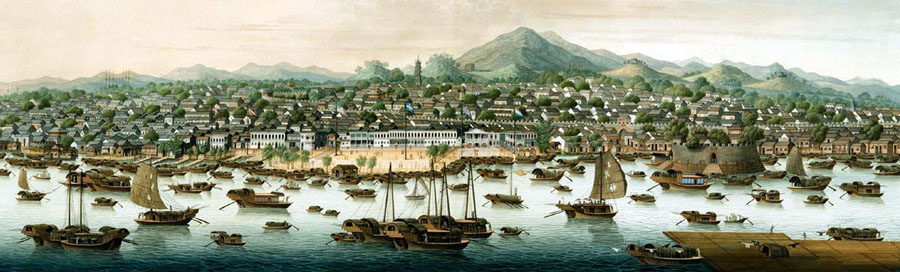
C. P. married Mary C. Chalmers in June 1862 in San Francisco. They sailed to Shanghai where Grace Lillian was born on October 1, 1864. During his time in Shanghai, he was a member of the Shanghai Yacht Club.
C. P. Blethen of Shanghai, China, is listed as an eastern passenger departing Ogden, Utah, on August 6, 1870 on the west-bound Overland Train, arriving at the Oakland, California wharf on August 8, 1870.
The Call, San Francisco, California, U.S.A.
The Last Will of the Late Capt. Blethen
The will of Clement P. Blethen, the capitalist who dropped dead of apoplexy on California street last Sunday, has been filed for probate. The will is dated Shanghai, February 13, 1878, and bequeaths to the widow of deceased, Mary Craig Blethen, all his household furniture, plate, pictures, books, etc., and 1,000 Mexican dollars.
The residue is the estate is bequeathed, in trust, to Geo. F. Broman, Wm. N. Olmstead and Clark Blethen and the said Mary Craig Blethen, the income of its proceeds and his stocks to be paid to his wife, without anticipation and free from the control or engagements of any husband with whom she may intermarry, and upon her death to their children upon their reaching their majority . . .
The following is part of a much longer publication with the unfortunate title of: China's Menace to the World. It was handwritten in 1878 in Washington D.C. by a man named Thomas Magee, who, with some foresight ended his diatribe against Chinese industriousness with: "The Chinese are all-day runners, and those who compete with them will need to rise early and sit up late. China has untiring industrial ability, unsurpassed staying powers, and a degree of patience which no other nation can pretend to equal. Friend and enemy of China should know these facts. Few do know them."
Thomas Magee.
April 21, 1876: C. P. Blethen, Esq. wrote to London, England to determine pedigree prior to 1580. John Pook & Co., 4 Lime Street Square, London, undertakes to inform C.P. Blethen that it will be expensive. First charge 10, 15s 6d. He says: "Not many, if any, Blethens now living in Wales. Pook warned "Searcher" Oliver to keep with 50 limit unless expressed requested to go further. Consulted manuscripts in British Museum, including four large folio volumes belonging to a private family who loaned it to the Museum. It would cost 190 pounds to put in genealogical tabular form. He would not vouch for the truth of one-tenth of such information. The only way to get at the truth is by "the collection of wills, ancient deeds, parish registers, etc." The expense would be very extensive. He furnished genealogies at various detached times, as follows:
Will of Lewys Blethin of Carlion, Co., Monmouth, Gent. dated September 19, 1542, proved at London, 16th November, 1542. Will of William Blethin, Bishop of Landaff, dated Oct. 1, 1590, proved at London 21st May, 1591.
On July 21, 1876 John Pook wrote to C.P. Blethen in Shanghai, China:
We have to own receipt of your letter of 21st April in reference to pedigree anterior to A.D. 1580. Mr. Oliver certainly mentioned the matter to us shortly before his death, but we feared after we had paid a man to search through old deeds and books we might find nothing reliable, and the expense would be considerable, but seeing by your letter you desired it done, we sent you the result of our researches and also a general letter and we shall be happy to continue them now we have got into the right groove; but of course we shall require your consent before proceeding further, and a part remittance on account. Our endeavors would be to do our best for you. We enclose memo of charge Ten pounds, 15s, 6d, which is more a time charge of a skilled man than otherwise. (Copy sent by Clark Blethen of San Francisco, Cal., to Bliven.) 140 Nassau St., New York.
February 8, 1880, Daily Alta California, San Francisco, California, U.S.A.
The steamer City of Peking, Capt. Morse in command, sailed yesterday for China and Japan, with the following passengers: C. P. Blethen, Mrs. Unger, S. P. Stratton, E. Fisher and wife, J. B. DaCosta, S. Strauss, Mrs. F. W. Reade, Mr. Whitney, D. E. Ongrage, W. A. Doltans, M. Soeb, G. W. Hill, Richard Reife, Rev. J. McKin and wife, J. Mendelson, A. F. Thompson, Mrs. Jos. Austio, J. Kinnear, Prof. L. W. Mason, E. Z. Simmons and wife, Miss Stein, J. H. Mackin and 102 Chinese.
June 27, 1882, Los Angeles Herald, Los Angeles, California, U.S.A.
LATE TELEGRAMS
Dropped Dead
San Francisco, 25 - Capt. C. P. Blethen, prominently known in mining and real-estate circles, dropped dead today on the streets. His death is attributed to heart disease. The deceased was fifty years of age, and leaves a wife and several children.
NOTE: Because Captain Clement Blethen was reported to have died in 1882,
the Clement Blethen mentioned hereafter is presumed to be a relative.
June 12, 1887, Daily Alta California, San Francisco, California, U.S.A.
Weddings
STILWELL-BLETHEN.
The most prominent wedding of the week was that of Miss Grace L. Blethen and Henry C. Stilwell, which was solemnized on Wednesday evening at the residence of the bride on the corner of California and Broderick streets (San Francisco) in the presence of a vast number of friends and relations. The floral decorations were of the most elegant and choice description. The rooms of the lower floor were all crashed. A canvas was stretched from the front door to the curbstone, with a canopy of canvas above. The embrasure of the bay-window was made into an arbor of floral structure, with a backing of ferns, the front being finished with loopings of smilax. Ferns, smilax and flowers were utilized to the best advantage, everywhere showing a graceful arrangement. Doors, windows, curtains, chandeliers, mirrors and mantels were hidden beneath sweetly-scented blossoms. Exquisite set pieces vied with each other in loveliness. At 9 o'clock Mendelssohn's Wedding March sounded forth and ushered in the bridal party, headed by the ushers, Messrs. David F. Nye, Clement Blethen and Charles Stilwell. The bride was attended by her sister, Miss Mamie Blethen, and the groom by James Otis. Rev. Dr. Mackenzie of the First Presbyterian Church officiating. Many hearty congratulations were offered, and at 10 o'clock a supper was partaken of. Among the bridal gifts were numerous costly articles of every description, embracing gold, silver, crystal, jewels, bronze, rare works of art. China, laces, etc.
Dancing was enjoyed till midnight, when the newly-married couple took their departure for the Occidental Hotel, and on Thursday morning left for a two weeks' visit to Lake Tahoe.
The bride wore a dress of heavy corded white silk, elaborately trimmed with heavy duchess lace, with corsage a la pompadour, with trimmings of duchess. The skirt was handsomely decorated with an accordion panel on one side and draperies and cascades of lace on both sides, while the court train hung in heavy folds from the corsage. The whole-was covered with a bridal veil artistically arranged and looped with diamonds. She carried an immense hand-bouquet of white rosebuds tied with long streamers of white ribbon. Her hair was dressed with Langtry front and French twist. Ornaments, diamonds.
Miss Mamie Blethen was attired in a yellow faille francaise, with draperies of escurial lace. "The corsage was cut "V" shaped, with lace trimmings and silk pendants. It was worn dancing length. She earned a beautiful bouquet of yellow roses tied with long streamers of ribbon of the same color, and a yellow feathered fan, and wore no ornaments. The hair was dressed similar to the brides.
January 6, 1889, Daily Alta California, San Francisco, California, U.S.A.
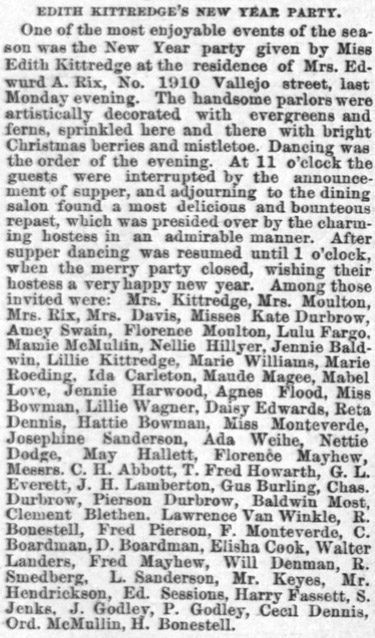
THE SOCIAL WORLD
June 21, 1890, Daily Alta California, San Francisco, Volume 82, Number 172
REAL ESTATE TRANSACTIONS
The following real estate transactions have been recorded:
ALAMEDA.
J.L. Moulthrop to C. Blethen, et al., lot 108x150
SE cor Pacific Avenue and Lafayette Streets, Alameda. $10.
November 14, 1890, North China Herald, Shanghai, China
. . . We are directed to an article that appeared recently in the Forum by the fact that it contains the evidence of a hard-headed Shanghai resident, Mr. C. P. Blethen, who must, however, have been playing with his bearer, or he is considerably misrepresented.
The article is on "The Activity of the Chinese," and the writer begins by asserting that "but for the-civilised powers. China would at once seize the Sandwich and Philippine Islands by conquest." This seems a somewhat wild statement to us who have seen China losing territory on all sides in the last fifty years; in the north to Russia, in the east to Japan, and in the south to France. We at any rate are convinced that China will not acquire any territory beyond seas by military conquest, but Mr. Magee, the author of the article, asserts that she is capturing these islands in an industrial way. "The Chinese are shopkeepers, and financiers before which the soft and easy-going natives of those islands must give way." The writer does not seem to see how his assertion of an industrial conquest by the Chinese conflicts with another complaint constantly made against the Chinese, that they never stay to enrich the countries where they labour, but pack up and go home with their earnings directly they have acquired what they consider sufficient. This is the common complaint in Australia and California, those who make it ignoring the fact that the Chinese leave their labour behind them, and that the work they have done in opening up the country is far more valuable than the few dollars each man takes away with him.
Mr. Magee, however, soon leaves the topic of the industrial conquest by the Chinese of the islands round China, for the topic which is of so much more interest to American exclusionists, the unfair competition of the Chinese with the white labourer. "If picked white workmen labour twelve hours a day, the Chinese labourer and mechanic will, if necessary, learn from them, and overtake them by working twenty hours, and that on incomparably poorer food, housing, and clothing." The Chinaman, it is said, can do with less fresh air and sunshine than any other human being, and can bear patiently being cramped up all day in the most uncomfortable position. " I have seen a Chinaman, while waiting at a railway station, lift himself upon an empty, headless, sharp-edged barrel, sit down upon the edge, and with his feet as a brace across the barrel, fall asleep . . . The Chinaman's ability to bear hunger and exposure to low temperature in thin clothing has been frequently noted and described by travellers." We who know how Chinamen dress in cold weather know very well that it is only compulsion which can make them face low temperature in thin clothing. " He can endure long fasting, the account being subsequently more than balanced by an overfeeding which one would think only an Eskimo or an anaconda could withstand." We presume Mr. Magee has good evidence for this; and we hope it is more accurate than what follows, which we quote in full:
"A Captain Blethen, who died in San Francisco recently, lived in China for twenty-two years previous to 1880. He kept a large ship-chandlery store at Shanghai, and owned a dry dock there, but sold his business because he was being forced out by Chinese competition. Said he to me : "
Shops in the Chinese Quarter
San Francisco, California. 1885."The trouble with you here in California is that you do not appreciate the staying powers of the Chinese. When a Chinese labourer conies here, he may, with his best efforts, save only a few dollars the first year; but, let him save little or much, he does and will save, and he will work in and out of season. Here is a letter I received by the last steamer from China. It is from the Chinese house that bought me out. It contains an order for some American goods in the ship-chandlery line. This letter is in the best of English. It was written by a young Chinaman, who manages the firm's business. I gave the man who filled a similar position for me $3,000 a year. This young Chinaman gets but $10 a month, his rice, and a place to sleep in. The hands in the store get no wages; only rice, and a bunk. How could I live against such competition? I had either to remain in business there, and thereby lose all I had made, or to sell out at a good price and leave. This process is going on at all the ports in China. White men employed and taught the Chinese, and the Chinese drove them out. We could no more compete with them than we could overcome death and fate."


It will be news to Mr. Magee that Captain Blethen's business still belongs to white men and is still flourishing, nor do Captain Blethen's successors complain that they find it impossible to live against Chinese competition. In fact this evidence attributed to Mr. Blethen is somewhat on a par with the statement made later on by Mr. Magee that "China is not yet a large manufacturer, but the signs in that direction are so promising that Prince Kung was lately reported to have said that fifty years hence China would manufacture for the world." Prince Kung probably does not even know what a manufactory is.
If the Wolseleys and the Magees and the other people who are so ready to tell the West in the magazines what China is doing and will do, would come here and see for themselves, it would be a very good thing. They would be very much disillusioned, and half their fine periods or more would have to be docked, but at the same time they would be much comforted, as they would find that it is not in fifty or even a hundred years that China is going to conquer the world, either militarily or industrially. As long as her system of government remains what it is, she will be fortunate if she retains what she has got; nor can we see at present where the material is to be found from which a new and better government could be constructed, if the empire were to show any general desire for a change.
 Copyright ~ 1998-2018.