Seaports, Captains, Merchants
° Andaman and Nicobar Islands ° Bengal ° Bombay (Mumbai) ° Calcutta ° Cawnpore ° Delhi ° Gujarat ° Indore ° Jodhpur ° The Konkan Coast (Goa) ° Madras (now Chennai) ° Patna (Bihar) ° Tellicherry ° Varkala
International Harbors
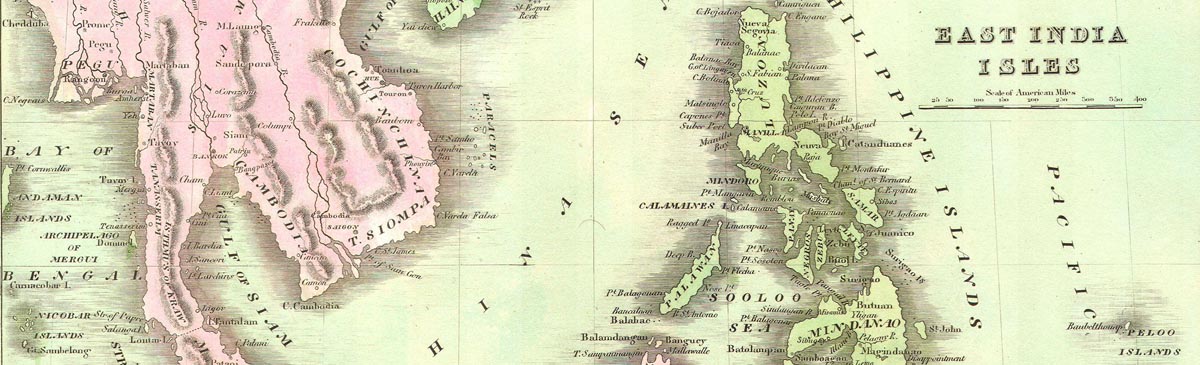
Riau Islands
Malay Archipelago (Maritime Southeast Asia): ° Bangladesh ° India ° Indonesia ° Malacca Strait ° Malaysia ° Maldives ° Myanmar (Burma) ° Pakistan ° Philippines ° Riau Islands ° Singapore ° Sri Lanka ° Thailand ° Timor
° Andaman and Nicobar Islands ° Bengal ° Bombay (Mumbai) ° Calcutta ° Cawnpore ° Delhi ° Gujarat ° Indore ° Jodhpur ° The Konkan Coast (Goa) ° Madras (now Chennai) ° Patna (Bihar) ° Tellicherry ° Varkala
After 1511, the Riau islands became the center of political power of the Sultanate of Johor based on Bintan island and were then considered the center of Malay culture.
When European nations began combing the seas for new opportunity, as they did elsewhere, they changed the fate of Riau as a political, cultural or economic center as they struggled to control the prime regional trade routes through the Malacca Straits. Singapore island, which had been part of the same greater Malay kingdoms and sultanates, and under direct control of the Sultan of Johor, came under control of the British.
The creation of a European-controlled territory broke the sultanate into two parts, destroying the cultural and political unity that had existed for centuries. The Anglo-Dutch Treaty of 1824 consolidated this separation, with the British controlling all territories north of the Singapore strait and the Dutch controlling territories from Riau to Java.
After the European powers withdrew from the region, new independent governments reorganized after inheriting 100 years of colonial boundaries. The territories of Indonesia, Malaysia, Singapore, Brunei and Borneo struggled and came into military conflict against each other, and the Riau islands once again found themselves in the middle of a regional struggle.
August 9, 1804, London Times, London, England
EAST-INDIA HOUSE, August 8
A letter from Captain Nathaniel Dance, Commander of the East-India Company's ship Earl Camden, was received this morning, of which the following is a Copy:--
SIR,
. . . On arrival at Malacca, we were informed that the squadron we had engaged was that of Admiral Linois, consisting of the Marengo, of 84 guns, the Belle Pouk and Semillante heavy frigates, a corvette of 28, and a Batavian brig, William, of 18 guns.
"The 28th of February, in the Straits of Malacca, lat. 4. 30. N. we fell in with his Majesty's ships Albion and Sceptre. I was then in a very poor state of health, and Mr. Lance went on board the Albion, and by his very able representation to Captain Ferrier, of the great national consequence of the Honourable Company's ships, he was induced to take charge of the fleet.
"On the 3d March I dispatched the Ganges brig with a letter to the Right Honourable the Governor-General, giving an account of our action, to be conveyed to the Honourable Count."
The strong cultural unity of the region with Riau in the heart of this region never returned, and the line drawn by the British in 1819 remained, dividing the area into three new countries in 1965: Singapore, the Malaysian federation in the north, and Indonesia in the south.
Riau Islands are located on the International Shipping lane of Malacca Strait on the borders of Singapore, Malaysia, Brunei, Vietnam, Cambodia and Thailand. The province covers 252,602 square kilometers now under six main districts: Tanjungpinang City, Batam City, Bintan Regency, Karimun Regency, Natuna Regency and Lingga Regency.
July 15, 1892, North China Herald, Shanghai, China
Capt. H., Supmer, of the German mail steamship Sachsen, reports :—Left Bremerhaven on the 25th of May for Shanghai. Arrived at Antwerp on the 26th, Southampton on the 29th, and Genoa on the 5th of June. Owing to repairs to the engines, we had to stop at Genoa until the 12th, when we continued the voyage. Arrived at Port Said on the 16th of June, Suez on the 17th, Aden on the 22nd, Colombo on the 29th June, Singapore on the 4th of July, Hongkong on the 10th, and Shanghai on the 14th of July. In the North Sea, English Channel and Atlantic Ocean had fine weather with moderate westerly winds and sea; in the Mediterranean Sea light easterly winds and smooth sea; in the Red Sea prevailing northerly winds; from Aden to Acheen Head experienced strong S.W. monsoon with rough sea, and heavy rainsqualls between Ceylon and Sumatra. In the Malacca Strait, and from Singapore to Shanghai, had fine weather and light easterly winds. Spoke at sea the Norwegian barque showing the letters HRBS, bound southward in Lat. 6" 7' N. and 88° 53' E. of Gr. " All well" on board.
Archaeology and History: Early Settlements in the Andaman Islands
Zarine Cooper
This is a multidisciplinary study of the archaeology of the Andaman Islands in the Bay of Bengal. It deals with a wide range of subjects, including the origins of the Andaman islanders, the history of early contact, the processes of site formation, and the dimensions of time and space defining human adaptation in this archipelago.

Leaves of the Same Tree: Trade and Ethnicity in the Straits of Melaka

Leonard Y. Andaya
Andaya's mastery of local geography, economic rhythms, commercial organization, political culture, elite family networks, literary production, and religious currents is apparent throughout the text and, together with his control of the diverse secondary literature and expertise in Dutch and Malay primary materials, gives his work a unique authority."
--Victor Lieberman, University of Michigan
"Few scholars have roamed as widely as Leonard Andaya in his historical peregrinations across the Malay Archipelago. Andaya has written on a broad band-width of worlds, from Aceh to Johor and from the Java Sea across to Eastern Indonesia. He has done this in over three decades of meticulous scholarship, and always with savvy and historiographical nous. This book sums up a lifetime of learning about the western reaches of the archipelago, and the place of `ethnicity' in these disparate lands. More importantly, it will make you want to jump aboard fast wooden ships, green sea in the air."
--Eric Tagliacozzo, Cornell University

Site Search


Warships of the World to 1900
Lincoln P. Paine.

True Yankees: The South Seas and the Discovery of American Identity
(Johns Hopkins University Studies in Historical and Political Science)
Dane A. Morrison
Stephan Talty

Navigation Rules and Regulations Handbook
U.S. Coast Guard
The Navigation Rules & Regulations Handbook supersedes Commandant Instruction M16672.2D This edition includes LNM 39-15 and NTM 41-15 33 CFR 83.01(g) requires: "The operator of each self-propelled vessel 12 meters or more in length shall carry, on board and maintain for ready reference, a copy of these Rules."


American Merchant Ships
1850-1900
Frederick C. Matthews



 Copyright ~ 1998-2018.