United States
Massachusetts
Boston
Boston is a tide-encircled city and like San Francisco Bay, Boston Harbor was a great natural resource even before the arrival of English and European settlers.
Local Native Americans fished and planted crops along the coasts of the 30 or so Islands that dot the Harbor.
In the early 1600's the Massachusetts Bay Company, a small band of Puritans led by John Winthrop, landed and began settling the area, clearing land for livestock and firewood.
Boston Harbor quickly became a busy trading port. By 1660 almost all English imports to New England came through these waters. As the colonists grew in number and strength, the British parliament began taxing unfairly, including a tariff on sugar, coffee and wine.


Then on May 10, 1773, the British parliament authorized the East India Co., to export a half a million pounds of tea to the American colonies for the purpose of selling it without imposing upon the company the usual duties and tariffs. With these privileges, the company could undersell American merchants and monopolize the colonial tea trade. This proved to be the spark that revived American passions about the issue of taxation without representation.
Three ships from London, the Dartmouth, the Eleanor and the Beaver, sailed into Boston Harbor from November 28th to December 8, 1773. Loaded with tea from the East India Company, they were all anchored at Griffin’s Wharf but were prevented from unloading their cargo.
Demanding that the tea be returned to where it came from or face retribution, the Sons of Liberty, led by Samuel Adams began to meet to determine the fate of the three cargo ships in the Boston harbor.
Samuel Adams
A leader of the Sons of Liberty in Massachusetts
before the Revolutionary War.


On the cold evening of December 16, 1773, a large band of patriots, disguised as Mohawk Indians, headed towards Griffin's Wharf and the three ships. Quickly, quietly, and in an orderly manner, the Sons of Liberty boarded each of the tea ships. Once on board, the patriots went to work striking the chests with axes and hatchets. Thousands of spectators watched in silence. Once the crates were open, the patriots dumped the tea into the sea.
Once the Revolutionary War broke out in earnest in 1776, Boston Harbor became a crucial battleground.
Boston. 1873.


After the Revolutionary War and the drafting of the United States Constitution, Boston Harbor and her islands continued to play an important role in civil defense and in international commerce with trade as far away as Shanghai. By the mid-1800s, the elegant and fast clipper ships were being built in her harbor by Donald McKay, and Boston joined in the race with New York shipbuilders to be first around the world and first to San Francisco to reach the gold fields in what was named The Deep Sea Derby.
By 1796, by the record of the Bureau of Navigation, the American fleet registered for foreign commerce amounted to 476,733 tons. The years between 1789 and 1826 were the golden age of American seaborne commerce: The growth of American shipping from 1789 to 1807 is without parallel in the history of the commercial world of the time.
From the New York Gazette of December 15, 1829
PIRACY.-- Our Boston correspondent, Mr. Topliff, writes us as follows, under date of Saturday evening: "The ship Candace, Lindsey, which sailed hence on the 20th of October, for Sumatra, having on board 19,850 dollars in specie, five bales of indigo, and seven bales dry goods, arrived at Marblehead this forenoon. Mr. Field, the supercargo, has arrived in town, and informs us that on the 13th of November, lat. 9. N., long. 24. W. to the southward of Cape de Verde, they fell in with an hermaphrodite piratical brig, which boarded and robbed them of all their specie, dry goods, some provisions, and the principal part of the clothing of the officers, their watches, &c. They put the officers below in the cabin, and the crew in the forecastle, and kept them under guard during the time they were plundering the vessel. They used no violence to the crew, nor injured the vessel in any respect. They boarded the Candace about three p. m., and left her at seven, at which time their was another vessel in sight, standing S.S.E., and could only tell that she was a full rigged vessel, which they stood for. The Candace had five bales of opium, which they declined taking, and said they would make them a present of it.
The brig Oscar, arrived at New Orleans from Vera Cruz reports that an hermaphrodite brig, name unknown, with an uncommonly large fore topsail, was cruising between the bar of Tampico and Tuspan on the 4th instant, and had captured a Mexican coaster from Tobasco, off Tampico. The captain of the coaster, Lieutenant F. Davis, of the Mexican navy says there is no doubt of her being a pirate ; he was treated with lenity, only losing a part of his apparel, having known the captain, a Canarian, personally, Blas Rodriguez. There was no authority or discipline on board, other than that which is acquired by the commander being the chief in villainy.
Burning of the Ocean Monarch Enroute to Boston
Ocean Monarch was an emigration barque which in 1848 caught fire at sea and sank with the loss of 178 lives. The barque was owned by the White Diamond Line and was registered in Boston, the port where she was built. The Ocean Monarch was launched from the East Boston shipyard of Donald McKay in July 1847.
January 12, 1844, Bangor Daily White and Courier, Bangor, Maine
The Salem Observer says that all the fishing vessels of Marblehead safely returned to that port before the winter set in, excepting one, which has not been heard from since she left the Grand Bank. Her crew consisted of Capt. Goodwin and five men, and it is feared that the vessel and crew are utterly lost.
  The Steamship Britannia leaving Boston Harbor. 1847. |
August 14, 1852, Weekly News and Chronicle
London, Middlesex, United Kingdom
THE DISPUTE BETWEEN ENGLAND AND AMERICA.
John Lamb (1735-1800) Speaking at the Sons of Liberty Meeting, New York City Hall


News from the Bay of St. Lawrence, brought by the Humboldt, which left New York on the 31st ult., and arrived at Cowes on Thursday, states that an anchorage duty of 6d. per ton had been demanded by the British upon all United States fishing vessels. Two more American fishing sloops had been seized by the English cruisers. Fourteen ships of war (English) were cruising on the grounds, four more being fitted out at St. John's. A part of the Japan expedition had been ordered to the scene of the dispute, and the Mississippi, Commodore Perry, was coaling for that object at New York. The New York Herald states that the President was displeased with Mr. Secretary Webster's course on the subject, and notwithstanding the threatening aspect of affairs, it was hoped an amicable arrangement would shortly be come to. Stock market and cotton firm; breadstuffs and freights dull. Exchange on London, 110-3/8. In reply to an address of congratulation, delivered to the United States Secretary of State on his arrival at Marshfield on the 25th ultimo, Mr. Webster replied, and referred in the following terms to the fisheries question:
"Mr. Sprague has made allusion to recent occurrences threatening disturbances on account of the fisheries. It would not become me to speak much on that subject until I speak officially, and under direction of the head of the Government. And then I shall speak. In the meantime be assured that interest will not be neglected by this administration under any circumstances.

The fishermen shall be protected in all their rights of property, and in all their rights of occupation. To use a Marblehead phrase, they shall be protected, hook and line, and bob and sinker. And why should they not? They employ a vast number. Many of our own people are engaged in that vocation. There are, perhaps, among you some who have been on the Grand Banks for forty successive years, and there hung on to the ropes in storm and wreck. The most potent consequences are involved in this matter. Our fisheries have been the very nurseries of our navy. If our flag-ships have conquered the enemy on the sea, the fisheries have been at the bottom of it ; the fisheries are where the seeds from which these glorious triumphs were born and sprung. Now, gentlemen, I may venture to say one or two things more on this highly-important subject. In the first place, this sudden interruption of the pursuits of our citizens, which had been carried on more than thirty years without interruption or molestation, can hardly be justified by any principle or consideration whatever.
It is now more than thirty years that they have pursued the fishing in the same water and on the same coast, in which and' along which notice has now come that they shall be no longer allowed these privileges. Now this cannot be justified without notice. A mere indulgence of too long continuance, even if the privilege were riot an indulgence, cannot be withdrawn at this season of the year, when our people, according to their custom, have engaged in the business, without just and seasonable notice, I cannot but think the late dispatches from the Colonial-office had not attracted, to a sufficient degree, the attention of the principal Minister of the Crown, for I see matter in them quite inconsistent with the arrangement made in 1845 by the Earl of Aberdeen and Edward Everett. Then the Earl of Derby, the present First Minister, was Colonial Secretary. It could not well have taken place without his knowledge, and, in fact, without his concurrence or sanction. I cannot but. think, therefore, that its being overlooked is an inadvertence. The treaty of 1811 was made with the Crown of England.
Decemeber 16, 1891, Sacramento Daily Union, Sacramento, California, U.S.A.
THE GERRYMANDER.
| The Original Gerrymander The verb gerrymander first appeared in 1812 when Massachusetts governor Elbridge Gerry redrew district boundaries, hoping it would help his party in an upcoming senate election. Then somebody noticed that the new district looked like a salamander, so they combined Gerry and -mander to create the new word gerrymander. And then a newspaper printed a cartoon with a giant salamander making fun of Gerry, which is what happens to politicians who don't behave. |
The President in hia message has called attention to the danger threatening the Union in the practice of the ''gerrymander." It is on the programme of certain politicians because it is the only means by which they can defeat the reform ballot system. Under the new census some 330 Congressional districts aro to be formed, and several thousand legislative, judicial and other districts must be rearranged.
Boston, Massachusetts, c 1884. Tilly Haynes, Mapmaker.


In Michigan only has there been accomplished any gerrymander that will seriously touch the choice of Presidential electors. The Republicans, being the administration party, have the affirmative in opening tbe campaign of 1892. They may bo counted upon to pronounce emphatically against the Michigan gerrymander. The Democratic party will thus be put to it to speak in its national platform on that subject. If it declines, however, or evades it by generalization, an issue will be joined that has not before gone to the people in a Presidential election. If it follows and denounces the Michigan system it will still be left open for the party in the States to act as it pleases.
But if the demand is made for amendment of the Constitution so as to require a uniform system to be adopted in choosing electors, the Democracy will probably refuse to indorse it as invasion of reserved right, and the issue will thus enter the campaign of IM'2. The President has advised constitutional legislation to secure to the people the right to select Presidential electors by popular vote in the several States. This will probably be taken as a keynote by his party, and since all the States but two already have that system, it is difficult to understand how the Democratic party can afford to declare in any way that will leave it open to party to manipulate district lines so that district choosing of electors may defeat the principle that free government and the integrity of the Union demands that electors shall be chosen in the States by the general or popular vote.
May 10, 1898, Los Angeles Herald
The Gerrymander Nuisance
The supreme court of Illinois has very properly killed the infamous gerrymander enacted at the recent special session of the Illinois legislature. The decision goes ft the very root of the question and prevents any further attempt at apportionment until after the next census. Every step that is taken toward putting apportionment beyond the reach of continued meddling is beneficial, and if the states would adopt the rational basis of county representation they would be rid of this perpetual nuisance altogether. lndianapolis Sentinel.
November 12, 1901, North Adams Transcript, North Adams, Massachusetts
CONGRESSMAN LAWRENCE WILL ASK FOR $3,600,000
To Make a Beginning on the Eight Million Dollar Improvement of Boston Harbor
One of the most important matters to come before congress, at least from a Massachusetts standpoint, is that of a big appropriation for the widening of the channel in Boston harbor for ocean-going steamships. As was the case when the fight was made for the appropriation last year, Congressman George P. Lawrence of this city will have charge of the bill. He is a member of the river and harbor committee, being urged for the place on the committee by prominent Bostonians for the express purpose of putting him in a position to help that city and its cause with the committee. Congressman Lawrence expects, however, the active support of the entire Massachusetts delegation in his fight and especially that of the two congressmen from Boston.
Since the fight of last session, the question has been discussed by the various business organizations and by public men generally. Even the republican and democratic state conventions have indorsed the proposition, thus giving the movement added strength when congress assembles next month.
Congressman Lawrence also expects the support of state and municipal authorities as well as the encouragement of such organizations as the Boston Chamber of Commerce, the board of trade and kindred bodies of business men. The Boston Post has interviewed the North Adams congressman on the way this matter is to be handled when it gets into the house this year, and the Post makes him say:
"During the second session of the Fifty-sixth congress the committee on rivers and harbors unanimously voted to adopt a project providing for a channel 35 feet deep, 1200 feet wide, from the navy yard to President Roads, and 1500 feet wide from President Roads to the sea. It was estimated by the war department that the cost of the project would be $8,000,000. In the bill reported to the house, and expenditure of $3,600,000 was authorized for prosecuting the work. The senate reduced the authorized' expenditure to $2,000,000. As is known, the bill was finally talked to death during the closing hours of congress.
"The Fifty-seventh congress meets on the first Monday of December, and the committee on rivers and harbors will at once enter upon the preparation of a new river and harbor bill. It is not expected that there will be much change in the personnel of the committee, and I do not anticipate any difficulty in securing another favorable report, the only question in my judgment being, the amount which will be authorized. "All over our country the people are realizing keenly the benefits which will come from generous appropriations for the improvement of our rivers and harbors.
"If we are to secure the desired appropriation for Boston harbor, it will be necessary for the Massachusetts delegation in congress to do hard work. It is also important that the press throughout the state and our commercial organizations should urge enthusiastically and persistently a large appropriation for Boston harbor. Our claim is certainly just; it is a great national project which will confer great national benefits, and is of vital importance to Massachusetts that Boston should remain a port of the first class. Today steamers costing $1,000,000, with a cargo costing half as much more, go in and out of Boston harbor at considerable risk. It is not safe to load them to their limit, and it cannot be expected that such great steamships will continue to be sent to Boston harbor unless the projected Improvements are made.
"As soon as the committee on rivers and harbors meets for the consideration of the bill I shall at once bring the matter before the committee and urge to the best of my ability prompt and favorable action."
Cape Cod
November 30, 1898, San Francisco Call
NEW ENGLAND'S COAST STREWN WITH CORPSES AND WRECKED VESSELS
BOSTON, November 29. The passing hours do not bring an end to the reports of wrecks and loss of life up and down the New England coast, as the outcome of Sunday's terrific storm. From Cape Cod the most terrible accounts of ruin and death are coming, and of these the loss of the steamer Portland, with all on board, nearly 100 souls, overshadows all. The graveyard of the coast, the treacherous bars and rips on the outside of Cape Cod, have claimed victims without number. Miles and miles of coast line is piled high with wreckage, most of which is ground so fine by the waves that identification of helpless craft is impossible.
As the fury of the Wind was as great on the bleak sand hills which make up the cape, it will be many hours before all places are heard from. Telegraph wires are down and railroads cannot break out of the snow drifts. This feature is distressing, as much suffering from cold and hunger must ensue among the poor people in the nearby hamlets. To-night the only means of reaching Cape Cod is by steamer across Massachusetts Bay, a disagreeable voyage, as the sea is yet boisterous.
Word from Provincetown tells of nearly thirty total wrecks, with the number of lives lost unknown.
Matters are improving slightly along Vineyard Sound, so far as means of communication is concerned. The best summing up of the disasters in that section is made by Captain Hard Jr. of the revenue cutter Dexter, who has cruised along the shore all day. He says that in Vineyard Haven hulls are piled upon the shore, and those vessels which are afloat seem mere shells. The Dexter reports possible additions to the wreck list in two schooners sunk of Menemsha Light and two big ones sunk abreast Presque Isle. The fate of the crews is unknown. Three wrecking steamers are around the Fairfax, ashore on Sow and Pigs Reef.
It is difficult to estimate the total loss of life and damage to shipping along this coast. The list of disasters seems to grow every hour, and from dispatches thus far received it appears that at least thirty schooners have been wrecked at different points from Eastport, Me., to New Haven, Conn. Eighty schooners have been driven ashore, and sixteen barges, loaded or empty, are aground.
This list does not include the thirty vessels either wholly or partially wrecked in Boston harbor, nor half a dozen or more craft which are reported missing, including the Wilson Line freighter Ohio, which is ashore on Spectacle Island. In this harbor the steamer John J. Hill is ashore at Atlantic; the Merchants' and Miners' transportation steamer Fairfax is ashore on Sow and Pigs Ledge; off Cuttyhunk, north; a small steamer, George Chaffee, foundered at Rockport, Mass. When these are added the list exceeds 110 vessels.
The loss of life is hard to determine. It is known that about fifty persons perished in and about Boston Harbor. Reports from other places in some cases state that the crew of this or that vessel escaped. Many, however, state that the fate of the crew is unknown. Some survivors have turned up, and life-saving stations and incoming vessels have brought a few sailors from wrecks. Perhaps a score would cover those of whom nothing is known, not including those who were on board the Portland.
Marblehead
Marblehead, Massachusetts, was for two centuries the principal cod fishing port of the new world, and at the same time raised large numbers of ship captains who set standards of competence and perseverance throughout the world s oceans.
Yet, little was known of this insular town by outsiders during the 18th and 19th centuries. Those outsiders that did visit Marblehead briefly and commented on it, criticized it for being backward, dirty, and immoral. Disasters etc. describes what Marblehead seafarers were really like, and how the pervasive maritime life of the town created a class of fishermen and shipmasters with unique character, ability, and success.
The fishermen were more productive than those of any other town; the seamanship standards of the town are exemplified by the Marblehead Captain Josiah Perkins Creesy of the clipper ship Flying Cloud and his Marblehead navigator wife, who set records of speed under sail that only recently were exceeded; and Joseph Story as a Supreme Court Justice established maritime law in the United States based on his experience growing up in Marblehead.
John Kimball's book The Maritime World of Marblehead 1815-1865
uses 19th century sources and the careers of individuals to describe Marbleheaders peculiar character: their indifference to the show and splendor of wealth, their generosity, bravery, and hardihood. It explains the workings of the cod fishery and the shipping industry through business practices and legal decisions. The story is set against the backdrop of the final rise and fall of the town s fishing industry between the War of 1812 and the Civil War, and the explosive rise and fall of the shipping business known as the clipper ship era.

A portrait of the Grand Banks fishery and the clipper ship era. "Disasters" includes 19th century documents. Set against the backdrop of the town's fishing industry between the War of 1812 and the Civil War.
A Puzzling Pair of Cape Cod Pirates: And Other Stories
This sequel to the author's previous work, The Boy Who Saved a Cape Cod Town, contains nineteen stories involving Cape Codders from four centuries. The book starts with "A Battle at Stage Harbor," which explores how Cape Cod became part of New England rather than "New France." 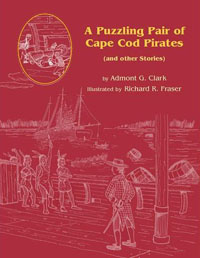 It finishes with "The Adventures of Captain Baxter," about the legendary exploits of a West Dennis captain.

An especially moving story is "Hannah Rebecca Burgess, Navigator," a tragic tale of love and adventure on the high seas. After the untimely death of her husband, a ship captain, young Hannah Burgess is forced to navigate a clipper ship full of cargo back to port-a feat virtually unheard-of for a woman of her era.
These stories illustrate the kind of character and determination that has made Cape Cod great. Included are tales about the invention of commercial salt-making from sea water, the initiation of the banana trade, and Cape Codders sailing the world.
  A Retired Sea Captain from Massachusetts, 1879 Eastman Johnson, Artist |
  Emigrants on the crowded lower deck |
Boston to New York
Fall River Line steamers docked at piers on the North River in New York City. The boats left in the evenings, easing out into the East River, then heading east on Long Island Sound to Newport. The boats arrived in the early morning hours in Fall River. Passengers disembarked from the steamers there and boarded the Old Colony Railroad trains. They arrived in Boston in time for their morning appointments.
On Sunday evenings, passengers left Boston for New York from the Old Colony Railroad Depot. They boarded the steamers in Fall River and traveled to Newport, then continued on the overnight trip back to New York. As overnight vessels, the Fall River Line steamers offered staterooms, dorm berths, and salon chairs for their guests. A September 20, 1881, advertisement from the Fall River Daily Evening News listed prices for first-class tickets at $3, and for second-class tickets at $2.25.
Room prices for the full route ranged from $1 to $5 per person. Free passes were available for some dorm berths on the lower deck. Competition from other lines kept prices low enough for passengers of all classes to ride the ships. The Fall River Line steamers were popular with both businessmen and summer travelers. Fall River residents took the steamers to Newport for the enjoyment of an evening ride, returning to Fall River by train.
For several summers the Fall River Line operated a separate "Newport Line," the first of the line's double service to accommodate summer travelers.
American Bloomsbury: Louisa May Alcott, Ralph Waldo Emerson, Margaret Fuller, Nathaniel Hawthorne, and Henry David Thoreau: Their Lives, Their Loves, Their WorkSusan Cheever brings new life to the well-known nineteenth century literary personages who produced such cherished works as The Scarlet Letter, Moby-Dick, Walden, and em>Little Women. The work of these literary personalities is at the heart of our national history and cultural identity; all were once considered avant-garde bohemian types at odds with the establishment.
These remarkable men and women were so improbably concentrated in placid Concord, Massachusetts that Henry James referred to the town as the "biggest little place in America." Among the host of luminaries who floated in and out of Concord's "American Bloomsbury" as satellites of the venerable intellect and prodigious fortune of Ralph Waldo Emerson were Henry David Thoreau, Louisa May Alcott, Nathaniel Hawthorne and Margaret Fuller -- a glamorous editor and foreign correspondent.
Perhaps inevitably given the smallness of the place and the idiosyncrasies of its residents the members of the prestigious circle became both intellectually and romantically entangled: Thoreau serenaded an infatuated Louisa on his flute. Vying with Hawthorne for Fuller's attention Emerson wrote the fiery feminist love letters while she resided (yards away from his wife) in his guest room. Far from typically Victorian this group of intellectuals like their British Bloomsbury counterparts to whom the title refers not only questioned established literary forms but also resisted old moral and social strictures. Thoreau of course famously retreated to a plot of land on Walden Pond to escape capitalism pick berries and ponder nature. More shocking was the group's ambivalence toward the institution of marriage. Inclined to bend the rules of its bonds many of its members spent time at the notorious commune Brook Farm and because liberal theories could not entirely guarantee against jealousy the tension of real or imagined infidelities was always near the surface.

1899. World's Fleet. Boston Daily Globe
Lloyds Register of Shipping gives the entire fleet of the world as 28,180 steamers and sailing vessels, with a total tonnage of 27,673,628, of which 39 perent are British.
| Great Britain | 10,990 vessels, total tonnage of 10,792,714 |
| United States | 3,010 vessels, total tonnage of 2,405,887 |
| Norway | 2,528 vessels, tonnage of 1,604,230 |
| Germany | 1,676 vessels, with a tonnage of 2,453,334, in which are included her particularly large ships. |
| Sweden | 1,408 vessels with a tonnage of 643, 527 |
| Italy | 1,150 vessels |
| France | 1,182 vessels |
For Historical Comparison
Top 10 Maritime Nations Ranked by Value (2017)
| Country | # of Vessels | Gross Tonnage (m) |
Total Value (USDbn) |
|
|---|---|---|---|---|
| 1 | Greece | 4,453 | 206.47 | $88.0 |
| 2 | Japan | 4,317 | 150.26 | $79.8 |
| 3 | China | 4,938 | 159.71 | $71.7 |
| 4 | USA | 2,399 | 55.92 | $46.5 |
| 5 | Singapore | 2,662 | 64.03 | $41.7 |
| 6 | Norway | 1,668 | 39.68 | $41.1 |
| 7 | Germany | 2,923 | 81.17 | $30.3 |
| 8 | UK | 883 | 28.78 | $24.3 |
| 9 | Denmark | 1,040 | 36.17 | $23.4 |
| 10 | South Korea | 1,484 | 49.88 | $20.1 |
| Total | 26,767 | 87.21 | $466.9 | |

Site Search
The Maritime History Of Massachusetts, 1783-1860
(Northeastern Classics Edition)
Samuel Eliot Morison


Commerce and Culture:
The Maritime Communities of Colonial Massachusetts, 1690-1750 (Maritime Cimmunites of Colonial Massachusetts. 1690-1750)
Christine Heyrman

Be There Then: A Guide to Exploring Greater Boston's Historic House Museums
Elizabeth S. Levy Merrick


The Boston Mob Guide:
Hit Men, Hoodlums & Hideouts
(The History Press)
Beverly Ford


The Pirates' Pact:
The Secret Alliances Between History's Most Notorious Buccaneers and Colonial America
Douglass R. Burgess


A Whaler's Dictionary
Dan Beachy-Quick


The Yankee Whaler
(Dover Maritime)


Sailors, Whalers, Fantastic Sea Voyages:
Activity Guide to
North American Sailing Life
Valerie Petrillo


Hudson's Merchants and Whalers: The Rise and Fall of a River Port, 1783-1850
Margaret B. Schram


Petticoat Whalers:
Whaling Wives at Sea, 1820-1920
Joan Druett


The Captain's Best Mate:
The Journal of Mary Chipman Lawrence on the Whaler Addison, 1856-1860
Mary Chipman Lawrence


A Shoemaker's Story:
Being Chiefly about French Canadian Immigrants, Enterprising Photographers, Rascal Yankees, and Chinese Cobblers in a Nineteenth-Century Factory Town
Anthony W. Lee
On a June morning in 1870, seventy-five Chinese immigrants stepped off a train in the New England factory town of North Adams, Massachusetts, imported as strikebreakers by the local shoe manufacturer. They threaded their way through a hostile mob and then -- remarkably -- their new employer lined them up along the south wall of his factory and had them photographed as the mob fell silent. So begins A Shoemaker's Story. Anthony Lee traces the rise of photography as a profession and the hopes and experiences of immigrants trying to find their place in the years following the Civil War. He describes the industrialization of the once-traditional craft of shoemaking, and the often violent debates about race, labor, class, and citizenship that industrialization caused.
Generously illustrated. Lee's narrative interweaves the perspectives of people from very different walks of life -- the wealthy factory owner who dared to bring the strikebreakers to New England, the Chinese workers, the local shoemakers' union that did not want them there, and the photographers.

The Last of the Cape Horners: Firsthand Accounts From the Final Days of the Commercial Tall Ships
Spencer Apollonio
A Brief History Of The Constitution And Government Of Massachusetts: With A Chapter On Legislative Procedure (1916)
Louis Adams Frothingham
Includes over 20,000 analytical, theoretical and practical works on American and British Law. It includes the writings of major legal theorists, including Sir Edward Coke, Sir William Blackstone, James Fitzjames Stephen, Frederic William Maitland, John Marshall, Joseph Story, Oliver Wendell Holmes, Jr. and Roscoe Pound, among others.
When America First Met China:
An Exotic History of Tea, Drugs, and Money in the Age of Sail
Eric Jay Dolin
Ancient China collides with America in this epic tale of opium smugglers, sea pirates, and dueling clipper ships. Brilliantly illuminating one of the least-understood areas of American history, best-selling author Eric Jay Dolin now traces our fraught relationship with China back to its roots: the unforgiving nineteenth-century seas that separated a brash, rising naval power from a ancient empire. Two maps, and 16 pages of color and 83 black-and-white illustrations.
United States History
Battle at Sea and
3,000 Years of Naval History

 Copyright ~ 1998-2018.