China
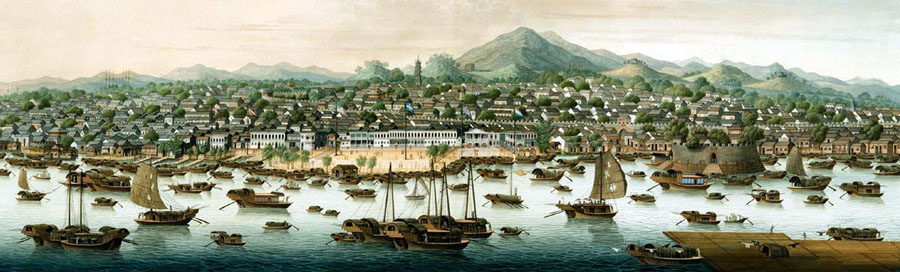
° Amoy ° Fuzhou, Pagoda Island ° Canton (Gunagzhou) ° Qingdao
° Hong Kong ° Fuzhou ° Macau ° Ningbo-Zhoushan ° Qingdao ° Peking (Bejing) ° Shanghai ° Tianjin
° Tientsin ° Whampoa
° Yangzhou ° Xiamen ° Pirates in the China Seas
° The Great Wall ° Mahjong ° Opium Wars ° Shaolin (Kung Fu) ° The Jews of Kaifeng (Henan Province)
Macao (Macau)
For nearly 300 years the Portuguese paid China an annual tribute for the use of the peninsula, but in 1849 Portugal proclaimed it a free port; this was confirmed by China in the Protocol of Lisbon in 1887.
Until trade through Hong Kong was established, almost all trade between Europe and China passed through its seaport. For centuries, seaborne traders took advantage of the monsoons, moving north and east to arrive off the southern coast of China in the spring and summer, and departing for South and Southeast Asia in the winter. The Canton fairs of January and June were held to coincide with the monsoons. Macao had the dubious distinction, along with other great seaports, such as San Francisco, as being one of the wickedest cities in the world. Macao was a primitive outpost, far from polite society. Explorers sought precious spices, the Portuguese accumulated bullion in the Japan trade, and British and American sailors traded opium for sea. Hong Kong and Macao were the hub of the whole underground traffic in opium. There was no income tax and no exchange control, complete freedom of import and export of foreign currencies, and all forms of bullion.


The Treaty of Wang Xia gave American cargo ships access to the five Chinese treaty ports, forced open to foreigners as a result of the Opium War, and it also gave Americans the right to construct hospitals, churches, and cemeteries in China, a privilege the missionaries who served as Caleb Cushing's translators in Macao were especially anxious to obtain.


The Imperial commissioner Qiying had been China's representative at the acrimonious Nanjing negotiations, and his large entourage of soldiers, servants, officials, and advisors was lodged at the Temple of Kun Iam during the negotiations with Cushing. The Treaty of Wang Xia, which governed the American relationship with China until 1905, committed the United States and China "to a perfect reciprocity." As Qiying wrote to Cushing when inviting him to take "fruit and tea" at the temple of Kun Iam: "This conduct is vastly different from that of the English taking and keeping possession of Hong Kong. . . " (Above right: Fishing village on stilts. Macao.)
In the middle of its vice, the rocky ridge of the peninsula was covered with churches, convents, turrets, and tall houses. A narrow, sandy isthmus joins the peninsula to the heights of Heang-shan, which are crowned with forts.
August 30, 1849, Alta California, San Francisco, California
Emeute at Macao.
The Hong Kong Register, Extra, gives the following particulars of an excitement at Macao:
SATURDAY, 3 P. M., 9th JUNE, 1849
We deem the following account of an exciting affair at Macao worthy of an Extra. We had heretofore given Senhor D'Amaral muc
The particulars which reached us are us follows:
"Mr. Summers, a resident of Hong Kong, landed at Macao on the evening of the 7th inst. On passing along a street, through which the procession of the Corpus Christi was passing, he was desired, as he supposed by some Catholic priest, and afterward by a soldier, to take off his hat; but, being a Protestant, and having religious scruples, he refused to comply; whereupon he was taken to the guard house, and kept there through the night without any food. Mr. Summers made a respectful communication to Senhor D'Amaral, the Governor, regretting the circumstance, and requested to be released on the grounds that he was ignorant of the customs of Catholic countries; else, as he could not have complied with the ceremony, he would have avoided the procession. Of this communication no notice was taken; but early on the morning of the 8th, he was removed to the common jail.
Upon this Mr. Summers wrote a note to Capt. Staveley, who happened to be at Macao at the time, begging his interference with the Governor, with the view of getting released. Capt. Staveley immediately waited on Capt. Keppel, detailing the circumstances of the case; when that officer, with his characteristic energy and determination, waited on the Governor, demanding the immediate release of Mr. Summers, and the reason for his having been thrown into confinement. We hear that the Governor distinctly separated the alleged offence from anything connected with religion; but threw it upon the grounds that Mr, Summers had refused to obey the Governor's orders to uncover, and was placed in custody accordingly that as the whole affair was in the hands of the judicial authorities, the case must wait the usual process, and that perhaps in a week judgment might issue upon it. This reply not conforming with Captain Keppel's notions of what was due to a British subject in a dependency of Portugal, demanded formally by letter, the immediate liberation of Mr. Summers, with a full explanation of the causes of the imprisonment. Senhor D' Amaral treated the demand with great nonchalance; whereupon Capt Keppel, not being able to get any satisfactory reply, immediately ordered the boats of the squadron, already preparing for work of another class -- namely, boat racing to be manned and armed, and to land at a certain point, where he and Capts. Troubridge, Hay, and Staveley would be ready to head them.
  |
A Market in Macao Auguste Borget |
The moment the first boat touched the beach, the crew were ordered to land and form, and proceed, under Capt. Keppel's direction, through Mr. Brane's house; they got into the square behind it, dispersed the guard, took possession of a park of artillery in front of the guard house, and released Mr. Summers.
While these things were passing, boat after boat, fully manned, came tumbling on to the beach, following the route of the first party; the Portuguese guard, adjoining the Governor's residence, looking with astonishment and consternation at the rapidity of the movement, and wondering what was coming next. Recovering from their astonishment, and hearing the report of musketry, (shots having been exchanged at the jail,) a party was detached to intercept the rescuing force; but they arrived at the scene of action too late, and only in time to discharge their muskets at the party retiring. No one was hit by the discharge, and within four minutes of the landing of the first boat's crew, Mr. Summers found himself released from prison, thus depriving Governor Amaral, and his judicial staff of much unnecessary discussion. Mr. Summers was brought over in H. M. brigColumbine, doubtless singing in his sleeve the popular melody of "We'll gang nae mair to you town."
His Excellency Senhor D'Amaral, while the above events were taking place, was enjoying the hospitality of Commodore Geisinger, on board the U.S. frigate Plymouth, and landed a short time after all was over, on which great excitement was apparent in the town, signals being passed through the forts, where the whole of the guns were apparently being loaded. At this time the boats, so recently employed in upholding the honor of their country, were engaged in the pleasant pastime of racing, in which two of the Meander's boats were winners.
We cannot say too much in praise of the gallant and dignified manner in which the whole affair was conducted by Capt. Keppel. We presume it will give occasion for correspondence between Senhor D'Amaral and the Governor of this place; but we trust such a foolish and indiscreet act, on the part of the Governor of Macao, will be looked over by the respective governments in Europe.


By the late nineteenth century, Macao was a European oasis for tycoons, with gambling, women and gold, and no one to answer to. By the 1840s, one writer reported that romantic Macao bore a striking resemblance to Naples with its curving beach and hills, and European buildings. Large houses had vast rooms, palatial staircases, and mysterious verandahs. On the opposite side of the peninsula, however, are filthy, old Chinese tenements, filled with wretchedly poor Chinese laborers who negotiate dark alleys by day and night.
Also on the back side of Macao is a deeply spiritual hillside along the shoreline. The A-Ma Temple -- Also known as the Ma-Gao Temple, it is the oldest temple in Macao with a history of over 500 years. The temple stands against the hill facing the sea. It is made up of the central hall, prayer halls and pavilions. The temple is dedicated to the Queen of Heaven, who is worshipped as the guardian of fishermen. The temple is crowded on March 23 every year on the lunar calendar, which is believed to be the birthday of the Queen of Heaven. Among the relics in the temple are a couple of stone lions carved 300 years ago, a 400-year-old stone tablet with carving of foreign ship and many stone inscriptions of verses of literary figures. During Chinese New Year, thousands of people flock to light incense and firecrackers to the goddess of the sea, the air fills with dark-grey smoke from the incense and firecrackers. Chinese ships nudge into the shoreline, cover their bows with 20 and 30 foot long strings of red firecrackers and light them for good fortune.


At one point in her history, Macao had a female dubbed the "Queen of the Macao pirates." Lai Choi San is said to have inherited the business and ships from her father, a brigand who had been granted refuge in Macao with the understanding that he and his gang would protect the colony's enormous fishing fleets. He owned seven fully armored junks when he died. Lai Choi San took them over, added five more, and was said to have barrels of money and absolute control. As a "protector", she was up against gangs who kidnapped men, women and children, burning their sampans and holding the families for ransom. Lai Choi San avenged the families, was said to be ruthless and cruel, and profitable in the business of protection.
The Silk Road is a historically important international trade route between China and the Mediterranean. Because silk comprised a large proportion of trade along this road, in 1877, it was named 'the Silk Road' by Ferdinand von Richthofen, an eminent German geographer. From the time Zhang Qian opened up the world-famous Silk Road during the Han Dynasty, until the collapse of the Yuan Dynasty, it enjoyed a history of about 1,600 years.

John N. Miksic


Sterling Seagrave


Gavin Menzies
On March 8, 1421, the largest fleet the world had ever seen set sail from China to "proceed all the way to the ends of the earth to collect tribute from the barbarians beyond the seas." When the fleet returned home in October 1423, the emperor had fallen, leaving China in political and economic chaos. The great ships were left to rot at their moorings and the records of their journeys were destroyed. Lost in the long, self-imposed isolation that followed was the knowledge that Chinese ships had reached America seventy years before Columbus and had circumnavigated the globe a century before Magellan. And they colonized America before the Europeans, transplanting the principal economic crops that have since fed and clothed the world.


During the nineteenth century, tens of thousands of Chinese men and women crossed the Pacific to work, trade, and settle in California. Drawn by the gold rush, they brought with them skills and goods and a view of the world that, though still Chinese, was transformed by their long journeys back and forth. They in turn transformed Hong Kong, their main point of embarkation, from a struggling, infant colony into a prosperous, international port and the cultural center of a far-ranging Chinese diaspora.

Making use of extensive research in archives around the world, Pacific Crossing charts the rise of Chinese Gold Mountain firms engaged in all kinds of trans-Pacific trade, especially the lucrative export of prepared opium and other luxury goods. Challenging the traditional view that this migration was primarily a "coolie trade," Elizabeth Sinn uncovers leadership and agency among the many Chinese who made the crossing. In presenting Hong Kong as an "in-between place" of repeated journeys and continuous movement, Sinn also offers a fresh view of the British colony and a new paradigm for migration studies.
A Cruise in Chinese Waters: Being the Log of "The Fortuna." (c 1882)
Augustus F. Lindley
Cornell University
Library Print Collections

The Treasure Fleet of the Dragon Throne, 1405-1433
Louise Levathes
A hundred years before Columbus and his fellow Europeans began making their way to the New World, fleets of giant Chinese junks commanded by the eunuch admiral Zheng He and filled with the empire's finest porcelains, lacquerware, and silk ventured to the edge of the world's "four corners." It was a time of exploration and conquest, but it ended in a retrenchment so complete that less than a century later, it was a crime to go to sea in a multimasted ship.


In Search of a Legendary Armada
James P., Delgado
In 1279, near what is now Hong Kong, Mongol ruler Khubilai Khan fulfilled the dream of his grandfather, Genghis Khan, by conquering China.

The Grand Khan now ruled the largest empire the world has ever seen—one that stretched from the China Sea to the plains of Hungary. He also inherited the world's largest navy—more than seven hundred ships. Yet within fifteen years, Khubilai Khan's massive fleet was gone. What actually happened to the Mongol navy, considered for seven centuries to be little more than legend, has finally been revealed. Renowned archaeologist and historian James P. Delgado has gone diving with a Japanese team studying the remains of the Khan's lost fleet. Delgado pieces together the fascinating tale of Khubilai Khan's maritime forays and unravels one of history's greatest mysteries: What sank the great Mongol fleet?

Chinese Sailed to America Before Columbus: More Secrets from the Dr. Hendon M. Harris, Jr. Map Collection
Charlotte Harris Rees


Douglas Kerr, Julia Kuehn, Editors
Hong Kong University Press

China: The World's Oldest Living Civilization Revealed.
Thames & Hudson Publishers
China's recorded history dates back more than 3,500 years. "China" examines the turbulent history of this immense nation, including the inventiveness of the Bronze Age society, the Barbarian invasions, the conquest by Genghis Khan, the rise and fall of the dynasties, and the Opium Wars. It takes in the architecture of the emperors; the magnificent buildings of the Forbidden City; the imperial tombs, and the mysterious entombed warriors


A Borrowed Place:
The History of Hong Kong
Frank Welsh
The tumultuous history of Britain's last major colony. In 1842 a "barren island" was reluctantly ceded by China to an unenthusiastic Britain. "Hong Kong", grumbled Palmerston, "will never be a mart of trade". But from the outset the new colony prospered, its early growth owing much to the energy and resourcefulness of opium traders, who soon diversified in more respectable directions. In 1859 the Kowloon Peninsula was sold to Britain, and in 1898 a further area of the mainland, the "New Territories", was leased to Britain for 99 years.

The Man Who Loved China:
The Fantastic Story of the Eccentric Scientist Who Unlocked the Mysteries of the Middle Kingdom
Simon Winchester


Toby Musgrave, Will Musgrave
Stories of seven plants - tea, tobacco, sugar, opium, quinine, cotton and rubber - whose discovery and cultivation changed the destinies of countries from America to China, India to Brazil. It investigates the complex legacy of trade routes overseas, the engine and imperative for colonial expansion, and shows how great fortunes were built upon a dark history of espionage, slavery, danger and conflict. Illustrated.

China and Maritime Europe
1500-1800: Trade, Settlement, Diplomacy, and Missions
John E. Wills, Jr., John Cranmer-Byng
A view of China in some of its most complicated and intriguing relations with a world of increasing global interconnection. New World silver, Chinese tea, Jesuit astronomers at the Chinese court, and merchants and marauders play important roles here. A full and clear summary, based on sources in Chinese and in European languages, making this information accessible to students and scholars interested in the growing connections among continents and civilizations in the early modern period.


An Exotic History of Tea, Drugs, and Money in the Age of Sail
Eric Jay Dolin
Ancient China collides with America in this epic tale of opium smugglers, sea pirates, and dueling clipper ships.
Brilliantly illuminating one of the least-understood areas of American history, best-selling author Eric Jay Dolin traces our fraught relationship with China back to its roots: the unforgiving nineteenth-century seas that separated brash, rising naval powers from ancient empires. It is a prescient fable for our time, one that surprisingly continues to shed light on our modern relationship with China. Indeed, the furious trade in furs, opium, and bêche-de-mer--a rare sea cucumber delicacy--might have catalyzed America's emerging economy, but it also sparked an ecological and human rights catastrophe. Peopled with fascinating characters--from the "Financier of the Revolution" Robert Morris to the Chinese emperor Qianlong, who considered foreigners inferior beings--this saga of pirates and politicians, coolies and concubines becomes a must-read for any fan of Nathaniel Philbrick's Mayflower or Mark Kurlansky's Cod. Two maps, and 16 pages of color and 83 black-and-white illustrations.

Historical Fiction

Hung Lou Meng: Book I
Cao Xeugin
Translated by H. Bencraft Joly
First appearing 1791, it is a masterpiece of Chinese literature and one of China's Four Great classical novels. It was composed during the Qing Dynasty and is generally acknowledged to be a pinnacle of Chinese fiction. The novel is believed to be semi-autobiographical, mirroring the rise and decay of author's own family and, by extension, of the Qing Dynasty. It is intended to be a memorial to the women the author knew in his youth - friends, relatives and servants. At the center of the story is Bao-yu, a precocious boy and his romantic affinity to his poetry-loving, orphaned cousin, Dai-yu. The novel is remarkable for its huge cast of characters and psychological scope, its precise and detailed observation of the life and social structures typical of 18th-century Chinese aristocracy.

 The Honored Dead
Robert N. Macomber
Seventh in the award-winning Honor Series. Lt. Cmdr. Peter Wake, in French Indochina in 1883, meets up with opium warlords, Chinese-Malay pirates, and French gangsters. Perfect for armchair historians and adventurers. It has been compared to the best historical sea fiction ever written by Patrick O'Brian and C.S. Forester as well as the historical fiction of Bernard Cornwell.


Pearl Comfort Sydenstricker was born on June 26, 1892, in Hillsboro, West Virginia. Her parents were Southern Presbyterian missionaries, most often stationed in China. From childhood, Pearl spoke both English and Chinese. She returned to China shortly after graduation from Randolph-Macon Woman's College in Lynchburg, Virginia, in 1914, and the following year, she met a young agricultural economist named John Lossing Buck. They married in 1917, and moved to Nanhsuchou in rural Anhwei province. In this impoverished community, Pearl Buck gathered the material that she would later use in her other stories of China. Her first novel, East Wind, West Wind, was published in 1930.


Site Search


Warships of the World to 1900
Lincoln P. Paine.
True Yankees: The South Seas and the Discovery of American Identity
(Johns Hopkins University Studies in Historical and Political Science)
Dane A. Morrison
Stephan Talty

Navigation Rules and Regulations Handbook
U.S. Coast Guard
The Navigation Rules & Regulations Handbook supersedes Commandant Instruction M16672.2D This edition includes LNM 39-15 and NTM 41-15 33 CFR 83.01(g) requires: "The operator of each self-propelled vessel 12 meters or more in length shall carry, on board and maintain for ready reference, a copy of these Rules."

American Merchant Ships
1850-1900
Frederick C. Matthews


 Copyright ~ 1998-2018.