Seaports, Merchants
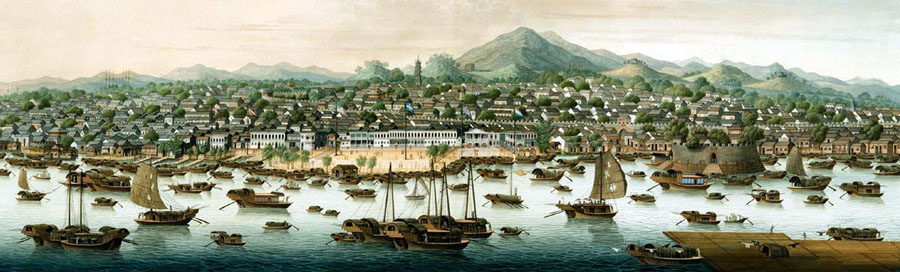
° Amoy ° Fuzhou, Pagoda Island ° Canton (Gunagzhou) ° Qingdao
° Hong Kong ° Fuzhou ° Macau ° Ningbo-Zhoushan ° Qingdao ° Peking (Bejing) ° Shanghai ° Tianjin
° Tientsin ° Whampoa
° Yangzhou ° Xiamen ° Pirates in the China Seas
° The Great Wall ° Mahjong ° Opium Wars ° Shaolin (Kung Fu) ° The Jews of Kaifeng (Henan Province)
China
Early in the 19th century, British merchants began smuggling opium into China in order to balance their purchases of tea for export to Britain. In 1839, China enforced its prohibitions on the importation of opium by destroying at Guangzhou (Canton) a large quantity of opium confiscated from British merchants. Great Britain, which had been looking to end China's restrictions on foreign trade, responded by sending gunboats to attack several Chinese coastal cities.
China, unable to withstand modern arms, was defeated and forced to sign the Treaty of Nanjing (1842) and the British Supplementary Treaty of the Bogue (1843). These provided that the ports of Guangzhou, Jinmen, Fuzhou, Ningbo, and Shanghai should be open to British trade and residence; in addition Hong Kong was ceded to the British.
CHINA.
Some negotiations having been entered into between her Majesty's Superintendent and the Imperial Commissioners respecting a mode of carrying on the trade between China and England under existing circumstances, the following public notice was issued in consequence thereof:--
TO HER BRITANNIC MAJESTY'S SUBJECTS


It has been agreed between their excellencies the High Commissioner and Governor upon the one side, and the Chief Superintendent of the trade of British subjects upon the other that under existing circumstances--
- The British trade may be carried on outside the Bucca Tigria, without any necessity of signing the bond of consent to Chinese legislation (to be handed to Chinese officers) upon the condition that the ships be subjected to examination.
- That the place of resort shall be the anchorage between Anuaghoy and Chumpee.
- It is fully understood that the vessels while discharging their cargoes outside the Bogue, shall pay the measurement charge in the same manner as if they went up to Whampoa.
The pilots' charges shall also be paid in like manner. - The vessels proceeding to Anungboy will transport their
cargoes by means of chop boats, and will undergo search by the officers.
By order of the Chief Superintendent,
EDWARD ELMSLIE,
Sec. and Treasurer to the Superintendents
From the Canton Register, October 22
We heard yesterday, for the first time, that Lin, the High Commissioner, issued orders to any Englishman to instant death who should land at Macao, during his Excellency's visit to the settlement on the 3d ult ; these murderous orders were to be in force for that day only. This barbarous measure would seem to betray that his Excellency was in bodily fear, and that he dreaded retaliation for the piratical attack on the Blath Joht, perhaps not undeservedly.
Within a few years other Western powers signed similar treaties with China and received commercial and residential privileges, and the Western domination of China's treaty ports began. In 1856 a second war broke out following an allegedly illegal Chinese search of a British-registered ship, the Arrow, in Guangzhou. British and French troops took Guangzhou and Tianjin and compelled the Chinese to accept the treaties of Tianjin (1858), to which France, Russia, and the United States were also party. China agreed to open 11 more ports, permit foreign legations in Beijing, sanction Christian missionary activity, and legalize the import of opium.
China's subsequent attempt to block the entry of diplomats into Beijing as well as Britain's determination to enforce the new treaty terms led to a renewal of the war in 1859.
February 19, 1875, Daily Alta California, San Francisco, California, USA
THE BURNING OF THE STEAMER JAPAN
A Graphic Account by a Correspondent of the Alta.


On the night of December 17th, at 11:25, the alarm of fire was given. The weather at the time was dark and cloudy, with a strong breeze of wind from the north and east with heavy cross sea running. Immediately on sounding The alarm, black smoke was seen issuing from The engine-room and ventilators. The ship at the time was about twenty miles from the nearest land and about 120 miles from Hongkong. The fore-topsail, main-topsail and foresail were set, the topsails were immediately clewed down and the foresail hauled up, the helm put to port, engine stopped and preparations made to ascertain and extinguish the fire. After working to the utmost and finding it impossible to extinguish the fire, the boats were cleared away and put in readiness for lowering. The smoke from the fire was suffocating in the extreme and of inky blackness. Finding it impossible to save the ship, the fire breaking out of the engine-room, the boats were lowered away, the fire in the meantime cutting off communication from the forward and aft part of the ship. Most of the Europeans were in the after boats. The Chinese passengers, on seeing the flames burst out amidships, were stupefied with terror, some huddling together in the forward part of the ship, others rushing to the boats with fright, filling the boats and increasing the danger of lowering them away, some loaded down with personal effects, jumping overboard with life preservers on, clinging on to pieces of the wreck and screaming for assistance. A great many were supposed to have been drowned by having so much weight about their person, which proved to be the fact.
  |
The Opium Traffic Chinese Selling Opium. The Illustrated London News February 4, 1882 English School |
Two days after the fishermen hooked up one body with a life preserver on, and a thousand dollars on his person. One of the large boats forward broke the davits while being lowered away, the davits being too weak to hold the immense weight of the people, it being impossible to keep them from the boats. After the boats were lowered away, it was very difficult to keep them from being stove against the ship's side, on account of the sea, which was increasing, also the wind accompanied by squalls. The boats remained In the vicinity of the wreck till daylight. During the night, cries for assistance were heard from every quarter, but none could be rendered, as most of the boats had to be kept head to the sea, or the boats were liable to be swamped. As daylight appeared, large numbers of Chinamen were seen in the water with life preservers on, drowned.
Several Chinese fishing junks were seen, the sight of which gave courage to all. One of them sailed close by the ship, and after palavering around for some time and prospecting on the number of dollars they were to receive, commencing in the moderate sum of $10,000, they concluded to let the few officers come on board (the time being about 8 a. m.).
Another one of the Junks sailed around one of the boats for some time, before taking the people on board, then searching them and taking their effects, clothes, etc., and ordering them below, out of the way, before they would allow another boat to come alongside, nearly all being used in the like manner. In the meantime they were getting out of the water such things as pleased their eye, one being a chest with $3000 in it, belonging to one of the Chinese passengers. After sailing around lor some time, and all the boats being picked up that were seen, the Captain of the Junk gave us to understand that the sun was getting past the meridian, and that he was going for the land. The last seen of the wreck was about 10 o'clock. About 3 o'clock p.m., the Junk was headed for the land.
From the Chinese sailors we soon ascertained that if we were once on shore in the vicinity of where we were heading, and in the hands of our deliverers, our chances were small to have clothes to cover us, and life to breathe.
The Purser on leaving the ship had some coin in bags, that were in his room, which he saved, though the Chinese fishermen had a peculiar liking for the dollars. Within fifteen or twenty minutes' sail of the place we were going to a place called Cup Chi -- It being then about six o'clock p.m., a light was seen, which proved to be the steamer Yottung. She was hailed and asked if they would take us on board. Being answered in the affirmative, we then went alongside with the junks. The steamer did not have sufficient boats to take us off, and at the time there being quite a chop of a sea which made it difficult and attended with considerable danger.
On getting alongside, the steamer was rolling heavily, also the Junk, and in confusion and excitement to get on board, a great many were knocked overboard, including the cook, Martin Cusick, who was drowned. All being on board, we steamed for Swatow, arriving about ten o'clock a. m., of the 18th. At 12 m. we went on board of the steamer Yesso. At 2 p.m., we steamed for Hongkong. On the passage from Swatow, when in the vicinity of the wreck, we spoke several fishing Junks in the hopes of getting some information of the missing boats, or in regard to the wreck; but failed to get any. We then steamed for Hongkong, arriving at 2 p.m. of the 20th. There we were cared for by the P. M. S. S. Co's agent, all having lost everything but the clothes they had on. Some were sent to the Sailors' Home; others going on board the steamer Alaska at Aberdeen.
On hearing of the disaster the United States steamers Yantic and Saco immediately steamed to sea and along the coast in search of the missing boats, and other information in regard to the wreck. Most of the boats were found along the coast, some having been picked up by fishing boats, also a number of passengers. One of the boats arrived at Hongkong on the 19th, having sailed from the wreck.
May 15, 1876, London and China Telegraph, London, United Kingdom
COCHIN CHINA, SAIGON.
The Independent de Saigon supplies the following particulars of the piratical seizure of the steamerPelican when on her voyage between Mytho and Vinh-Long:
The Pelican is a regular trader between Cholon and Pnumpenh, and belongs to a rich Chinese firm in Cholon. On the morning of the 24th March she left Cholon for Pnumpenh with a crew of ten men, and twenty passengers, all Chinese. All went well till the middle of the first night, when four of the passengers, armed with hatchets and knives, attacked the man at the helm and threw him overboard; they then rushed into the cabin, where the master and a wealthy Chinese merchant of Sadee were sleeping, and killed them. It is said that one of the firemen was in collusion with the four assassins, and that he despatched the first fireman, who was in charge of the engine. This is the more likely, because without his assistance the four pirates could not have managed the engine. The passengers were next attacked as they lay asleep on deck, and ten of them, several of whom were wounded, were thrown overboard, but succeeded in gaining land. The rest of the crew and passengers are missing, except two bodies, which have been found in the river. One of the corpses was headless and unrecognisable, the other was that of the Sadec merchant. The pirates then plundered the vessel and scuttled her at the mouth of the river Mytho.
The Pelican had a good deal of cargo on board, and $20,000 to $25,000 worth of Chinese silver and gold leaf. Immediately on receipt of the news in Saigon the Government despatched two gunboats to the scene of the tragedy, and there are some hopes entertained of the capture of the pirates and the recovery of their booty. The owners of the Pelican have offered a reward of $500 for any information that may lead to their discovery.
May 22, 1876, London and China Telegraph, London, United Kingdom
COCHIN CHINA, SAIGON
Three of the thirteen Chinese who were missing after the piratical attack on the steamer Pelican have been found, thus reducing the number to ten; but it is feared that the whole of the remainder have been either killed or drowned. It is thought that the pirates must have hidden themselves in the swamps and brushwood near the place where the Pelican was scuttled, and that some of them may probably be captured.
The German steamer Madagascar, which arrived at Saigon on the 20th March, in a damaged state, appears to have narrowly escaped being totally lost. The Madagascar left Bangkok, with a full cargo of rice, for Hong Kong, and was driven out of her course by currents and thrown on the Britto Banks, about fifty miles from Cape St. James, on the 19th March. The position of the steamer becoming critical, the captain was obliged, in order to lighten the ship, to throw overboard 10,000 piculs of rice, this operation occupying about eighteen hours, and then the ship floated off from the bank. The captain steered for the Cape, the ship making much water, and it was deemed necessary to run her ashore inside the bay to prevent her going down. The leak was then stopped, and the Madagascar was steered for Saigon, the pumps working constantly. Fortunately the dock was "ready to receive her when she arrived there, for in a few moments more she would infallibly have sunk. The bank on which the Madagascar stranded is the same one where a similar accident happened to the Portuguese corvette Duque de Pamella in 1873.


The port of Quiuhon was opened to foreign commerce on the 1st November last, under the conditions stipulated in the treaty of 15th March, 1874. The Government rate for Treasury payments has been reduced from f .5.55 to f.5.35 per dollar. Hospital charges have undergone some alteration, and officers are now received at f.9, and seamen at f.7 per diem. Cost of burial from hospital is f.20. Postal rates to Europe and America have been very much reduced, being now 40c. per 15 grammes, while the rate to Singapore, Hong Kong, and Chinese ports remains at 48c. The prompt measures taken in apprehending the pirates engaged in the Pelican affair, and their subsequent speedy execution, has apparently rid the country of an organised gang that bade fair to cause considerable trouble.
September 3, 1884, Burlington Hawk Eye, Burlington, Iowa, U.S.A.
THE CHINESE MERCHANT FLEET SOLD
London, Sept. 2 - The Times Foochoo correspondent telegraphs that the Chinese merchant fleet has been sold to Russell, consisting of twenty-six steamers, aggregating 23,544 tons. The company started twelve years ago and was under the patronage of Li Hung Chang, who obtained loans from the government, to whom the company was indebted to the amount of two millions taels -- $3,000,000.
Their business was mainly India and China ventures to London and San Francisco, but it proved a failure. The managers engaged on speculations of their proper business to the disadvantage of the company, for a long time, during which these practices were in operation, led to serious financial difficulties, and the unfortunate condition of China served to increase the troubles. The sale of the merchant fleet has ended one of the most important steps in the industrial progress of the Chinese empire.
September 16, 1886
The Celestial Empire
The Hongkong and Whampoa Dock Company have declared a dividend of 7 per cent, for the half year.
A report is also current in Canton that a German mission station at Kwai Shin has been pulled down.
In response to urgent and persistent appeals, her Majesty the Empress Regent has consented to reign in conjunction with the young Emperor until be has reached the age of twenty.
A proposal has recently been brought before the Chinese in Hongkong and Canton by a foreigner to establish a company to make sugar out of rice. The capital of the company is to be $250,000, in $100 shares.
The missionaries who were at Chungking during the recent riots there and who were compelled to seek refuge in the Taotai's Yamen for a fortnight, have arrived at Ichang. Some of them were badly treated. News was received here on the 18th inst. that the British steamer Madras, Captain Plensje, while on her way from Nagasaki to Hongkong with a cargo of Takasima coal, had stranded on Taichiow, some sixty miles to the south of Ningpo, on the Chinese coast, and that she would probably become a total loss.

Charles Bivington, co-proprietor of the Shanghai Mercury, son of Mr. Bivington of Messrs. Bivington & Co., publishers, London, and for a quarter of a century a resident of the Far East, died at Shanghai on the 2d inst.
A member of the American Bible Society, who left Canton last February for a tour overland, taking with him some 4,000 books for sale, has arrived at Shanghai. During all this time he had been virtually a prisoner in the hands of Chinese officials, who, on the pretext of looking after his safety, prevented him from going where he wanted and gave him no opportunity of selling his books.
During the late riots at Chungking a French missionary was killed. The latest advices received by the Shanghai Courier, which carry as up to the 5th instant, are to the effect that rioting was still going on, and that Mr. Bourne, the British Consul, and two missionaries were still detained at the Yamen, and are not allowed to go out for fear of their being maltreated. A further report in Canton is to the effect that the Tsung-li Yamen, or Foreign Board of China, have adopted the suggestion of the Viceroy and the Governor of Canton and a Special Commissioner named Pang Yn Lin, made some time ago with regard to Christianity, viz., that the propagation of Christianity should be countenanced openly, but secretly it should be suppressed. Of course there may be nothing in all this, except that it shows what the feeling of the native mind with regard to missionaries is at the present time.
Amoy (Xiamen Island)
October 21, 1890, London, United Kingdom, London and China Telegraph
MISCELLANEOUS.
In a recent issue we gave, an account of the execution of eleven pirates at Amoy. The comrades of the men have taken a ghastly revenge, having seized a trading junk and murdered in cold blood the whole of the crew of thirty-six men. The Amoy correspondent of the North China Daily News, in an account of the execution of the pirates, says: It is rumoured that about a hundred pirates came down to this execution to try and effect a rescue, but the large number of troops present effectually over-awed them. A curious custom prevails here ; the executioners, when they have done their work, go with their swords reeking with human gore and demand a squeeze at each of the butcher's shops, and, in the event of their not getting one smear the meat exposed for sale with the hot blood from the swords.
Tientsin
Distance between San Francisco and Tientsin, China: 6,815 Nautical Miles.


Tientsin has been a major transportation and trading centre since the Yuan dynasty in the 13th century. It was a garrison town during the Ming dynasty (1368 1644). The British and French occupied it during the Second Opium War (1856 60); a treaty opened 11 Chinese ports to foreign trade.
On October 26, 1860, the Emperor of China and the Emperor of the French agreed that:
His Majesty-the Emperor of the French and his Majesty the Emperor of China, wishing to put an end to the difference which has arisen between the two empires, and to re-establish and secure for ever the relations of peace and friendship which existed between them, and which regrettable events have interrupted, have named for their respective representatives the following personages: The Emperor of the French, Jean Baptiste Louis Baron Gros, Senator of the Empire, Ambassador and High Commissioner of France in China, Grand Officer of the Imperial Order of the Legion of Honour, Knight Grand Cross of several Orders, &c., and his Majesty the Emperor of China, Prince Kong, member of the Imperial family, and High Commissioner:
Who, after having exchanged their full powers, found good and in due form, have agreed to the following articles:
ART. IX. It is agreed between the high contracting parties that, as soon as the ratifications of the Treaty of Tien-tsin shall have been exchanged, an Imperial decree shall order the superior authorities of all the provinces of the empire to permit every Chinaman who may wish to go into countries situated beyond the seas, to establish himself there or to seek his fortune, to also embark with his family, if he desires, in the French vessels which may be in the ports of the empire opened to foreign commerce. It is further agreed that, in the interest, of these emigrants, to assure them full liberty of action and secure their interests, the competent Chinese authorities, in. concert with the Minister of France in China, shall adopt such regulations as will give to these engagements, always voluntary, the guarantees of morality and validity which they ought to possess.
ART. X It is well understood between the contracting parties that the tonnage dues, which, by mistake, were fixed in the French Treaty of Tien-tsin at five maces (about 15 sous each) per ton, on vessels gauging 150 tons and upwards, and which, in the treaties signed with England and the United States in one thousand eight hundred and fifty-eight, are fixed at four maces only, shall only amount to that sum of four maces, without having to appeal to the last paragraph of Art. 27 of the Treaty of Tien-tsin, which gives France the formal right to claim the treatment of the most favoured nation.
Whampoa
February 13, 1840, Courier, London, Middlesex, United Kingdom
We stopped the press yesterday to give insertion to some important intelligence, which the Morning Herald published in a second edition, relative to China and India, and which arrived by express, via Paris. We now repeat what we gave then, as it did not appear in the whole of our impression, with the addition of fresh details.
We stated last week that the Hong merchants had after a short absence, returned to Macao, and that, the agreement entered into between them and a weiyune of the Commissioner on one side, and Captain Elliot and a Committee of British merchants on the other, had not been sanctioned by the Commissioner. It appears that at Henngshan the Hong merchants were met by a messenger from the Commissioner, who upbraided them and the weiyune for having entered into the agreement of permitting the discharge of British ships at Chumpee, His Excellency having since altered his mind, and insisting now on the British ships proceeding immediately to Whampoa and signing the new bond threatening with destruction by fire and sword the shipping at Hongkong, if, in three days, these new orders were not complied with. The Hong merchants were ordered to convey this to Captain Elliot and the committee of British merchants, and returned to Macao on Friday last week, with the exception of Howqua, who proceeded to Canton. They accordingly made their calls of duty, and entreated such of the Committee as had not left for Hongkong, to consent to their ships proceeding to Whampoa, and received, of course, an answer in the negative.
From the tenor of the official documents translated by Mr. Morrison, and of which only the two first have yet been received. Mr. Morrison having accompanied Captain Elliot to the Bogue, It will be seen that the Thomas Coutis, having submitted to the signing of the bond and proceeded to Whampoa, made the Commissioner believe that by annulling the temporary arrangement entered into with his consent, the British shipping at Hongkong would follow her example, and that be would soon have the whole of the ships in his power at Whampoa; but we hope that a few will be found bold enough to do so, though we regret to say that another English vessel, the Royal Saxon, Captain Towns, with a cargo of rice from Batavia, has since applied for and obtained a pilot, and left the roads of Macao for the Bogue on Tuesday last. The captain of the ship applied, we hear, for leave to take his wife to Whampoa; this was not granted, but he was directed to leave her at Macao, where she would be under the special protection of the Chinese authorities.
Captain Towns has, we understand, signed six copies of the bond which will no doubt be sent up to Peking several compliances with the commissioner's orders, meanwhile a chop bas been placarded, ordering the English to proceed immediately either to Whampoa or to their own country; all servants that were with such of the English as had returned to Macao on the faith of the settlement agreed to last week, were again ordered to leave, and the Chinese prohibited from supplying them with provisions. About two hundred men are encamped at the barrier in tents; four hundred more are said to be in Casablanca, and more are expected. For what purpose this new demonstration of force has been made we cannot guess at, unless it be to enforce the chop from one of the Macao authorities, ordering three English ladies that lately returned from Hongkong, to leave Macao again within three days; failing which to be driven hence by eight hundred men.
-- Canton Press. Nov. 2
The Silk Road is a historically important international trade route between China and the Mediterranean. Because silk comprised a large proportion of trade along this road, in 1877, it was named 'the Silk Road' by Ferdinand von Richthofen, an eminent German geographer. From the time Zhang Qian opened up the world-famous Silk Road during the Han Dynasty, until the collapse of the Yuan Dynasty, it enjoyed a history of about 1,600 years.

John N. Miksic


Sterling Seagrave


Gavin Menzies
On March 8, 1421, the largest fleet the world had ever seen set sail from China to "proceed all the way to the ends of the earth to collect tribute from the barbarians beyond the seas." When the fleet returned home in October 1423, the emperor had fallen, leaving China in political and economic chaos. The great ships were left to rot at their moorings and the records of their journeys were destroyed. Lost in the long, self-imposed isolation that followed was the knowledge that Chinese ships had reached America seventy years before Columbus and had circumnavigated the globe a century before Magellan. And they colonized America before the Europeans, transplanting the principal economic crops that have since fed and clothed the world.


During the nineteenth century, tens of thousands of Chinese men and women crossed the Pacific to work, trade, and settle in California. Drawn by the gold rush, they brought with them skills and goods and a view of the world that, though still Chinese, was transformed by their long journeys back and forth. They in turn transformed Hong Kong, their main point of embarkation, from a struggling, infant colony into a prosperous, international port and the cultural center of a far-ranging Chinese diaspora.

Making use of extensive research in archives around the world, Pacific Crossing charts the rise of Chinese Gold Mountain firms engaged in all kinds of trans-Pacific trade, especially the lucrative export of prepared opium and other luxury goods. Challenging the traditional view that this migration was primarily a "coolie trade," Elizabeth Sinn uncovers leadership and agency among the many Chinese who made the crossing. In presenting Hong Kong as an "in-between place" of repeated journeys and continuous movement, Sinn also offers a fresh view of the British colony and a new paradigm for migration studies.
A Cruise in Chinese Waters: Being the Log of "The Fortuna." (c 1882)
Augustus F. Lindley
Cornell University
Library Print Collections

The Treasure Fleet of the Dragon Throne, 1405-1433
Louise Levathes
A hundred years before Columbus and his fellow Europeans began making their way to the New World, fleets of giant Chinese junks commanded by the eunuch admiral Zheng He and filled with the empire's finest porcelains, lacquerware, and silk ventured to the edge of the world's "four corners." It was a time of exploration and conquest, but it ended in a retrenchment so complete that less than a century later, it was a crime to go to sea in a multimasted ship.


In Search of a Legendary Armada
James P., Delgado
In 1279, near what is now Hong Kong, Mongol ruler Khubilai Khan fulfilled the dream of his grandfather, Genghis Khan, by conquering China.

The Grand Khan now ruled the largest empire the world has ever seen—one that stretched from the China Sea to the plains of Hungary. He also inherited the world's largest navy—more than seven hundred ships. Yet within fifteen years, Khubilai Khan's massive fleet was gone. What actually happened to the Mongol navy, considered for seven centuries to be little more than legend, has finally been revealed. Renowned archaeologist and historian James P. Delgado has gone diving with a Japanese team studying the remains of the Khan's lost fleet. Delgado pieces together the fascinating tale of Khubilai Khan's maritime forays and unravels one of history's greatest mysteries: What sank the great Mongol fleet?

Chinese Sailed to America Before Columbus: More Secrets from the Dr. Hendon M. Harris, Jr. Map Collection
Charlotte Harris Rees


Douglas Kerr, Julia Kuehn, Editors
Hong Kong University Press

China: The World's Oldest Living Civilization Revealed.
Thames & Hudson Publishers
China's recorded history dates back more than 3,500 years. "China" examines the turbulent history of this immense nation, including the inventiveness of the Bronze Age society, the Barbarian invasions, the conquest by Genghis Khan, the rise and fall of the dynasties, and the Opium Wars. It takes in the architecture of the emperors; the magnificent buildings of the Forbidden City; the imperial tombs, and the mysterious entombed warriors


A Borrowed Place:
The History of Hong Kong
Frank Welsh
The tumultuous history of Britain's last major colony. In 1842 a "barren island" was reluctantly ceded by China to an unenthusiastic Britain. "Hong Kong", grumbled Palmerston, "will never be a mart of trade". But from the outset the new colony prospered, its early growth owing much to the energy and resourcefulness of opium traders, who soon diversified in more respectable directions. In 1859 the Kowloon Peninsula was sold to Britain, and in 1898 a further area of the mainland, the "New Territories", was leased to Britain for 99 years.

The Man Who Loved China:
The Fantastic Story of the Eccentric Scientist Who Unlocked the Mysteries of the Middle Kingdom
Simon Winchester


Toby Musgrave, Will Musgrave
Stories of seven plants - tea, tobacco, sugar, opium, quinine, cotton and rubber - whose discovery and cultivation changed the destinies of countries from America to China, India to Brazil. It investigates the complex legacy of trade routes overseas, the engine and imperative for colonial expansion, and shows how great fortunes were built upon a dark history of espionage, slavery, danger and conflict. Illustrated.

China and Maritime Europe
1500-1800: Trade, Settlement, Diplomacy, and Missions
John E. Wills, Jr., John Cranmer-Byng
A view of China in some of its most complicated and intriguing relations with a world of increasing global interconnection. New World silver, Chinese tea, Jesuit astronomers at the Chinese court, and merchants and marauders play important roles here. A full and clear summary, based on sources in Chinese and in European languages, making this information accessible to students and scholars interested in the growing connections among continents and civilizations in the early modern period.


An Exotic History of Tea, Drugs, and Money in the Age of Sail
Eric Jay Dolin
Ancient China collides with America in this epic tale of opium smugglers, sea pirates, and dueling clipper ships.
Brilliantly illuminating one of the least-understood areas of American history, best-selling author Eric Jay Dolin traces our fraught relationship with China back to its roots: the unforgiving nineteenth-century seas that separated brash, rising naval powers from ancient empires. It is a prescient fable for our time, one that surprisingly continues to shed light on our modern relationship with China. Indeed, the furious trade in furs, opium, and bêche-de-mer--a rare sea cucumber delicacy--might have catalyzed America's emerging economy, but it also sparked an ecological and human rights catastrophe. Peopled with fascinating characters--from the "Financier of the Revolution" Robert Morris to the Chinese emperor Qianlong, who considered foreigners inferior beings--this saga of pirates and politicians, coolies and concubines becomes a must-read for any fan of Nathaniel Philbrick's Mayflower or Mark Kurlansky's Cod. Two maps, and 16 pages of color and 83 black-and-white illustrations.

Historical Fiction

Hung Lou Meng: Book I
Cao Xeugin
Translated by H. Bencraft Joly
First appearing 1791, it is a masterpiece of Chinese literature and one of China's Four Great classical novels. It was composed during the Qing Dynasty and is generally acknowledged to be a pinnacle of Chinese fiction. The novel is believed to be semi-autobiographical, mirroring the rise and decay of author's own family and, by extension, of the Qing Dynasty. It is intended to be a memorial to the women the author knew in his youth - friends, relatives and servants. At the center of the story is Bao-yu, a precocious boy and his romantic affinity to his poetry-loving, orphaned cousin, Dai-yu. The novel is remarkable for its huge cast of characters and psychological scope, its precise and detailed observation of the life and social structures typical of 18th-century Chinese aristocracy.

 The Honored Dead
Robert N. Macomber
Seventh in the award-winning Honor Series. Lt. Cmdr. Peter Wake, in French Indochina in 1883, meets up with opium warlords, Chinese-Malay pirates, and French gangsters. Perfect for armchair historians and adventurers. It has been compared to the best historical sea fiction ever written by Patrick O'Brian and C.S. Forester as well as the historical fiction of Bernard Cornwell.


Pearl Comfort Sydenstricker was born on June 26, 1892, in Hillsboro, West Virginia. Her parents were Southern Presbyterian missionaries, most often stationed in China. From childhood, Pearl spoke both English and Chinese. She returned to China shortly after graduation from Randolph-Macon Woman's College in Lynchburg, Virginia, in 1914, and the following year, she met a young agricultural economist named John Lossing Buck. They married in 1917, and moved to Nanhsuchou in rural Anhwei province. In this impoverished community, Pearl Buck gathered the material that she would later use in her other stories of China. Her first novel, East Wind, West Wind, was published in 1930.


Site Search


Warships of the World to 1900
Lincoln P. Paine.
True Yankees: The South Seas and the Discovery of American Identity
(Johns Hopkins University Studies in Historical and Political Science)
Dane A. Morrison
Stephan Talty

Navigation Rules and Regulations Handbook
U.S. Coast Guard
The Navigation Rules & Regulations Handbook supersedes Commandant Instruction M16672.2D This edition includes LNM 39-15 and NTM 41-15 33 CFR 83.01(g) requires: "The operator of each self-propelled vessel 12 meters or more in length shall carry, on board and maintain for ready reference, a copy of these Rules."

American Merchant Ships
1850-1900
Frederick C. Matthews


 Copyright ~ 1998-2018.