Passenger Lists
  Ship Passenger Lists, New York and New Jersey (1600-1825) Ship Passenger Lists, New York and New Jersey (1600-1825)
Emigration from the United Kingdom
Selections include Emigration from England, Scotland, Wales and Ireland: Lists of Passengers Arriving in America during the 1870s and in 1880.- Emigration from the United Kingdom to America: Lists of Passengers Arriving at U.S. Ports, March 1877 - May 1878

- Emigration from the United Kingdom to America, Volume 1: Lists of Passengers Arriving at U.S. Ports: January 1870 - June 1870
 , Ira A. Glazier , Ira A. Glazier
Emigration from the United Kingdom to America: Lists of Passengers 1870-1897
This series on Emigration from the United Kingdom to America concentrates on UK emigration in the period 1870-1897, listing migrants from the UK who arrived in New York. The original passenger lists transcribed by shipping agents and ship's officers and filed by all vessels entering US ports have been used in the preparation of Emigration from the United Kingdom to America. Presented in chronological order by each ship's date of arrival, these passenger lists provide the names of ships, ports of departure and arrival and debarkation dates. The researcher can also locate data regarding a person's age, sex and occupation as well as village of origin and destination when reported.
- Emigration from the United Kingdom to America, Volume 3: Lists of Passengers Arriving at U.S. Ports, January 1871 - June 1871
 , Ira A. Glazier , Ira A. Glazier
- Emigration from the United Kingdom to America: Lists of Passengers Arriving at U.S. Ports, January 1880 - June 1880
 , Ira A. Glazier , Ira A. Glazier
|
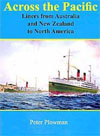 Across the Pacific Across the Pacific
Liners from Australia and New Zealand to North America 
Peter Plowman
For just over a hundred years there was a regular passenger liner service across the Pacific connecting Australia and New Zealand with the west coast of North America. This book describes the rather chaotic development of these services into a reliable and successful trade that flourished into the 1970s and the termination of the trans-Pacific passenger liner. With meticulous research, Peter Plowman describes the liners that traversed the Pacific and companies that owned and managed them. The main North American ports were San Francisco, Los Angeles and Vancouver. The Pacific Mail Steamship Company was the first to instigate regular operations; the route was then taken over by the Oceanic Steamship Company. This in turn became the Matson Line with its famous liners the Mariposa and the Monterey. Some of the liners operated by the Union Steam Ship Company to San Francisco and Vancouver included the Makura, Marama, Tahiti, Niagara, Aorangi and Monowai. Details of the liners and their fittings are given, their voyages, changes of name and ownership and their eventual fate. The various company mergers and associations are covered (such as that of the Canadian Pacific Railway Company and the Union Steam Ship Company of New Zealand). Some of the liners were requisitioned during the two World Wars. This information is supplemented with accounts of crew conditions, union activities and of passenger life on board, in peace and in war. One chapter gives popular novelist Zane Gray's atmospheric account of a Pacific crossing in 1925. |
Filibusters and Financiers: the Story of William Walker and His Associates 
Bernard Bailyn gives a compelling account of the first great transit of people from Britain, Europe, and Africa to British North America, their involvements with each other, and their struggles with the indigenous peoples of the eastern seaboard.
They were a mixed multitude from England, the Netherlands, the German and Italian states, France, Africa, Sweden, and Finland. They moved to the western hemisphere for different reasons, from different social backgrounds and cultures, and under different auspices and circumstances.
Even the majority that came from England fit no distinct socioeconomic or cultural pattern. They came from all over the realm, from commercialized London and the southeast; from isolated farmlands in the north still close to their medieval origins; from towns in the Midlands, the south, and the west; from dales, fens, grasslands, and wolds. They represented the entire spectrum of religious communions from Counter-Reformation Catholicism to Puritan Calvinism and Quakerism.
They came hoping to re-create if not to improve these diverse lifeways in a remote and, to them, barbarous environment. But their stories are mostly of confusion, failure, violence, and the loss of civility as they sought to normalize abnormal situations and recapture lost worlds. And in the process they tore apart the normalities of the people whose world they had invaded.
Later generations, reading back into the past the outcomes they knew, often gentrified this passage in the peopling of British North America, but there was nothing genteel about it.
Bailyn shows that it was a brutal encounter brutal not only between the Europeans and native peoples and between Europeans and Africans, but among Europeans themselves. All, in their various ways, struggled for survival with outlandish aliens, rude people, uncultured people, and felt themselves threatened with descent into squalor and savagery. In these vivid stories of individual lives some new, some familiar but rewritten with new details and contexts Bailyn gives a fresh account of the history of the British North American population in its earliest, bitterly contested years. |
To Make Our World Anew: Volume II:
A History of African Americans Since 1880
Robin D.G. Kelley and Earl Lewis
Oxford University Press
Illustrated.
The two volumes of Robin D. G. Kelley and Earl Lewis's seminal work offer the most up-to-date and authoritative account available of African-American history, from the first Africans brought as slaves into the Americas, right up to today's black filmmakers and politicians. In this first volume the authors begin with the story of Africa and its origins. They then present an overview of the Atlantic slave trade, following the forced migration and enslavement of between ten and twenty million people. |
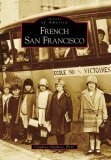 |
French San Francisco 
Claudine Chalmers Ph.D.
Many visitors from France starting in 1786 with legendary explorer Count de Laprouse made their way to the remote and beautiful territory. As France's troubled revolutionary era began in the 1840s, tens of thousands of Frenchmen journeyed to Californi's goldfields. Some found wealth, others freedom, and some death. Many remained in San Francisco, helping shape the city and make it French from the inside. |
 Germans to America: Germans to America:
300 Years of Immigration 1683-1983
Gunter, Ed Moltmann
Germans to America:
Lists of Passengers Arriving at U.S. Ports,
Vol. 1: Jan. 2, 1850-May 24, 1851
Germans in America 1844-1929  
Lucius Burrie
This is a reproduction of a book published before 1923. This book may have occasional imperfections such as missing or blurred pages, poor pictures, etc. that were either part of the original artifact, or were introduced by scanning processes. We believe such works are culturally important, and despite the imperfections, include them as we locate them.
|
 Immigrants in America - The German Americans Immigrants in America - The German Americans

Diane Yancey
Covers reason for leaving their homeland, conditions during the voyage to America, and adjustment to life in America. Includes primary source quotations, informational sidebars, and annotated bibliographies. Starts with events that triggered mass immigration.  (Reading Level: 9-12) (Reading Level: 9-12)
|
The German-American Experience
Don Heinrich Tolzmann
 Representing one-third of the population, German-Americans constitute the largest ethnic element, according to the U.S. Census, with well over 60 million claiming German heritage. In 26 states, they comprise at least 20 percent of the population, and in 5 states they number more than 50 percent -- important statistics in understanding the role played by German-Americans in U.S. history. The German-American Experience provides a comprehensive record of the essential facts in the history of this group, from its first U.S. settlements in the 17th century to the present. Beginning with "The Age of Discovery, " this volume explores the earliest contacts between America and Germany, immigration and settlement patterns of Germans, foundations of German-American community life, their major involvement in the American Revolution, and the role German-Americans played in our Civil War. The author also analyzes German-American influences on agriculture, industry, religion, education, music, art and architecture, politics, military service, journalism, literature, and language. Representing one-third of the population, German-Americans constitute the largest ethnic element, according to the U.S. Census, with well over 60 million claiming German heritage. In 26 states, they comprise at least 20 percent of the population, and in 5 states they number more than 50 percent -- important statistics in understanding the role played by German-Americans in U.S. history. The German-American Experience provides a comprehensive record of the essential facts in the history of this group, from its first U.S. settlements in the 17th century to the present. Beginning with "The Age of Discovery, " this volume explores the earliest contacts between America and Germany, immigration and settlement patterns of Germans, foundations of German-American community life, their major involvement in the American Revolution, and the role German-Americans played in our Civil War. The author also analyzes German-American influences on agriculture, industry, religion, education, music, art and architecture, politics, military service, journalism, literature, and language.
Hollyhocks and Grasshoppers: Growing Up German from Russia in America
The German-American , George Meyer , George Meyer
The German-Americans , LaVern J. Rippley , LaVern J. Rippley
German-American Names , George F. Jones , George F. Jones
Hopeful Journeys:
German Immigration, Settlement, and Political Culture in Colonial America, 1717-1775
(Early American Studies)
Aaron Spencer Fogleman
In 1700, some 250,000 white and black inhabitants populated the thirteen American colonies, with the vast majority of whites either born in England or descended from English immigrants. By 1776, the non-Native American population had increased tenfold, and non-English Europeans and Africans dominated new immigration. Of all the European immigrant groups, the Germans may have been the largest.
Aaron Spencer Fogleman has written a comprehensive history of this eighteenth-century German settlement of North America. Utilizing a vast body of published and archival sources, many of them never before accessible outside of Germany, Fogleman emphasizes the importance of German immigration to colonial America, the European context of the Germans' emigration, and the importance of networks to their success in America. |
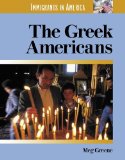 |
The Greek Americans Meg Greene
Covers reason for leaving their homeland, conditions during the voyage to America, and adjustment to life in America. Includes primary source quotations, informational sidebars, and annotated bibliographies. Starts with events that triggered mass immigration. (Reading Level: 9-12) |
|
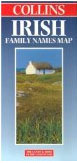
Irish Family Names Map: Collins British Isles and Ireland Maps
Nora O'Shea
The map will help anyone trying to develop a family tree. It is well laid out and clear. Gives one a solid grasp on where families originated and lived.
Celtic Baby Names: Traditional Names from Ireland, Scotland, Wales, Brittany, Cornwall & the Isle of Man
Irish Families: Their Names, Arms, and Origins (243 Coats of Arms illustrated in full colour)
The Dictionary of Irish Family Names , Ida Grehan , Ida Grehan
This comprehensive reference includes over 550 entries with the origin, geographical distribution, and historical anecdotes for each name. |
|
The Irish Way: Becoming American in the Multiethnic City (Penguin History of American Life)
A lively, street-level history of turn-of-the-century urban life explores the Americanizing influence of the Irish on successive waves of migrants to America's cities.
 James R. Barrett James R. Barrett
In this award-winning Penguin History of American Life series, James R. Barrett chronicles how a new urban American identity was forged in the streets, saloons, churches, and workplaces of the American city. This process of “Americanization from the bottom up” was deeply shaped by the Irish. From Lower Manhattan to the South Side of Chicago to Boston’s North End, newer waves of immigrants and African Americans found it nearly impossible to avoid the Irish. While historians have emphasized the role of settlement houses and other mainstream institutions in Americanizing immigrants, Barrett makes the original case that the culture absorbed by newcomers upon reaching American shores had a distinctly Hibernian cast.
By 1900, there were more people of Irish descent in New York City than in Dublin; more in the United States than in all of Ireland.
Barrett reveals how the Irish vacillated between a progressive and idealistic impulse toward their fellow immigrants and a parochial defensiveness stemming from the hostility earlier generations had faced upon their own arrival in America. They imparted racist attitudes toward African Americans; they established ethnic “deadlines” across city neighborhoods; they drove other immigrants from docks, factories, and labor unions. Yet the social teachings of the Catholic Church, a sense of solidarity with the oppressed, and dark memories of poverty and violence in both Ireland and America ushered in a wave of progressive political activism that eventually embraced other immigrants.
Drawing on contemporary sociological studies and diaries, newspaper accounts, and Irish American literature.
The Irish Race: In California, and On The Pacific Coast (1878)
Hugh Quigley
 
The Irish Americans
A History
Jay P. Dolan of Notre Dame University is one of America’s most acclaimed scholars of immigration and ethnic history. Although more than 30 million Americans claim Irish ancestry, no other general account of Irish American history has been published since the 1960s. Dolan draws on his own original research and much other recent scholarship to weave an insightful, colorful narrative. He follows the Irish from their first arrival in the American colonies through the bleak days of the potato famine that brought millions of starving immigrants; the trials of ethnic prejudice and "No Irish Need Apply;" the rise of Irish political power and the heyday of Tammany politics.
The Cross and the Shamrock Or, How To Defend The Faith. An Irish-American Catholic Tale Of Real Life, Descriptive Of The Temptations, Sufferings, Trials ... And Female Servants Of The United States.
Hugh Quigley
Written in the mid-1800s.
 
Irish Californians: Historic, Benevolent, Romantic
Patrick Dowling has written a collection of brief biographies of Irish immigrants that he found admirable. Published when Patrick was 94, this book contains his personal choices of Irish heroes, entrepreneurs, and colorful characters, arranging from Timothy Murphy, who came to California before the American conquest, to Thomas Sweeny, who tried to invade Canada, to Eleanor Martin, who was the doyenne of San Francisco high society. Index and bibliography. 120 illustrations.
 
How the Irish Saved Civilization
The Untold Story of Ireland's Heroic Role From the Fall of Rome to the Rise of Medieval Europe
(The Hinges of History)
Thomas Cahill
In this entertaining and compelling narrative, Thomas Cahill tells the story of how Europe evolved from the classical age of Rome to the medieval era. Without Ireland, the transition could not have taken place. Not only did Irish monks and scribes maintain the very record of Western civilization -- copying manuscripts of Greek and Latin writers, both pagan and Christian, while libraries and learning on the continent were forever lost -- they brought their uniquely Irish world-view to the task.
This service combines advanced DNA science with the world's largest online family history resource to predict your genetic ethnicity and help you find new family connections. It maps ethnicity going back multiple generations and provides insight into such possibilities as: what region of Europe are my ancestors from, or am I likely to have East Asian heritage? AncestryDNA can also help identify relationships with unknown relatives through a dynamic list of possible DNA member matches.
|
|
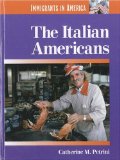
The Italian Americans (Immigrants in America) 
Reviews the reasons why millions of Italians have immigrated to America, what their passage was like, the kind of jobs most found, communities they formed, and the prejudice they faced.Each Immigrants in America volume describes the immigrants' reasons for leaving their native country, challenges the people faced in their new home and the group's lasting legacy. Primary source quotations enrich the stories and enhance the clear, compelling narrative.
The Italian Americans
Allon Schoener
The Italian Americans
 Richard Bowen Richard Bowen
Describes the history of Italian immigration to the United States from the late nineteenth century to the present, including the reasons for immigration, how they thrived, and the cultural legacies Italian immigrants have left behind.

Mary Ellen Mancina-Batinich
Italian-American Folklore (American Folklore Series) 
Frances M. Malpezzi
Voices of Italian America: A History of Early Italian American Literature with a Critical Anthology
Martino Marazzi
Oral History, Oral Culture, and Italian Americans (Italian and Italian American Studies)
Edited by Luise del Guidice
The Italian 100: A Ranking of the Most Influential Cultural, Scientific, and Political Figures,Past and Present
Stephen J. Spignesi |
 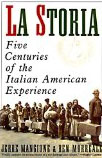 La Storia: Five Centuries of the Italian American Experience La Storia: Five Centuries of the Italian American Experience
Jerre Mangione
From the early Italian adventurers who played an important role in the European expansion across the Atlantic to the political and business leaders of the 1990s, this book tells a dramatic story. The heart of the story is the mass migration that took place between 1880 and 1924, when a whole culture left its ancient roots to settle in the cities and towns of America.
|
 |
Spirit of the Nikkei Fleet
British Columbia's Japanese Canadian Fishermen
Masako Fukawa
An impeccably researched history of Japanese Canadians--their stuggles and triumphs--complete with photographs and detailed biographies.
Encyclopedia of Japanese Descendants in the Americas:
An Illustrated History of the Nikkei
Akemi Kikumura-Yano
Japanese Americans have played an important and largely unrecognized role in American history. Only in the last twenty years has a more complete story emerged, when scholars began focusing on the Japanese Americans themselves. Completely revised and updated, this accessible A-to-Z reference is organized into four sections -- an illuminating historical overview by Gary Okihiro, a distinguished scholar of Japanese American history; a chronology of major events in Japanese American history; encyclopedic entries on significant individuals, organizations, events and movements; and an updated bibliography. More than 400 entries cover such topics as changing migration laws, picture brides, the "yellow peril", J-towns, the revolution of 1954, and the redress movement. |
 |
Lectures of Lola Montez : :
California Adventures of Europe's Notorious Cortesan
This study details Lola Montez's western adventures. This stunning nineteenth century beauty dominated and manipulated the social circles with which her life became entwined, and she added much needed glamour to California in the years following the Gold Rush. |
 |
The Madams of San Francisco
Curt Gentry
A hundred years of the City's secret history unfold in these pages. Many of society's own started in the saloons and dancehalls of the Barbary Coast. San Francisco in the 1840 s was a place nearly absent of women. "It is estimated that during the first half of 1849, 10,000 people landed in San Francisco; only about 200 were of the weaker sex," wrote Gentry. "Over the next six months some 24,000 gold seekers arrived by sea; not more than 500 females were among them." With the stage set, Gentry begins a description of the colorful women and their men who made their fortunes plying the oldest profession in the world. A French woman is reputed to have made $50,000 in one year, the author attests. |
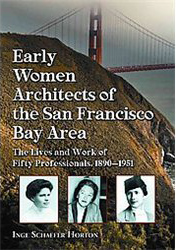 |
Early Women Architects of the San Francisco Bay Area:
The Lives and Work of Fifty Professionals, 1890-1951
Inge S. Horton.
This book presents the lives, careers, and work of fifty path-breaking women enteringthe male-dominated field of architecture. Included are photographs of buildings, portraits of the architects, and blueprints. Each biography includes vital data, a description of the career, a list of known buildings and work, and a bibliography.
As the designer of tourist attraction "Hearst Castle" on the California coast, Julia Morgan was widely known as an outstanding architect. Though women architects were unusual, she was not alone. Many other women practiced architecture in the late 19th and early 20th century in California, though their work was often overshadowed by the work of male architects. This book presents the lives, careers, and work of fifty of these largely unknown pioneers. It chronicles the triumphs and challenges these path-breaking women faced. |
 |
From Shtetl to Milltown: Litvaks, Hungarians, and Galizianers in Western Pennsylvania 1875-1925
Robert Perlman
The Litvak Legacy, Mark N. Ozer
Ukrainians of Western Pennsylvania (PA)
(Images of America - Arcadia Publishing) |
 |
Trade in Strangers:
The Beginnings of Mass Migration to North America
Marianne Sophia Wokeck
This book addresses the earliest trans-Atlantic mass migration to North America - those immigrants from southwestern Germany and northern Ireland who arrived prior to 1775. The elements of the system of immigration to America which were to remain constant until at least 1924 are highlighted because they were first used to channel these two early immigrant streams.
Thoroughly-researched, this well-written book will interest historians of the American colonial experience, students of immigration, and family historians. |
Voyage to California: Written at Sea, 1852: The Journal of Lucy Kendall Herrick

In 1852, 24-year-old Lucy Kendall was a passenger on the "Josephine," traveling from New York City around Cape Horn to San Francisco. She was traveling with her family to join her father, Joseph Kendall, who had sailed to California in 1849. During the 137-day voyage, the travelers suffered many hardships: extremes of temperature, terrifying storms, a man lost overboard--and boredom, all of which Lucy records with wit and compassion. She also describes the pleasures of travel at sea: an endless horizon filled with glowing sunrises, radiant sunsets, a luminous moon, and countless stars. Lucy's journal is framed with the story of her childhood in England and New York and her later life in San Francisco.
This book, identical in size to Lucy's original journal, has twenty-six black-and-white illustrations, including charming sketches by Lucy and her father. An introduction by historian Andrew Rolle places the journal in its historical context. |
 |
Confidence Men and Painted Women: A Study of Middle-class Culture in America, 1830-1870
(Yale Historical Publications)
Professor Karen Halttunen
From Amazon.com: A must for both scholars and living historians alike. Halttunen's work vividly details the social and cultural development of 19th Century Middle Class America, their etiquette, values and mores. Taken from etiquette books, manuals and magazines of the era, Halttunen's study covers the sentimental culture of fashion, etiquette, hypocrisy of the time and even mourning the dead. |
| Angel Island: Immigrant Gateway to America
Erika Lee
From 1910 to 1940, more than half a million people sailed through the Golden Gate, hoping to start a new life in America. But they did not all disembark in San Francisco; instead, most were ferried across the bay to the Angel Island Immigration Station. For many, this was the real gateway to the United States. For others, it was a prison and their final destination, before being sent home. In this landmark book, historians Erika Lee and Judy Yung (both descendants of immigrants detained on the Island. |



 Copyright © 1998-2017.