Vietnam
°; Vietnam ° Saigon (Ho Chi Minh City) ° Ba Rja Da Nang ° Hue Nha Trang
Saigon
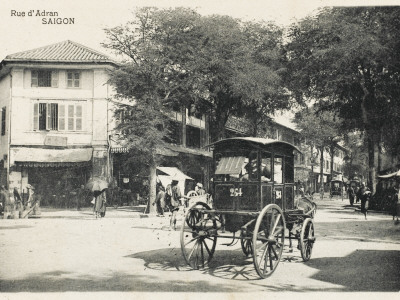
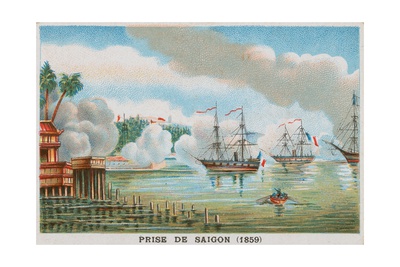
Under Napoleon III, France took possession of Saigon in 1859-61. Mail for that outpost was carried by the P&O as far as Singapore, where the French navy took over. In autumn of 1862 the first mail transport without British support left Marseilles on the steamer "Neva" to Alexandria, proceeding through Egypt by rail and from Suez on board of the "Imperatrice" of the Compagnie des Services Maritimes des Messageries Imperiales.
Asia, 1812. Aaron Arrowsmith, Mapmaker

After completion of the Suez Canal, the company inaugurated the first direct service between Marseilles and South East Asia in April 1870, before its name was abbreviated to Compagnie des Messageries Maritimes after Napoleon's abdication in 1871. Fighting in Asia however continued and the colony Indochina was formed not before 1887.
Towards the end of the 19th Century, Cook's timetable listed Messageries Maritimes with monthly departures Marseilles - Yokohama via Djibouti, Colombo, Saigon and Shanghai, and a monthly service via Bombay. The timetables of the 1920's showed the lines Marseilles - Yokohama via Saigon, Marseilles - Haiphong via Tourane and every two months a departure for Sydney and Brisbane. Messageries Maritimes introduced in 1922 the Aramis (14,825 gt), in 1931 the Georges Philippar (16,990 gt), both the first of new series. Returning form her maiden voyage, the Georges Philippar sank near the Horn of Africa, caused by fire. In 1930 for the first time a motor-ship, the Eridan (9,928 gt), was used on the Sydney line, later extended to Noumea.
Cook's timetable also listed NGI services from Genoa to Bombay, Hong Kong and to Massawa. Bradshaw of 1914 showed a monthly Naples - Bombay service run by the Societa Marittima Italiana.
May 15, 1876, London and China Telegraph
London, United Kingdom
COCHIN CHINA.
SAIGON.
The Independant de Saigon supplies the following particulars of the piratical seizure of the steamer Pelican when on her voyage between Mytho and Vinh-Long:
The Pelican is a regular trader between Cholon and Pnumpenh, and belongs to a rich Chinese firm in Cholon. On the morning of the 24th March she left Cholon for Pnumpenh with a crew of ten men, and twenty passengers, all Chinese. All went well till the middle of the first night, when four of the passengers, armed with hatchets and knives, attacked the man at the helm and threw him overboard; they then rushed into the cabin, where the master and a wealthy Chinese merchant of Sadee were sleeping, and killed them. It is said that one of the firemen was in collusion with the four assassins, and that he despatched the first fireman, who was in charge of the engine. This is the more likely, because without his assistance the four pirates could not have managed the engine. The passengers were next attacked as they lay asleep on deck, and ten of them, several of whom were wounded, were thrown overboard, but succeeded in gaining land. The rest of the crew and passengers are missing, except two bodies, which have been found in the river. One of the corpses was headless and unrecognisable, the other was that of the Sadec merchant.
The pirates then plundered the vessel and scuttled her at the mouth of the river Mytho. The Pelican had a good deal of cargo on board, and $20,000 to $25,000 worth of Chinese silver and gold leaf. Immediately on receipt of the news in Saigon the Government despatched two gunboats to the scene of the tragedy, and there are some hopes entertained of the capture of the pirates and the recovery of their booty. The owners of the Pelican have offered a reward of $500 for any information that may lead to their discovery.
|
May 22, 1876, London and China Telegraph, London, United Kingdom
COCHIN CHINA.
SAIGON
Three of the thirteen Chinese who were missing after the piratical attack on the steamer Pelican have been found, thus reducing the number to ten; but it is feared that the whole of the remainder have been either killed or drowned. It is thought that the pirates must have hidden themselves in the swamps and brushwood near the place where the Pelican was scuttled, and that some of them may probably be captured. The German steamer Madagascar, which arrived at Saigon on the 20th March, in a damaged state, appears to have narrowly escaped being totally lost. The Madagascar left Bangkok, with a full cargo of rice, for Hong Kong, and was driven out of her course by currents and thrown on the Britto Banks, about fifty miles from Cape St. James, on the 19th March. The position of the steamer becoming critical, the captain was obliged, in order to lighten the ship, to throw overboard 10,000 piculs of rice, this operation occupying about eighteen hours, and then the ship floated off from the bank. The captain steered for the Cape, the ship making much water, and it was deemed necessary to run her ashore inside the bay to prevent her going down. The leak was then stopped, and the Madagascar was steered for Saigon, the pumps working constantly. Fortunately the dock was "ready to receive her when she arrived there, for in a few moments more she would infallibly have sunk. The bank on which the Madagascar stranded is the same one where a similar accident happened to the Portuguese corvette Duque de Pamella in 1873.
|
June 11, 1877, London and China Telegraph
London, United Kingdom
CONSULAR KEPORT UPON THE TRADE OF SAIGON.
A Blue-book has been issued containing the subjoined Report by Consul Tremlett on the Trade, Commerce, and Navigation of Saigon for the year 1876:
This colony (Cochin China) has for several years become of" less and less value to European merchants, and the change to their disadvantage during the twelve months under review has been more marked than formerly. Chinese have been gradually obtaining possession of the export trade until, as present statistics show, they have shipped during 1876 nine-tenths of the entire rice crop, and the whole of all other articles of produce; the reason may be found in their ability to purchase from the natives, with whom Europeans cannot come directly in contact, at slightly cheaper prices, but principally in the fact that their inexpensive establishments enable them to reduce their charges, and commissions proportionately. The import trade has long been entirely in their hands.
From the following statement it will be seen that 317 vessels of all nationalities, and aggregating 234,299 tons register, loaded at this port, of which 215 vessels of 158,151 tons were British; again, about two-thirds of the tonnage employed, and the predominance of British steam tonnage has been as noticeable as in previous years.
The production of the staple of the colony shows again an increase upon any previous year, and reached the large quantity of 5,700,000 piculs, equal to 340,000 tons, somewhat, but the average value may be placed at $1.38 per picul of 133-1/3 pounds English; as usual, the greater part of the crop has been taken by China. The following table of the exports of rice will show destinations, actual quantity, and value.
|
Pepper, Sugar, Cotton, and Coffee have been produced to about the same extent as during the previous year. The trade in hides, horns, and gamboge has been upon a very limited scale.
Manchester goods continue to supply the entire native population, and larger quantities than ever have met a fair market here. Coals: The Government contract amounted to 5,000 tons Australian, and was taken at f.54.88, equal to about 39s. 6d. per ton; importations privately were inconsiderable. The opium and spirit farms remain upon the same terms previously advised.
The port of Quiuhon was opened to foreign commerce on the 1st November last, under the conditions stipulated in the treaty of 15th March, 1874. The Government rate for Treasury payments has been reduced from f.5.55 to f.5.35 per dollar. Hospital charges have undergone some alteration, and officers are now received at f.9, and seamen at f.7 per diem. Cost of burial from hospital is f.20. Postal rates to Europe and America have been very much reduced, being now 40c. per 15 grammes, while the rate to Singapore, Hong Kong, and Chinese ports remains at 48c. The prompt measures taken in apprehending the pirates engaged in the Pelican affair, and their subsequent speedy execution, has apparently rid the country of an organised gang that bade fair to cause considerable trouble.
Friday, April 14, 1905, The Washington Post, Washington, D.C., U.S.A.
Hospital Ship at Saigon.
Chicago, April 18. A Chicago Daily News special from Saigon, Indo-China, says. "Rojestvensky's hospital ship arrived here last night to take on board provisions, coal, and medicines. It will leave to-morrow at midday to rejoin the main squadron."
London, April 13 British naval men comment on the lack of secrecy regarding Admiral Rojestvensky's movements since his arrival in far Eastern waters. The fact that he is keeping to the main trade route, although knowing his squadron would constantly be sighted and reported by passing vessels, they consider clearly shows that the Russian admiral is keenly anxious to meet Admiral Togo and fight it out to a finish.
Telegraphing from Hongkong, under date of April 13, the Dally Mail's correspondent says:
"The United States battle-ship Wisconsin and three torpedo-boat destroyers will start for Cavite this afternoon."
|
1899. World's Fleet. Boston Daily Globe
Lloyds Register of Shipping gives the entire fleet of the world as 28,180 steamers and sailing vessels, with a total tonnage of 27,673,628, of which 39 perent are British.
| Great Britain | 10,990 vessels, total tonnage of 10,792,714 |
| United States | 3,010 vessels, total tonnage of 2,405,887 |
| Norway | 2,528 vessels, tonnage of 1,604,230 |
| Germany | 1,676 vessels, with a tonnage of 2,453,334, in which are included her particularly large ships. |
| Sweden | 1,408 vessels with a tonnage of 643, 527 |
| Italy | 1,150 vessels |
| France | 1,182 vessels |
For Historical Comparison
Top 10 Maritime Nations Ranked by Value (2017)
| Country | # of Vessels | Gross Tonnage (m) |
Total Value (USDbn) |
|
|---|---|---|---|---|
| 1 | Greece | 4,453 | 206.47 | $88.0 |
| 2 | Japan | 4,317 | 150.26 | $79.8 |
| 3 | China | 4,938 | 159.71 | $71.7 |
| 4 | USA | 2,399 | 55.92 | $46.5 |
| 5 | Singapore | 2,662 | 64.03 | $41.7 |
| 6 | Norway | 1,668 | 39.68 | $41.1 |
| 7 | Germany | 2,923 | 81.17 | $30.3 |
| 8 | UK | 883 | 28.78 | $24.3 |
| 9 | Denmark | 1,040 | 36.17 | $23.4 |
| 10 | South Korea | 1,484 | 49.88 | $20.1 |
| Total | 26,767 | 87.21 | $466.9 | |

Site Search


Khmer Legends
Demaz Tep Baker


Vietnam: A History
Stanley Karnow


The Road to Chiang Mai:
Tranquil Buddhas
Video: Flying Monk Films


Angkor and the Khmer Civilization
(Ancient Peoples and Places)
Michael D. Coe


A Record of Cambodia:
The Land and Its People
Zhou Daguan


Colloquial Cambodian
(Colloquial Series)
Chhany Sak-Humphry



 Copyright ~ 1998-2018.