VIPS in California during the 1800s
The Alleghanians
Manager Jesse Hutchinson led the Alleghanians on a successful California tour in 1852, the peak year of that state's Gold Rush. During his Pacific Coast trip, Jesse wrote news correspondence for his friend Horace Greeley's newspaper, the New York Daily Tribune.
They left New York in the steamship Daniel Webster and were to sail to Nicaragua, cross the Isthmus overland, then sail up the coast to San Francisco on theNorth America.
However the North America had run aground on a sunken reef and was a total loss. All passengers were saved and brought to San Francisco on other vessels, including the Alleghanians. The Daniel Websterfolk crossed the Isthmus in ten days or more, some traveling faster than others.
A steam propeller, the Monumental City, said Jesse, has been chartered to take as many as possible of the North America's passengers, and we are momentarily expecting her here, she having gone down the coast some three days ago for coal.
On April 22, the Monumental City arrived. Once on board, Jesse estimated that there were about 600 passengers and crew members crowded on the ship; and he reported that nearly 100 of them were sick, including twenty women and children. "Our afflictions," he said, "have indeed been very great, and up to the present time, eleven of our companions have died. Most of these were steerage passengers, and contracted their diseases on the Isthmus, being obliged to leave their stranded boat in the river, and work their way on foot through the woods for more than three miles, carrying their own baggage along with them."
The Alleghanians came to California to sing the songs of Home and Hope and Promise - of the "Good Time coming." The group planned on visiting all the principal mines and great points of interest.
On May 24, the Alleghanians gave their first concert in San Francisco at the Adelphi. According to one newspaper, the highly respectable audience included many of our most lovely and intelligent ladies.
June 5, 1852, Daily Alta California, San Francisco
THE ALLEGHANIANS--Our readers will not forget that the Alleghanians give another grand Concert at the Jenny Lind theatre this evening. They sing several new songs. Amongst others is a Greet Song to California, written expressly for them by Mrs. Sigourney.
June 5, 1852, Daily Alta California, San Francisco
SATURDAY MORNING, JUNE 5.
Purchase of the Jenny Lind Theatre for a City Hall
Contrary to the anticipations of most of our citizens, we are compelled to announce to our readers this morning the consummation of the scheme for the purchase of the Jenny Lind Theatre, to be converted into a City Hall. We do so with pain and deep regret. Amongst the majority of our inhabitants, we had also entertained the opinion that the Board of Assistant Aldermen would be firm enough to prevent the passage of the bill in opposition to the Mayor's veto message; but we have been sadly mistaken. The virtue of Alderman Galloway could not resist the fiery assault of those interested in promoting this purchase, and through his defection the required two thirds were obtained.
It was hoped that we had seen the end of measures calculated to increase our city debt. The prior Council had so economized the city funds, and the present one had thus far followed so well in the steps of its predecessor, that city credit had continued steadily to advance for many months past, until it was found alternating between 90 and 95. This flourishing state of our city finances will be at once dashed by the issue of $100,000, or $125,000, in Comptroller's warrants. The consequence must inevitably be that script will go down to 75 cents, and possibly lower. This will work a positive loss, at one blow, to all the city creditors, of fifteen to twenty cents upon the dollar, and must therefore be very pernicious in its effect upon all branches of the municipal government. And yet this act of perfidy has been deliberately carried out.
In the face of the notorious opposition of four-fifths of the people in view of its embarrassing effect upon the city finances, and consequently upon all city employees in spite of the veto of the Mayor and in the full knowledge of the unsuitableness of the building, this scheme which pensions off a few at the expense of the many has been boldly and promptly adopted! We can never sufficiently regret such proceedings, both for the welfare of the city, and the fair fame of those who have lent their aid to further them. However, this is useless lamenting. The deed is accomplished, and the city must make the best of it, whilst the tax -payers foot the bills! Truly, a most unpleasant and unsatisfactory reflection.
It is difficult to form an opinion as to the course of Alderman Galloway. Upon the first passage of the ordinance. Mr. G. was found voting against it; but strange to relate, we now find him voting with the majority. There are those who indulge in severe aspersions upon the character of Alderman Galloway, but we do not choose to follow our correspondents or others in that species of warfare. Alderman Galloway, according to all accounts is an honorable man. We have no personal acquaintance with the gentleman, and would not like to assail the reputation of a man of whom we are ignorant; but there is no denying that his course upon the subject under consideration is one calculated to give vitality to the suspicion that he has been influenced by unworthy motives. It is a pity, a very great pity, that he should have left the public the slightest cause for entertaining such opinions; for, true or false, nothing could so speedily or certainly dash the hopes of him and his friends, or leave so dark a stain upon his escutcheon.
During their time in the Golden State, they performed in cities such as Stockton, Sacramento, Marysville, Nevada City and Yreka. Miriam Goodenow was the Alleghanians' chief attraction and the key to their success.
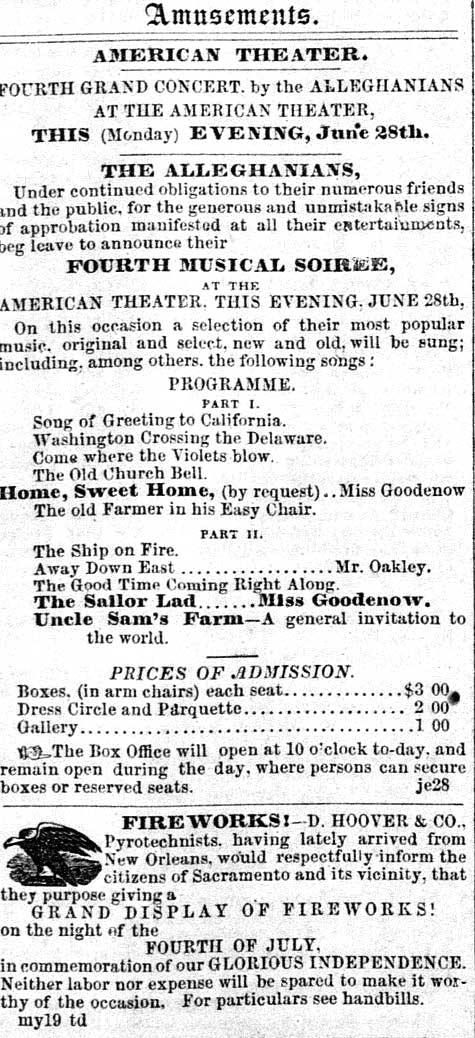
The Alleghanians worked the northern mines, planning to tour through the southern ones starting about the middle of September. But now the future of their California enterprise was put into question by the success of competing entertainments.
Booth and the Bakers, said Jesse, and Starks, and Mrs. Woodward and hosts of theatricals, are all doing well here and in Sacramento. There is no unoccupied room fit for a concert in this city. A Hall or Theater will soon be built, and the Alleghanians will then return. But Miriam Goodenow became ill at Columbia.
Very late in his stay in San Francisco, Jesse's writings took on an uncharacteristically dark tone. He was still mourning the loss of his family and it seems that the the Alleghanians quartet was starting to unravel - no doubt because of the engagement and then marriage of star vocalist Miriam Goodenow to T.P. Robb and her subsequent retirement from concert tours. Along with James Duhig, Hutchinson briefly became the proprietor of the Graham Flour Depot, a whole-grain market at 154 Sansome Street.
On September 13, 1852 the Alleghanians gave one of their most successful concerts at Armory Hall in San Francisco. But Miriam Goodenow took sick again; and it was then that the others positively decided to leave for the East - as an all-male trio - as soon as they could. "I am now en route," wrote Jesse, "to the Northern mines for the last time. While the Alleghanians will go on their way rejoicing into the Southern mines, and probably closing their concerts in California within a very few weeks."
Jesse's letter of September 15 is the last commonly known correspondence from this trip. After this details of events and circumstances come from scattered sources. The Alleghanians continued giving concerts through November.
Click for a Selection of California History Books

Site Search
Written by noted genealogist and lecturer George G. Morgan. This guide takes you inside the #1 website for family history research. This edition includes chapters on searches at Ancestry, MyCanvas, and Ancestry DNA.

Artists in California, 1786-1940
Edan Milton Hughes

Edwin Deakin: California Painter of the Picturesque
Scott A. Shields

Lure of the West
Treasures from the Smithsonian American Art Museum
Amy Pastan
Striking paintings and sculptures by artists who traveled west in the decades following the Lewis and Clark explorations, portray the expanding frontier from an array of compelling viewpoints: pristine wilderness, rugged landscapes, the Gold Rush, Hispanic cultures of the Southwest, tribal Indian life, and romanticized views of the West as a place of primal beauty and spiritual values. Artists include Emanuel Leutze, Albert Bierstadt, Thomas Moran, Charles Bird King, George Catlin, Irving Couse, Olin Warner, and others.

California's Frontier Naturalists
Richard G. Beidleman
Stories of enthusiastic, stalwart, and talented naturalists drawn to California's spectacular natural bounty from 1786, when the La Pérouse Expedition arrived at Monterey, to the Death Valley expedition in 1890-91. Narrative describes the lives of botanists, zoologists, geologists, paleontologists, astronomers, and ethnologists as they camped under stars and faced blizzards, made discoveries and amassed collections, kept journals, sketched flowers and landscapes, recorded comets and native languages. He weaves together the stories of their lives, demanding fieldwork, contributions to science, and exciting adventures against the backdrop of California and world history.

Independent Spirits: Women Painters of the American West, 1890-1945
Patricia Trenton, Virginia Scharff

Artful Players: Artistic Life in Early San Francisco
Birgitta Hjalmarson
With a handful of wealthy Gold Rush barons as patrons, an active community of artists appeared in nineteenth-century San Francisco almost overnight. A subculture of artistic brilliance and social experimentation was the result. Witness Jules Tavernier, hungry and in debt, accepting a stuffed peacock and two old dueling pistols in payment for a Yosemite landscape; Mark Twain as reluctant art critic, etc.
 Copyright ~ 1998-2018.