The Maritime Heritage Project.

Very Important Passengers Arriving in the Port of San Francisco During the 1800s

° SITE SEARCH
° HOME PORT
° THE BLOG
° STORIES
° IN PORT
° LOG/LISTS
° CAPTAINS
° VIPS
° SHIPS
° WORLD PORTS
° SHIPS STORE

SUPPORT
° TESTIMONIALS
° DONATIONS

BACKGROUND
° RESOURCES
° ABOUT THE MHP
° DIRECTORS
° BIBLIOGRAPHY

This site started with my daughter's family tree homework project in 1998. The Project has taken us around the world in search of family. Our generational tree is now 5'x4' and goes back to the 1700s in Maine, and prior to that to Ireland, Wales and Germany. A family tree is a marvelous way to keep your family connected.

Expedia.com
Travel to find your family!

Squirrel


Recommended Reading.
Books can be ordered just by clicking on a cover.


The Pratt Name in History
Pratt Name.

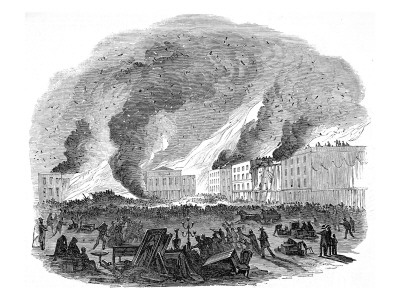
Annals of San Francisco.
The Annals of San Francisco by Frank Soule, John H. Gihon, James Nisbet
Originally published 1855. Many illustrations.


The Barbary Coast: An Informal History of the San Francisco Underworld
Herbert Asbury
Asbury's history of the Barbary Coast properly begins with the gold rush to California in 1849..."

Travel with InternationalHarbors.com

Parley Parker Pratt is an important figure in Mormon history. He was born April 12, 1807, in Burlington, Otsego County, N.Y. On Sepember 9, 1827, he married Thankful Halsey in a Baptist ceremony in Canaan, Columbia County, N. Y.

In 1830, he had "discovered" the Church of the Latter Day Saints and The Book of Mormon, and left his home to seek out its translator, Joseph Smith. By September, 1930, he had been baptized by the hand of an Apostle of the Church of Jesus Christ, by the name of Oliver Cowdery at Seneca Lake in Western New York.

For years, Pratt and his wife travelled throughout Kansas, Missouri, New York, etc., preaching and meeting with other members of the Church of the Latter Day Saints. He was imprisoned, along with Joseph Smith and other Mormons.

In September, 1841, Brother Amos Yielding and Pratt chartered a large new ship called the Tyrean, Captain Jackson, master, for New Orleans. The ship sailed with 207 passengers on the morning of the September 21, followed by Sidney with 280 emigranting Saints, the Medford with 214 passengers, the Henry with 157 passengers, and finally the Emerald, with 250 passengers, including Pratt and his family. After ten weeks at sea, they reached New Orleans where they chartered a steamer, the Goddess of LIberty, for St. Louis.

His travels took him to England and on January 19th, fourteen immigrants travelled with him in the second cabin of the large new ship, the America. Shortly after leaving shore, a gale hit and stayed with them for nine days while they were were beating in a land-locked channel between Ireland and England, without gaining fifty miles on our course, being in imminent danger of being cast away on a lee shore. The Captain lay sick in his berth with a fever on the brain, and much of the time in a state of mental derangement.

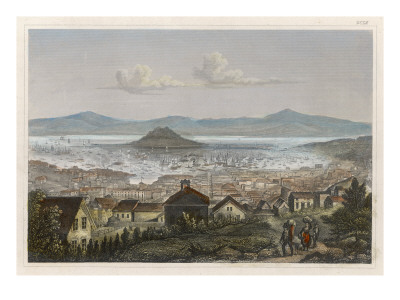
By 1848, he was in Salt Lake City, Utah. From there, he went to Los Angeles, and then on July 7th, boarded the steamship Ohio, and set sail for San Francisco, at 4 PM. After four days' rather rough passage, we arrived in San Francisco on the 11th 11 AM and "Found some good brethren who rendered us assistance in various ways. Rented a house the same day, and all moved into it together." He wrote the following letter to Elder Addison Pratt, Society Isles:
SAN FRANCISCO, July 26, 1851.

DEAR BROTHER PRATT: My long contemplated mission to the Pacific has at length become a reality. I am here, having left home in March last. Eight of us are here, and will go to the Sandwich Islands and elsewhere as the way opens and the Spirit directs.

Brother P. B. Lewis and wife would have sailed for your islands with letters, etc., but Brothers Clark and Thompkins having arrived, we concluded to send no more laborers to that part of the vineyard at present.

I hold the presidency of all the islands and coasts of the Pacific, under the direction of the First Presidency of the Church--to open the door to every nation and tongue, as fast as the way is prepared and the Lord directs, for the preaching of the gospel of salvation.

As president of that part of the vineyard you will preach the gospel to every people as fast as possible. Send men to the Friendly Isles, or to any other groups where the way may be open, and as circumstances will permit, as you are led by the Holy Ghost. If you need more laborers send to me at this place. I am well known here, and making some progress. Also make your report to me from time to time, and ask such counsel as you may need.

Elder Philip B. Lewis will sail for the Sandwich Islands, accompanied by his wife, Brother Hammond and wife, and Brother Woodbury and wife. He will have the presidency of those islands.

It would be well if you would correspond with him. The work is prospering wonderfully in Deseret, England, Wales, Scotland, Switzerland, Italy, Denmark, Sweden, Norway, etc.

Several young men are with me who will go to Chili and Peru in due time. Bishop Murdock will also go soon to the English Colonies in New Zealand, Van Dieman's Land, or New Holland, if the Lord will. Our instructions to the elders abroad, everywhere, are to seek the Spirit and gift of the Holy Ghost, by humble prayer and faith and good works.

Also, to take no part in government matters, except to uphold and obey the authorities and laws of every nation where they may labor, and teach others to do so. The laws of the country we are in will govern us in all things consistent with liberty of conscience, freedom of speech, etc. With sentiments of love and good will I subscribe myself, Your brother in the gospel, PARLEY P. PRATT.


Sept. 5, 1851.


I sailed for Valparaiso, Chili, on board the bark Henry Kelsey.

After a tedious and disagreeable passage of sixty-four days, arrived safe in Valparaiso, Nov. 8th, accompanied by my wife and Elder Rufus Allen, all in tolerable health.

Found the country in a state of civil war, and most kinds of business at a dead stand--men's hearts failing them for fear. I then finished the following letter which I had commenced on the sea:
SHIP HENRY KELSEY, PACIFIC OCEAN, Lat. 24 N., Lon. 115 W., Sept. 15, 1851.

Dear Family--Here we are on the deep, bound for Chili, S. A.--self, Phebe and R. Allen.

We sailed from San Francisco on the 5th inst. Have had fine weather, excepting three days, in which we were becalmed; and have sailed more than eleven hundred miles. We are now running before the wind seven miles an hour. We have all been sea sick, and have not yet recovered in full. We are the only passengers, and have the cabin to ourselves, except at meals. We study Spanish every day. It is a beautiful language, and wonderfully adapted to the simplicity of the Lamanites.

I hope to master it during the passage and a few months' residence among the Chileans. We pay sixty dollars for passage in the cabin, and found. We expect to be two months in going. Well, dear ones, six months have passed, and their events been recorded in the records of eternity since we parted; all this time I have had not one lisp from you. Oh, how lonesome! Just imagine the monotony. Sky and sea! Sea and sky! Night and day! Day and night! Infinitude of space! Boundless waste! Emblem of eternal silence! Eternal banishment! Eternal loneliness, where the voice of the bridegroom and of the bride are not heard. Where the holy music of children's voices, in joyous merriment, falls not on the ear; where no changing or varied landscape relieves the eye; where no vegetation, or leafy bower, or sweet blooming flower cheers the senses, where no birds tune their soft notes of praise announce the dawn, or sound the requiem of the closing day. Even the fierce and ravenous beast of the desert (which, in his native solitude, announces with doleful and prolonged howls the midnight hour, or wakes the weary traveller at early dawn, and gives the signal for another day of thirst, and toil, and suffering) is lacking here.

On this boundless waste of waters there is seldom anything to break the monotony of eternal silence, or, rather, of the roar of the waves as they break in increasing foam upon each other, or against the vessel's side . . . . Behold him standing leaning over the vessel's side as it glides over the waters of the lone and boundless Pacific, gazing for hours in succession into the bosom of its dark abyss, or watching its white foam and sparkling spray! . . .

This done, he commends himself, the vessel and his all on board to God, and to the guardianship of his good angel. Amen. Walks the deck a few minutes, examines the sails, the speed of the vessel, the course of the wind, and then retires to rest to dream of home.

October 5th.--Coast of Peru, S. A., lat. 3 deg. 30 m. S.

A month passed on the ocean; much head wind, some calms, and more or less sickness has attended us by turns until the present. We have not been able to read, write, or study much, therefore the time has passed off very tediously indeed.

We have a miser for a captain, who thinks more of a sixpence than he does of our lives or even of his own. He will not suffer the steward to cook potatoes, bread, pies, puddings or any other wholesome food, but keeps us on hard, mouldy bread, full of bugs and worms, and on salt beef and pork--the pork being rotten. He has flour, potatoes and good pork, but will not allow it to be used; thus you will readily perceive that we ate truly in unpleasant circumstances.

Last evening we came near a shipwreck, having run near the land without knowing it, and it fell calm. The ship became unmanageable, and was drifting on to the shore, but we cast anchor and awaited the light of morning, when we got under weigh with much labor, and stood again to sea.

FRENCH HOTEL, Valparaiso, Chili, S. A., November 9th.

Dear Friends: After a most disagreeable and tedious passage of sixty-four days we have at length arrived in port, in tolerable health. We landed yesterday at noon, and took lodgings and board at a French Hotel, where we have a great variety of good eating, and a front parlor to ourselves--price four dollars per day for three of us. The proprietor speaks French, the clerk French, with a little English, the landlady German, the waiter Spanish, and ourselves English, with a little Spanish. So you see we have a little Babel of our own, independently of Nimrod or the great tower. We find the country in the midst of revolution and civil war. Two persons and their adherents fighting for power and rule. Business is dull, living high, and doubt and uncertainty characterizing every transaction in the various business departments. . .

Sunday, November 16th.

Dear friends--During the past week we have rented a house, purchased furniture and commenced housekeeping. We devote almost our entire time to the Spanish language.

Our house is in the rear of a block of buildings which fronts a large and beautiful street, called Victoria street. It opens into a large yard, surrounded with high walls and with other buildings, and filled with beautiful trees, such as orange, fig, peach, pear, etc., together with pinks and a variety of other flowers and shrubs. Its walks and pavements are neatly swept, and the houses around it occupied with widows, orphans, etc., of a good class of Spanish or Chilanoes, and their kind and sociable young people and little children. . . . Rents are high here, provisions and fuel dear. Strawberries, oranges, lemons, etc., are in market, as well as green peas, and other vegetables, and melons. It is, in fact, a state of advanced spring or early summer. The peaches, pears and figs are perhaps one-third their size on the trees, while the flowers are in full bloom. . . . To her nest in the Andes, the condor retires, the winds from magellan no longer prevail, And Sol, with the north breeze returning, inspires New life on the zephyr, and love on the gale . . .

With sentiments of the most endearing affection, I remain yours, etc., P. P. PRATT
He and his 8th plural wife, Pheobe Sopher, traveled on the Dracut May 20, 1852 to San Francisco from Valparaiso, Chile, where he served as a missionary for a short time.

From Parley Pratt’s diary where he spoke of travel on the Dracut.


Fifty-five days have passed like a dreary imprisonment to us, with but little to eat. We live on a little poor, hard bread, probably baked some two or three years ago, and some beans, and very poor damaged salt beef and pork. We have had no flour, potatoes, sugar, molasses, rice, or other comforts, although we pay a good price for cabin passage.

We have not had one day of good sailing in month; it is either calms or light head winds. We seldom sail more than from thirty to fifty miles in twenty-four hours. We are hungry, weary, lonesome, and disconsolate. But, after praying much for a fair wind and speed, we find our prayers are not answered, and we have given it up, and have asked our Heavenly Father to give us patience and reconciliation to His will.

We are now some eight or nine hundred miles from port and our provisions (poor as they are) must fail us soon. But live or die we trust in God and try to serve Him.

There is no one on board who fears God or regards man,as far as we know, except one of the sailors and ourselves. The most horrid blasphemies resound in our ears every day in the cabin and on deck, from captain and mate together, with gambling and blackguardism. We are shunned and hated because of our testimony, and because our example is a reproof. But we mind our own business, and study language and the Scriptures every day.
May 20, 1852: Brig Dracut, Captain Loper, 75 days from Valparaiso. Coal to N. Miller. Ten passengers:
Mr. P. Pratt and lady
R. Allen, J. Brown,
M. Lopez,
J. Beal,
A. Ryard,
P. Rello,
R. Lord and
J. Loomis.
Anchored off Griffin's Wharf.

Editor's Note: David Grow, webmaster for the Pratt Family Association, one of the oldest and largest family history organizations in the country, has provided a link to the Pratt family sites for those interested in their Pratt heritage, particularly Parley and Orson Pratt. They have dozens of photographs and images of Parley P. Pratt, links to PDFs of the originals and transcriptions of many of his pamphlets and discourses, and hundreds of pages of transcriptions of other documents relating to his life, teachings and death, and relating to his journey to Chile and back.

Pratt Family Site
Parley P. Pratt's History

To Top of Page


Page: http://www.maritimeheritage.org/vips/pratt
Date Entered: January 2004
Source: Erin Jennings: http://www.boap.org/LDS/Early-Saints/PPPratt.html


Research and WebDesign: D. Blethen Adams Levy
Contact: D. Blethen Adams Levy
www.MaritimeHeritage.org
Post Office Box 2878
Sausalito, California 94966
U.S.A.