Very Important Passengers
Lola Montez
1820-1861. Born Eliza Gilbert (Maria Dolores Eliza Roseanna Gilbert)
Limerick, County Sligo, Ireland
Daughter of Ensign Edward Gilbert and his fourteen-year-old wife who claimed descent from Spanish nobility. Her father died in 1824 and her mother married Major John Craigie, later adjutant-general of the British army in India. Educated at boarding schools in Britain and France, Lola was ordered by her mother at 19 to marry an aged judge. Instead Eliza eloped with Lieutenant Thomas Jamesin Ireland on July 23, 1837. In 1839 James took her to Simla, India, but eloped with another woman. Lola returned to England in 1842 and James won a judicial separation on the ground of her adultery on shipboard.
She wanted to become an actress, but learned that she couldn't act; so she decided to fabricate another career of her own design. With the help and support of two admiring gentlemen, Lord Malmesbury and Lord Brougham, Eliza changed her name to Lola Montez, and launched herself as a "Spanish dancer."
Lola found the greatest love of her life in Alexandre Dujarier, an editor and part-owner of La Presse. He was killed in a duel in 1845; the duel was unrelated to Lola.
 
|
| Portrait of Lola Montez (1820-1861) Painted 1847 |
| Joseph Karl Stieler (1781-1858)
Joseph Karl Stieler was a German painter strongly influenced by English portraiture. In 1812 he went to Munich, where he painted portraitures of middle-class clients. From 1820 until 1855, he worked as royal court painter for Bavarian Kings. He painted various members of the royal houses of Austria, Prussia and Sweden. His sitters included some of the most important figures in the political and intellectual life of Germany int he first half of the 19th century. He is known for his Neoclassical portraits, especially for the Gallery of Beauties at Nymphenburg Palace in Munich and for his portrait of Beethoven painted in 1819-1820. His works include Johann Wolfgang von Goethe, Amalia of Greece, alterpieces, and in 1847 he painted a portrait of Lola Montez, whose affair with King Ludwig I of Bavaria led to the monarch's abdication the next year. |
By October 1846 Lola was in Bavaria, where she achieved her greatest triumphs and tragedies. After auditioning for the State Theatre, Lola was told her dancing might cause moral offence. The theater's manager had heard rumors of her scandalous performances elsewhere. Determined to defend her reputation, Lola stormed the palace unannounced to plead with King Ludwig of Bavaria for help. Lola got her wish. The King agreed to let her dance and Lola made her debut in a play called The Enchanted Prince.
At the time that they met, Lola was 25 years old and Ludwig was 60. Ludwig I (1786-1868) was responsible for turning Munich into a cultural mecca. He sponsored artists, writers, craftsmen, and architects.
On August 25, 1847 Ludwig created her Countess Marie von Landsfeld but the Bavarian aristocracy and middle class refused to acknowledge her. In February 1848 street riots broke out against her influence; thousands of burghers marched on the palace to demand her expulsion. Presented with proof of her background and infidelities, Ludwig gave way but also insisted on abdicating the throne. Lola fled to Switzerland when her Bavarian rights were annulled.
She returned to London and within months, she had met and married Army officer George Trafford Heald, who came from a rich and distinguished family. A family member found out about her questionable past; her choices were to go to jail or leave England. George and Lola fled. Heald drowned the following year and Lola returned to the stage.
Lola arrived in New York in 1852, dressed like a man, with spurred boots and a riding whip, which she used immediately on an admirer who dared to grab onto her coat tails. Once in the States, controversy began anew.
She toured the country for three years, then headed for California on the heels of the Gold Rush.
May 23, 1853, Sacramento Daily Union, Sacramento, California
The P.M.S. Co's steamer Northerner arrived on Friday night in San Francisco. "The Countess of Landsfeldt," or, more generally known as the "Divine Lola" was a passenger on the Northerner. She comes unheralded, yet her arrival has produced great excitement among the "quid nuncs" of the Union Saloon. We hear that she will immediately enter upon her professional career.
By the time she reached San Francisco in 1853 with her dog and her manager, Edward Willis, she was thirty-five, then considered past her prime. She discarded her manager, and got a booking at the American Theater on Sansome Street.
Later that year, she married her third husband (again bigamous), Patrick Hull, owner of the San Francisco Whig newspaper in a Catholic ceremony at Mission Dolores. The marriage with Hull lasted two months. Hull sued for divorce, naming a German doctor as co-respondent: a few days later the doctor was found shot dead in near-by hills.
She purchased a house in Grass Valley, where she lived between tours. There, Lola showed another side to her character: She began to devote her time to helping out troubled women. There is a legend that she took the young Lotta Crabtree under her wing, teaching her how to dance and to command the stage. She became a model citizen of Grass Valley, much admired by the other townsfolk. She kept a menagerie of pets including a tamed grizzly bear which she took for walks.
But Lola Montez still had dynamic appeal; she retained a surfeit of overwhelming beauty, a cocky spirit and a quick wit, and she was well-known in the world at large for the distinguished male scalps she had collected (including Franz Liszt and King Ludwig of Bavaria) and for her scandalous antics all across Europe.
San Francisco, Sacramento, Marysville and Grass Valley played host to her temper, wit and grace, and received in the bargain a mine of gossip and scandal for their press.
Lola ran her course through California's theatre circuit, always maintaining an air of importance and inviting passionate, if mixed, reviews. Quickly known, her path crossed with Alonzo Delano, John Sutter, John Southwick, Dr. David Gorman ("Yankee") Robinson, Gilmore Meredith, and others.


Glamorous and boldly unconventional, Miss Montez attracted an enthusiastic following based more on her persona and her beauty than on her talent. She thrilled Gold Rush San Francisco with her amorous scandals and famously suggestive "Spider Dance." She was also known for her affairs with Franz Liszt and King Ludwig I of Bavaria. First appearing in San Francisco in May of 1853, Lola Montez spent a year in California's sleepy Sierra town of Grass Valley, where she took an interest in a young neighbor named Lotta Crabtree.
April 7, 1852, Sacramento Daily Union
Lola Montez as a Politician and Prophetess. -- Lola Montez, says the Republic, may be called upon to serve the Southern Rights section of the Democratic party in its present strait. The editor of the Richmond (Virginia) Enquirer is as enamored of her politics as her person, and volunteers to become security for her soundness on important questions. In an account of an interview with her, he says:--
She is sound on the " intervention" question, and seems to belong to the Southern school in her advocacy of a conservative system of checks and balances. She commended, with much animation, Mr. Calhoun's work, just published, which she has sent to Eugene Sue to have translated into French. She speaks in the highest terms of the destinies of this country, and predicts that we shall have two Presidents or Executive heads, as recommended by Mr. Calhoun.
Calhoun on Government, continues the Republic, done into French by Eugene Sue, with an explanatory and laudatory preface by Lola Montez, will be almost as great a curiosity as a bipartite Presidency, and will probably appear at about the same period.
May 23, 1853, Daily Alta California, San Francisco
LOLA MONTEZ -- The public of San Francisco will have an opportunity to gratify its long awakened curiosity, on Thursday night next, by visiting the American Theatre, where and when Lola Montez make her debut before a California audience. An engagement has been made with her by Mr. Baker, and she will appear on that night.
We can say nothing of her theatrical ability, never having seen her upon the stage. But who has not heard of her and her gallant spirit, her independent and Republican nature? Who has not heard how the sins of the aristocracy were heaped upon her because she possessed the royal favor, and how her troublesome Democracy was got rid of by the usual tyranny of despotism exile? Are not these things written in the books of the history of Bavaria?
This favorite and sport of fortune, now a member of the ballet, now a Countess; now brilliant with the smiles of majesty, now dragged by a mob through the streets of a revolutionary city; ready with the pen as with the steel, and dangerous with both -- comes from the palaces and royal theatres of the East to the borders of civilization, where free hands and free hearts construct temples for the Muses, and free thought and free welcomes greet those who seek our favor. We doubt not she will meet a fair, and just, and generous reception.
May 28, 1853, Daily Alta California, San FranciscoTHE AMERICAN THEATRE.--
LOLA MONTEZ -- Seldom is actress or artist greeted with such a house as was the renowned Countess of Landsfeldt last evening at the American. The building was literally stowed with human beings. The performances commenced with the farce of Damon and Pythias, which was performed passably well by the stock company. But the people had no patience to watch and listen to that. They came to see Lola Montez, and were impatient till she appeared. In the character of Yelva, Madame Lola's powers of pantomime were exhibited, and she portrayed the sufferings of the orphan with a great deal of truthfulness and effect, though we could see but little merit in the piece apart from the impassioned representation of the deserted orphan.
Following this came the Nabob for an Hour, and then the Dance. The dance was what all had come to see, and there was an anxious flutter and an intense interest at the moment approached which would bring her before the house. She was greeted with a storm of applause, and then she executed the dance, which is said to be her favorite, and has won for her much notoriety. The Spider Dance is a very remarkable affair. It is thoroughly Spanish, certainly, and it cannot be denied that it is a most attractive performance. At a danseuse, Madame Lola is above mediocrity. Indeed, some parts of her execution was truly admirable. We shall endeavor to do her full justice in another notice.
She was heartily applauded, and at the close of the performance, being called out she very neatly expressed her profound gratitude for the reception she had met with. Lola is sure to have fine success with us -- this is a fixed tact; and to say that is to say that she has merit of a high order, for nothing less could succeed with a people so practical and exacting as ours. This bill of last evening is again offered tonight.
July 8, 1853, Sacramento Daily Union, Sacramento, California
Great Excitement Third Concert of Lola Montez Pride Humbled, but Beauty Triumphant!
When the doors of the Theater were thrown open for the third grand concert of Madame Lola Montez, on Thursday evening, a multitude of people continued to pour in until the edifice was 'crowded. Many persons went there with the expectation of witnessing a row, while by far the largest proportion were prepared to frown down all attempts of the kind. Marshal White was present with a full police force, and expressed the determination to quell every attempt at outbreak, by the arrest of the first man who exhibited the slightest symptom of being unruly.
When the audience were seated among whom were several ladies Major General John A. Sutter entered the Theater, and was received (bless the noble old hero!) with an enthusiastic round of applause. The orchestra performed an overture, after which Mr. Charles King made his bow, and said that Madame Lola Montez desired to offer a word of explanation before she danced; [applause;] that he should regard this applause as a demonstration favorable to the request, [renewed applause,] and he hoped it would be unanimous. He then retired, and leading Madame Lola Montez in by the hand, left her to speak for herself. (Enthusiastic applause.)
SPEECH OF MADAME LOLA MONTEZ.
Ladies and Gentlemen: Last evening there was an occurrence in this theatre which I regret. It is a small theatre; it is more like a drawing room. I am close to you; I am almost along side of you; and the sound is not always distinctly understood. I am subject to a palpitation of the heart, and since I have been in Sacramento, I have suffered with it very much, which makes me at times feel very bad. While I was dancing I stamped my foot several times upon the stage, and some one laughed, as I supposed to insult me. I have many enemies, who have followed me from Europe and offered me insults, and I supposed it might be some of these who had followed me with that intention. I knew it was no American, for I have been loved and cherished by the Americans, wherever I went. And, now, could I come here to Sacramento to offer the Americans an insult, after loving them so much and receiving so many marks of kindness from their I hands? I have travelled all over Europe, and I danced the Spider dance in Russia, Germany, England, France, Italy and Spain, but have never met with so much kindness and fame as in America and particularly in California. It is so well known that it is called the "world-renowned Spider Dance;" and why should I not dance it in California! I can't always find the spider when I hunt for it it can't always be seen I can't always put it to the ground; and when I stamped, it was only in a joke. It is sometimes customary for my friends to throw a bouquet of flowers upon the stage, and for me to trample on it, to represent a spider, as it is not always convenient to find a real spider; but it is no insult to my friends. I will wipe out from my memory what occurred. It was unworthy of me, and I shall speak of it no more. Ladies and gentlemen, if you wish me to go on with my dance, you have only to say the word.
At the conclusion of this speech, the Countess was hailed by thunders of applause; amid which she smiled sweetly, dropped a curtesy and retired 'gracefully.
After the performance of her first dance, the applause was so loud, unanimous and prolonged, that she re-appeared on the, stage, and in her blandest tones said:
Ladies and Gentlemen: Believe me, I am overwhelmed with gratitude for your kind reception of me this evening. I came to California, not so much for what I might gain, as to see it and the people. I came to this city impressed with the belief that I should meet men noble men who had worked hard, and twice built up a city; once from ruin by a flood. and once from fire; and now you have redeemed the character of Lola Montez! . . .
Her fourth appearance was the signal for renewed applause, and from the great agility, spirit and grace with which she acquitted herself, it was at once evident that she was determined to please, if such a thing were possible under the peculiar circumstances of the case. While she danced, an orange was thrown upon the stage (the only symptom of rudeness manifested during the evening) and a straw "hat." which, in a moment of unrestrained enthusiasm, some excited gentleman plucked from his head, and tossed at her feet as a token of his huge delight at what was transpiring.
This grand denouement of the programme having been successfully accomplished, the Countess advanced to the foot-lights, curtsied gracefully again and again, kissed both hands at the audience, and retreated behind the proscenium.
Now, however, that the tide of public feeling had set in her favor, Madame Lola was not to be let off so easily. The audience arose to their feet, and made the Theater tremble to its deep foundations with the delirium of their applause. The fair recipient of so much generosity could not withstand this final appeal. She was a woman, and her heart swelled with gratitude at the flattery bestowed upon her many accomplishments, although it had been purchased at the expense of her pride.
For the fifth time she made her appearance in obedience to the popular demand. She advanced again to the front of the stage, her head surmounted by the straw hat alluded to, bowed lowly under the universal ebullition of enthusiasm, smiled archly, nodded her head approvingly, and when the clamor had sufficiently subsided to allow her to be heard, spoke as follows:
Ladies and Gentlemen: Now, indeed, I perceive that I have gained your favor. May I ask if 1 shall be permitted to dance .in , Sacramento one or two evenings more ? [Immense applause, which was intended to bo interpreted as "yes thousand times, yes!"] I would leave Sacramento with the good opinion of every citizen in it and especially of the ladies!
At the conclusion of this last speech, the Countess hesitated, looked lovingly upon the audience, advanced a step, retreated, smiled, curtsied, flung several additional kisses in the faces of her newly won friends, and disappeared from view.
Altogether so racy a night's entertainment has never been witnessed in Sacramento, (which has become famous for getting off more original and unheard of things than any city in the known world). The Countess entirely retrieved herself by the force of that genius which is justly an object of high admiration among all classes of intelligent men. It were impossible to behold its workings and refuse to render it homage. Our citizens, with a discrimination which is the pride of a free and enlightened community however much they may have felt outraged at the real or imaginary insult offered them could not resist this singular woman's eloquence ; and the noble manner in which they consented to forget the past, was the proudest triumph to their magnanimity that could possibly have been achieved.
July 12, 1853, Sacramento Daily Union
THE CITY.
Sixth Grand Concert of Lola Montez.


The Concert of this lady was attended last evening by the following fire companies: Protection No. 2, Alert Hook and Ladder Company No. 2, and Tehama Hose Company No. 1, preceded by a band of music, and in full uniform. At the expiration of the Madame's first dance, they arose to their feet and gave three cheers, to which she responded in a very neat and appropriate speech. When she had finished the Spider Dance, and before she left the stage, the firemen arose to their feet a second time, and cheered her three times more. To this generous reception the Countess made a very feeling reply laying her hand upon her heart, and declaring that her emotion overcame her. Among all her speeches, this, though brief, was perhaps the most sentimental. She bade her audience a kind farewell, and protested that she would remember their kindness to the last. After the concert, the firemen formed into rank, marched to the front of the Orleans Hotel, cheered, had the band of music play a national air, and then awaited the arrival of Madame Lola from the Theater. Having arrived in her room and divested herself of bonnet and shawl, she appeared at the window to answer the summons of the multitude below. At the conclusion of a few remarks, she threw a small national banner to the firemen (which she had carried with her all through the United States) as a souvenir of her affection. Mr. Charles A. King responded to a call of the crowd by a few remarks, and Mr. Hull, also, (the husband of Lola Montez,) who invited the firemen to step into the bar room below and take a drink at his expense, which they did; and thus ended the evening's entertainment. During the performance of the Spider Dance, a champagne basket filled with bouquets was emptied of its contents, which were cast at the feet of the Countess by the gallant firemen. A crowded house, among whom were many ladies, attended Madame Lola's last performance.
Benefit to Mr. Charles A. King. The lateness of the hour at which the correspondence was received, leaves us only time and room to say at present, that the numerous friends of Mr. Charles A. King have tendered him a complimentary benefit, which is to come off on Thursday evening. Lola Montez has volunteered to appear on the occasion. Allusion to this matter will be made more in detail tomorrow.
July 14, 1853, Sacramento Daily Union
Mlle. Lola Montez, accompanied by her husband, came up on the Senator last night, for the purpose of appearing this evening at Mr. King's benefit.
February 16, 1854, Sacramento Daily Union
BY THE ALTA CALIFORNIA LINE!
Weather Snow Failure of the Mails- Mr. Meagher Lola Montez.
Grass Valley, Feb. 15th
. . . The Countess of Lansfeldt, Lola Montez, Patrick Purdy Hull, has nearly recovered from the bite of bruin.
November 22, 1854, Sacramento Daily Union, Sacramento, California
BY THE ALTA TELEGRAPH LINE.
Assault on an Editor by Lola Montez - Exciting Scene, etc., etc.
Grass Valley, November 21
Our town was thrown into a state of ludicrous excitement this forenoon by the appearance of Madame Lola Montez rushing from her residence through Mill street towards Main street, with a lady's delicate riding whip in one hand and a copy of the "Telegraph" in the other, "her eyes in fine frenzy rolling," vowing vengeance on that scoundrel of an editor, &c. She met him at the Golden Gate Saloon, the crowd who were on the qui vive following in her footsteps. Lola struck at the editor with her whip, but he caught and wrested it from her before she could hit him a blow. She then applied woman's best weapon-- her tongue. Meanwhile her antagonist contented himself with keeping most insultingly cool. Finding all her endeavors powerless, the "divine Lola" appealed to the miners, but the only response rendered was a shout of laughter. Mr. Shipley, the editor, then triumphantly retired, having, by his calmness, completely worn out his fair enemy.
The immediate cause of the fracas was the appearance of sundry articles, copied from the New York Times, regarding the "Lola Montez-like insolence and effrontery of the Queen of Spain." The entire scene was decidedly rich.
The appeals of the Countess to the "honest miners" were powerless, and so she invited all hands in to take a drink, but the response was a groan, and none stepped forward to show themselves her champion. The whole affair, so far as the lovely Lola was concerned, was a complete farce.
"How are the mighty fallen; none so poor to do her reverence."
November 22, 1854, Sacramento Daily Union, Sacramento, California
BY THE ALTA TELEGRAPH LINE.
Assault on an Editor by Lola Montez Exciting Scene, &c., &c.
Grass Valley, November 21.
Our town was thrown into a state of ludicrous excitement this forenoon by the appearance of Madame Lola Montez rushing from her residence through Mill street towards Main street, with a lady's delicate riding whip in one hand and a copy of the "Telegraph" in the other, "her eyes in fine frenzy rolling," vowing vengeance on that scoundrel of an editor, &c. She met him at the Golden Gate Saloon, the crowd who were on the quivive following in her footsteps. Lola struck at the editor with her whip, but he caught and wrested it from her before she could hit him a blow. She then applied woman's best weapon -- her tongue. Meanwhile her antagonist contented himself with keeping most insultingly cool. Finding all her endeavors powerless, the "divine Lola" appealed to the miners, but the only response rendered was a shout of laughter. Mr. Shipley, the editor, then triumphantly retired, having, by his calmness, completely worn out his fair enemy.
The immediate cause of the fracas was the appearance of sundry articles, copied from the New York Times, regarding the " Lola Montez-like insolence and effrontery of the Queen of Spain." The entire scene was decidedly rich.
The appeals of the Countess to the "honest miners" were powerless, and so she invited all hands in to take a drink, but the response was a groan, and none stepped forward to show themselves her champion. The whole affair, so far as the lovely Lola was concerned, was a complete farce.
"How are the mighty fallen; none so poor to do her reverence."
December 1, 1854, Wide West
RESIDENCE OF MADAME LOLA MONTEZ, GRASS VALLEY.
Time has been when the "Residence of Lola Montez" could only have been represented by a palace of towering front and castellated form with all the princely adjuncts to them pertaining. Tempora mutantur, et nos mutamur cum illos. The once occupant of a throne is now the happy tenant of a ranch. She who had passed the first years of her life in the heart of European civilization is now an inhabitant of the State most recently admitted to the American confederacy. Fortune has made many changes, yet none more striking than this.
Yet we doubt not that to the pampered daughter of luxury, even California life has a charm. The freedom of movement, the absence of restraint, the difference in social intercourse, cannot fail to please one whom ennui in her European home was no stranger. Mountain life has a charm for all bold, adventurous spirits, among whom none can deny Lola Montez a place. And as she roams on the hills thickly covered with the wild flowers daughters of our spring or flies on her willing steed over the plains that spread themselves at her feet as if inviting a gallop over their surface, she is no true lover of freedom if a longing for her future home ever enters her heart, or its memory dims her eye.
The accompanying engraving, we think may be relied on as correct. The sketch was taken on the spot, and has been carefully engraved. As a feature of California life it will be interesting to our friends in this State and the East.
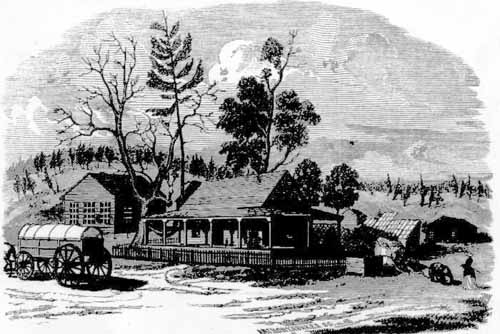
The gentleman who took the sketch assures us that the representation of the bear in the engraving is a correct likeness of the beast that recently treated so ungratefully the hand that fed him. The animal certainly looks quite capable of such an atrocity, and would probably be quite as unscrupulous in the gratification of his palate as any of his species.
In May 1855 Lola appointed a young actor Noel Foland as her manager. In June they sailed for Sydney in the clipper barque Fanny Major with their own company.
June 1, 1855, Sacramento Daily Union, Sacramento, California
Lola Montez. Mr. Folland, of the Metropolitan Theater, informs us, in relation to an item which appeared in yesterday's Chronicle under the above heading, that the Paris, London and New York newspaper folks know nothing about the movements of the Countess of Lansfeldt. He says, it is a fact that a dramatic company has just been organized in this city for he has managed it so far himself which is immediately about to depart for Australia, under the personal direction of Mme. Lola Montez. The Countess and her party will probably sail in about a fortnight for Sydney. After performing there, at Melbourne and at other Australian towns, the party intend to visit Hongkong, from whence they will likely proceed to Calcutta. The company will be composed of artists of some repute, and will be able to produce effectively commdiettas, vaudevilles and similar light pieces. It may be expected that the Countess herself will play a prominent part in many of the pieces. The professional trip will likely extend over a twelvemonth. There is very little doubt but that it will prove a lucrative speculation. The celebrity of the Countess is sure to "draw" full houses wherever she goes. Perhaps she may perform one night in San Francisco before departing. Who knows? Folland, who appears to have been made very unhappy at the idle gossip of the London News and the New York Times, may, ere long, enlighten the public on this interesting subject. Chronicle, Wednesday.
June 5, 1855, Sacramento Daily Union, Sacramento, California
Madame Lola Montez takes her departure for Australia on the Fanny Major, to sail in the course of a week. It is her intention to visit also Hongkong, Calcutta and other points in the East. She has engaged a troupe of performers to accompany her, comprising Mrs. and the Misses Fiddes, Mr. Simmonds, and Mr. Folland, which with her agent, Mr. Jones, and two attendants, constitute a party of nine; no small undertaking for one of less resolution than the Interesting Countess of Lansfeldt. Golden Era
June 9, 1855, Sacramento Daily Union, Sacramento, California, U.S.A.
A large crowd assembled yesterday afternoon at Cunningham's wharf, to see the Fanny Major leave for Sydney. Among the passengers were Lola Montez and the dramatic troupe who are proceeding to Australia under her direction on a professional trip. Much curiosity was manifested by the crowd to see the celebrated Countess. There's Lola! That's her, with the green parasol! See, quick! Hurrah for Lola! J--s, look at her, there! These, and similar exclamations, were muttered on all sides. The rigging, the ship's bulky boats, the bustle and crowd on the deck of the Fanny Major, required some tip-toe effort on the part of the spectators to see and follow the movements of " the observed of all observers," When the vessel got clear of the wharf, (5.30) several faint attempts were made to get up three cheers for Lola; but except an occasional enthusiastic yell, the multitude only laughed or remained silent. The pink ribbons and green parasol of the lady fluttered and glistened on deck, till theFanny Major got into the stream, loosed her wings, and sped westward through the Golden Gate.
They arrived in Sydney on August 16 and opened with local actors at the Royal Victoria Theatre on the 23rd in a farrago entitled 'Lola Montez in Bavaria'. Two weeks later Lola and Follin (who had changed his name to Folland) decamped from Sydney. A sheriff's officer followed them on board the Waratah with a debtor's warrant of arrest; Lola undressed in her cabin and dared the officer to seize her but he left on the pilot boat without her. They continued touring throughout Australia, then sailed with Folland for San Francisco. He was lost overboard near Fiji on the night of July 8.
July 30, 1856, Marysville Daily Herald
From Australia: By the Talkingburg from Austrlia, Lola Montes arrived. During the passage of theTalkingburg, Mr. A. Folland, an actor, who went to Australia with Lola Montez, fell overboard and was drowned.
July 26, 1856, Sacramento Daily Union, Sacramento, California
Lola Montez "Whipped by a Woman. The Ballarat Times of March 3d contains an account of a whipping, at length administered to this most terrible whipper, by one of her own sex. Lola Montez was engaged to perform at the Ballarat Theater, for Mr. Crosby. She quarreled with him about accounts, abused him, and was then set on by his wife. Mrs. Crosby broke a whip on her opponent, then seized Madam by the hair the rest may be imagined. The Times says that Lola Montez will not be able to appear for a long time oil the stage.
August 17, 1856, Wide West
THE WEEK'S AMUSEMENTS
American Theatre. Mine. Lola Montez has been very successful here during the week, in her personations of Charlotte Corday, and the principal character in Lola Montez in Bavaria. In the last part of the week she appeared in her capacity as a danseuse, in which she was not particularly successful, owing probably to her want of practice lately. By the time she is ready to appear in the "spider dance," she will probably have regained her usual skill.
At the age of 41 she had a schizophrenic collapse, abandoned the West and all her travels, and spent the last two years of her life on the streets of New York as a pauper. She shuffled along, speaking aloud to herself, urging God to forgive her wicked life.
At 43 she died of a stroke in a wretched boardinghouse, alone.
Her two children, one of whom ran a lamp shade store in California, declined to claim the body. Both were "constrained by the pressures of business" the first one said, which was an interesting perspective, since the second was in jail.
The Annals of San Francisco
Frank Soule, John H. Gihon, Jim Nisbet. 1855
Written by three journalists who were witnesses to and participants in the extraordinary events they describe. The Annals of San Francisco is both an essential record for historians and a fascinating narrative for general readers. Over 100 historical engravings are included. Partial Contents: Expeditions of Viscaino; Conduct of the Fathers towards the natives; Pious Fund of California; Colonel John C. Fremont; Insurrection of the Californians; Description of the Golden Gate; The Presidio of San Francisco; Removal of the Hudson's Bay Company; Resolutions concerning gambling; General Effects of the Gold Discoveries; Third Great Fire; Immigration diminished; The Chinese in California; Clipper Ships; Increase of population; and Commercial depression.

San Francisco, You're History!
Politicians, Proselytizers, Paramours, and Performers Who Helped Create California's Wildest City
J. Kingston Pierce
Seattle-based freelance writer Pierce presents a fascinating view of a variety of colorful people and events that have molded the unique environment of San Francisco. He chronicles historical highlights along with a focus on current issues. Pierce touches on the gold rush, earthquakes, and fires and introduces the lives of politicians, millionaires, criminals, and eccentrics. Pierce sparks the imagination in relating the stories of yesterday to today.


The Naval Order of the United States
The San Francisco Commandery meets the first Monday of each month in San Francisco, California and holds two formal dinners each year:
 Copyright ~ 1998-2018.