VIPS in the Port of San Francisco

Cochituate Mining Co.


On the East Coast, groups of men formed corporations with the sole purpose of hiring a ship to bring them to California's gold fields where they would then work together to strike it rich. The groups had mixed success; problems began even before they reached the West Coast in that divisions developed in some groups during the difficult passage.
August 2, 1999: John Ireland provided the following from The Argonauts of 'forty-Nine: Some Recollections of the Plains and the Diggings,
Scholar's Choice Edition. He adds: "I can't locate who "Sn of Salem" is. No index in book but it has information on 124 mining groups in the appendix, usually including name of ship, captain, mates, and some officers of the mining company."
FOR CALIFORNIA!
|
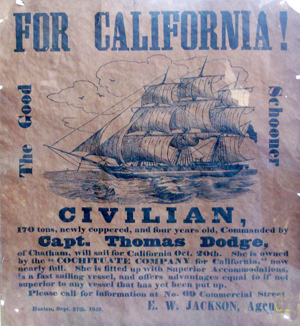
Cochituate Mining and Trading Company
Sailed from Boston, November 6, 1849, on schooner Civilian, Thomas Dodge, master; John Dillingham of Brewster, mate; Paul Howes of Dennis, second mate. The shares were two hundred dollars each and Captain Dodge was given one free for his services.
The Civilian was a nearly new schooner of 170 tons and she arrived at San Francisco, April 5, 1850, making the fast passage via Magellan. 43 in company.
The topsail schooner Civilian, Captain Thomas Dodge, sailed from Fisk's Wharf, Boston, for California, November 6, 1849, carrying the Cochituate Trading and Mining Company. The company was raised by Josiah Hayward and son of Salem and numbered sixty men from towns in Essex County and Cape Cod. The shares were two hundred dollars each and the captain received one free for his services.
The Civilian stopped five days at St. Catherine's and five at Valparaiso and arrived out in one hundred and forty-five days, going via Magellan. The company divided up one hundred dollars a share.
The Civilian left San Francisco in 1850 and was sold to Peruvian parties.

Site Search
Argonauts of '49: History and Adventures of the Emigrant Companies From Massachusetts 1849-1850
Octavius T. Howe
Harvard University Press.

Shanghaiing Days: The Thrilling Account of 19th Century Hell-Ships, Bucko Mates and Masters, and Dangerous Ports-Of-Call
Richard H. Dillon
D. Michael Abrashoff
Merchant Kings: When Companies Ruled the World, 1600--1900
Stephen R. Brown

California Indian Languages
Victor Golla.

American Merchant Ships
1850-1900
Frederick C. Matthews

The Annals of San Francisco
Frank Soule, John H. Gihon, Jim Nisbet. 1855
Written by three journalists who witnessed and participated in the extraordinary events they describe. This essential record for historians is also a fascinating narrative for any reader. 100+ historical engravings are included. Partial Contents: Expeditions of Viscaino; Conduct of the Fathers towards the natives; Colonel John C. Fremont; Description of the Golden Gate; The Mission and Presidio; Removal of Hudson's Bay Company; gambling; General Effects of Gold Discoveries; Third Great Fire; The Chinese in California; Clipper Ships; commercial depression.

 Copyright ~ 1998-2018.