Japan
° Chiba °
Hakata
° Kawasaki
° Kobe
° Kyoto
° Moji
° Nagasaki
° Osaka
° Shimizu
° Yokohama
° Ryukyu Islands
Queen Jingo
Prior to the mid-nineteenth century, Japan secluded itself from much of the rest of the world guided by myths. Japanese legend describes an early foray out of Japan and into Korea under Queen Jingo and her son Ojin. According to legend, the surprised and terrified Koreans surrendered at once and promised to pay homage and tribute to Queen Jingo until the sun rose in the west, rivers flowed backwards and stones turned into stars.
Japan 1812. Aaron Arrowsmith, Mapmaker


Japan was first brought into contact with Europe in the sixteenth century when Francisco de Jasso y Azpilicueta (1506-1552), a Portuguese Jesuit missionary, began his teaching in the Far East in a country greatly devastated by perpetual feudal war. St. Francis Xavier reached Japan in 1549 and directed to the port of Yamaguchi.
For a time Japan welcomed European interaction, and the Christian missionaries were able to convert the Japanese to Christianity. For forty-five years the Jesuits were the only missionaries in Asia; eventually Franciscans also began proselytizing in Asia. Christian missionaries were later forced into exile, along with their assistants. Some were able to stay behind, however Christianity was then kept underground as to not be persecuted
 
|
Kokugawa Ieyasu Japanese
Shogun Lawgiver, Founder of the Tokugawa Dynasty 1543-1616 |
In 1638, closed its islands to Europeans, and they remained closed for over 200 years. During those two centuries it was forbidden to build any ship larger than a mere coasting boat. No Japanese could go abroad, and no European could enter the country.
Prior to closing her doors, William Adams, of Gillingham, Kent, became the most trusted European adviser of the Japanese, and showed them how to build big ships. There were voyages in Japanese-built ships to India and Peru.
In 1837 a ship sailed into Yedo Bay flying a strange flag of stripes and stars, and carrying some Japanese sailors she had picked up far adrift in the Pacific. She was driven off by a cannon shot. This flag presently reappeared on other ships. In 1853 four American warships under Commodore Perry sailing into Japanese waters. Perry sent messages to the rulers. In 1854 Perry returned with ten ships, amazing ships propelled by steam, and equipped with big guns, and he made proposals for trade and intercourse that the Japanese had no power to resist. He landed with a guard of 500 men to sign the treaty.
 
|
1855 Map of Japan. Showing prefecture boundaries |
Russia, Holland, and Britain followed in the wake of America. Foreigners entered the country, and conflicts between them and Japanese gentlemen of spirit ensued. With astonishing energy and intelligence the Japanese set themselves to bring their culture and organization up to the level of the European powers. Never in all the history of mankind did a nation make such a stride as Japan then did.
In 1603, after decades of civil warfare, the Tokugawa shogunate (a military-led, dynastic government) ushered in a long period of relative political stability and isolation from foreign influence. For more than two centuries this policy enabled Japan to enjoy a flowering of its indigenous culture. Japan opened its ports after signing the Treaty of Kanagawa with the US in 1854 and began to intensively modernize and industrialize.
May 23, 1855, Daily Alta California, San Francisco, California, U.S.A.
THE JAPANESE.
 
|
| Japanese print showing Commander Anan, Commodore Matthew Perry, Captain Henry Adams |
Two Japanese went on board the flag ship of Commodore Perry, while at the port of Simoda, Japan, and requested that they might be carried to the United States, which request was refused. Some days after, an officer, in passing through one of the streets, saw two men caged, one of whom called the attention of the officer to their condition, and thrust through the bars a board, upon which was the following, as translated by the interpreter to the exhibition. It was supposed that they were the same individuals who were afterwards, it is said, executed at the capitol:
"When a hero fails in his purpose, his acts are then regarded as those of a villain and robber. In public have we been seized and pinioned, and darkly imprisoned for many days; the village elders and head-men treat us disdainfully, their oppressions being grievous indeed; therefore looking up while yet we have nothing wherewith to reproach ourselves, it must now be seen whether a hero will prove himself to be one indeed.
"Regarding the liberty of going through the sixty States (of Japan) as not enough for our desires, we wished to make the circuit of the five great continents; this was our hearts' wish for a long time. Suddenly our plans are defeated, and we find ourselves in a half-sized house, where eating, resting, sitting and sleeping are difficult, nor can we find our exit from this place. Weeping we seem as fools, laughing as rogues alas! for us, silent we can only be. (Signed,)
"I SA GE KOO-DER KWA-NOU MAN-GE."
Every one in Japan is not only a spy on his neighbor, but members of families exercise an espionage over one another. They were therefore discovered by the Japanese authorities, and their fate was as above stated.
November 18, 1864, Daily Alta California, San Francisco, California, U.S.A.
Very Late from Japan
By the arrival of the Edith Rose from Shanghai, via Yokohama, we have received a copy of the Japan Herald of October 15th.
If our readers will refer back to the Herald of October 25th, 1862, they will find an account of what we then termed a "great revolution," under which Japan had just passed, and by which a great change in the whole constitution of the country had been wrought. They will find there that amongst the laws framed by Iyeyas for the government of the country, was one by which it Daimios were compelled, with their wives and families to live alternately at Yedo (instead of Miako, as formerly) and in their provinces; and that this important law had been reversed; that by this new constitution the highest Daimios were released from this service thus far; that the highest class were compelled to visit Yedo once only in seven years, and then only for 100 days at a time; the second class only in three years; the third class remaining as heretofore; whilst in all cases their wives and families were released from the obligation to remain in Yedo, and permitted to return to their provinces.
Amongst the important news of the past week is that by which, as we learn, a decree has passed by which this has been again reversed; the original order of things reconstructed, and the obligation of the Daimios to reside in Yedo again reasserted.
 
|
| Reception by the Mikado |
We are also made aware of the issuing, by the Mikado, of a decree for the entire degradation of Choshiu, Matzdaira Daizen no Daiboo.
The Prince of Nangto, it is known, has entered into engagements with the Admiral Commanding-in-chief, to pay all indemnities as they should be fixed by the foreign representatives, for past outrages on foreign flags, all the expenses of the expedition, and a ransom for Simonseki.
During the week, envoys from the Prince had communication with the foreign representatives, one object of which was, to solicit time and indulgence for the amount and payment of these indemnities. The result of these interviews has not transpired.
From Yedo, also, we learn that the city palace of the late Prince Choahiu is levelled to the ground that not one stone or stick thereof now rests upon another.
No political importance seems to be attached to the attack upon the Dutch Consulate General al Yedo. It seems very doubtful whether it was an attack, or anything but a drunken quarrel among the Yakonins, in which one was killed and some five or six wounded.
For the last ten days silk has begun again to come to Yokohama freely and in considerable quantities. Just at first all that found its way down was either contracted for or under advances; but other parcels were soon put upon the market, and gave rise to a very animated demand at gradually increasing prices, culminating in the highest figure that was ever paid in Japan. The market now seems to be more quiet, and should the arrivals from the country continue upon a liberal footing, prices may experience a slight reaction. To all appearance, the supply will continue abundant tor at least some time to come. A considerable portion of the late arrivals turns out to be last year's silk, in a good state of preservation. The coarse Hatchogrees of good quality. which had been all but invisible throughout this year, have again made their appearance, to a fair extent hitherto.
The prospects held out in our last for imports have been realized; through the sale of a comparatively large quantity of raw silk during the week, a considerable amount of capital has become disengaged amongst the native dealers, which aided by the exchange of Itziboos in their favor, they have been able to invest freely in imports. A considerable amount of business has been done in staple articles, and prices, with few exceptions, show a considerable advance upon last quotations.
In 1866 Japan was a caricature of the extremist romantic feudalism. By 1899 visitors to the Land of the Rising Sun found a completely Westernized people, on a level with the most advanced European powers, and well in advance of Russia.
February 12, 1877, Daily Alta California, San Francisco, California, U.S.A.
Japan and Her Progress
The evidences of Imperial stability given during a decade or more of years by the Mikado of Japan, although surprising, perhaps, are not more so than are the steps taken by him and his Ministry in the line of economy. Up to about the time when California, then almost a terra incognita to most of the world, began to excite interest in the minds of our Government and portions of the American people, Japan was quite as little known to the outer world as was this California cow-pasture. It was an Empire with two Emperors, so called one the Spiritual Emperor, a sort of Japanese Pope, residing in one of the large cities of the Empire, invisible to the people, and held to be so sacred that it was supposed by many that to look upon him would be about equivalent to death. Such superstition prevailed, and it was the interests of the Priests, particularly, to teach and encourage the idea that the Spiritual Emperor was like unto a god too sacred for vulgar eyes to look upon. There was another Emperor, or what foreigners had come to consider such, a man who had gradually, following the course of his predecessors, made himself and his rule seem to be the first power in the nation, the civil and active ruler; the outside Emperor, in fact, grown into importance and strength by gradual encroachments upon the prerogatives of the Spiritual ruler, until it had become a rival power, which assumed to right fully give direction and tone to about all the active movements of the nation.
This condition of things could not last. While the nation continued looked up to the world like a prison, all those within shut up like bees in amber, and all the rest of the world shut out, with the exception of a Dutch trading ship, once a year, the status quo might last.
 
|
| Daimio A domestic scene in an aristocratic household |
But when the civilized and commercial nations began to object to this exclusive and excluding system, and a treaty, allowing of intercourse between the people of Japan and those of other nations, was forced upon the Japanese Government, the exclusives the Daimios, the feudal lords of the Empire resolved to oppose all the innovations, and as the representative of the new order of things, considered the Tycoon, the Civil Emperor, the head of the offending theory. The Mikado was their acknowledged head and representative, and war like that which our own country waded through from 1861 to 1865, was the result. The Civil Emperor was defeated, driven from the main island, besieged on the island to which he had retreated, defeated, taken prisoner, his office declared vacant, and the Mikado became the sole ruler of the Empire. He forthwith came out from his life of monkish retirement, left his hiding place, showed himself to his people, lost the odor of sanctity hitherto held by him, but gained a much better character that of being a man, intelligent, determined and progressive. Within the short time certainly short in the life of a nation since our American officers made the first treaty with Japan, the nation has made most wonderful progress. That treaty broke the fetters which had bound down all ideas of progress in Japan for centuries. Gradually her people came in contact with foreigners, and began to get glimpses of civilization in America and Europe, and Japan yearned to come into the family of nations.
The Mikado, coming from his cloisters, almost at a bound became a wise, progressive civil ruler. He says that feudalism was not suited to the age, and that the good of the people and the progress of his people demanded that it should be ended. His decree was issued, and feudalism went out like a flash, like serfdom in Russia. All this was not accomplished without hazard, with uprisings and warfare. But it has been done and Japan has made more rapid strides, and done more to bring herself into sympathy with the civilized world than ever before had been done by any nation, ancient or modern, in the same length of time.
The ruling power of Japan is no longer the Daimios. It is in the keeping of a wise and progressive Emperor and his Ministry. The different departments of the Government have been organized and reorganized. The Government has held out inducements to foreigners of high standing to take service under the Empire, and friendly nations have been requested to detail competent men to initiate and perfect the work. Her Custom House regulations and system were put more or less under charge of American experts; so has been her Postal Service; and her Military has had similar advantages in its reorganization. And now has come another great movement the cutting down of the Government expenditures nearly one-half, at a single blow, and without previous warning, which has saved all the trouble of the opposition which would have been made had it been announced as prospective. Yet that national expense, as announced, was only about what was the national expenditure of the United States during the administration of John Quincy Adams, fifty years ago. That must be an enlightened and strong Government which could and can do such things safely, and which has accomplished so much in less than a third of a century.
September 16, 1886 (Excerpts below.), Daily Alta California, San Francisco, California, U.S.A.
ORIENTAL NEWS.
The steamer Gaelic arrived yesterday, bringing Chinese and Japanese newspapers, from which the following summary of news is clipped:
From Japan
Marquis Hachieuka, Minister to Paris, is now on his way home to Japan.
Prince Napoleon, who arrived at Osaka on the 19th ultimo, visited the Castle, Arsenal and Mint, afterward proceeding to Nara. He will remain about a week at Kyoto and then return to Tokio overland.
Eruptive typhus, which had lately been prevalent in Kyoto, has now greatly diminished, and only eighteen patients remain in the hospital.
The Finance Department has ordered from Germany a set of engraving machinery, to be used in the Printing Bureau. The cost is set down at yen 24,000.
The grape crop in Yamanashi Prefecture has been a very large one this season, and prices are expected to be at least ten per cent above those of last year. The first of the crop will reach Tokio about the end of this month.
The amount of camphor exported from Kobe during the first half of the current year was 20,800 piculs, valued at yen 832,800.
Cholera in Tokio continues severe. The scene of its worst ravages is now the Kanda district. Two foreign residents of the capital have been attacked.
A recent ascent of Fujiyama has disclosed the fact that fiery vapors are now being emitted from fissures in the summit of the mountain in much greater volumes than was the case formerly.
The standing army of Japan numbers 34,000 rank and file, and the medical staff consists of one surgeon to every hundred men.
The manufacture of handkerchiefs of hemp grown in Goehu, on an experimental scale only, has turned out to be such a great success that the business will now be engaged in extensively. Trade in Osaka shows continuous signs of revival, and the excellent prospects of farmers are expected to induce a further improvement in business. Traders are laying in stock to meet the anticipated demand, and cotton and linen goods have already appreciated from 25 to 3O per cent., silks 20 per cent., and manure, fish oil and similar commodities 15 per cent.
During this time, Russia began an assault on China, which led to a war with Russian financial adventurers surrounding the Tsar who had gambled in the prospective looting of Manchuria and China. Japanese soldiers crossed the China sea to Port Arthur and Korea. The Russians were beaten on sea and land alike and the Russian Baltic Fleet was utterly destroyed in the Straits of Tsbushima
In joining the world powers in 1858 the shogun signed disadvantageous commercial treaties with the United States and several European countries. Tokugawa leadership was questioned, and numerous samurai attacks were made on the foreigners now allowed to enter Japan. By 1864 most activists realized that the foreigners' military power prevented their exclusion, and they turned against the Tokugawa instead. In 1867 Japan's warriors finally forced the resignation of the shogun, and imperial government was restored under the young Meiji emperor in 1868.
During the Meiji period, people flocked to Edo and adopted as the imperial capital. 

August 8, 1892, London and China Telegraph, London, United Kingdom
A Reuter's telegram from Yokohama states that Count Matsukata, the Premier, has resigned in consequence of the recent appointment of Mr. Kono Tokana, who retains his portfolio as Minister of Justice, to the Ministry of Home Affairs, which had been for some time under Count Matsukata's own control. In all probability the task of forming a new Ministry will be entrusted to Count Ito, President of the Privy Council. The changes in the Ministry have certainly been made with almost kaleidoscopic rapidity of late. With the return of Count ITO, one of the strongest men in Japanese politics, it is to be hoped that further stability will be acquired.
March 31, 1894, Colonies and India, London, United Kingdom
The match makers' returns in Japan for December last are as follows: 500 gross of safety matches, valued at 130.00 yen, exported to Australia; 108,600 gross of safety matches, valued at 32,232.50 yen, to British India; 156,100 gross of safety matches, valued at 40,325.90 yen, and 12,425 gross of phosphorus matches, valued at 5,615.20yen, to China; 25,56G gross of safety matches, valued at 5,292.50 yen, and 0,425 gross of phosphorus matches, valued at 5,620.00 yen, to Korea; 679,200 gross of safety matches, valued at 181,708.00 yen, to Hong Kong; 50 gross of safety matches, valued at 12.00 yen, to the Philippines ; 60 gross of safety matches, valued at 15.50 yen, to the United States; and 150 gross of safety matches, valued at 52.00 yen, to other countries.
Hakata
Hakata is the oldest natural port in Japan and has played an important port as a gateway for economic and cultural exchanges with China since ancient times.
Gateway to Japan: Hakata in War And Peace, 500-1300
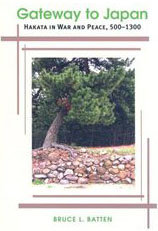
A thousand years ago, most visitors to Japan would have arrived by ship at Hakata Bay, which was the one and only authorized gateway to Japan. Over the ages, Hakata was a staging ground for Japanese troops on their way to Korea and ground zero for foreign invasions of Japan. Through the port passed a rich variety of diplomats, immigrants, raiders, and traders, both Japanese and foreign. Gateway to Japan spotlights four categories of cross-cultural interaction --"war, diplomacy, piracy, and trade" -- over a period of eight hundred years to gain insight into several larger questions about Japan and its place in the world: How and why did Hakata come to serve as the country's "front door?" How did geography influence the development of state and society in the Japanese archipelago? Individual chapters focus on the subtle (and not-so-subtle) contradictions and obfuscations of the diplomatic process as seen in Japanese treatment of Korean envoys visiting Kyushu; random but sometimes devastating attacks on Kyushu by Korean (and sometimes Japanese) pirates; and foreign commerce in and around Hakata, which turns out to be neither fully "foreign" nor fully "commerce" in the modern sense of the word.
In 759 the name Hakata first appeared in Japanese history books, where it was written that the security of Hakata Otsu should be tighter because of the fear of invasion from foreign countries. As the gateway to the Asian continent, goods, people, and new cultures passed through Hakata.
During the 13th and 14th centuries, many Zen and Buddhist temples were constructed to provide warriors and merchants with both meeting and gathering places. Shofuku-ji temple was the first Zen temple in Japan, and was built on land given by the founder of the Kamakura Shogunate (first military ruler of the country) in eastern Hakata, with financial support from wealthy merchants.
These temples were also the places where commodities originated that became an important part of Japanese culture such as tea, udon (wheat noodle), soba (buckwheat noodle, Hakata textiles and Manju (steamed bean-jam bun).
A combination of serene nature, particularly in Hakata Bay, urban characteristics and traditional culture cultivated over a long history, are key characteristics of Fukuoka City.
Powerful military families seeking control often attacked Hakata, known for its wealth and deep culture. However, it was Toyotomi Hideyoshi who eventually unified the nation. He ordered the reconstruction of Hakata as soon as possible, as the city played a key role in trade with Asia, and was also the linchpin of Kyushu, western Japan.
Innovative city planning was undertaken to reconstruct the town and tempt back merchants who had fled the battles. A new law was implemented, exempting property taxes and opening the market. An organization consisting of Hakata merchants and local residents was formed to promote self-governance through discussions and consensus.
Shofukuji Temple, Hakata-ku, Fukuoka, is the oldest Zen temple in Japan. The calligraphy on the main gate, presented by the emperor Gotoba, is inscribed with the words "This is the first Zen Temple in Japan." It was founded in 1195 by the priest Eisai, who studied Buddhism in China and returned to Japan with the Rinzai sect of Zen and tea.
September 30, 1880, North China Herald, Shanghai, China
HIOGO.
Japan: Chief towns & ports, 1880
Jeddo, Tokyo, Hiogo, Bay of Hakodate
The gale of the 25th ultimo, says the Osaka Nippon, has been severely felt throughout the whole Empire. A letter from Hakata states that the gale was very violent there, and on the sea off Hakata five junks disappeared from sight in a few minutes. Seven or eight days later, thirty-six bodies were washed up on the shore, and it is said that the bodies of a woman and a child of three years of age were found tied together; while the body of a man lashed to a mast was also washed ashore. The Corean Envoy and suite arrived on the 10th inst., per S.S. Takasago Maru from Yokohama. The Coreans have made a rapid stride in civilisation, all in a few weeks. When they made the voyage from Corea to Japan they were conveyed in a steamer manned solely by Japanese; at Kobe, they took passage by another Japanese steamer for Yokohama, but the chief engineer of this boat was a foreigner, the only foreigner on board. The Coreans had serious objections to his presence at first, but nevertheless 'they ventured on the voyage to Yokohama. However, they have now got over their scruples, having gained more confidence, when they see there is no danger in trusting their precious lives in the hands of foreigners. Their voyage from Yokohama to Kobe in the mail-boat is the crowning instance of their progress in civilisation. It is probable that they will sail from Kobe to Corea in some small Japanese steamer.

 
|
A young woman writing at a desk. A girl with a book looks on. Utamaro Kitagawa |
Kobe
Kobe covers a long and narrow stretch between the coast and the mountains and was one of the first cities to open for trade with the West, in 1868. Because Kobe is surrounded by calm, deep water, it was a desirable port. By the early 20th century, Kobe's trade value accounted for 40 percent of Japan's entire trade value.
November 1, 1892, London, United Kingdom, London and China Telegraph
HIOGO.
Government sanction has been given for the erection of Oil Tanks in Kobe and work will be proceeded with forthwith, the material having already arrived. The site chosen is alongside the warehouses already existing for case oil at Wada Point, which is convenient for the discharge of steamers, which will be able to come alongside a Pier and discharge by means of a pipe line direct to the Tanks.
The extension of the harbour limits having at the same time been pushed forward and promulgated, foreign vessels will, from the 1st October, be allowed to discharge at Wada. Messrs. Samuel Samuel and Co., expect their first cargo to arrive next January, and its advent will no doubt greatly lessen the sale price of Oil. Similar arrangements are also in progress as regards Yokohama.
 
|
| Hiogo, 1868 |
The extension of the harbour limits of Kobe is approved of by the native Press as a necessary and judicious step to meet the requirements of the increasing prosperity of foreign trade at that place. The extension carries with it the opening of Hiogo, entirely, to foreign trade.
Three kerosene vessels arrived in the port on the 18th September with 209,000 cases of kerosene.
For some months past there has been a movement on the part of certain influential Japanese in favour of the opening of Hiogo port to foreign commerce. Practically Kobe and Hiogo are contiguous, and one and the same; it is only the bed of the Minatogawa dry for half of the year which divides one from the other. The petition lately forwarded to the authorities in Tokio, and backed by the personal influence of the Governor of the ken, has received official sanction, and an Imperial Ordinance has been published in the Official Gazette fixing the limits of Kobe port and harbour from Oct. 1 at Wada Point, on the south-west, and the former bed of the Ikuta River (Onohama) on the east. This decision on the part of the Government receives the hearty approval of foreigners as well as Japanese.
November 22, 1895, San Francisco Call, San Francisco, California, U.S.A.
J. J. Connolly, Deputy United States Consul at Kobe, Japan, was among the arrivals on the steamer Rio de Janeiro yesterday. He is on his way to New York, and will be absent several weeks. The Deputy Consul does not have a very high idea of the probability of this coast getting the shipbuilding for Japan.


"There is, I fear, nothing in it," said he. "The representatives of the American yards were there recently, but they couldn't find out anything, and just what Japan is yet going to do remains a closely guarded secret. Japan appears to want more ships, but out there among most classes the impression prevails that to get ships made so far away, although it has been done formerly, would add too greatly to the cost. This, however, may possibly be overcome, so that yet some of the warships may be manufactured. As yet, though, nothing has been given out as to the exact intention of the Japanese officials, one of the most influential of whom is Count Ito.
"Kobe, where I have been stationed since June, I found a very pleasant place, and the members of the foreign colony are very friendly to each other. l am making a hurried business trip, largely in the interest of niy father, Consul Connolly."
Nagasaki
NAGASAKI. (FROM A CORRESPONDENT.)
  |
| Map of Nagasaki, 1700s Japan Plan de la ville et du port de Nagasaki |
NAGASAKI, JULY 2, 1873. My last was dated the 14th ult., and on the 30th idem the French mail arrived, bringing dates from London down to the 9th May; but, as usual, telegrams had been previously received, and have taken off much of the interest newspapers used to have formerly. The interval has been marked by a rebellion breaking out in Chikuzen, Kokura, and other places lying some sixty miles or so northwards of this port. Various reasons to account for its origin are given, and they perhaps all have some little foundation, but do not exactly hit the mark, though they one and all agree in attributing the disturbances to the influence and even the open action of the disbanded Samurai, who are now no longer able to lead the life of luxurious idleness they did formerly. In this country it is very difficult to trace any rumour to its source, and hence the reason why anything more than disconnected bits of information never can be obtained at Nagasaki, and it is not unlikely that very little further particulars will be heard of the present troubles until executions take place by the dozen. Much dissatisfaction is known to exist amongst the population of Japan, and no little of this feeling has been caused by the continual changes ordered by the authorities, and the obnoxious manner in which the people have been forced into making them. The export of rice now entirely monopolized by the Government, who are reported to have sent it out of the country, and even sold it at a loss, has also furnished the lower and uneducated classes with materials for bitter complaint, and this has been greatly increased by the people more keenly feeling its action by rice rising in price owing to an almost unprecedented drought in this neighbourhood this year.
At whose door lies such a political mistake as this rice question I believe no foreigner has ever been able to discover; one thing, however, is certain a continuance of the monopoly must periodically render this country liable to the deplorable outbreaks of the character as those recently recorded if rice lie at the root of the disturbances, as some seem to think. As freedom of thought becomes more extended popular feeling will increase proportionately and be a source of trouble to the Government, unless continually checked by very harsh measures scarcely befitting Japan of the present day. A few particulars relating to the rebellion appears in the columns of the Nagasaki Express, but I observe that no attempt is made by that journal to attribute the origin to any particular cause. Perhaps in the absence of being able to give the real cause it is better left alone.
Business at this place appears to have come to nearly a standstill, but whether this is caused by the disturbing influence of affairs in the neighbourhood or by the forthcoming revision of the treaties is by no means clear, as the dullness has now been of long duration. We hear no noisy babel in the tea-firing establishments, no noisy coolies carting away imports into the native town ; and, indeed, the quietude into which we have relapsed forms a very unpleasant reminiscence of the bygone days of some three years ago.
The wet days of June have been few and far between, but July has come in wet; last evening and up to the moment of writing there has been a steady downfall of rain, so much needed by the rice crops.
Visits from men-of-war have been few recently the Russian despatch-boat Gornostay, now on the patent slip undergoing repairs, the crew of which is now located at Juasa, being the only one in port. It is somewhat remarkable that the Vitiay and Bogatyr both should leave this port for Yokohama on the day the news reached this place reporting a considerable increase in the insurrection both in Chikuzen and Kokura. American and British war-vessels are conspicuous by their absence the attraction of Shanghai has secured the presence of no less than seven of the former and two of the latter nationality, but here we have none, although troubles are in places at no great distance away.
August 27, 1894, London and China Telegraph
SHIPPING
The total shipping entered in the port of Nagasaki during 1893 was 713 vessels carrying a tonnage of 950,540 tons. As compared with the preceding year this shows a decrease of twenty vessels, but an increased tonnage of 52,266 tons. At the commencement of the year the Pacific Mail and the Occidental and Oriental Steamship Companies sent their regular mail steamers here for coaling purposes. Several of these steamers are British, but the United States now figure for the first time for many years in the shipping returns of this port. Fifteen United States steamers called during the year with a carrying capacity of 35,784 tons. British shipping shows a decrease of fourteen vessels, but an increased tonnage of 401,525 tons, as compared with 372,638 tons in 1892. Norwegian shipping shows an increase of seventeen vessels and 9,500 tons.
1899. World's Fleet. Boston Daily Globe
Lloyds Register of Shipping gives the entire fleet of the world as 28,180 steamers and sailing vessels, with a total tonnage of 27,673,628, of which 39 perent are British.
| Great Britain | 10,990 vessels, total tonnage of 10,792,714 |
| United States | 3,010 vessels, total tonnage of 2,405,887 |
| Norway | 2,528 vessels, tonnage of 1,604,230 |
| Germany | 1,676 vessels, with a tonnage of 2,453,334, in which are included her particularly large ships. |
| Sweden | 1,408 vessels with a tonnage of 643, 527 |
| Italy | 1,150 vessels |
| France | 1,182 vessels |
For Historical Comparison
Top 10 Maritime Nations Ranked by Value (2017)
| Country | # of Vessels | Gross Tonnage (m) |
Total Value (USDbn) |
|
|---|---|---|---|---|
| 1 | Greece | 4,453 | 206.47 | $88.0 |
| 2 | Japan | 4,317 | 150.26 | $79.8 |
| 3 | China | 4,938 | 159.71 | $71.7 |
| 4 | USA | 2,399 | 55.92 | $46.5 |
| 5 | Singapore | 2,662 | 64.03 | $41.7 |
| 6 | Norway | 1,668 | 39.68 | $41.1 |
| 7 | Germany | 2,923 | 81.17 | $30.3 |
| 8 | UK | 883 | 28.78 | $24.3 |
| 9 | Denmark | 1,040 | 36.17 | $23.4 |
| 10 | South Korea | 1,484 | 49.88 | $20.1 |
| Total | 26,767 | 87.21 | $466.9 | |

Site Search

Tokyo from Edo to Showa 1867-1989: The Emergence of the World's Greatest City
(Tuttle Classics)
Edward Seidensticker

Encyclopedia of Japanese Descendants in the Americas: An Illustrated History of the Nikkei
Gary Okihiro and Eiichiro Azuma with a Foreward by Senator Daniel K. Inouye.
Comprehensive guide to the history of Japanese immigrants in the western hemisphere. The story of the Nikkei (people of Japanese descent and their descendants) from early immigration to the present, as they settled in Argentina, Bolivia, Brazil, Canada, Chile, Mexico, Paraguay, Peru, and the United States. Each chapter provides four primary areas of information: historical overview, bibliographic essay, annotated bibliography, and supplementary materials including demographic data, and rare historical photographs. Noted scholars Gary Okihiro and Eiichiro Azuma provide key introductory essays on the historical context of Japanese migration from 1868 to the present.

Miyamoto Musashi:
His Life and Writings
Sherab Chodzin


Russian Views of Japan, 1792-1913: An Anthology of Travel Writing
David N. Wells


Illustrated Encyclopedia of Japanese Family Crests
The Book of Five Rings
Miyamoto Musashi


Art And Artifice: Japanese Photographs Of The Meiji Era
Sebastian Dobson

Splendors of Meiji: Treasures of Imperial Japan: Masterpieces from the Khalili Collection
Joe Earle


The Exhaustion of Heaven: Constructing and Deconstructing Natural Rights in Meiji Japan
Fourteenth Annual University Lecture in Religion at Arizona State University

Isabella Bird
1800s: Japan, the Rocky Mountains,
Sandwich Islands, Among the Tibetans, Persia and Kurdistan, Korea, Singapore, Malay Peninsula


A Year in Japan
Kate T. Williamson

The Inland Sea
Donald Richie


History of Japan:
660 BC to 1872 AD
William Elliot Griffis

Japan
Illustrated Histories
(Hippocrene)
Shelton Woods


Kyoto: City of Zen:
Visiting the Heritage Sites of Japan's Ancient Capital
Judith Clancy

Sakura Petals Sakura Petals:
Temples and Zen
Flying Monk Films


Historical Fiction
The Tale of Genji
(Penguin Classics)
Written in the eleventh century, this exquisite portrait of courtly life in medieval Japan is widely celebrated as the world' s first novel. Genji, the Shining Prince, is the son of an emperor. He is a passionate character whose tempestuous nature, family circumstances, love affairs, alliances, and shifting political fortunes form the core of this epic. Detailed notes, glossaries, character lists, and chronologies to help navigate the narrative.


Musashi
Charles S. Terry


Shogun
James Clavell

Shogun: Roman
(German Edition)

Silk
Alessandro Baricco
The year is 1861. A French merchant of silkworms combs the known world for their gemlike eggs. Seeking quality worms compel him to enter Japan, a country legendary for the quality of its silk and its hostility to foreigners. Woven through the story of the importance of silk is a story of his interaction with a woman forbidden to outsiders. (Note: The cover of the new version of this book is tacky and does not represent the quality of the writing. Please ignore it in the event you click through.

The Dragon Scroll:
A Mystery of Ancient Japan Featuring Sugawara Akitada
I. J. Parker


The Tokaido Road
Lucia St. Clair Robson
A Literary Guild selection that takes readers along the old Todaido Road in fuedal Japan.

The following were written by Laura Joh Rowland, a detective/mystery author known for her series of novels set in the late days of feudal Japan, mostly in Edo during the late 17th century. Her main protagonist is Sano Ichiro
Shinju
1689 in Japan. Detective Sano solves a crime that no one wants solved.


The Way of the Traitor



 Copyright ~ 1998-2018.