Indonesia
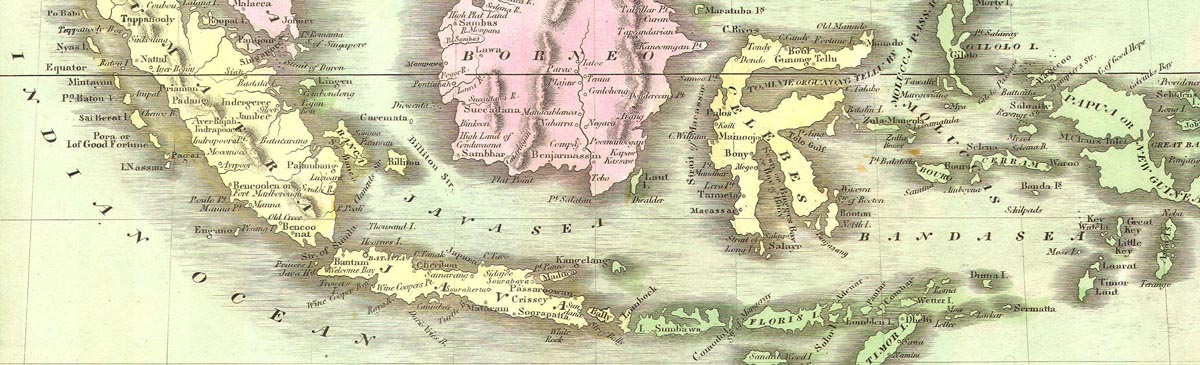
Malay Archipelago (Maritime Southeast Asia): ° Bangladesh ° India ° Indonesia ° Malacca Strait ° Malaysia ° Maldives ° Myanmar (Burma) ° Pakistan ° Philippines ° Riau Islands ° Singapore ° Sri Lanka ° Thailand ° Timor
Indonesian Archipelago
Indonesia ° Batam Island ° Batavia ° Borneo ° Derawan Island Chain° Java ° Krakatoa ° Panjang ° Surabaya ° Tidore ° Timor


Indonesia is the world's largest archipelago. Estimates are that the country is made up of over 13,000 islands, many of which are mountainous and have active volcanoes. Another name for the group is the Moluccas. (This is the group of islands Christopher Columbus was seeking when he sailed into the Americas in 1492.)
The Spanish and Portuguese had a monopoly of the East Indies spice trade until destruction of the Spanish Aramada in 1588, which permitted the British and Dutch to seek their share of this wealthy import business. Because of the risks taken to bring spices to Europe, they were very expensive.
Early on, their delivery was largely in the hands of the Moslem world which Catholic Europe was often at war with. Spices attained luxury status as emblems of conspicuous consumption.


Fortunes were made in the East Indian and Spice Island trade, since precious spices brought huge rewards to successful importers. The glittering wealth of the Portuguese and Spanish courts, of Italian port cities, Dutch trading firms, German bankers and British speculators was followed by the extraordinarily successful entry in 1672 of the United States into the spice trade.
Over the course of the nineteenth century, Southeast Asia was colonized by Britain, France, and Holland. The Dutch virtually excluded company members from the East Indies after the Amboina Massacre in 1623 (an incident in which English, Japanese, and Portuguese traders were executed by Dutch authorities), but the company's defeat of the Portuguese in India (1612) won them trading concessions from the Mughal Empire. In 1799, the Dutch government took over the Dutch East India Company's rule of parts of the Indonesian archipelago. Over the next hundred years, control extended throughout the entire archipelago, including Sumatra and Bali, and the modern boundaries of Indonesia were established at this time. By the early 1800snew plantations of spices in Africa and India opened up new supplies to the traders. As a consequence, prices fell.
Britain's East India Company went out of existence in 1873. During its heyday, the East India Company not only established trade through Asia and the Middle East but also effectively became of the ruler of territories vastly larger than the United Kingdom itself. In addition, it also created, rather than conquered, colonies. Singapore, for example, was an island with very few Malay inhabitants in 1819 when Sir Stamford Raffles purchased it for the Company from their ruler, the Sultan of Johor, and created what eventually became one of the world's greatest trans-shipment ports.
Merchants sailing the world also faced many natural disasters, such as Krakatoa Volcano which erupted in 1883.
 
|
The Island of Krakatoa Front cover of "The Illustrated London News." September 8, 1883 |
Its fine ashes followed wind streams as far away as over New York City, whereas the eruption's tidal waves reached the American West Coast. At that very instant, Krakatoa vanished as if devoured by the sea, causing formidable tidal waves which in turn swept off just about everything alive from the surrounding coastal areas.
However, the disappearance of the gigantic Krakatoa also meant the birth of small islands in its place, one of which is called Anak Krakatau or Krakatoa’s Child which is at present an extremely active young volcano. From both West Java’s West Coast and from Sumatra’s Lampung Province, this young and very active volcano is clearly visible. A boat trip to this place may be worth making.
Batavia
Article 17, about the Company’s factory at Batavia from 1619-1740, is not so much the story of Dutch settlement, as it is one of a Chinese colonial town within Batavia. Batavia had been founded as the center of an inter-Asian maritime trading empire competing with the Spaniards and the Portuguese. When trade with the Dutch Republic became more important than Asian trade in the late 1600s, the Company gradually became a territorial power collecting tributary payments, and Batavia lost its position in the maritime trade empire.
A View of Batavia also known as Djakarta


Agriculture was almost completely controlled by the Chinese in Batavia by 1649, using both Javanese and Chinese labor. New Chinese immigration occurred after 1683. The effort to develop sugar plantations and sugar mills was almost entirely in the hands of the Chinese, and population was growing outside the city. The administrative system did not change to meet the needs of this rural population and the cooperation between the Dutch and the Chinese gradually deteriorated.
When the sugar market declined, mass poverty, unemployment and ruin followed. The rural Chinese revolted in 1740. Not only were they defeated, but there was also a massacre of urban Chinese. By 1781, only sixty sugar mills were operating. Still, half of Batavia’s population profited from the industry. The company's encounters with foreign competitors eventually required it to assemble its own military and administrative departments, thereby becoming an imperial power in its own right, though the British government began to reign it in by the late eighteenth century.
February 10, 1864, Daily Alta California, San Francisco, California, U.S.A.
The Capture of the Amanda and Winged Racer.
 
|
The Castle of Batavia, as Seen from Kali Besar West c. 1656. Andries Beeckman |
BATAVIA, November 14th. 1863. 0n the morning of tbe 12th instant the officers and crew of the American ship Amanda (660 tons register) arrived here at the United States Consulate, reporting that on the night of Friday, the 6th instant, one hundred and twenty miles south south-west of Java Head, in the Indian Ocean, the Amanda was burned by the so-called Confederate steamer Alabama, Semmes commander. She had on board a full cargo of sugar and hemp shipped by Messrs. Ker & Co. of Manila and bound to Queenstown.
After the crew of the Amanda were taken on board the Alabama the vessel was burned, and the Alabama steered for Sunda Straits, where she arrived at night-time and anchored close under the coast of Sumatra. When there, she was informed by a Dutch vessel lying at anchor, that the U. S. Steamer Wyoming was at Batavia, upon which she steamed on, always keeping close to the Sumatra coast, and finally running out of Sunda Straits, stood in near North Island on the 10th, and at 5 p.m. signalized the American clippership Winged Racer, Cummins, commander, which was owned by Robert L. Taylor. Esq., of New York, and had on board a full cargo of sugar and hemp, bound from Manila to New York, shipped by Messrs. Peele, Hubble, & Co. After distributing, her crew in three of the ship's boats, they were permitted to take such clothing, provisions and water as they wanted and the boats could carry, and the ship was burnt. Captain Cummins, who had his wife and child, went on board the British shipJulia bound from Shanghai to London, then at anchor not far off, and they were landed at Anjer. The Alabama then put the crew of the Amanda into a boat in which they arrived at Batavia.
The Winged Racer sunk at half-past eight. When the Alabama was last seen she was steering far the northward. The U.S. steamer Wyoming left Batavia, on the morning of the 8th inst., for a cruise, having been detained at Batavia in order to repair her machinery. The Amanda was the first vessel destroyed by the Alabama since she left Cape Town.
By later telegram, the Alabama was cruising between North Island and Nicholas Point. The Wyoming had gone on a cruise to Christmas Island, supposed to be a coaling station for rebel steamers.
From the Java Times, November 13th.
Borneo
January 17, 1876, London and China Telegraph, London, United Kingdom
Consular Reports.
Borneo.
The report of Acting Consul General Low, on the trade and commerce of Borneo for the year 1874, has just been issued. The foreign trade of the Port of Brunei for that year consisted, as usual, chiefly of imports and exports to the British Colonies of Singapore and Labuan, and the results taken at Brunei are imports, from Singapore, 26,545, Labuan, 17,595, total, 44,140, against a total of 31,840 in 1873. The trade with the provinces from Labuan was to the value of 33,326, against 30,268 in 1873, thus making the total British import trade at Brunei 77,466, against 56,466 in 1873. The total exports from. Brunei were 77,444 in 1874, against 56,161 in 1873, or an increase of 21,283. The Consul points out that if the valuable coal mines of Borneo be worked, "revenues would be obtainable which, while supporting the Eajahs, would permit the introduction of a regular fiscal system in place of the irregular exactions now made upon the people of the various rivers by their territorial lords." Mr. Low says :


I have known the coast for many years, and remember that in 1845 the trade of Borneo Proper was conducted with Singapore in a very few native prahees, which, at great risk, made annual voyages. It was dangerous at that time to move by sea from one village to another during the fine season, and the river of Brunei was annually blockaded by squadrons of Llancon and Balinini pirates. No instance of piracy has occurred during the last two years, on the whole coast line from. Tanjong Api to Sancakan Bay, a distance of 700 miles, and for many years no considerable fleet has been known to visit these waters.
That a steam vessel has been placed in the trade is entirely owing to the efforts of Sir H. Bulwer in forcing this question on the attention of those whom it was intended to benefit. So apathetic and so averse to innovation were they, that every kind of objection was raised to the trial of the experiment, and it was only by great perseverance on Sir Henry's part that the necessary energy and enterprise could be aroused. This vessel, while paying as a commercial undertaking exceptionally well, has been of signal service in relieving the famine caused by the invasion of the small-pox, the ripening harvests having been abandoned ungarnered at its approach, and the whole community now see and acknowledge the propriety of Sir Henry's disinterested exertions. It is believed that it will soon be necessary to establish another vessel of the same size to carry the increasing trade of Brunei and Labuan to Singapore.
August 11, 1895, San Francisco Call, San Francisco, California, U.S.A.
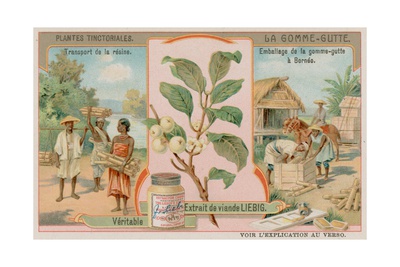 |
| Gamboge and its Transport from Borneo |
Gamboge
One of the cherished treasures of the schoolboy's paintbox is a piece of gamboge. Gamboge, one of the most interesting of Siamese products, is a resinous product indigenous only in the islands and on the sea coast of the Gulf of Siam, lying between the tenth and twelfth degrees of north latitude. The tree grows to a height of some fifty feet, and is straight-stemmed with no lower branches, owing probably to the dense shade of the forest in which it grows.
Ten years' growth is required before the tree is ready for tapping. The tapping, which is carried on by the Cambodian and Siamese islanders in the rainy months from June to October, when the sap is vigorous, consists in cutting a spiral line around the trunk from a height of about ten feet downward to the ground. The resin wells out of the bark, and trickles down these grooves in a viscous stream into a hollow bamboo placed at the base of the tree, and from these it is decanted into smaller bamboos, where it is left for one month to solidify. To remove the earnboge the bamboo is placed over a red-hot fire and the bamboo husk cracks off, leaving the article known as "pipe" gamboge. The trees can be tapped two or three times in one season and often present a curious appearance from their network of intersecting spirals. The utmost care has to be taken to prevent rainwater mixing with the resin, as the mixture of foreign liquid causes honeycombing and discoloration.


The most valuable gamboge is that which is the least honeycombed or darkened. The bamboos contain on an average less than one pound of gamboge. The price asked by the pickers is at the rate of 75 cents for rive hamboos full, and the local price is at the rate of 75 cents for three, or $24. 50 for 100. The whole output is sold to local Chinese traders and taken by sailingboat to Bangkok. A Southern Mode of Overcoming the Molasses Difficulty. What to do with the excess of molasses produced in the manufacture of sugar has been such a source of anxiety to the Southern planter that prizes have been offered to any one who will devise a method of meeting the difficulty. A New Orleans inventor claims to have found an inexpensive process by whicn the molasses can be solidified. He says that a machine which will solidify or concrete fifty barrels of molasses daily can be furnished for $1500, and the cost of'operation is not more than 2 or 3 cents a barrel. The exhaust steam from the sugarhouse engine- is injected into the bulk molasses with the normal pressure as it escapes and at a temperature of about 140 degrees Fahrenheit. This expels about twenty-five gallons of water from a barrel of molasses, and the residuum concretes and is ready for storing or shipment as soon as cooled. In appearance it resembles coarse sugar.
Derawan Island Chain


Stretching over 100 miles along the coast of East Kalimantan, the Derawan island chain is one of the most biologically rich areas in all of Indonesia. Here, water from the Berau river mixing with the Sulawesi Sea created a unique seascape characterized by a broad river delta leading to a scattered groupings of patch reefs, fringing reefs, and atolls. (Right: Christmas Tree Worms.)
Krakatoa
The Java Earthquake struck on August 26, 1883, beginning on the Island of Krakatoa; it then extended to every island and sea for 100 miles in either direction. This quake caused tidal waves, the first over 100 feet in height, which swept the coast of adjacent islands and the country for 500 miles, destroying every living thing in its course. Estimated deaths: 80,000 people. The brig Tahiti rescued the crew of the bark Oswingo, from Newcastle, N.S.W. for Wilmington, Cal., near Apar Island which was affected by the earthquake.
September 5, 1883, Los Angeles Herald, Los Angeles, California, U.S.A.
The Java Horror.


New York, September 2. Without any warning there was a tremendous outburst of subterranean thunder, and the volcano of Krakatoa vomited forth an ink-black cloud which spread over the clear tropical sky with inconceivable quickness, involving the land in complete darkness. Then it began to rain scoaries and dust, and in a very few minutes the greater part of Norrthern Bantam, a very fertile and very populous country, was completely destroyed. A tremendous explosion followed and stones and volcanic matter were hurled to a distance of from 200 to 300 miles. The sides of the great volcano were blown out into the sea, its structure collapsed and the entire island of Krakatoa subsided into the water and disappeared. On Monday morning there was not a vestige of it to be seen, the ocean having taken its place.
The volcanic action of the region was intense, but it was thought the world was over, when about noon the inhabitants of the Merak coast and the prosperous settlement between Merak and Tjeringen were alaarmed by the sudden receding of the ocean from the shore, and on looking out to sea they beheld a great wall of water, varying in height from thirty to ninety feet, approaching the land. It destroyed everything in its path, overwhelming the entire coast, sweeping away all the dwellings, the lighthouse and the government buildings within reach and retired, charged with a vast freight of death and ruin. There is no estimate furnished in the fragmentary and panic-stricken dispatches of the loss of life, but according to the best information it must be something appalling. The next day sixteen active volcanoes rose ont of the sea between the side of Krakatoa and Sibisie islands, and on Thursday the great volcano of Soragapano burst forth, collapsed and resolved itself into five distinct volcanoes. New charts will have to be prepared of the entire coast as its marine topography has been completely changed. Deep channels have become dry land and towering volcanoes stand where had been the open sea.
Tidore
Tidore is an island located in the Maluku archipelago. Before Islam came to earth archipelago, known by the name of Kie Tidore Duko, which means the island is volcanic.
Like nearby Ternate, Tidore was the seat of an ancient and powerful sultanate. In the year 1495 AD, Sultan Ciriliyati ascended the throne and became the first ruler of Tidore who took the title of sultan. At that time, the center of the kingdom was in Gam Tina. When Sultan Mansur ascended the throne in 1512 AD, he moved the center of the kingdom by establishing new settlements in North Tidore Rum. Position adjacent to the new capital of Ternate, and flanked by the Cape and islands Mafugogo Maitara. With state of the beautiful and tranquil sea, the location of the new capital rapidly developed and became a bustling port.
In the 16th and 17th century as Spanish strength in the region diminished prior to their withdrawal from the region in 1663, Tidore became one of the most independent kingdoms in the region, resisting direct control by Dutch East India Company. Particularly under Sultan Saifuddin (1657-1689), the Tidore court was skilled at using Dutch payment for spices for gifts to strengthen traditional ties with Tidore's traditional periphery. As a result he was widely respected by many local populations, and had little need to call on the Dutch for military help in governing the kingdom, as Ternate frequently did.
Tidore remained an independent kingdom, albeit with frequent Dutch interference, until the late eighteenth century.
Timor
Timor.
Painting by French explorer Louis de Freycinet.


Eastern Timor had been a Portuguese territory since the 16th century. When the first traders and missionaries reached the coast of Timor in 1515, the island was organized in small states, ruled by two kingdoms, Sorbian and Belos, who practiced animism. Islam, a religion that is still prevalent in Indonesia, has never reached Timor. Even Buddhism, extensively practiced in Java, especially in the 13th century, did not prevail.
During the third quarter of the 16th century, the first Portuguese Dominican priests arrived in Timor and started developing a progressive religious influence, even as the Portuguese domination was still being settled. Culture developed in an opposite direction to that of today's Indonesian islands of Java and Sumatra and of the coasts of Kalimantan and Sulawesi, where Islam was the dominant religion. In 1651, the Dutch invaded Kupang in the Western end of the Island of Timor, and took control of half of its territory. In 1859, the Dutch concluded a treaty with Portugal to determine the border between the Portuguese Timor (present-day Timor-Leste) and the Dutch Timor (Western Timor). Upon Indonesian independence in 1945, Western Timor was integrated into its territory.
Timor Leste Government

(The World Readers)
Tineke Hellwig

Indonesia:
Peoples and Histories
Jean Gelman Taylor



Spice:
The History of a Temptation
Jack Turner
Vintage Books, 2004
Art Forms from the Ocean:
The Radiolarian Prints of Ernst Haeckel
Olaf Breidbach
 It is now available in a paperback edition, beautifully reproducing his drawings and watercolours. While the variety and detail of Haeckel's drawings display an impressive understanding of biological structure, the skill with which Haeckel drew these tiny, aquatic protozoa renders them genuine works of art. This volume features commentary and descriptions of each of t


The Day the World Exploded: August 27, 1883
Simon Winchester, New York Times bestselling author of The Professor and the Madman, examines the legendary annihilation in 1883 of the volcano-island of Krakatoa, which was followed by an immense tsunami that killed nearly forty thousand people. The effects of the immense waves were felt as far away as France. Barometers in Bogot and Washington, D.C., went haywire. Bodies were washed up in Zanzibar. The sound of the island's destruction was heard in Australia and India and on islands thousands of miles away. Most significant of all -- in view of today's new political climate -- the eruption helped to trigger in Java a wave of murderous anti-Western militancy among fundamentalist Muslims, one of the first outbreaks of Islamic-inspired killings anywhere. Krakatoa gives us an entirely new perspective on this fascinating and iconic event.

The Shipwreck of the Batavia combines the birth of the world's first corporation, the brutality of colonisation, the battle of good vs evil, the derring-do of sea-faring adventure, mutiny, ship-wreck, love, lust, blood-lust, petty fascist dictatorship, criminality, a reign of terror, murders most foul, sexual slavery, natural nobility, survival, retribution, rescue, first contact with native peoples and so much more. The story is set in 1629, when the pride of the Dutch East India Company, the Batavia, is on its maiden voyage en route from Amsterdam to the Dutch East Indies, laden down with the greatest treasure to leave Holland. The magnificent ship is already boiling over with a mutinous plot that is just about to break into the open when, just off the coast of Western Australia, it strikes an unseen reef in the middle of the night.


Batavia's Graveyard: The True Story of the Mad Heretic Who Led History's Bloodiest Mutiny
Mike Dash
In 1628 the Dutch East India Company loaded the Batavia, the flagship of its fleet, with a king's ransom in gold, silver, and gems for her maiden voyage to Java; the ship itself was a tangible symbol of the world's richest and most powerful monopoly. The company also sent along a new employee to guard its treasure. He was Jeronimus Corneliszoon, a disgraced and bankrupt man with great charisma and dangerously heretical ideas. With the help of a few disgruntled sailors, he hatched a plot to seize the ship and her riches. The mutiny might have succeeded, but in the dark morning hours of June 3, 1629, the Batavia smashed through a coral reef and ran aground on a small chain of islands near Australia. The captain and skipper escaped the wreck, and in a tiny lifeboat they set sail for Java some 1500 miles north to summon help. More than 250 frightened survivors waded ashore, thankful to be alive. Unfortunately, Jeronimus and the mutineers had survived too, and the nightmare was only beginning.


Site Search


Warships of the World to 1900
Lincoln P. Paine.
True Yankees: The South Seas and the Discovery of American Identity
(Johns Hopkins University Studies in Historical and Political Science)
Dane A. Morrison
Stephan Talty

Navigation Rules and Regulations Handbook
U.S. Coast Guard
The Navigation Rules & Regulations Handbook supersedes Commandant Instruction M16672.2D This edition includes LNM 39-15 and NTM 41-15 33 CFR 83.01(g) requires: "The operator of each self-propelled vessel 12 meters or more in length shall carry, on board and maintain for ready reference, a copy of these Rules."


American Merchant Ships
1850-1900
Frederick C. Matthews



 Copyright ~ 1998-2018.