Taiwan
International Harbors
The Portuguese sighted the island and named it Ihla Formosa (Beautiful Island) in 1544 and spent the next couple of decades establishing regular trade.
A small number of Spanish traders from the Philippines followed the Portuguese to the Guangdong and Fujian coast in the late 1500s.


But it was the Dutch who extended trade. The Dutch had begun regular trading with China from the early 1600s but found it difficult to settle on the China coast, due to Chinese hesitancy. Consequently they occupied Formosa in 1624 and turned it into a trade station to service their commercial interests in both Japan and China. They also used Formosa to provision ships sailing on the southern trade route to the Dutch East Indies.
Statues at the Pureland Cave, Fokuangshan monastery, Kaohsiung area, Taiwan


The Dutch occupation infuriated the Chinese and it was from Ku Lang Hsu that the pirate warrior Koxinga (Zheng Chenggong), already in rebellion against the Ch'ing (Qing), marshalled his troops to recapture Formosa from the Dutch. Leaving Ku Lang Hsu in April 1661 with 25,000 troops, Koxinga defeated the Dutch in January 1662, liberated Formosa, and ended the 38-year occupation.
However, foreign tradecontinued and in 1684 the Ch'ing established a Customs House in Amoy that welcomed first the Portuguese and then the British and by the early 1700s even the Dutch had returned on favourable terms.
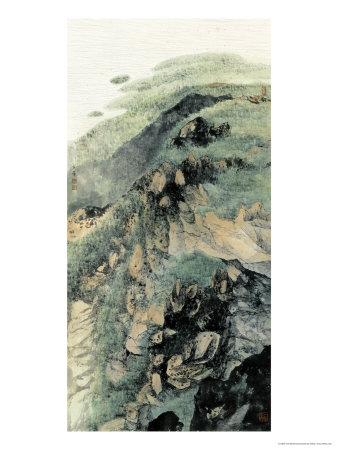 |
Coast of Southern Taiwan Tsai Shihmei |
During the 1700s and 1800 British and French rivalry dominated the China scene along with a growing American presence in the late 1800s and early 1900s.
Ku Lang Hsu
Great Britain established a concession on Ku Lang Hsu in 1851 and by 1902 an International Settlement had been formalized with well established Consulates from Britain, Portugal, Holland, Spain, the USA, France, Germany, Japan, Denmark, Austria, Norway, Sweden, Belgium and the Philippines. Foreign Consulates, Trading Houses and wealthy merchants built colonial style residences on Ku Lang Hsu and the International Settlement became the official centre of foreign tradeand diplomacy throughout the hinterland of Fujian and beyond. Ku Lang Hsu also became notorious for heavy drinking, excessive gambling, wild nightlife and exotic bordellos.
Between the late 1840s and the late 1930s many European colonial-style buildings were constructed on Ku Lang Hsu and the island became renowned amongst Europeans for its trading opportunities, benign climate, architectural splendour and convivial lifestyle. Most of the wealth on display on Ku Lang Hsu was accentuated by the imposing colonial architecture and came primarily from the profits of the opium trade. Opium use in China continued even after European firms left the trade, which was largely controlled by Chiang Kai-shek (Jiang Jieshi) in collaboration with the invading Imperial Japanese Army and was not finally eradicated until Mao Tse-tung established The People’s Republic of China in October 1949.
In the late 1800s, the export of sugar brought riches to the Takow traders. Yet those same riches were to bring suffering to many of the local population, and caused a major problem for the Japanese colonialists, as the British traders sought to balance their trade through the sale of opium into the local market. In the early part of the 1870s, sugar made up fully 90% of the exports, whereas opium made up fully 90% of the imports. The British had seemingly unlimited reserves of opium at hand in their colonies and vassal states in British India.
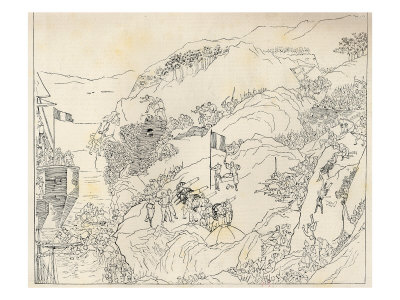 |
War between France and China: French driven to their ships at Kelung, Formosa |
Although the British East India Company, the "Honourable John Company" which effectively controlled the trade of India on a charter dating back to 1600, had supposedly backed out of the trading of opium to Canton and China, it remained utterly willing to promote sales from India where they held a production monopoly. This revenue was necessary to support the operation of a de facto colony of Britain.
Local officers during the late 1870s and early 1880s appreciated navigation and set about to build a good harbor to the South at Takow, which is on the edge of a lagoon with a virtually impassible entrance to vessels drawing more than six feet.
The deeper draught of the steamers increased the difficulties of crossing the bar.
Despite the golden prospects for revenue accruing from the port of Takow in the 1870s and early 1880s, the Ching authorities, in their local guise as the Tao-tai (Circuit Intendant), failed to respond to the situation.
Little investment was made to improve either sugar production or port facilities. As a result, the trade shifted back to Anping.
The British trade of principally Indian opium to China was not to stop until 1917. It is clear that then, as today, the major revenue-payers have inordinate influence on government policy.
Formosa was handed over to Japan in 1895 through the Treaty of Shimonoseki.
1899. World's Fleet. Boston Daily Globe
Lloyds Register of Shipping gives the entire fleet of the world as 28,180 steamers and sailing vessels, with a total tonnage of 27,673,628, of which 39 perent are British.
| Great Britain | 10,990 vessels, total tonnage of 10,792,714 |
| United States | 3,010 vessels, total tonnage of 2,405,887 |
| Norway | 2,528 vessels, tonnage of 1,604,230 |
| Germany | 1,676 vessels, with a tonnage of 2,453,334, in which are included her particularly large ships. |
| Sweden | 1,408 vessels with a tonnage of 643, 527 |
| Italy | 1,150 vessels |
| France | 1,182 vessels |
For Historical Comparison
Top 10 Maritime Nations Ranked by Value (2017)
| Country | # of Vessels | Gross Tonnage (m) |
Total Value (USDbn) |
|
|---|---|---|---|---|
| 1 | Greece | 4,453 | 206.47 | $88.0 |
| 2 | Japan | 4,317 | 150.26 | $79.8 |
| 3 | China | 4,938 | 159.71 | $71.7 |
| 4 | USA | 2,399 | 55.92 | $46.5 |
| 5 | Singapore | 2,662 | 64.03 | $41.7 |
| 6 | Norway | 1,668 | 39.68 | $41.1 |
| 7 | Germany | 2,923 | 81.17 | $30.3 |
| 8 | UK | 883 | 28.78 | $24.3 |
| 9 | Denmark | 1,040 | 36.17 | $23.4 |
| 10 | South Korea | 1,484 | 49.88 | $20.1 |
| Total | 26,767 | 87.21 | $466.9 | |

Site Search
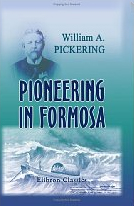
A selection of books on the History of Formosa
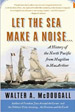
Let the Sea Make a Noise: A History of the North Pacific from Magellan to MacArthur
Walter A. McDougall
Author of "Freedom Just Around the Corner" and the Pultizer Prize winning "the Heavens and the Earth"
"Four centuries of exciting voyages of discovery, pioneering feats, engineering marvels, political plots, business chicanery, racial clashes and brutal wars."


 Copyright ~ 1998-2018.