Qatar
International Harbors
Qatar's shares maritime boundaries and land boundaries with Saudi Arabia, Bahrain, the United Arab Emirates and Iran.
Evidence of early habitation in Qatar that can be traced as far back as to the 4th century BC appeared in many artifacts such as inscriptions, rock cravings, flint spearheads and examples of pottery, which were all uncovered by the Danish (1965), the British (1973) and the French (1976) expeditions.
In the 5th century BC, the Greek historian Herodotus referred to the seafaring Canaanities as the original inhabitants of Qatar.
The Greeks came to the Gulf with Alexander the Great (356-323 B.C.E.) and settled in Failaka in Kuwait, in Bahrain, in the Emirate of Sharjah and had logged all the ports that could be turned into profitable trading posts.
The Peninsula of Qatar became one of the richest places in the Gulf due to trade and commerce during the 3rd and 2nd millennium B.C. Trade between Mesopotamia and the Indus Valley was channeled through the Gulf; the western coast of Qatar played a role in the transshipment of commercial goods. Archaeological evidence found in Qatar suggests the Greek and Roman influences in the Peninsula particularly at Ras Abaruk, where some stone structures, including a dwelling, a cairn, a hearth and a low mound containing a large quantity of fish bones were located. Pearls and dried fish were the major items for exportation from Qatarduring the Greco-Roman period.
In the first century AD, Pliny the Elder (23 A.D. - 79 A.D.), a Roman writer, used the word Catharrei to refer to the people who lived in this area.
Ptolemy (90 A.D. - 168 A.D.), the famous Greek geographer, added the word qatara over the peninsula on his map of the Arab countries, which is believed to refer to the Qatari town of Zubarah.
The whole Arabian Gulf region emerged as the most important trade centre linking between the West and the East, during the time of the Persian Sasanid Empire in the 3rd century A. D.
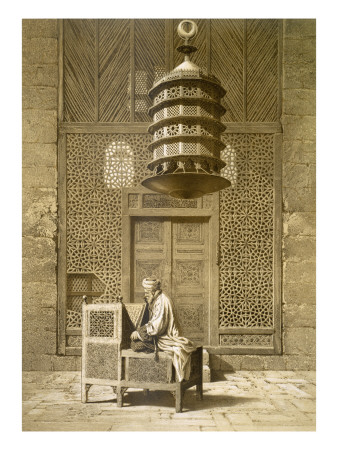 |
An Imam reading the Koran in the Mosque of the Sultan. Morocco. 1817 "Imam" is an Arabic word that means "leader." In addition to being a spiritual leader, an imam is often the worship leader of a mosque and the Muslim community. Maurice Keating. |
Cargoes of copper, spices, sandalwood, teak, blackwood, etc. arriving from the East were exchanged for shipments of purple dye, clothing, pearls, dates, gold and silver.
Qatar contributed at least two of these commodities to the Sasanid trade: purple dye and precious pearls.
It was not an easy industry. Men would leave their homes for months, although financial reward was far from certain. The process was dangerous, for the waters were shared with jellyfish, barracuda, sword fish and sharks. Men would close their noses with clips made out of bone and wood, and grasp a stone to take them to the bottom of the sea. Once there, they would grasp the oysters, cutting them from rocks if necessary, and put them into bags attached to the line. When their bags were full, or they were exhausted, they would jerk the line sharply and their handler would pull them to the surface.
Each dive could last up to two minutes, and a diver would make 60 to 100 of these dives in a day. With depths of up to 200 feet, divers could suffer from hallucinations, earaches and the bends. These afflictions were attributed to evil djinns, and the sailors would treat the suffering diver by covering him with a sail, sitting upon him, reading him verses from the Koran and burning incense under his nose.
And the prayer of faith shall save the sick.
|


Qatar in the Islamic History
In the middle of the 7th century AD, the Qatar peninsula and the surrounding region were under the rule of the Al Munzir Arabs. Their king, al-Munzir Ibn Sawi al Tamimi, embraced Islam, making Qatar to enter, ever since, the realm of the Islamic civilization and participate in all its successive stages and eras. Records of Arabic Islamic history reflect the presence of the skilled seafaring Qataris and acknowledge their valuable contribution towards the formation and provision of the first naval fleet, which was assembled to transport the Islamic army under the leadership of Abu al-Al a al-Hadrami. Under the Abbasid state during the 8th century AH, Qatar experienced great economic prosperity and pledged a great deal of financial support towards maintaining the Caliphate in Baghdad. During the 10th century AH, the Qataris aligned with the Turks to drive out the Portuguese. Subsequently, Qatar, like the entire Arabian Gulf region, came under the Turkish rule for four successive centuries. Ottoman sovereignty, however, was only minimal as the real power and control were in the hands of the sheikhs and princes of local Arab tribes.
Arabian Camel Boys. 
The most important of all the animals to the medieval Muslims was the camel. Camels were called "the Gift of God" and "the Ships of the Desert." Camels could live where few other animals could live. They are strong enough to carry heavy loads for the Arab caravan traders. At the time of the Prophet Muhammad, the camel was the most important animal in war. The earliest wars were attacks with warriors mounted on camels' backs. Camel caravans carried goods and people across the empire. Pilgrims also traveled to Mecca from all over the World of Islam on the hajj, or Pilgrimage. Some caravans were from 1,000 to 2,000 camels long. To encourage trade, the kings built caravanserai (camel "hotels") along the trade routes. |
Yaqut al-Hamawi, an Arabian historian, who died in 1229, considered Qataras a village; it was famous for camel and horse breeding during the Umayyad period.
During the ascendancy of the Abbasid in Baghdad, the pearling industry in the rich waters around Qatar developed considerably and the demand for Qatari pearls increased in the East, extending as far as China. By 1515, the Portguese held Qatar, exporting gold, silver, silks, musk, cloves, pearls, amber, horses, etc., through various ports in the Gulf, including Qatar. In 1652, the Imam of Muscat (above) drove the Portuguese out.
With the establishment of the East India Company's Factory at Basra in 1635, in came the British. Qatar was held under the pretext of protection of the shipping lines in the Gulf.
In 1766, the al-Khalifa families moved from Kuwait to Qatar, and held rein over the area even during the Persian invasion of 1783.
During the mid-1800s, while pearl extraction was controlled by the al-Khalifa family, Qatar transformed itself from a poor British protectorate noted mainly for the pearling into an independent state with significant oil and natural gas revenues.
Qatar was once controlled by the sheikhs of Bahrain, but in 1867, war broke out between the people and their absentee rulers. To keep the peace in the Persian Gulf, the British installed Muhammad ibn Thani al-Thani, head of a leading Qatari family, as the region's ruler. In 1893, the Ottoman Turks made incursions into Qatar, but the emir successfully deflected them. In 1916, the emir agreed to allow Qatar to become a British protectorate.


Al-Bida (late Doba) is established as the capital of the realm of ath-Thani, when the leader of the family, Shaykh Muhammadi bni Th-Thani, claims the role of emir. In 1867, after conflict with neighboring Bahrain over territorial claims, Britain signed a treaty which recognized Qatar as a separate entity in order to protect him from the Khalifas of Bahrain.
In 1872, the Ottoman Empire occupied Qatar. Emir Qasim signed a treaty with the Turks allowing them to establish a garrison in Doha. Qasim managed to remain independent of the British and the Turks, but nominally he acted as a representative of the Ottoman sultan. Qasim became one of the strongest leaders of eastern Arabia.
November 1, 1902, Sausalito News, Sausalito, California, U.S.A.
Sultan's Warship Held for Debt.
Constantinople. Abdul Hamid is anxious to return the visit paid him by Grand Duke Nicholas as a representative of the Qatar. The Commander of the Faithful is desirous of sending his representative in a battleship with as much pompas was displayed by Nicholas at Constantinople, [ but finds himself unable to do anything. His only available war ship is at present held in pawn by the shipbuilding company until the bill for repairs is paid.
1899. World's Fleet. Boston Daily Globe
Lloyds Register of Shipping gives the entire fleet of the world as 28,180 steamers and sailing vessels, with a total tonnage of 27,673,628, of which 39 perent are British.
| Great Britain | 10,990 vessels, total tonnage of 10,792,714 |
| United States | 3,010 vessels, total tonnage of 2,405,887 |
| Norway | 2,528 vessels, tonnage of 1,604,230 |
| Germany | 1,676 vessels, with a tonnage of 2,453,334, in which are included her particularly large ships. |
| Sweden | 1,408 vessels with a tonnage of 643, 527 |
| Italy | 1,150 vessels |
| France | 1,182 vessels |
For Historical Comparison
Top 10 Maritime Nations Ranked by Value (2017)
| Country | # of Vessels | Gross Tonnage (m) |
Total Value (USDbn) |
|
|---|---|---|---|---|
| 1 | Greece | 4,453 | 206.47 | $88.0 |
| 2 | Japan | 4,317 | 150.26 | $79.8 |
| 3 | China | 4,938 | 159.71 | $71.7 |
| 4 | USA | 2,399 | 55.92 | $46.5 |
| 5 | Singapore | 2,662 | 64.03 | $41.7 |
| 6 | Norway | 1,668 | 39.68 | $41.1 |
| 7 | Germany | 2,923 | 81.17 | $30.3 |
| 8 | UK | 883 | 28.78 | $24.3 |
| 9 | Denmark | 1,040 | 36.17 | $23.4 |
| 10 | South Korea | 1,484 | 49.88 | $20.1 |
| Total | 26,767 | 87.21 | $466.9 | |

Site Search
Qatar: Sand, Sea and Sky
Diana Untermeyer


Jassim - The Leader:
Founder of Qatar
Mohamed A. J. Althani
(A former minister in the Qatari government)
The Gulf state of Qatar tops the Forbes list of the world's richest countries. In 2010 the country had the world's highest GDP per capita, and its reserves of oil and natural gas are vast. Yet Qatar has climbed to this pinnacle of wealth and influence in a remarkably short time, and from a starting point of obscurity and insignificance. This astonishing transition is the direct result of the efforts nearly two hundred years ago of one visionary man Jassim bin Muhammad Bin Thani, known as "the Leader."


Constructing Qatar:
Migrant Narratives from the Margins of the Global System
Yogamaya Mantha
Every year, tens of thousands of men and women from South Asia, Africa, and other parts of the world journey to Qatar and the other petroleum-rich states of the Arabian peninsula to work. As construction workers, drivers, servants, accountants, shopkeepers, custodians, general laborers, and countless other vocations, these men and women toil in relative obscurity. Constructing Qatar is an attempt to illuminate the experiences and perspectives of these transnational labor migrants. The stories carry the reader from the villages of Nepal, India, Sri Lanka, and many other places to the labor camps of Qatar. The chapters were authored by six researchers: Elma Atic, Nora Biary, Zaid Haque, Elizabeth Jose, Yogamaya Mantha and Marwa Saleh. The book contains eighteen migration stories, two photo essays by Kristin Giordano, and an introduction by editors Andrew Gardner (University of Puget Sound) and Autumn Watts (Weill Cornell Medical College in Qatar).
All profits from the sale of this volume will be distributed to organizations that support outreach and assist labor migrants in Qatar.

Qatar & Britain:
Celebrating a Century
Khalid Al Mansouri


 Copyright ~ 1998-2018.