Korea
International Harbors


The Korean Peninsula extends southward from the northeast part of the Asian continent. The country has a long history and proud tradition. Buddhism and Confucianism have influenced the nation's society and culture.
Koreans, like many other Asian peoples, are descendants of the Mongolian Tungus stock. They differ from the neighboring Japanese and Chinese, however, in that Koreans are a homogeneous ethnic group with their own language, culture, and customs.
February 28, 1865, London and China Telegraph,
OPENING UP OF BRITISH TRADE WITH KOREA.
It is time that the attention of merchants trading with the Far East should be directed to the peninsula of the Korea. The inquiries that have recently sprung up as to the possibility of our establishing commercial intercourse with the Korea will prove, we may hope, forerunners of an active foreign trade with that peninsula.
Here then, to the north-west of Japan, to which the Korean islands serve as so many stepping-stones, a country larger than Great Britain, and peopled by an industrious agricultural population, offers itself to our enterprise, a country having mines of iron, lead, coal, and sulphur, sedulously worked, and with manufactures in metals, silk, cotton, and paper.
Japan and Korea. 1800.

Yet
with all the materials of a productive commerce, the Korean trade
with Japan has never risen above barter, the Japanese being subjected i
All European connection with Korea has been confined to the wreck of a Dutch vessel on the coast, and the occasional stoppage of vessels on their way to the Sea of Tartary, at the most southern of the Korean islands. The mines and manufactures of Korea manifestly provide the elements of a lucrative business in exchange; and should that country possess, as appears probable, copper in abundance, we have, to begin with, a valuable article on which to base the export trade. The manufactures that would suit the Koreans are thick and heavy woollens, similar to those produced in Russia and Poland, invaluable in northern Asiatic trade, but which our manufacturers refuse to imitate, stout white cotton goods, and, generally, the articles exported to Japan.
China, Korea. 1855


The Koreans barter with the latter country, sword blades, javelins, harpoons, bar-iron, lead, ginseng root, canvas, and a peculiar kind of paper, for copper, silk, and cotton twist, foreign piece goods, sugar, timber, various condiments and lacquered ware. To China, Korea sends ginseng root and most of her manufactures, receiving in return, tea, silk, foreign goods, porcelain, and various other articles. The late stimulus to the trade of the Korea with her two rich neighbors may be traced to the Korean demand for foreign goods which English and Russian importations have excited. The China trade has even allowed of Europeans making ventures on their own account. The Koreans have plainly enough refinement to experience keenly all the wants common to civilisation, after having had a foretaste of the mode in which luxuries and necessities may be supplied, and have already ceased to act the part of a recluse. The Japanese, who have had a factory in the Korea for 250 years, are not the people to push trade with it; Korean traditions go against them, and they have never surrendered their claims to the ownership of a peninsular they have twice conquered.
The question as to how our commercial relations may best be opened with the Korea, involves slightly the question of sovereignty. As between the claims of China and Japan to the fealty of the Korean Sovereign, those of China clearly predominate, for whilst the Emperor of China exacts a yearly tribute and sends envoys to crown each new Sovereign, all that the tycoon has to show is a present on these rare occasions a token falling short of the accustomed Asiatic symbols of submission. Besides having been the field where China and Japan have fought out their quarrels, the Korea has afforded fine scope for Chinese and Japanese diplomacy, Japan especially having constantly interfered in the affairs of the several States.
China has merged the claims of conquest in those of adoption, leaving the Korean Sovereign practically independent, the functions of this monarch for all purposes of foreign negotiation are intact. The Japanese, indeed, renewed their own trading relations with the Korea through the mediation of a Chinese Emperor, but it will be time for us to go to Peking for commercial privileges when we have failed in a direct embassy to Kinkaito In any event, the Chinese EMPEROR, already disposed to grant us inland trading posts in China, could not fail to regard a foreign settlement on the Korean coast as an additional bulwark against the aggressions of Russia.
Korea: The Harbor at Kyomon
(Known to the British as Port Hamilton)


A favourable position for a foreign settlement might be found in "Deer Island," commanding one of the two entrances to a noble harbour at the southern extremity of the peninsula, known as Tsau-liang-hai, and backed by a thickly-peopled district. The island is from five to six miles in circumference, with good building ground, a plentiful supply of water, and a healthy climate, and but twenty miles distant from Tsusima. A thorough exploration of channels would render the navigation less intricate. In addition to securing " Deer Island" for a settlement, negotiations should be directed to the establishment of trading stations and the opening of ports on the western coast, where a good harbour may be found within easy distance of the capital, and above all to the cession of the magnificent group of islands discovered by Her MAJESTY'S steamer Action, in 1859, commanding the entrance to the sea of Tartary and Japan.
Pulguska Temple.  UNESCO World Heritage Site |
Their magnificent sound, in which the navies of the world might ride, and their almost equal distance from the Gulf of Pecheli, Yedo, and Russian Manchuria, invite to the creation at this point of a British naval station. So highly did Russia appreciate their position, that two years from the discovery the Russians were found erecting a block-house, and, would have succeeded in effecting a lodgment but for the protests of the European representatives in Japan. Let us delay the acquisition, and Russia will certainly renew the attempt, and next time more successfully. A British settlement on the south of the peninsula and our occupation of' these islands would check, more than anything else, Russian encroachments in the Eastern Seas. Russian designs on the Korea, are no secret. A power that has acquired an outlying province of China without war, has the means of becoming mistress of the Korea. For fifteen years she has held the southern portion of the island of Saghalien, with its rich coalfields; why not the anthracite deposits of the Korea? Only a narrow strait separates Saghalien from Yesso, and at Broughton Bay, on the Manchurean coast, Russia reaches the northern limits of the Korean peninsular. Japan lies between this as in a vice. It is a necessity of her position, too, to advance quickly, for to delay is to see new barriers raised up against her. It is not the counter trade of Russia we have to fear, but her sterile Asiatic polity, which aims to circumvent our commercial supremacy. In addition to mines, which have their special attractions in Muscovite eyes, Russia would obtain in Korea what she obtained from Finland, hardy seamen to man the Imperial fleet.
There are, then, political as well as commercial reasons for prompt action on the part of our Government to open relations with this extremity of the Asiatic continent. Our diplomacy to this end must not be of too refined an order. We shall gain nothing by such homage as that which marked our earlier approaches to the Chinese and Japanese Courts. We must dictate our terms rather than receive them, after the manner in which Lord Elgin finally concluded our Treaty with Japan. The Koreans, with all their imperturbability of countenance and air of independence, exhibit more real barbarism under the show of refinement than any other Asiatics in fact, show all the signs of a people fitted to wear the badges of despotism, exhibiting before superior power cringing fear and servile submission.
The arts and sciences they possess result from the transmission of their from China to Japan, represented in allegory by the departure of the three thousand from "the land of the rising sun" to seek for a Mongol Emperor in the Japanese isles, the plant of immortality.


Sir John Bowring, the British Plenipotentiary in China, ten years ago, was actually accredited to the Korea, and with a view to ascertaining the desirableness of visiting the country and of endeavouring to open the trade, entered into correspondence with some Catholic missionaries and a Korean convert. When the Koreans treat Chinese Ambassadors more like prisoners than guests, it is improbable that they would give to utter strangers opportunities for learning the extent of their resources. The prospect was not judged by his Excellency, at the time, as sufficiently encouraging; the changed position, however, of matters in Japan now fully justifies some action to this end on the part of Her MAJESTY'S Government.

August 8, 1892, London and China Telegraph, London, United Kingdom
LONDON, MONDAY, JULY 8, 1892.
TRADE PROSPECTS IN KOREA.
We fear that it will probably be the lot of British Consular officers for some years to come, when penning their reports on the trade of Korea, to have to point to the absence of any transport facilities and the shocking state of the currency of the country as causes why the foreign trade of the peninsula does not make greater strides.
Korea:
Master of the I-Ching tells a woman's fortune.


Certainly these subjects form the major themes of Mr. Walter C. Hillier, H.B.M.'s Consul-General, in his report for 1891. The currency was hitherto not so bad for the internal wants of the country. The people were at least used to it, though to transport even a comparatively small sum necessitated many pack animals. Banking systems are unknown and doubtfully looked on, so that a few hundredweight of these cash had to be moved for only small commercial transactions.
During last year, however, other causes contributed to aggravate the question of currency by means which brought a transient and small profit to the Government, but which checked imports completely for the time being. The bulky and inconvenient one-cash piece has hitherto been the only medium, but it was suggested to the Government they should issue five-cash pieces, the profit of the scheme lying in the fact that the new pieces, though of good fair quality at first, did not contain five times as much metal as the one-cash pieces. As the issue of these coins continued it was found more profitable to lease the privilege of making them to private speculators, who paid a certain royalty per cent. As might have been anticipated, each new issue was inferior to the List, the latest specimens being made of brass instead of copper, with a large admixture of sand, and the value fell from 70 pieces, or 350 cash, to the dollar in 1883, to 680 pieces, or 3,400 cash, to the dollar in 1891. This only had to go on long enough and an impasse was reached. The stoppage of the import trade became a natural sequence; but, worse than this, the Koreans of the poorer classes and petty officials were reduced to much want, as to meet the decreased value of the currency the prices of rice and fuel, on which the masses are in the main dependent, rose considerably. To alleviate the condition thus brought about the Government withdrew for the time being a certain amount of the local currency, which was sent elsewhere. The general state also seems to have caused them to again think of the foreign mint, which was erected at considerable cost some time ago, and a small silver issue has been provided for. Concerning this Mr. Hillier says.: "Any departure from an absolute "standard of purity will, I anticipate, be the ruin of the "venture; while the new coin will probably be exported to China and melted down into sycee if it bears the value it is intended to represent." In the matter of currency, therefore, the country still seems to be between the devil and the deep sea.
It will be incidentally gathered that the cumbrous nature of such a coinage as cash and cash only tends to aggravate the difficulties of a transport system which mainly relies on cattle, and some ponies, for its maintenance. The currency, instead, of assisting and creating trade in the country, acts as a stumbling block, and restricts transport by itself requiring it.
Of roads and other facilities none exist, whilst the rivers, which afford some means of communication, though-these are very few, have never been supplemented by means of any artificial waterways. Pack animals are the only method of carrying on trade, and it may be quickly realised that a large trade cannot spring up under such conditions. Even were some of these drawbacks remedied, there still remains the natural apathy of the majority of Koreans to work, and even when he does the grasping official brings his heavy band on those who have the ambition to earn more than they absolutely require from day to day. Last year was likewise particularly disastrous by reason of the severe plague amongst cattle which in many parts carried off some 60 per cent, of the animals.
Japan and Korea, 1895.


The paragraph which Mr Hillier inserts in his report on the trade of Korea during 1891 as to sport in that country will deter all but the keenest of shikaris.
That there is big game shooting to be had is testified by the skins which are brought down to the ports from time to time, but the difficulties and discomforts seem to be more than the usual hunter has to put up with.
October 9, 1899, Waterloo Daily Courier, Waterloo, Iowa, U.S.A.
The Most Uninteresting Country
What is the most uninteresting country in the world? The writer of a foreign office report puts in a bad word in this connection for Korea. The scenery is indeed, he admits, strikingly beautiful, "but apart from this there is an absence of almost everything which makes a country interesting to the traveler. There is nothing whatever which he cares to take away with him as a memento of his visit. There can be few countries anywhere which do not offer more attractions in this respect than Korea. It is the habit to attribute this uniform dreariness and desolation to the Japanese invasion o three centuries ago, but there must be something lacking in the character of a people who have failed during such a long interval to achieve any advancement in arts or manufactures." --London News
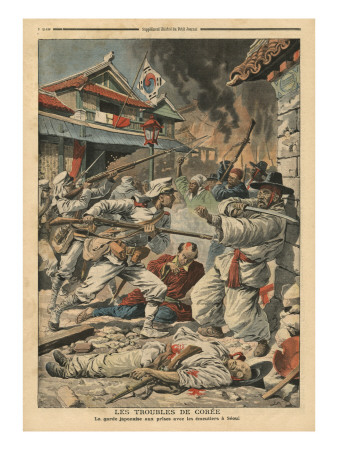 |
Unrest in Seoul, Korea Illustration from Le Petit Journal Supplement, August 4, 1907 French School. |
After World War II, a republic was set up in the southern half of the Korean Peninsula (in August 15, 1945) while a communist-style government was installed in the north.
The Korean War (1950-53) had US and other UN forces intervene to defend South Korea from North Korean attacks supported by the Chinese. An armistice was signed in 1953 splitting the peninsula along a demilitarized zone at about the 38th parallel. Thereafter, South Korea achieved rapid economic growth, with per capita income rising to 13 times the level of North Korea.
1899. World's Fleet. Boston Daily Globe
Lloyds Register of Shipping gives the entire fleet of the world as 28,180 steamers and sailing vessels, with a total tonnage of 27,673,628, of which 39 perent are British.
| Great Britain | 10,990 vessels, total tonnage of 10,792,714 |
| United States | 3,010 vessels, total tonnage of 2,405,887 |
| Norway | 2,528 vessels, tonnage of 1,604,230 |
| Germany | 1,676 vessels, with a tonnage of 2,453,334, in which are included her particularly large ships. |
| Sweden | 1,408 vessels with a tonnage of 643, 527 |
| Italy | 1,150 vessels |
| France | 1,182 vessels |
For Historical Comparison
Top 10 Maritime Nations Ranked by Value (2017)
| Country | # of Vessels | Gross Tonnage (m) |
Total Value (USDbn) |
|
|---|---|---|---|---|
| 1 | Greece | 4,453 | 206.47 | $88.0 |
| 2 | Japan | 4,317 | 150.26 | $79.8 |
| 3 | China | 4,938 | 159.71 | $71.7 |
| 4 | USA | 2,399 | 55.92 | $46.5 |
| 5 | Singapore | 2,662 | 64.03 | $41.7 |
| 6 | Norway | 1,668 | 39.68 | $41.1 |
| 7 | Germany | 2,923 | 81.17 | $30.3 |
| 8 | UK | 883 | 28.78 | $24.3 |
| 9 | Denmark | 1,040 | 36.17 | $23.4 |
| 10 | South Korea | 1,484 | 49.88 | $20.1 |
| Total | 26,767 | 87.21 | $466.9 | |

Site Search

Korean History in Maps: From Prehistory to the Twenty-First Century
Lee Injae, Owen Miller, Park Jinhoon, Yi Hyan Hae, Michael D. Shin.
Korean History in Maps is a beautifully presented, full-color atlas covering all periods of Korean history from prehistoric times to the present day. It is the first atlas of its kind to be specifically designed for students in English-speaking countries. There is a map for each era in Korean history, showing every major kingdom or polity that existed on the Korean peninsula, and maps are also included for topics of additional historical interest, including each major war that took place. In addition, the atlas contains chronologies, lists of monarchs, and overviews of the politics, economy, society, and culture for each era which are complemented by numerous photos and full color images of artifacts, paintings, and architectural structures.
Let the Sea Make a Noise: A History of the North Pacific from Magellan to MacArthur
Walter A. McDougall
Author of "Freedom Just Around the Corner" and the Pultizer Prize winning "the Heavens and the Earth"
"Four centuries of exciting voyages of discovery, pioneering feats, engineering marvels, political plots, business chicanery, racial clashes and brutal wars."


 Copyright ~ 1998-2018.