Iran
Mesopotamia
Southern Persia (Iran):
Shiraz to Jask. Bandar-Abbas. Preece. 1885


From earliest times Iraq was known as Mesopotamia the land between the rivers for it embraces a large part of the alluvial plains of the Tigris and Euphrates rivers.
An advanced civilization existed in this area by 4000 B.C. Sometime after 2000 B.C., the land became the center of the ancient Babylonian and Assyrian empires.
 
Gameron (Bandar Abbas), 17th Century Bandar Abbas has always been a port, and as such its various names have all addressed this function. The most common name over time (Gameroon) has traditionally been said to derive from Persian customhouse (from Late Greek kommerkion, from Latin commercium, "commerce"), but is now speculated to be from Persian kamrun, shrimp (which in Portuguese is camaro, similar to the former Portuguese name). The earliest record of Bandar Abbas is during the reign of Darius the Great (between 586 and 522 B.C.E.). Darius' commander, Silacus, embarked from Bandar Abbas to India and the Red Sea
During Alexander's conquest of the Persian Empire, Bandar Abbas was known under the name of Hormirzad. By the 16th century, Bandar Abbas was known as Gamrun to the Persians. In 1565, a European navigator called it Bamdel Gombruc (or "Customhouse Port"), citing this as the Persian and Turkish name. Bandar Abbas was conquered by the Portuguese in 1514, and was an important to protect their commerce in the Persian Gulf and India. They named the city Comoros, due to the presence of lobsters and crabs on its shores.
In 1614, Comoros was taken by Abbas the Great from the Portuguese and renamed Bandar-e Abbas, or "Port of Abbas".
Backed by the English navy, Abbas developed Bandar-e Abbas (known to the English-speaking world as Gombraun) into a major port. By 1622, the Portuguese and English names had been officially combined to form Combr or Combu, although the inhabitants still called it Bandar-e Abbas. Sir Thomas Herbert said the official English name was Gumbrown, but pronounced "gomroon". He wrote in 1630 that "some (but I commend them not) write it Gamrou, others Gomrow, and othersome Cummeroon." By the 1670s, the city was known as Gameroon. From 1740 onward, control of the town was sold to various Arab rulers, and from c. 1780 it was controlled by Muscat (now a governorate of Oman). In 1868, during Oman's decline, the town reverted to Persian rule. |


Mesopotamia was conquered by Cyrus the Great of Persia in 538 B.C. and by Alexander in 331 B.C. After an Arab conquest in 637-640, Baghdad became the capital of the ruling caliphate. In the early Middle Ages, Iraq was the heartland of the Islamic Empire. 

A brutal Mongol invasion in 1258 destroyed its importance when the country was pillaged by the Mongols. During the 16th, 17th, and 18th centuries was the object of Turkish and Persian competition.
Nominal Turkish suzerainty imposed in 1638 was replaced by direct Turkish rule in 1831.
 REVIEW OF NEW BOOKS. Constantinople in 1828. A Residence of Sixteen Months in the Turkish Capital and Provinces; with an Account of the Present State of the Natural and Military Power of the Ottoman Empire. By Charles Mac Farlane, Esq. London, 1829. |
EVERYTHING which tends to throw light on the present state of the Ottoman empire, and the condition and amount of its resources, is full of interest at the present crisis.


The destruction of the janizaries, and the efforts of the sultan to replace them by troops hitherto unknown in Moslem warfare, and whose very dress would have cost the wearer his life a few years ago, together with the energetic European character of the sultan himself, as contrasted with the dreamy oriental imbecility of his predecessors, has imparted an air of originality to the contest between Russia and Turkey which, independent of the vast practical results involved in the issue, clothes the war itself with the novelty and interest of an untried game, whose course cannot be calculated by existing rules, but whose progress must be watched with the patience of a learner; and the power, activity, and sphere of action of whose pawns and pieces must be ascertained by experience, before we can venture to predicate without incurring the charge of presumption, about the chance of victory to either party, much less the final destiny of the nations whose fortunes, interest, and geographical boundaries must remain in abeyance, like the estate of a dicer, until their rulers shall have played out their game of blood, and agreed to sit down and count their losses.
A few years ago the tide of popular opinion flowed so strongly in favour of the Greek cause, that any one who ventured to hint at the inexpedience of exterminating the Turks, was looked upon as little less than an accomplice in their atrocities; and a crusade against the infidels was nearly as popular in theory, in the days of George the Fourth the age of steam-engines and gas, of lukewarm plans and smoky systems-as it was in practice in the matter-of-fact time of Richard the First, when peoples' sympathies did not evaporate in pamphlets or meetings at the Crown and Anchor, but when our iron-clad progenitors having decided, after their own pithy fashion, that the heathens ought to be beaten, forthwith proceeded to demonstrate the sincerity of their conviction on the subject by selling their moveables, like Swan River settlers, and embarking, king, nobles, gentry and all, to administer the prescribed chastisement . But alas for the age of romance! the calculators of the nineteenth century have cast up their accounts, and the balance is against Greece and in favour of Turkey and Demosthenes himself could not talk an item out of the ledger. Now, though we are as unwilling as the close-fisted multiplier of pounds, shillings, and pence, within the fascination of the lulling music of Bow bell, to sacrifice any of the interests of England in a war of chivalry, yet we cannot help thinking that the present decline of generous sympathy, and the corresponding growth of selfishness, (at once sordid and deaf), on the question of Greek independence, utterly unworthy of
"The inviolate island of the sage and free."
And we therefore hail with pleasure a traveller like Mr. Mac Farlane, who, without reasoning very closely or elaborately on the probable consequences of the present war, as affecting Europe in general, supplies us out of his own observation with facts in support of our opinion, that whatever be the causes be between Constantinople and the Porte let the czar and the sultan make up their quarrel on what terms they may let the Cossack and the Osmanli mix their greasy beards in the kiss of peace to-morrow, England, as the acknowledged guardian of liberty, the palladium of her strength, her commerce, and her power, has a right to demand that the sacred and immutable laws of humanity and one common nature be no longer outraged in the face of the Christian world, by the unutterable atrocities committed by the Ottoman tyrants upon their Grecian slaves.

Abdulmecit I (1823-1861): Abdulmecit I was the 31st Sultan of the Ottoman Empire and succeeded his father Mahmud II on 2 July 1839. His reign was notable for the rise of nationalist movements within the empire's territories.
We are no advocates for the interference of one power in the internal concerns or domestic management of another, either in public or in private life; but the same principle of humanity, older than law and stronger than selfishness, which, under the eye of the authorities of the land and in the heart of the metropolis, forces the passenger to violate the sanctuary of a private dwelling, the legal castle of its occupant, and drag the Hibners or the Brownriggs of the day from their den of impious cruelty to the bar of public justice, that self-same principle invokes the interference of every nation pretending to the name of civilized, between the Turk and his victim; and, despite of the crimes, the offspring of slavery and oppression which disgrace the modern Greek, his heart must, be cold in whom the voice and features of the friend of childhood cannot awaken one feeling of compassion when borne down by misery, though that misery be darkened by guilt who closes his ears to supplications in the sacred tongue which Homer has immortalized and Plato made divine who will not snatch from torture or death, or mutilation worse than death, the unhappy victim in whose wasted form, squalid with poverty and emaciated with hunger, still linger some fading touches of the awful beauty of an Apollo or a Theseus, or dearer still, of a Venus or an Aspasia. As writers like Mr. Mac Farlane, who tell what they have seen while the impression is strong, and the picture distinct in their minds, are very likely to win converts to our way of thinking, we will quote from him no more that sufficient to excite in our readers, an interest on the subject, and a desire to peruse him at length. We take, almost at chance, the following picture of the state to which Scio has been reduced . . .
A grim old Osmanli, from the inland district of Magnesia, a true Turk, who looked upon every change as a crime, happened one morning at the review to enter into conversation with a Levantine gentleman, with whom he was acquainted. " So these are the new troops," said he, "that I have heard so much of; these are the troops that are to defend the Ottoman empire from its enemies! And what in Allah's name can the sultan expect to do with these beardless, puny boys, with their little shining muskets! Why, they have not a yataghan among them! What does this mean? It was with the yataghan the Osmanlis conquered these territories and the countries of the Christians; and it is with the yataghan they ought to defend them. The yataghan is the arm of Mahomet and of his people, and not that chibouque-wire I see stuck at the end of their guns. Mashallah! And what sort of a monkey's dress is this? What sort of ugly-faced, shriveled, puling dogs are these?, Why, they don't look like Osmanlis! and the land of Mahomet to be defended by such as these! Baccaloom!" He continued somewhat in this style, blaming all he saw, and breathing his choler from time to time with a " If it please Allah!" "Allah be praised!" " We shall see!" What is written is written!" and other good Turkish orthodox exclamations. Of their deploying, their lines, their squares, and other mathematical figures formed in the course of their evolutions, he could make out nothing, except that it all appeared very silly. But when they came to firing ; when he saw a regular rolling fire maintained along the line; the firing in platoons; the means of defense of a solid square all which was very tolerably executed and other things which his philosophy had not dreamt of, he was obliged to confess that it would not he so easy as he had imagined to charge and cut such troops to mince-meat, with the yataghan in hand. Indeed, at length his progress to conversion seemed merely impeded by the conviction, that though clever and effective, this mode of warfare was wicked and unbecoming of the children of Mahomet, being derived from profane, infidel sources.
In the conclusion of his preface, the author deprecates the severity of criticism, on the ground of continued ill-health during the composition of the work; now as we are decidedly opposed to the publication of books of travels of a sickly hue, by reason of their general feebleness of tone and hypochondriac monotony of character, we are glad to be able to say, that Mr. Mac Farlane appears to have penned his descriptions with much fidelity, and as they paint distinct and vivid pictures of scenery and manners interesting at all times, but peculiarly so now, we have only to express our regret on that score that illness and the state of society in the east, prevented him from extending his canvass and multiplying his views.

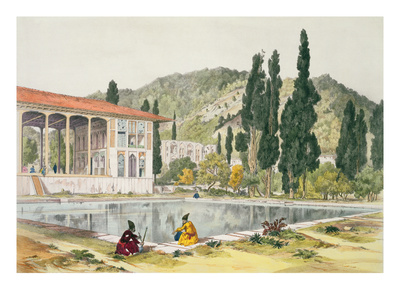 |
| The Palace and Gardens of Ashref, Persia Plate 80 from "Voyage in Turkey and Persia" Jules Joseph Augustin Laurens |
In World War I, Britain occupied most of Mesopotamia and was given a mandate over the area in 1920. The British renamed the area Iraq and recognized it as a kingdom in 1922.
1899. World's Fleet. Boston Daily Globe
Lloyds Register of Shipping gives the entire fleet of the world as 28,180 steamers and sailing vessels, with a total tonnage of 27,673,628, of which 39 perent are British.
| Great Britain | 10,990 vessels, total tonnage of 10,792,714 |
| United States | 3,010 vessels, total tonnage of 2,405,887 |
| Norway | 2,528 vessels, tonnage of 1,604,230 |
| Germany | 1,676 vessels, with a tonnage of 2,453,334, in which are included her particularly large ships. |
| Sweden | 1,408 vessels with a tonnage of 643, 527 |
| Italy | 1,150 vessels |
| France | 1,182 vessels |
For Historical Comparison
Top 10 Maritime Nations Ranked by Value (2017)
| Country | # of Vessels | Gross Tonnage (m) |
Total Value (USDbn) |
|
|---|---|---|---|---|
| 1 | Greece | 4,453 | 206.47 | $88.0 |
| 2 | Japan | 4,317 | 150.26 | $79.8 |
| 3 | China | 4,938 | 159.71 | $71.7 |
| 4 | USA | 2,399 | 55.92 | $46.5 |
| 5 | Singapore | 2,662 | 64.03 | $41.7 |
| 6 | Norway | 1,668 | 39.68 | $41.1 |
| 7 | Germany | 2,923 | 81.17 | $30.3 |
| 8 | UK | 883 | 28.78 | $24.3 |
| 9 | Denmark | 1,040 | 36.17 | $23.4 |
| 10 | South Korea | 1,484 | 49.88 | $20.1 |
| Total | 26,767 | 87.21 | $466.9 | |

Site Search
The Persian Gulf: A Political and Economic History of Five Port Cities 1500-1730
(Mage Persian Gulf Series)
Willem Floor.


Ottoman Wars, 1700-1870:
An Empire Besieged
Virginia H. Aksan.
The Ottoman Empire had reached the peak of its power, presenting a very real threat to Western Christendom when in 1683 it suffered its first major defeat, at the Siege of Vienna. Tracing the empire’s conflicts of the next two centuries, The Ottoman Wars examines the social transformation of the Ottoman military system in an era of global imperialism.


Understanding Iran:
Everything You Need to Know, from Persia to the Islamic Republic, from Cyrus to Ahmadinejad
William R. Polk

A History of Iran:
Empire of the Mind
Michael Axworthy
Former Head of the Iran Section of the British Foreign Office from 1998-2000. He is currently Senior Lecturer and Director of the Centre for Persian and Iranian Studies at the University of Exeter.

Revolutionary Iran:
A History of the Islamic Republic
Michael Axworthy
Axworthy is described as "a Foreign-Office-expert-turned-academic" who has drawn on his own experience as well as archival research to produce a highly readable narrative of the Islamic Republic.


 Copyright ~ 1998-2018.