San Francisco News and Tall Tales: 1800s
Licorice Growing
Pacific Rural Press, April 14, 1883
Queries And Replies
Licorice Growing
Editors Press: You had an item last week about licorice growing in Sacramento county. Will licorice pay?
Editors Press: Your San Jose subscriber asks the question if there is any money to be made in raising licorice. I think there is, from the fact that children like it, and prefer it to candy after once tasting it, while it is green. It can be had in its green form over four months in the year, and it can be converted into paste licorice, and in that form it is worth from twenty-seven to thirty cents per pound, by wholesale. The plant will yield about forty tons of green root to the acre. I have put in 50,000 plants this season.- Isaac Lea, Florin, Cal.
Mr. Lea also sends us a clipping from the American Grocer, New York, as follows:
Editors American Grocer: We sent you last night by mall a small piece of licorice root, raised by Isaac Lea, of Lancashire, England, near Florin, Cal., about fifteen miles from this place. He has in three fourths of an acre, and claims that his is the first successful venture in raising the root in America, or rather in the United States. We thought it might be of interest to you to see a sample. Adams, McNeil & Co. , Sacramento, Cal.
The sample of licorice sent we submitted to one of the beat druggists in New York city, and are pleased to say that he pronounced it quite as good as the imported article. We must express our hearty congratulations to Mr. Lea on his success in cultivating so many different products never attempted in this country before. He is certainly made of the right kind of stuff, and we hope he may reap a substantial reward.
San Francisco Call, August 20, 1891
The Manifold Uses of Licorice
"Not many people in the country understand how important a part in the imports the plant known as licorice plays," said W. F. Gerald of Richmond, Virginia,, who is at the Lindell, "We all know that school children are in the habit of chewing it, and are familiar with the thick black sticks in which it is most commonly seen. Sometimes the root is sold, but stick licorice has about driven the root out of the, market. But this is its most unimportant use. The tobacco chewer is apt to look with scorn upon the masticator of licorice, oblivious to the fact that much of his enjoyment is derived from the same source, as chewing tobacco without licorice would not vary greatly from smoking tobacco. Hundreds of tons of it are used every year by tobacco manufacturers. Physicians use it extensively, and it is one of the most valuable articles in the druggists' pharmacopeia for disguising the tastes of unpleasant medicines. In porter breweries it is used to impart the familiar sweetish taste, and even ale brewers sometimes employ it. All of it is imported, the most coming from Sicily, but a very considerable quantity from England. There has recently been a movement set on foot by some tobacco manufacturers to establish plantations in this country and before long we may raise our own licorice." St. Louis Post Dispatch.
Amador Ledger, August 18, 1905
The Licorice Plant.
The licorice plant resembles a rose with a single green stem, reaches a height of about three feet and bears a small purple star shaped flower. The first year's root growth resembles a loosely twisted string of tow and may run to twenty feet in length. The second year it assumes a woody substance when dry, and the third year it acquires its commercial value. The time for digging the root Is the winter, when it is dried and crushed under heavy stones drawn round on it by mules, much as olives are crushed to extract their oil.
Sausalito News, December 21, 1912
Licorice
Licorice belongs to the pea or vetch family, and grows wild, the plant commonly reaching a height of about four feet. It is the long, straight root which is of commercial value. No means have been adopted for cutting the plant, which requires about three years to reach maturity or for improving its condition.
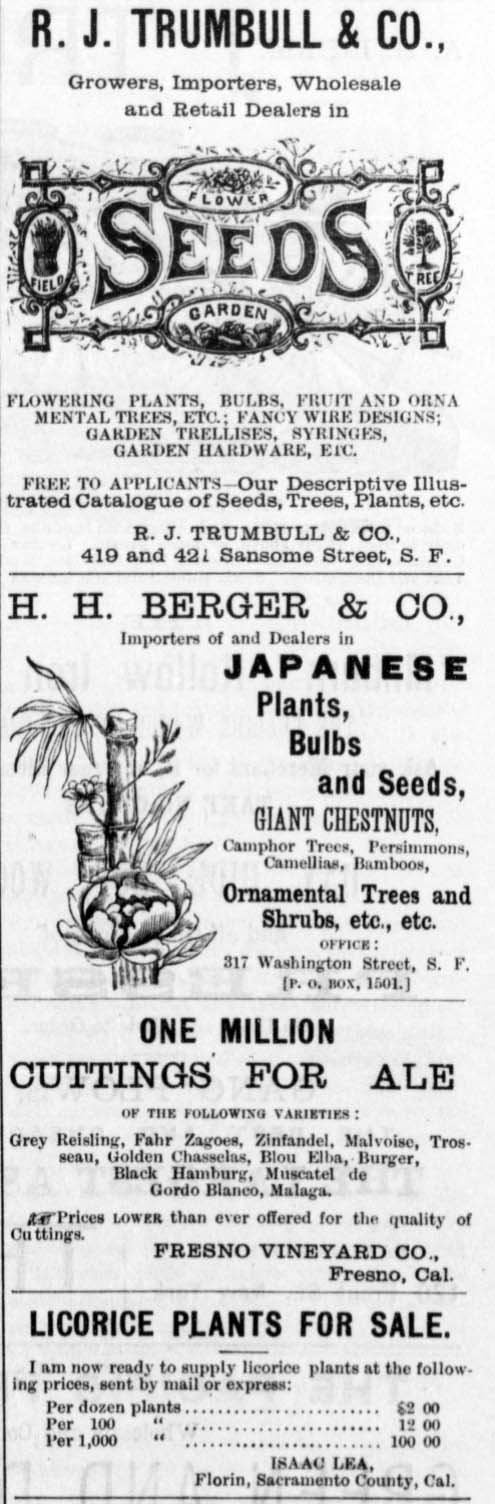
Pacific Rural Press, January 5, 1884
In 1925, American Licorice Co. purchased the assets of a bankrupt licorice company in San Francisco named Universal Licorice Co. and began operations on the west coast. It was a difficult time to start up a new operation, but the company persevered, shipping virtually all the candy made each day to customers. That year Charlie Chaplin asked the company to create a licorice shoe to be used as a prop for his classic film The Gold Rush, in which his character eats shoe leather to avoid starvation.
In the 1950s American Licorice Co. expanded beyond traditional black licorice and began producing Raspberry Vines. Unlike black licorice, which uses extract from the Glycyrrihiza glabra bush root for its flavoring, red licorice has a fruitier taste. The public called it red licorice because of its similarities in format and texture to the original black. Later Raspberry Vines were renamed Red Vines and the packaging was updated with the addition of a tray in 1958. Though sales were slow with red candy in the beginning, eventually red candy became a much bigger seller than black.
In 1963 American Licorice produced unwrapped Red Ropes and Licorice Ropes, the longest pieces of licorice to hit the market. The pieces that were formally cut up to make the Lic-Ris-Ets became the rope candy. Later that decade, American Licorice began wrapping the ropes individually, thus creating the Super Ropes brand.
The American Licorice Company was at 75 Federal Street, San Francisco, on the southeast side between First and Second Streets (image right). It is a two-story reinforced concrete office building in the South End Historic District, built in 1948. The subject property is zoned M-1 (Light Industrial) District and is in a 50-X Height and Bulk District.
In 1969, a project to move San Francisco operations to Union City broke ground. Union City candy production began in 1970. Four years later, the Chicago plant was relocated to a 40,000-square-foot space in nearby Alsip, Illinois. At one point a Natural Licorice Bar, sweetened with only molasses, was made. A Natural Orange Bar was also made with natural flavor and colored with annatto seed powder. This natural coloring agent was used by the Central American Indians as facial war paint. The Natural Licorice Bars were individually wrapped in metalized film.

Site Search
Written by noted genealogist and lecturer George G. Morgan. This guide takes you inside the #1 website for family history research. This edition includes chapters on searches at Ancestry, MyCanvas, and Ancestry DNA.
Bummer & Lazarus
San Francisco's Famous Dogs
Malcolm E. Barker


The Imaginary Emperor
A Tale of Old San Francisco
Steve Bartholomew


An Emperor Among Us
The Eccentric Life and Benevolent Reign of Norton I, Emperor of the United States, as Told by Mark Twain
David St. John

San Francisco Curiosities
Quirky Characters, Roadside Oddities & Other Offbeat Stuff
Saul Rubin
More San Francisco Memoirs 1852-1899: The Ripening Years
Malcolm E. Barker

The Golden Gazette
News Stories of 1848-1857
Dudley T. Ross
Because of the poor cover image, "The Golden Gazette" seemed that it would be fair-to-middling. Turns out that it is a fabulous collection of news stories for anyone curious about the quirky and sometimes frightening episodes of San Francisco's early days: hangings (including women), fires, fleeing criminals, notes on theatrical stars, ship wrecks, ads for things like "Oriental Tooth Wash," impressive wheat crops shipping out of Martinez and Benicia, sheep prices, etc. His selection will please anyone exploring California with family and friends . . . be sure to bring this book along.


 Copyright ~ 1998-2018.