VIPS in the Port of San Francisco

Michael and Charles deYoung
Charles DeYoung: Born 1845, Natchitoches, Louisiana
DeYoung was born in Natchitoches, Louisiana, in 1845. When in his eighth year he arrived in San Francisco, in 1854. After a short term in the public schools, the brothers Charles and M. H. DeYoung commenced their journalistic career as type-setters on an amateur paper devoted to educational affairs. Selling out their interest in this journal, they next entered into the publication of the Holiday Advertiser, which was soon abandoned for the Dramatic Chronicle. It was originally a small sheet run in "the interests of theatrical news, but having good financial success, it soon developed into the San Francisco Chronicle. From the date of its birth the editorial department of the paper has been under the exclusive management of Charles DeYoung, who imparted to it all the individuality which it possessed. In the control of the business department M. H. DeYoung has been given a sphere for the exercise of his abilities as a financier. Charles De Young, however, was the leading spirit and mainstay of the Chronicle. He it was who dictated the social and political policy of the journal whose victories and defeats were taken by him with characteristic stoicism.
In 1865, the teenage brothers Michael and Charles de Young entered the publishing business by borrowing a $20 gold piece from their landlord. They used the money to buy an old desk, several fonts of used type, some newsprint, and then tucked themselves away in the corner of their landlord's Clay Street print shop.
The de Young brothers started with a free theater program sheet they called The Daily Dramatic Chronicle, which debuted on January 16, 1865. The four-page Daily Dramatic purported itself to be "a daily record of affairs -- local, critical, and theatrical," but represented little more than a gossip sheet. The two teenagers handed out the Daily Dramatic at hotels, theaters, restaurants, and saloons, and by the end of their first week were able to pay their landlord back.
By the end of their first month, the de Young's had increased the circulation of their fledgling effort to 2,000. It was an encouraging start, to be sure, but that successful first month would be soon forgotten when the de Youngs broke free from their role as upstarts and scored an even more remarkable coup.
Abraham Lincoln President of the United States
assassinated by John Wilkes Booth


In April, three months after the inexperienced brothers had printed the first copy of the Daily Dramatic, Abraham Lincoln was assassinated, and the first newspaper to report the news to San Franciscans was the Daily Dramatic. Word of the president's death appeared in the de Youngs' first "extra" edition, hitting the streets several hours before the city's other daily journals reported on the national tragedy. The scoop represented a significant coup for the de Youngs and quickly legitimized their position as news reporters, marking the first pivotal step in their bid to become aggressive, competitive journalists.
May 8, 1871, Daily Alta California, San Francisco, California
An Affray in the Lick House Billiard Saloon
Mr. M. H. DeYoung, of the Chronicle, whilst playing billiards in the Lick House saloon, last evening, was attacked by Mr. William T. Higgins, of the Republican County Committee, who, entering the room, walked straight up to him, and struck at him with a heavy cane. Mr. DeYoung was just about to make a stroke with his cue, when, seeing Mr. Higgins approaching angrily, he raised it in time to ward off the blow. The cue was broken into fragments, with one of the larger of which Mr. DeYoung defended himself, eventually clinching Mr. Higgins. The latter drew a revolver, but Tommy Chandler made a dash for it and succeeded in securing it, and other bystanders interfered. Our authorities for this recital of the occurrence are Messrs. M. H. and Chas. DeYoung, the latter of whom was also in the room at the time, and witnessed the whole transaction, which he attributes to the publication of a political article in Sunday's Chronicle. Mr. M. DeYoung was uninjured, but Mr. Higgins was cut about the head.
July 4, 1871, Daily Alta California, San Francisco
An Outraged Citizen.
In Sunday's Chronicle appeared another of those descriptions of a private party which have been condemned by all right thinking and intelligent people. Among the ladies who were mentioned in a most disgraceful manner, was Mrs. McKinstry, the estimable wife of Judge McKinstry. About a quarter past three o'clock yesterday afternoon, Charles DeYoung was standing, engaged in conversation with ex-Mayor McCoppin, near the corner of Clay and Montgomery street, when Judge McKinstry happened to come along. His Honor spoke a few words to Mr. McCoppin, during which he enquired of him who was the man to whom he was talking. He was informed that it was DeYoung. The Judge, who is known to be of an even temperament, became very naturally excited. The mean and low attack on his wife had disgusted him as it had all right thinking people. Raising his walking cane, the Judge struck at DeYoung, the blow being warded off. Mr. McCoppin then interfered, and caught Judge McKinstry's arms. As soon as the latter released himself, he again raised his cane and struck several times at DeYoung, who by this time managed to get into the doorway of Hixon's carpet store. DeYoung was then told to leave by Mr. McCoppin, who subsequently spoke a few words to Judge McKinstry, and the affair was thus ended.
May 1, 1880, Mariposa Gazette, Mariposa, California
MORE BLOOD.
Another Fearful Act in the Kalloch - DeYoung Vendetta
Charles DeYoung Killed by I. M. Kalloch --
A Terrible and Bloody Scene in the "Chronicle" Business Office
(From the Daily Examiner, April 24th)
Last evening the city was fairly convulsed by the report flying through the streets, like a storm-reared whirlwind, that Charles DeYoung, the senior proprietor of the San Francisco Chronicle, had been shot and instantly killed by Isaac M. Kalloch, the son of Mayor Kalloch.
An Examiner reporter was immediately dispatched to learn the facts concerning the terrible report, and found that it was true that Charles DeYoung had been killed by Kalloch, and that the latter had just been taken to the Central Police Station. The following are the statements of the eye-witnesses of the fatal recontre:
A man named Anthony, who was standing in front of the Chronicle publication office, stated that about eight o'clock last night his attention was attracted by the sounds of shooting within. Turning quickly around, he saw F. M. Kalloch leaning as far as possible over the angle of the counter with his pistol pointed at Charles DeYoung, who stood facing a desk almost midway between the private office of M. H. DeYoung and the Kearny-street door. Just as he glanced within Kalloch fired three more shots. DeYoung drew his revolver, a small silver-mounted five-shooter, and attempted to cock it, but his strength failing, the pistol fell from his weakened grasp, and he fell forward, gasping, against the desk. Anthony rushed toward the door just in time to catch Kalloch, who was in the act of walking away.
At this point a policeman came forward, and relieved him of his prisoner. Rushing into the office, Anthony was just in time to prevent eYoung from falling to the floor. He asked: "What is the matter, Charles?" but the livid lips of the wounded man made no reply, and in three or four minutes he died. Examination of DeYoung's lifeless form, as he lay stretched on the floor, showed that one ball had entered his mouth, and, glancing upward, had penetrated the back of his brain, while another had bored a ghastly hole in his neck about four inches below his chin. Three of the bullets had missed their mark. One had broken the glass window of tho private office. Another shot I struck the wall to the south and glanced through the glass door opening on the Bush-street hallway, while a third had grazed the plastering and imbedded itself in the window casing.
E. B. Read says that with Joseph S. Spear they last evening entered the Chronicle publication office, and after transacting some business, started to go out when they met Charles DeYoung and engaged in conversation with him . . . when Mr. Head says the door was suddenly opened and I. M. Kalloch walked, or rather rushed in. He apparently took but a stride when he was abreast of DeYoung, the pistol gleaming in his hand, and placing the weapon within two feet of his face fired . . . DeYoung reached the gate of the fence which separates the front part of the counting-room from the private office, he turned and raised his revolver, pointing it toward Kalloch who had started in pursuit, but had been seized by Head. The latter says that when he saw DeYoung raise his revolver, and knowing that he had been hit . . . Kalloch discharged his weapon the third time as?DeYoung stood in tho gateway, the fall striking the wall. After this De Young ran around the high desk, and Kalloch, stepping back a little, turned and leaning over the counter fired again once or twice when DeYoung ell. . . . William Dreypolcher, of No. 945 Folsom street, a clerk in the Chronicle office said, "I was present at the time of the shooting. About ten minutes to 8 o'clock two gentlemen came into the office, one of them a Mr. Spear of E. S. Spear A Co., the auctioneers, the other E. B. Head; I don't knew what he does; I know him only by sight. A moment or two afterward Charles DeYoung came into the office by the front door. They greeted each other and began talking together in the office . . . I heard the door open and shut very quick, and glanced up and saw Kalloch just inside the door . . . he had a pistol in his hand, and almost at the same instant he fired a shot. Mr. DeYoung looked up and saw him at the same time that I did, and after the first shot was fired he ran back toward the gate. He was about to open the gate when the second shot was tired, and he got down behind it at the third shot. He was right at the corner when the fourth shot was fired. He was down his overcoat was in the way and he was trying to get his pistol out of his pocket. Kalloch was about two feet from him, and stooping over . . . Kalloch just stood and looked at him for a second, and I saw him turn round to go out, and I halloed "catch him!."
Elias DeYoung made the following I statement: At the time of the shooting I was sitting in the back part of the office conversing with Mr. Douglas and I heard a shot fired in the office. I looked up and saw Charley conversing with some gentleman at the counter. The man kept firing very rapidly, and after the third shot Charley moved back towards the gate and got inside behind the counter. Charley came behind the counter and stooped down and was trying to pull his pistol out of his pocket but was unable to do so. I saw Charley was about to fall and I went to him and he fell over into my arms and I laid him down on the floor. He did not say a word, he could not speak . . . I went up to the Station House and recognized the man there, who they said was Kalloch, as the man who shot him . . .
Officer Peckinpali, who assisted in making the arrest, said that he was a short distance from the Chronicle office when he heard the shots, and running up entered the office a moment after Officer Ward had laid hold of young Kalloch, and be then walked him down to the Central Office.
From the statements of the foregoing witnesses it will seem that a few minutes after the infliction wound DeYoung died.
June 24, 1890, Woodland Daily Democrat, Woodland, California
The Republican nominee for Governor is at yet, a myth. Boruck does not intend running his horse -- Waterman, and Morrow and McKenna, both of whom have an eye on the official char, have done little or no fighting as yet. Mr. DeYoung, proprietor of the Chronicle, would take it if it were offered him -- so would many others.
December 10, 1889, Mountain Democrat, Placerville, California
Republican Wrangle Summarized
San Francisco Southern Pacific Terminus.  As Mission Bay was gradually filled and the port of San Francisco continued to grow with more and more commerce passing through, railroads were built right up to the docks. By 1896 one of the U.S.'s most efficient systems of beltline railroads was operating between every wharf along SF's waterfront and the numerous railroad warehouses and the terminus built in Mission Bay. The South Pacific Terminus, above, was built in 1915 to serve the Panama Pacific Exposition. |
To keep the Southern Pacific Company out of politics, for all purposes except their own, the saints of the Call and Chronicle have bunched their temporalities. Prior to their reconciliation, they had each and severally held sundry interviews with Wm. F. Herrin, chief counsel of the corporation whose influence they coveted. He says and they admit that in all these conferences, he disclaimed the power to commit his company to any Senatorial aspirant. He says and it is tacitly admitted, that when threatened with the implacable hostility of the Chronicle, he frankly told DeYoung that the S. P. Company would not support him. He also told him that Spreckels would not support him. Such being the situation, the most that he could do, was to give him a personal option on the toga, couplet with the suggestion that he might develop a candidate satisfactory to all concerned. This the irate editor of the Chronicle flatly refused to do.
Thus matters ended and remained until about two weeks ago, when Herrin was summoned by telephone to the Spreckels building, where he found the two editors in conference. Having failed in his previous efforts to reconcile them to each other, or to the neutrality of his company, the meeting was a surprise to him. The manifest emergency was explained by Spreckels to be that he and DeYoung had pooled their individual options and were ready to name the next Senator from California. In the colloquy which followed Herrin expressed a personal preference for Col D. M. Burns, but again disclaimed any right to speak for his company, or to forestall the people in their choice of a Senator. To this DeYoung replied that he and his fellow editor, with the "leading Republican papers," did represent the people" and were "entitled to a controlling voice in the matter. While expressly asserting the same editorial primacy, Spreckels is said to have "complained of the fact that the Southern Pacific Company had no authorized representative in political matters,' and "no one could ever find what the company really wanted, or who represented it."
Hence it was agreed that Herrin should sound his company for its official preference among Senatorial aspirants and report to the confiding-editors the following Tuesday. At the time appointed he presented to them the final decision of his company, written by George Crocker, as follows:
"We do not think the Company should undertake to make any one United States Senator or to assist in the fight of any candidate for that place. When it shall appear that any fit person is the choice of a majority of the people, the company may then use its legitimate influence In behalf of such person. In no event will the company use its funds to make any one United States Senator. We have no doubt a Senator can easily be selected who will ably represent the people of the State, and at the same time not antagonize our interests."
This was the anticlimax of all previous conferences and only confirmed the disclaimers so often reiterated by Herrin on behalf of his company. But the tall towers of the Call and Chronicle are still swaying with the shock of disappointment to the Warricks who claim to "represent the people." Their overtures to the Southern Pacific Company for that purpose, sound like Sheridan's satire on himself and fellow courtiers, addressed to George IV. The conditions of homage are the same, as follows:
"In all humility we crave,
Our Regent may become our slave,
And, being so, we trust that he
Will thank us for our loyalty."
February 5, 1899, Los Angeles Herald, Los Angeles, California
Here for His Health
DeYoung in Search of Fifteen Pounds He Has Lost
Is Not a Candidate for Paris or Any Other Old Thing --
The Senatorial Contest Stinks
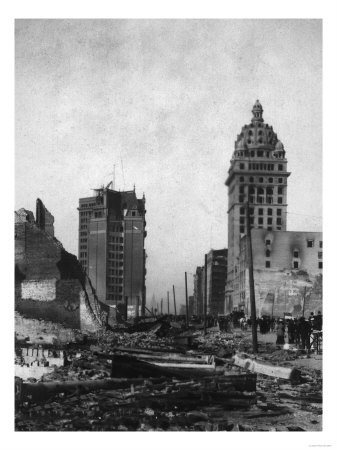 |
| San Francisco, California View of Call and Chronicle Buildings After 1906 Fire 
|
M. H. DeYoung, editor of the San Francisco Chronicle, and Mrs. DeYoung arrived in the city yesterday and are at the Van Nuys.
"My presence here has no political or business significance whatever, said Mr DeYoung. "I contracted the grippe and it has held me so long that. I have come to the genial climate of Southern California to recuperate. I have lost fifteen pounds in weight, concluded that was l enough to lose, and ? l'm here. It has been years since I visited Los Angeles and I notice a remarkable improvement in the city.
"No, I am not a candidate for state commissionership to the Paris exposition. When I said I was not a candidate for the United States' senate, people would not believe me, until the absence of my name from the legislature's list convinced them. Now, when I say I am not a candidate for the commissionership, I mean that. Neither am l interested personally in the aspirations of any individual beyond that of any other citizen ? the desire that the appointee be a man who will represent this state and its resources with credit and distinction.
"I know nothing more about the senatorial light than is-reported in the papers. I am taking no personal interest in it, and like many others, am looking on," and then Mr. DeYoung made a significant gesture, suggestive of an expression by Senator White a few days ago.
"l can only hold my nose and wonder." After that Mr. DeYoung and several friends went to the horse show. During the afternoon Mr. DeYoung had a long conference with L. E. Mosher of the Times but from latest accounts neither of these statesmen evolved any solution of the senatorial deadlock.
February 16, 1900, Ukiah Dispatch Democrat, Ukiah, California
President McKinley has appointed M. H. DeYoung to be a United States Commissioner to the Paris Exposition.

Site Search
Johannes Gutenberg
Inventor of the Printing Press
(Signature Lives: Renaissance Era)
Fran Rees

A History Of California Newspapers, 1846-1858
Edward Cleveland Kemble


The Annals of San Francisco
Frank Soule, John H. Gihon, James Nisbet

Printing Presses: History and Development from the Fifteenth Century to Modern Times
James Moran

A History of the Book in America
Volume 2: An Extensive Republic
Print, Culture, and Society in the New Nation, 1790-1840
Scott E. Casper
The Invention of News: How the World Came to Know About Itself
Andrew Pettegree

Communities of Journalism
A History of American Newspapers and Their Readers (History of Communication)
David Pauli Nord


The Golden Gazette:
News from the Newspapers of 1848-1857
Dudley T. Ross
"The Golden Gazette," turns out to be a fabulous collection of news stories for anyone curious about the quirky and sometimes frightening episodes of San Francisco's early days: hangings (including women), fires, fleeing criminals, notes on theatrical stars, ship wrecks, ads for things like "Oriental Tooth Wash," wheat crops shipping out of Martinez and Benicia, sheep prices, etc. His selection will please anyone wandering and exploring California.
A History of the Black Press
(Moorland-Spingarn Series)
Armistead S. Pride
The History of the Gold Discoveries of the Northern Mines of California's Mother Lode Gold Belt As Told By The Newspapers and Miners 1848-1875
Lewis J. Swindle

 Copyright ~ 1998-2018.