Maritime Nations
° Constantinople (Istanbul) ° Smyrna
Turkey
Turkey's history dates back to 6500 B.C. It is also referred to (along with Africa and Egypt) and the "Cradle of Civilization."
The Ottoman Turk lived originally in central Asia, where they were members of a race related to the Mongols, a branch of the Ural-Altai family. Under their first sultan, Ottoman, who ruled from 1288 to 1326, they founded a realm In Asia Minor, but soon extended it into Europe, entering Armenia. With the capture of Constantinople in 1453, they succeeded to the Byzantine empire, and their rule at its zenith during the sixteenth century extended over the greater part of southeastern Europe and much of western Asia and northern Africa, but they lost Hungary, Roumania, Servia, Greece and practically Bulgaria and Egypt, etc. The Ottoman Turks are Sunnlte Mohammedans and regard the Sultan, who Is the supreme head of the church and recognized as such by all Mohammedans, as representative of former caliphs.
Sausalito News, Sausalito, California
June 23, 1906
The Ottoman Empire was created by Turkish tribes in Anatolia. One of the most powerful states in the world during the 15th and 16th centuries, it spanned more than 600 years and came to an end in 1922, when it was replaced by the Turkish Republic and various successor states in southeastern Europe and the Middle East.
The Turkish Empire 
John Speed (1552 - 28 July 1629) was an English cartographer and historian. He is known as England's most famous Stuart period mapmaker. It was with the encouragement of William Camden that Speed began his Historie of Great Britain, which was published in 1611.
|

 His work as a historian is considered mediocre and secondary in importance to his map-making, of which his most important contribution is probably his town plans, many of which provide the first visual record of the British towns they depict. His atlas The Theatre of the Empire of Great Britain was published in 1610/11.
Arts and culture were factors in trade routes through the Middle East. Much of the Arts in Middle East evolved around religion. Some famous art techniques during the ruling of the Ottoman Empire were Tile work, Turkish Rugs, and Army bands. Firstly tile work was an important design of the floors and walls in mosques and government buildings. The geometric designs helped accentuate open worship.
Due to the invasion of the Ottoman Empire, Islam brought many influential preachers and artists from different parts of Middle East. Trade played a significant role in the world of arts in Middle East during the 1700s. Turkish rugs were important for the Ottoman Empire, as rugs were used as prayer rugs and decorations. It is known that each Muslim man owned at least one prayer rug. Many of these rugs came from Azerbaijan and Egypt.
Turkey. 1804. Pinkerton mapmaker.


The Port of Istanbul is more than 2500 years old and is the largest city in Turkey. The old city is located on the peninsula between Europe and Asia, covering both continents. It was the capital of the Byzantine Empire, the Ottoman Empire, and the Turkish Republic. Located on a peninsula at the entrance to the Black Sea.
The Port of Istanbul was first used for sea-borne trade during the Ottoman period when small boats and barges carried passengers and cargo across the Marmara Sea and along the Golden Horn and Bosporus. The Tersane-i Amire (Grand Shipyard) was established in the Port of Istanbul in 1455 for ship building. The vessels created there, as well as at other shipyards in the Ottoman Empire, formed the foundation for today's Turkey Maritime Enterprise.
Egyptian wool enabled carpets to achieve a high place in art of the Middle East.
Nautical Standard, December 24, 1853, Great Britain
The Eastern Questions, with its Increasing Complications
As between independent States, the demands of Russia were untenable, and the submission of the Ottoman Empire to the hard conditions of the Czar would, from the moment of an ignoble submission, have degraded Turkey into a province of Russia, and made the' guarantee of other Powers of Turkish independence a mere sounding brass and tinkling cymbal.
Sultan Abdulaziz. Ruler of the Ottoman Turks.


With a formulated policy built upon the traditions of European history, the conduct of England, upon the aggression of Russia, was plain and straightforward; but was the actual course it pursued reconcilable with such a policy? On the contrary, have we not exhibited a vacillating and timid course of conduct towards Russia, affording that country time to gather up its resources, to recruit its decayed powers, and to concentrate, where need required exertion, the means of making its scourge the more formidable against its threatened victim? Who that has seen the successive steps taken by Russia in late events, could suppose for a moment that our nation and her ample resources were pledged if not by actual treaty, at least by conventional policy against such dangerous aggressions upon a friendly state? If we have not feared, we have certainly taken no pains to manifest in the eyes of the rest of Europe, any palpable demonstration of the firmness of our purpose, or the efficient means at our disposal ready to check the first advances of a mischievous feud.
Like the small trader who submits to be kicked that he may preserve the patronage of an eccentric and violent customer, we have met open defiance by a craven inactivity and equivocal submission, We have seen the provinces of our ally invaded, and fire and sword carried through its domain. We have coerced its ships in its own harbours, and most probably facilitated the miserable event which has stained the harbour of Sinope with Turkish blood, and deprived the Ottoman Empire of its ships, to say nothing of the moral influence which such a catastrophe must inevitably impress upon the energies of a people upon the commencement of an unequal conflict. That we as a nation are responsible for much of the mischief that has lately fallen upon our ally cannot be doubted, and that our vacillation and infirmity of purpose have hitherto given strength and confidence to the arms of Russia seems equally clear. It cannot be denied that we have been overreached by the refined policy of a State ever remarkable for the craftiness of its diplomatic agency, and that we are only aggravating the mischief which we profess to be endeavouring to avoid. Shall we see Turkey cancelled from the map of Europe and then come to the rescue? What sort of alliance is that which stands by without aid or resistance, whilst our friends are step by step reduced to a condition of infirmity and dependence?
Harbour at Galata with Customs House
Golden Horn, Constantinople (Istanbul)


But is it to be supposed that the stealthy march of Russia will be confined to Turkish subjugation, should she succeed in turning from their purpose and their duty the States which are pledged to sustain Ottoman integrity? Is there not at the present moment a nucleus of mischief established in the heart of Persia? Is not the lever of Russian power already extended to the Persian Gulf, and is not that lever ready to work against England should the occasion render its agency of importance against her and her Eastern empire? All tends to demonstrate the deeply working agency which Russia has employed to complicate the difficulties of the Turkish question. The time has now gone by for wholesome warning: the seeds have been sown which must produce a crisis. Tardily and gracelessly we have at length dared to hoist the British standard in the Black Sea. The occupation of the Danubian provinces was the defiance which has been thus slowly responded to, and we shall now soon see the development of a subtle policy which we have hitherto either not understood, or have affected not to comprehend . . .
THE BRITISH FLEET AT CONSTANTINOPLE
Reports have been industriously circulated to the effect that the British Ambassador at Constantinople had intimated to the French representative that the British fleet was not in a condition to enter the Black Sea, in justice to the gallant commander-in chief, Vice-Admiral Dundas, we enumerate the ships under his command as a contradiction to so unfounded a statement. No fleet has ever collected together at any period of the history of this country so powerful and so efficient. In the fleet of Admiral Dundas there are the best ships, the best steamers, the best officers, and the best men, that ever served under the British pendant, and we know, from the very best authority, that all and each are animated with a burning desire to rr.eet the much-vaunted Russian fleet in their very best trim. At the last telegraphic date from Constantinople the following was the British force collected :
SAILING THREE DECKERS |
|||
| Guns | Men | Commanders | |
| Britannia | 120 | 1000 | Captain Carter (flag ship) |
| Trafalgar | 120 | 970 | Capt. Greville |
| Queen | 116 | 170 | Capt. Michell |
SAILING TWO DECKERS |
|||
| Albion | 90 | 820 | Capt. Lushington |
| Rodney | 90 | 820 | Capt. Graham, C.B. |
| London | 90 | 820 | Capt. C. Eden |
| Vegeance | 84 | 750 | Capt. Lord E. Russell |
| Bellerephon | 78 | 650 | Capt. Jones |
SCREW TWO-DECKERS |
||||
| Guns | Men | H.P. | Commanders | |
| Agamemnon | 91 | 850 | 600 | Capt. Mends (flag) |
| Sanspareil | 71 | 626 | 360 | Dapt. Dacres |
Here is a force of ten sail-of-the-line, better equipped, and thrice as efficient as any fleet that ever engaged an enemy. The Queen, London, and Agamemnon it is true left England under-manned, but everybody who knows the Mediterranean is well aware, that as the men-of-war touch at Gibraltar or Malta they have little difficulty in completing their crews. But take the fleet generally, they are all better manned than either the Navarino fleet or the Syrian fleet in 1840-41, for they have few "Minto sailors," and they were not compelled, in order to make up the ships' companies, to break up a battallion of marines and distribute them through the fleet.
Having said so much of the ships and the men, we may give our readers some idea of their terrific armaments by singling out the three-decker Queen, the screw 90-gun ship Agamemnon, and the twodecker, London.
QUEEN, 116 GUNS |
|||
| No. | Description | Length | |
| Lower Deck | 30 | 8 inch | 65 cwt. 9 ft. |
| Middle Deck | 30 | 32-pounder | 56 cwt. 9 ft. 6 in |
| Main Deck | 32 | 32-pounder | 42 cwt. 8 ft |
| Quarter Deck | 8 | 32-pounder | 42 cwt. 8 ft. |
| And Forecastle | 16 | 32-pounder | 42 cwt. 8 ft. |
AGAMEMNON, 91 GUNS |
|||
| Lower Deck | 34 | 8-inch | 65 cwt. 9 ft. |
| Main Deck | 34 | 32-pounder | 65 cwt. 9 ft. 6 in. |
| Quarter Deck | 22 | 32-pounder | 45 cwt. 8 ft. 6 in. |
| And Forecastle | 1 | 68-pounder | 95 cwt. 10 ft. |
LONDON, 90 GUNS |
|||
| Lower Deck | 18 | 8-inch | 65 cwt. 9 ft. |
| 14 | 32-pounder | 56 cwt. 9 ft. 6 in. | |
| Main Deck | 6 | 8-inch | 65 cwt. 9 ft. |
| 28 | 32-pounder | 56 cwt. 9 ft. 6 in. | |
| Quarter Deck | 2 | 8-inch | 65 cwt. 9 ft. |
| And Forecastle | 22 | 32-pounder | 42 cwt. 8 ft. |
It will thus be seen that the modern screw 90-gun ship and the latest built saling three-decker in this fleet, throw about the same weight of shot in a single broadside (namely, about 2800lb.), whereas the 90-gun sailing ship's broadside is about 2000lb. These are specimens of a fleet whose effective fire has never yet been tested against an enemy; for the only ship in the above Jist that has used her shotted guns in action is the least powerful of the lot, the Bellerophon. This is the heavy force of the British fleet; the lighter force is comprised in the following sailing frigates and steamers:--
SAILING FRIGATES |
|||
| Guns | Men | Commanders | |
| Leander | 50 | 500 | Capt. King |
| Arethusa | 50 | 500 | Capt. Symonds |
PADDLE STEAM FRIGATES |
||||
| Guns | Men | H.P. | Commanders | |
| Terrible | 21 | 300 | 400 | Capt. O'Callaghan |
| Retribution | 22 | 300 | 400 | Capt. Drummond |
| Tiger | 16 | 220 | 400 | Capt. Gifford |
| Furious | 16 | 220 | 400 | Capt. Loring |
| Firebrand | 6 | 220 | 400 | Capt. H. Parker |
| Sampson | 6 | 200 | 467 | Capt. L. T. Jones |
PADDLE SLOOPS, &c. |
||||
| Inflexible | 6 | 160 | 378 | Com. Popplewell |
| Fury | 6 | 160 | 515 | Com. Tatham |
SCREWS, &c. |
||||
| Highflyer | 21 | 236 | 250 | Capt. Moore |
| Niger | 13 | 170 | 400 | Com. Heath |
| Wasp | 14 | 170 | 100 | Com. Ld. J. Hay |
With the 10 line-of-battle ships, manned and commanded as they are, the Russian fleet in the
Black Sea would have just as much chance as the transports of the poor Turks; and accompanied by
the dashing frigates and sloops, it might well be said that the " impregnable" Sevastopol would not save the Russians from utter destruction, but that Sebastopol would become another Sinope, with this difference that the Russians, 

It is idle then to delude the French or the English with any statement to, the effect that the British fleet is not in a condition to enter the Black Sea. It is not the fact. Admiral Dundas's fleet is ready for any service on any sea.
  Zaraporoski Cossacks Ilya Repin, Artist. |
Atlas, January 27, 1855, London, Middlesex, United Kingdom
ASIATIC TURKEY
All the environs of Kars are fortified. At all proper points, bastions and redoubts are to be seen in course of construction by Miyor Mahmoud Effendi, after the plans of Hussein Pasha, the chief of the staff.
French Galley
Operating in the Ports of the Levant since Louis XIEach spot has been appropriated to a particular regiment or battalion in case of an attack; and even the inhabitants have their stations for defense assigned to them. Each week the soldiery are perfected in a different manoeuvre, and are prepared for the various evolutions that may be necessary during a campaign. The bread and rations are excellent, and the men have quite forgotten their past misery. The sanitary condition of the army is perfect. The Heis Kerim Pacha has effected a communication with Schamyl. A little time back Schamyl entered Sarybach and made prisoners of some hundreds of Russians. He then withdrew to Aver, leaving at Sarybach Daniel Sultan and Mahmoud Gari Effendi, his son and the brother-in-law of Daniel Sultan. The latter was formerly a Russian General. He has 20,000 men under him, of whom 6,000 are regulars, principally Russian deserters officered by Poles. He has also 32 guns. "Very lately the Polish Prince Beratynski, a Lieutenant in the Imperial Guard, deserted and entered our service.


Atlas, March 28, 1857, London, United Kingdom
TURKEY.--It is said that upon receiving the false news of the capture of the Kangaroo by Russian gunboats, Lord Stratford de Redcliffe immediately sent his first dragoman, M. Pisani, to the Russian embassy with an energetic demand for an explanation, and that in case of the fact being substantiated, Lord de Redcliffe seemed disposed to adopt very decided measures in the case.
Egyptian Dragoman


The Sultan has published a firman, ordering that land shall be given to foreign families who may feel disposed to establish themselves in Turkey. The essential condition required for such settlers will be that they shall become subjects of the Sultan and swear fidelity to him. The colonists are to have full freedom of religion, and have their own churches.
The squadron of Admiral Lyons had not quitted the Bosphorus on the 16th. It was at anchor opposite Constantinople.
A despatch from Tangiers says the Emperor of Morocco's troops have been attacked by hostile tribes. He had sent his son to oppose them. The Emperor was about to retire to Fez for security.
Allens Indian Mail, London, United Kingdom, August 15, 1863
THE LATE GALE.
The last voyage of the S. S. Bengal, though very brief, was anything but a pleasant one. About three hours after discharging her pilot on the night of the 24th June, her screw shaft broke in two, and she was accordingly obliged to let go her anchor.


An attempt was then made to splice the broken shaft, but at the first revolution of the screw the splicing gave way. In the meantime the wind began to rise rapidly, and by the morning it blew a heavy gale from the south-west, which continued for three consecutive days. Every precaution which long experience and skilful seamanship could suggest, was taken to insure the safety of the ship in such critical circumstances. Fortunately the holding ground was good, and the cable withstood the immense strain without yielding, so that with the exception of the discomfort usually endured by landsmen in a stormy sea, the passengers had not much to complain of. At the very height of the gale a seaman fell overboard from the topgallant yard, but no sooner was the alarm given than an African secondly, or "seedy boy" as these men are usually called caught hold of a life-buoy, and the end of a rope, and sprang into the raging sea. For one moment he got near enough to the drowning man to push the life-buoy within his reach, but the line snapped by the sudden jerk caused by the convulsive clutch of the poor wretch, and in the next instant both man and buoy disappeared in the surge. The brave African himself was saved with great difficulty, being hauled up by the rope to which he had clung throughout his dreadful buffeting by the waves. It is needless to add that a subscription was at once got up to reward his heroic, if unsuccessful, effort to save a fellow creature's life at the imminent risk of his own.
Bengal Chukka.
The Bengal arrived in Aden on December 17, 1863 under tow by Sultan and remained at Aden until February 13, 1864.
  A View of Constantinople Michael Zeno Diemer |
Fort Wayne Daily Sentinel, Fort Wayne, Indiana, April 8, 1881
The Ruined City
The island of Seiko, which has been so fatally shaken by an earthquake, is a possession of Turkey, off the west coast of Asia Minor, and four miles west of Cape Blanca, and from which it is separated by the strait of Seiko. The length of the island from north to south is thirty-two miles, and its greatest breadth is eighteen miles. The area is 508 square miles. The surface is very much diversified. Seiko is naturally one of the richest and most beautiful islands of the Levant. The principal products are wine of superior quality, mastic, silk, wool, cheeses, figs, lemons, orange and other fruits; less corn has usually been raised than is required for home consumption.
 
Isles of Levant, View of Cape Benat |
Previous to 1822, this island was the best governed and most prosperous in the Grecian archipelago, and had thriving silk manufactories, and considerable trade with Constantinople, Syria and Egypt; but in the above years, some of its inhabitants having joined the Samians in their revolt, nearly all the population, comprising from 120,000 to 130,000 persons, were massacred or sold into slavery, and the buildings and plantations were for the most part destroyed. The chief productions are silk, cotton, wool, fruit, oil and gum mastic, the latter being the staple of the island.
Chios is of ancient renown, and the chief city, also named Chios, claimed the honor of being the birth place of Homer. It was invaded by the Persians and devastated in 494 B. C. It subsequently belonged to the Athenian League, and afterwards became subject to Rome. After being captured by the Turks, it was won from them by the Genoese, but in 1655 again fell under the Turkish dominion, and, excepting a short interval during which it was subject to Venice, has been under the same government.
During the revolution of 1822, within two months 23,090 Sciotes, without distinction of age or sex, were put to the sword, 47,000 were sold into slavery, and 5,000 sought safety in other parts of Greece. By the end of August of that year the former Christian population of 104,000 was reduced to 2,000, and since then, although there have been other efforts to dispute the supremacy of the Turks, the crescent has still remained in the ascendant. Scio, or Kostro, the capital, is near the middle of the east coast, and in 1875 had a population of 14,500. It has a harbor, is defended by a castle, and manufactures velvet, silk, and cotton.
September 21, 1896, San Francisco Call , San Francisco, California, USA
At the Golden Horn. A View from Constantinople
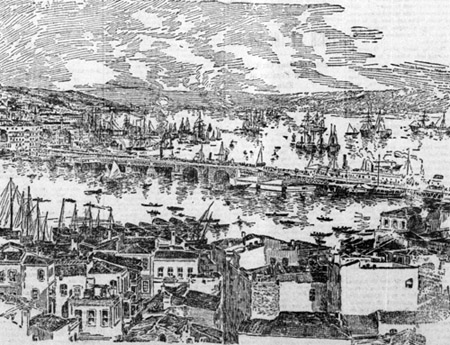
The capital of the Ottoman Empire is now a point upon which the eyes of the leading diplomats of European powers are turned. Anxious as England and Germany appear to suppress the slaughter of Armenians, both nations are loth to act except in concert with Russia.
Turkish Steamship Ertogrul.  September 19, 1890: |
Burlington Hawk Eye , May 12, 1897, Burlington, Iowa, USA
People wondering how the Turks can reconcile their consciences to the awful slaughters of the Armenians may find their answer in the following official prayer of Islam, dally repeated by tens of thousands of the sultan's subjects:
"I seek refuge with Allah from satan the accursed. In the name of Allah the 'the compassionate, the mercifuil! O Lord of all creatures! O Allah! Destroy the iInfidels and polyetheists, thine enemies, the enemies of the religion! O Allah! Make their, children, orphans and defile their abodes! cause their feet to slip; give them and their families, their) households and their women, their children and their relations by marriage, their brothers and their friends, their possessions and their race, their wealth and their- lands, as booty to the moslems, O Lord of all creatures!" The Koran, chapter ix., 6, has this frank advice: "Kill the idolaters wheresoever ye shall find them and take them prisoners and besiege them, and lay- wait for them in every convenient place. But if they shall repent and observe the appointed times of prayers and pay the legal alms, dismiss them freely."
Constantinople 1572
Perhaps because of its advantageous location, this old city has a history of strife from its earliest days under various religions and conquerors. Constantinople unites Europe with Asia and putting in communication the Black Sea and all Southern Russia with the greater part of Europe and Asia. It is surrounded by water on all sides except the west, which is protected by walls. Its sea front is about eight miles in length. Constantinople forms a special district (cordon) divided into three principal sections, two in Europe and one in Asia. The two European sections are Stamboul (ancient Byzantium), whose suburbs border the Sea of Marmora; Galata and Pera, more or less Europeanized quarters, with many villages rising in rows along the green hills that look down on the Golden Horn and the Bosporus. The Asiatic section is Scutari (Turk. Uskudar; Chrysopolis) and Kadi-Keui (Chalcedon), with their extensive suburbs on the Asiatic shore of the Bosporus, the pleasant coasts of the Gulf of Nicomedia, and the Isles of the Princes.
Constantinople 1858. Amadeo Preziosi.
 
Amedeo Preziosi was born in 1816 to a noble family in Malta. Amedeo was attracted by the arts from early age and was taught by Giuseppe Hyzler in Malta. While his father wanted Amedeo to study law, sending him to study at the Law School in Sorbonne, Amedeo was more interested in arts and continued his painting studies at the Lecole des Beaux-Arts. His earliest drawings of Istanbul are dated November 1842. Two years later, in 1844, Preziosi was commissioned by Robert Curzon, the private secretary of the British Ambassador to Istanbul, to create an album called Costumes of Constantinople, which now is located in the collections of the British Museum. |
The Bosporus separates Europe from Asia; it is about eighteen miles long and varies in width from about half a mile to a mile and a half. The Golden Horn separates Stamboul from Galata and Pera, extends inland for about four and one-half miles and ends abruptly at the Valley of the Sweet Waters beyond Eyoub. Two wooden bridges unite Galata with Stamboul, which latter section is mostly inhabited by Turks, and still preserves its ancient ramparts with their towers and gates.
In 1807 a British fleet threatened the city, which was courageously defended by Sultan Selim III and the French ambassador, General Sebastiani. In 1854 Anglo-French armies encamped at Constantinople before and after the Crimean expedition against Russia. In 1878 the Russians advanced to San Stefano, a little village in the European suburbs, and dictated there the treaty of that name. In 1821 the Greek patriarch, Gregory V, with many bishops and laymen, was hanged on the occasion of the outbreak of the Greek War for Independence. In 1895-1896 the capital, as well as the provinces, saw many Armenians massacred by the Kurds, with the complicity, or rather by order of the Government. Even the dreadful physical catastrophes of former times have been renewed; great conflagrations in 1864 and 1870 destroyed entire quarters at Stamboul and Pera. In the latter place many thousands of lives were lost (most of the houses are built of timber). In 1894 an earthquake laid low a great part of the Bazaar and killed several thousand persons.
Oshkosh Daily Northwestern, April 18, 1900, Oshkosh, Wisconsin, USA
In the Great City of Constantine.
Mr. Broad Reaches Constantinople and is Admitted to "Pratique" Without Difficulty -- He Views the Bosphorus and the Golden Horn -- Where Europe and Asia Come Together.
(No. XL Special to The Northwestern.)
In a Constantinppole Hotel.
Constantinople, March 18.

I am writing this letter in my room in the "Grand Hotel de Londres." From the windows I can feast my eyes on a fine collection of antique tiles and chimneys, back yards and old roofs. The hotel is in Pera, one of the divisions of 
Golden Horn from Suleymaniye Mosque


All writers who speak of Constantinople go into rhapsodies over the picturesque appearance of the city as it looks when you approach it by steamer. This is March, and, of course, there is but little foliage or vegetation to be seen, yet the view is grand and beautiful. Entering the Bosphorus in a northerly direction, we have Scutari, the Asiatic port, on the right and Stamboul, or Constantinople, on the left. Then, after a mile or two, the course is to the left across the mouth of the Golden Horn and the ship anchors at Galata on the north of the Horn and within sight of the bridge connecting Galata with Stamboul.
How to Get On Shore
One of the perplexities of steamship traveling in foreign countries is the landing and embarkation. You would think that when the ship anchors all you had to do was to go on shore, but the fact is that it is then that your troubles really begin. We had been told terrible stories about the "unspeakable Turk" and his petty meanness to tourists. No one is allowed to land without a passport, no liquor, no "tabac," no books, no firearms, are allowed to go on shore, and they told us that we were liable to be detained on the wharf three or four hours and have our baggage turned topsy-turvy on the dock. To go from the ship to the shore a small boat must be hired and then a carriage for the journey to the hotel and to obviate the difficulty of landing the tourist agencies sell "landing tickets " For $1.50 each person. Cook & Son or Gaze will furnish tickets entitling passengers to the ride ashore carriage to the hotel, services of a guide and interpreter, and tips to the custom house people.
Jan Luyken 
Jan Luyken was born in Amsterdam on April 16, 1649, into a family that had become Mennonites shortly before his birth. His father was a schoolteacher and writer. Jan Luyken was nineteen years old when his father died. After his father s death, he began to study painting at the studio of Martins Saeghmolen. Although Luyken became a fine painter, he eventually concentrated solely on being an engraver. It is estimated that more than 3,500 prints are by his hand. |
For ladies traveling alone or men who are at all timid or unaccustomed to traveling, the landing tickets are an indispensable blessing-and always a great convenience. But I took my chances without landing tickets and succeeded in getting through at a total expense of four francs or eighty cents each. All the rest of the party had tickets and had precisely the same experience I did and paid nearly twice as much. And I found that the annoyance and difficulties had been greatly exaggerated. We passed through the customs examination with just about the same delay we had in Italy or Greece, and from my experience at his hands that day, I am prepared to say that the Turk is "a gentleman and a scholar" and a much abused creature. Still, others were not so fortunate. One woman who carried a large bag full of manuscripts of some kind was stopped and the documents were taken from her. When we left she was trying to explain that her mission was a peaceful one, and she was on the point of crying as we took carriages end started for the hotel.
Water Power Going to Waste


Constantinople is situated in latitude 41 degrees, longitude 29 degrees at the junction of the Bosphorus and the Sea of Marmora. At a rough guess, I should say it was about in the same latitude as St. Louis or Washington, and it is not quite so far to the east as Cairo, for Cairo time is about ten minutes faster. The Black Sea is constantly pouring into the Sea of Marmora at a speed of from two to five miles an hour, and this great mill-race has a depth of from 20 to 66 fathoms, or from 120 to 400 feet . . . Another important natural feature is the Golden Horn. This an estuary or arm of the sea. While the Bosphorus separates Europe from Asia, the Golden Horn is on the European side and separates only the Stamboul proper from Galata and Pera, its suburbs where Europeans are allowed to live. But it is one of the finest waterways in the world. New York is probably the only city in the United States that possesses any thing like the accommodations for ships that Constantinople has in the Golden Horn, to say nothing of the Bosphorus. This little estuary is called the Golden Horn because in shape it resembles a rams horn; it is six miles long, with an average width of 1,600 feet and a depth of 138 feet. Its water, of course, is salt although its upper end receives the fresh water of two small rivers. All the steamships in the world might ride at once in peace and quiet disturbed by no storm that could arise . . .
 
Le Come d"or. Vue de Constantinople Felix Ziem |
 
Ziem was born in February 26, 1821 in Beaune (Cote d'Or, France) and was originally an architect student at the "Academie d'architecture" in Dijon. He was excluded from a scholarship because of "disciplinary" problems, after which he left for Rome via Nice. His home of choice became Venice. He exhibited at the Paris Salon of 1849 and exhibited until 1868, with Constantipole and Venice as his favorite subjects. In 1864, Princess Victoria (Queen Victoria) was his pupil. He exhibited at the Paris Salon of 1849 and exhibited until 1868, with Constantipole and Venice as his favorite subjects. |
Smyrna
Los Angeles Herald , February 28, 1894, Los Angeles, California, U.S.A.
Movements of American Warships
WASHINGTON, Feb. 27 -- The Bennington today sailed from St. Vincent for Pernambuco. The training ship Portsmouth arrived at Santa Cruz and the Monocacy arrived at Shanghai, China, yesterday. The Ranger has sailed from La Libertad for Corinto and the Chicago from Naples to Smyrna.
  The 'Pasaport' Quay - |
Los Angeles Herald, December 1897, Los Angeles, California, U.S.A.
TURKISH TEMBLORS
Smyrna Suffers Damage and Some People Are Killed
CONSTANTINOPLE, Dec. 22 -- A number of earthquake shocks, increasing in intenisty, have occurred today around Smyrna, Asia Minor. Already considerable damage has been done and some persons have been killed and many injured. Smyrna, which has sufered repeated vicissitudes, especially from destructive earthquakes, is the capital of the vilayet of Aiden, on a plain at the head of the gulf of Smyrna and partly upon the declivity of Mount Pagus. For centuries it has been the most important center of trade in the Levant. At the last census it had a population of nearly 170,000.
March 4, 1906, San Francisco Call, San Francisco, California, U.S.A.
Circus Princess Banished.
CONSTANTINOPLE. March 3. Princess Fehim has been banished from Turkey by the Sultan's order. She came here as circus rider, an American girl, the dashing Margaret Morgan. Prince Fehlm saw her giving her bareback riding performance, married her and installed her in his harem as his favorite wife. The Sultan learned of it, banished the Prince to a remote part of Arabia and had the American Princess take herself out of the Ottoman empire.
September 2, 1909, Los Angeles Herald , Los Angeles, California, U.S.A.
SULTAN OF TURKEY WILL VISIT ANCIENT CAPITAL
Mehemmed V Takes New Turn for Ottoman Rulers by Leaving Constantinople
CONSTANTINOPLE, September 1 -- The sultan of Turkey left Constantinople at daybreak today on board the imperial yacht for Brusa, Asia Minor.

 He is accompanied by the heir apparent, the princess and the grand vizier and will spend three days in the first capital of the Ottoman empire, where great preparations have been made to celebrate.
Later the sultan will go to Gallipolis to visit the tomb of his ancestor, the conqueror of Rumelia.
Jack Fothergill worked on Melbourne's trams before he went to war and was killed on Pine Ridge on April 15, 1915. In Gallipoli: A Short History
, Michael McKernan tells Jack's story and that of his family, who never recovered from their grief. He also tells the stories of journalist Charles Bean, Chaplain Bill McKenzie, John Treloar and General Ian Hamilton, capturing the essence of what it was really like for the men who fought on the Gallipoli peninsula during that long campaign. While saluting the bravery, determination and resourcefulness of the Anzacs, McKernan also tells of the failed leadership in London and on the Peninsula that caused great loss of life. He makes clear that "the most dramatic moment in Australian history" was known to be unwinnable within fifteen hours of the first Anzacs going ashore. There are few, if any, new issues to emerge from the story of Anzac, but Gallipoli puts the facts in context and brings to the fore the essential moments in the campaign.
The Blue Mosque. Istanbul.  Following the Peace of Zsitvatorok (1606) and the unfavourable result of the wars with Persia, Sultan Ahmed I decided to build a huge mosque in Istanbul. It would be the first great imperial mosque to be built in more than forty years.His predecessors had paid for their mosques with their war booty, Sultan Ahmed I had to withdraw the funds from the treasury, because he had not won any notable victories during his time. This provoked the anger of the Ottoman ulema, the Muslim legal scholars. Construction of the mosque started in August 1609 when the sultan himself came to break the first sod. It was his intention that this would become the first mosque of his empire. |
 Interior of the Blue Mosque Interior of the Blue Mosque |
  Map Showing Turkey T. Conder. |
1899. World's Fleet. Boston Daily Globe
Lloyds Register of Shipping gives the entire fleet of the world as 28,180 steamers and sailing vessels, with a total tonnage of 27,673,628, of which 39 perent are British.
| Great Britain | 10,990 vessels, total tonnage of 10,792,714 |
| United States | 3,010 vessels, total tonnage of 2,405,887 |
| Norway | 2,528 vessels, tonnage of 1,604,230 |
| Germany | 1,676 vessels, with a tonnage of 2,453,334, in which are included her particularly large ships. |
| Sweden | 1,408 vessels with a tonnage of 643, 527 |
| Italy | 1,150 vessels |
| France | 1,182 vessels |
For Historical Comparison
Top 10 Maritime Nations Ranked by Value (2017)
| Country | # of Vessels | Gross Tonnage (m) |
Total Value (USDbn) |
|
|---|---|---|---|---|
| 1 | Greece | 4,453 | 206.47 | $88.0 |
| 2 | Japan | 4,317 | 150.26 | $79.8 |
| 3 | China | 4,938 | 159.71 | $71.7 |
| 4 | USA | 2,399 | 55.92 | $46.5 |
| 5 | Singapore | 2,662 | 64.03 | $41.7 |
| 6 | Norway | 1,668 | 39.68 | $41.1 |
| 7 | Germany | 2,923 | 81.17 | $30.3 |
| 8 | UK | 883 | 28.78 | $24.3 |
| 9 | Denmark | 1,040 | 36.17 | $23.4 |
| 10 | South Korea | 1,484 | 49.88 | $20.1 |
| Total | 26,767 | 87.21 | $466.9 | |

Site Search


The Struggle for Sea Power: A Naval History of the American Revolution
Author Sam Willis is a maritime historian, archaeologist, and broadcaster. He is the author of a number of books on maritime and naval history, including The Fighting Temeraire: Legend of Trafalgar
and the Fighting Ships



Archaeology of East Asian Shipbuilding
Jun Kimura
“The most comprehensive technical inventory of East Asian shipbuilding and shipwrecks available to date, this detailed analysis refines our understanding of East Asia ship construction.”—Hans Konrad Van Tilburg, author of Chinese Junks on the Pacific: Views from a Different Deck


A Civil War Gunboat in Pacific Waters: Life on Board USS Saginaw
(New Perspectives on Maritime History and Nautical Archaeology)
Hans Konrad van Tilburg


Pirate Nation: Elizabeth I and Her Royal Sea Rovers
David Childs.
For all the romantic mythology surrounding the court of Queen Elizabeth I, the financial underpinning of the reign of 'Gloriana' was decidedly sordid. Elizabeth's policy of seizing foreign assets made her popular at home but drew her into a partnership with pirates who preyed on the state's foes and friends alike, being rewarded or punished depending on how much of a cut the Queen received, rather than the legitimacy of their action. For this reason the rule of law at sea was arbitrary and almost non-existent. Even those, such as the Lord Admiral and the Court of Admiralty, who were tasked with policing the seas and eliminating piracy, managed their own pirate fleets.



A Seaman's Book of Sea Stories
C. S. Forester



American Merchant Ships
1850-1900
Frederick C. Matthews


The Pursuit of Power: Technology, Armed Force, and Society since A.D. 1000
William H. McNeill.


 Copyright ~ 1998-2018.