Ireland
° Ireland:
° Belfast
° Giant's Causeway
° Bristol
° Cork
° Dublin ° Fallmore and Blacksod ° Galway
° Limerick
° Londonderry
° Queenstown
° Rosslare
° Waterford
° Home Rule in Ireland
° Irish in America
Ireland's Distress
September 1, 1843, Christian Examiner, London, United Kingdom
CONGREGATIONAL UNION OF IRELAND.
No subject is more discussed in Parliament in the Cabinet in the Newspapers than IRELAND. To judge of her importance by the amount of thought and time bestowed on her, we should pronounce no price too great with which to purchase her welfare. But with capabilities which, rightly directed, would place Her high and blessed among the nations, and after being for centuries in England's care from the Giant's Causeway to Cape Clear she is rent with distractions, masses of her population are sunk in wretchedness hardly to be believed by those who have not seen it, while their minds and consciences are held spell-bound by Antichristianism. Yes I take up the map of Europe; there lies Ireland alongside Britain, and an integral part of the empire; a rock on which administration after administration has split a problem that confounds statesmen of every creed a perpetual clog on the wheels of government a source of annoyance and anxiety to the whole community.


Can any thing be done for Ireland? "Repeal the Legislative Union, and give us our own Parliament," exclaim thousands of her sons. "Adopt at once coercive measures put down the Papists, and re-establish the glorious Protestant Ascendancy," exclaim thousands more. Volumes would fail to record the receipts prescribed by empirics or sober minded physicians to heal the land. Numbers who professed that they would serve her if they could, have become weary in hearing about her, and seem abandoning her to her fate, judging her case hopeless without an interposition of Providence next to miraculous. But there are Christians in Ireland acquainted with the country, and there are Christians elsewhere acquainted with the Bible, who think they see a bow of promise in the cloud that now appears to have settled on her destinies, and who have an instrumentality which, by the blessing of God, can achieve for her what nothing else can do. Reader, God's " saving health" can cure Ireland's maladies the "Sun of Righteousness " arising, will dissipate Ireland's gloom the preaching; of the Cross can do for Ireland, and sooner or later shall do for Ireland, what it has done elsewhere, as "the power of God unto salvation."
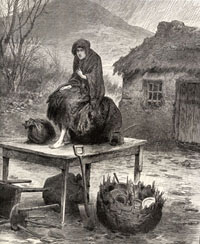 The " Green Isle" is a land of picturesque scenery a land of stirring
intellects and generous hearts a land of poets, warriors, statesmen,
orators, artists, &c., whose names rank high in present fame. It is
wished to make her in the best sense an " ISLAND OF SAINTS."
The " Green Isle" is a land of picturesque scenery a land of stirring
intellects and generous hearts a land of poets, warriors, statesmen,
orators, artists, &c., whose names rank high in present fame. It is
wished to make her in the best sense an " ISLAND OF SAINTS."
December 27, 1848, The Ohio Repository
Ireland -- The London Sun represents that emigration and "extermination" will soon leave the southern and southwestern counties barren wildernesses. Such is the extent of the desolation, that whole towns are tenantless, and large tracts of land lying idle and uncultivated. In one barony of Kerry, through which a correspondent rode, there was no sign of tillage, and in another quarter, there were only two fields cultivated in a range of 35 miles! A correspondent of the Limerick Examiner says, that the country is in a wretched condition, and there was not the least inclination to put in any seed. In the Kilrush Union, upwards of 2,000 houses have been pulled down, and the inmates turned out to beg, during the last 12 months.
August 12, 1893, Black and White, London, United Kingdom
Ireland as a Tourist Centre.
THIS year, the peasants and inn-keepers of the West of Ireland have been astonished at the number of tourists that have invaded their territory, for a season of quiet and a respite from fierce agitation, has sent crowds into the far west districts of Connemara and Donegal, to return surprised at the beauty of these western highlands, and perhaps surprised also at some other matters.
The whole of Ireland, from Glengariff at its extreme south, to the Giant's Causeway upon its northern shores, is crowded with objects of extreme interest.
To take a flying survey of the whole of Ireland as a tourist resort, we will enter the Green Isle by its southern gate of Cork which the Great Western Railway system enables us to do in a comfortable manner and steam up the lovely Cove of Cork, or Queenstown Harbour.
 
|
Eviction Duty in Ireland: Galway with Military and Police Forces The Illustrated London News. 1886 |
The entry by Cork enables us at once to dive into the very heart of some of the most beautiful of Ireland's scenery. The Cork and Bandon railway takes one by rail, and char a banc on to Glehgariff; and its enterprise has made this the favourite route; but the now almost forgotten route, vid Macroom, leads through some of the noblest arid wildest scenery, and through a district where the working out of the new Land and Labourers Cottages Acts can be well studied.
It is a pleasant stroll at Macroom by the river Sullane, above which rises between the trees the tall square castle of Lord Bantry, now in a neglected, dilapidated condition, and bearing evidence of a life's story that is full of madness and folly. Standing by the castle gate, as we emerged from it not long since, was a man attended by two of the famous constabulary, who shadow him for his safety wherever he turns, for twice he has been fired at, and as on the following; morning we drove on towards Gougane Barra, we passed two other gentlemen who had been fired at, one having his driver killed by his side; but matters are quiet now, and even landlords drive fearlessly along the wild country roads. This whole drive of forty miles to Glengariff is full of interest, but the two points especially strange and beautiful are the little Holy Islands on Gougane Barra, the strange lake amid the mountains to which flock in hundreds the peasantry of Kerry to bathe in the Holy well, and to pray amid the ruins of the chapel of St. Vinbar, who exterminated the one monster reptile that had been too much for St. Patrick. Of the oft praised beauties of Glengariff and Killarney, we need to say but a word.
Ross Castle, Killarney, Co. Kerry, Ireland
 Who that has, climbed a mountain and looked down upon the islet flecked bay of Glengariff,
or wandered up to Cromwell's Bridge and lingered by the swift flowing
river that rushes round its ruined piers, has not felt enwrapt by the beauty of
the scene, and the warm, soft enervating atmosphere that gives luxuriant growth
to the flowers and vegetation around?
Who that has, climbed a mountain and looked down upon the islet flecked bay of Glengariff,
or wandered up to Cromwell's Bridge and lingered by the swift flowing
river that rushes round its ruined piers, has not felt enwrapt by the beauty of
the scene, and the warm, soft enervating atmosphere that gives luxuriant growth
to the flowers and vegetation around?
And at Killarney, when in early morning one can be free from tourist and guide, it is pleasant to linger on the soft lawns around Muckross Abbey, or to row lazily out on the lakes' lifting waters, and look round at Tomjer and Tore and mighty Mangerton and the bold ruins of Ross Castle, or to stroll up the Glengariff road and look down upon the whole sweep of the lakes.
The Seven Celtic Nations
The seven original Celtic Nations:

- Eire (Ireland): Ireland is the third-largest island in Europe and the twentieth-largest island in the world. A Norman invasion in the Middle Ages gave way to a Gaelic Resurgence in the 13th century.
- Galicia (Spain): Galacia is in northwest Spain, and descends from one of the first tribes of Celtic heritage in Europe. The name Galicia comes from the Latin name Gallaecia, associated with the name of the ancient Celtic tribe that resided above the Douro river.
- Kernow (Cornwall): Cornwall forms the tip of the south-western peninsula of Great Britain. It was occupied in the Iron Age by Celts. Cornwall was a division of the Dumnonii tribe—whose tribal centre was in the modern county of Devon.
- Mannin (Isle of Man): The Isle of Man is located in the Irish Sea between the islands of Great Britain and Ireland, within the British Isles. It began to be influenced by Gaelic culture in the AD 5th century and the Manx language, a branch of the Gaelic languages.
- Breizh (Brittany): Brittany occupies a large peninsula in the north west of France. Its land area is 34,023 km² (13,136 sq mi). After the Neolithic period, Brittany became home to several different Celtic tribes.
- Alba (Scotland): Alba is the Scottish-Gaelic name for Scotland. It occupies the northern third of Great Britain and it includes over 790 islands. Groups of settlers began building the first known permanent houses on Scottish soil around 9,500 years ago, and the first villages around 6,000 years ago.
- Cymru (Wales): During the Iron Age and early medieval period, Wales was inhabited by the Celtic Britons. A distinct Welsh national identity emerged in the centuries after the Roman withdrawal from Britain in the 5th century, and Wales is regarded as one of the modern Celtic nations today.
Source: The Celtic Crier
To arrive at Galway from this Killarney district the rail runs through Limerick; arid a halt at Limerick Junction gives the opportunity of a walk through the rich, badly cultivated fields to New and Old Tipperary. Limerick is an excellent centre for trips down the lower Shannon to the Kilkee and famous cliffs of Moher district, and, as around Kerry, there is much here to interest the archaeologist and historian: prehistoric and early monastic remains, cashels and cloghauns, abbeys and castles.
The town of Galway still possesses some curious relics of the past--bits of its walls, and remnants of mediaeval houses and the fisherman's heart will be gladdened by the sight of the salmon in the river, and in the mighty expanse of Lough Corib adjoining it. Just outside the town, luckily near the open breezy bay, is the strange cluster of huts of the fishermen's colony, known as the Claddagh, and a Sadder sight than this curious colony, living in low huts amidst dirt and squalor, without windows and in idleness, save when the fish come in, and begging for the price of a potato, can hardly be seen. To those who have not entered Ireland at Dublin, by the Holyhead route, Galway makes a convenient spot fort breaking the Western tour, and by a run across to the capital, especially if he wants to end his visit at Belfast and in the district around Dublin, comfort is again obtained, and the tourist's wants are considered, although the beggar and useless guide is too much in evidence.
 
|
Departure of Irish Emigrants at Clifden County Galway. 1883 |
There is one spot that should be missed by no one who visits Dublin, and that is the strange picturesque Valley where lie the lakes of Glendalough, near whose shores stand the deeply interesting remains of the Seven churches, and a noble example of the strange Round towers. It is curious in wandering amid these churches to note how, in miniature, the architecture in many points resembles that at Mykeme and Tiryns in Greece.
Certainly the true tourist district of Ireland of the future lies between Galway and Donegal. Oftimes in the summer the scenery is hid by pelting rain, but the car agents and "drivers provide no aprons for the passengers, or even tarpaulins for the luggage, and when cars have to be changed the luggage is thrown down into the road, though torrents of rain may be falling. The drivers of these cars are often brutally uncivil, and demand their tips as it were blackmail, and curse the intrepid traveller who refuses any fee on account of their neglect or insolence. But the sight of Clew Bay, from over the hills above Westport, repays one for much discomfort; and the mountain ranges enwreathed and capped with cloud masses, are strikingly grand.
Ere reaching Donegal one town lying inland should not be missed, clean, neat, busy little Enniskillen, where is an excellent little hotel; and a row out on Lake Erne, in half-an-hour if wind is fair, brings one to the lovely island of Devenish, where are the ruins of an Abbey and the most perfect Round tower in all Ireland, perfect to its apex, with a carved moulding running round beneath its peaked summit.
At Donegal, where the Bay is very beautiful, are also some most interesting remains of an Abbey and a Tudoresque castle. The Abbey ruins being famous as the scene of the composition of Ireland's history the "Annals of the Four Masters." Not far from Donegal, but a day's ride, are the stupendous cliffs of Slieveleague, descending in swift descent some 1,700 feet to the sea. From Donegal it is an easy run by rail up through the picturesque pass of Barnesmore Gap, and past Lakes Eask and Mourne and skirting, to finish, the pleasant Lough Foyle, into Londonderry. The notable walls of Derry with their little jutting Bartisan towers will claim a stroll round them ere starting for Portrush, and the district of the Giant's Causeway; but arrived at this northern point, some little time should be taken ere reaching Belfast. The 'whole district is teeming with interest, of strange outfitting castles on precipitous isolated cliffs such as Dunluce, of cliff scenery, varying from the white lime stone to the dark iron-like basalt, that starts up in stupendous forms above that spot that grows upon one as he lingers about alone amidst the thousands of pillars the Giant's Causeway.


From the Causeway there is the most charming of drives -reminding one in miniature of the Cornice, though colour and formation are so different around the coast to Larne. The scenery, that includes that dizzy swinging rope bridge of Carrick-a-rede, repays one for much roughness, and at Larne the rail brings one quickly to Belfast, the thriving town that exports all kinds of work, from the delicate point lace 'kerchief to the mighty Atlantic greyhounds, such as the "Teutonic," proving that Ireland is capable of great things.
SIR ROBERT BALL, the Irish astronomer, has a very fascinating article in the current number of the Fortnightly Review. " The Wanderings of the North Pole" sounds startling as a subject, for the average non-mathematic and non-astronomical mind is under the impression that the North Pole is a very stable abstraction. This, however, is far from being the case, and Professor Ball, in treating of stellar photographs, shows how Polaris, the northern star, itself revolves in a circle round the true Celestial Pole, and how the; position of the North Pole is ever changing. A time will come when Polaris is the North Star no longer and the most critical point in the heavens will be not far from the star Vega. Then, after further twenty-five thousand years, the North Pole will have wandered back to its present position once again. The charm of all Sir Robert Ball's writings marks this brilliant and learned essay.
 
|
The Eviction: Ireland Published by J. T. Foley, 1871 |
Bristol
Until the early 19th century, rivers were the most important means of moving goods and people around Great Britain. Bristol grew up around the point where the rivers Avon and Frome met, a convenient crossing place at the furthest point inland that ships could reach by drifting on the tidal current. The earliest evidence of Bristol as a named place (Bristol means Bridge place ) is about the year 1000, but the Romans had a port further down the river Avon at Abonae.
At the end of the 1600s, Bristol merchants broke into the lucrative Africa trade, transporting trade goods, including cooking pots and guns, to West Africa, exchanging these for enslaved African people and carrying them to the West Indies and America. There they were sold to buy sugar, tobacco and other luxury goods grown on plantations. For a time, Bristol was the main port in this trade but by the 1750s most merchants traded directly with the Caribbean rather than transporting African people; there were fewer risks involved in this. At this time, too, Bristol regained its place as second port in the kingdom, but was quickly overtaken by Liverpool and other new ports before the end of the century.
 
|
| Bristol. 1848. |
After the creation of the Floating Harbour, Bristol continued to grow as a port, but declined in overall importance other places expanded more quickly because they benefited from the development of industry in the north of England. In the 1830s, Isambard Kingdom Brunel built two ships in the port, the paddle steamer Great Western and later the iron screw steamship Great Britain. Each was the largest ship in the world when it was built. After this shipbuilding declined, although some ships are still built in Bristol today.
In the 1870s, new docks were built on the Severn estuary at Avonmouth and Portishead to accommodate larger ocean-going ships. Avonmouth was expanded greatly throughout the 1900s and became the main centre of the Port of Bristol, although the Floating Harbour (known as the City Docks) remained important until its closure to commercial traffic in 1975. In 1977, another enormous new dock was opened at Royal Portbury (on the south side of the mouth of the Avon) and it, with Avonmouth, is the thriving centre of Bristol’s present day port.
Cork
Shipping and maritime trade have always been a vital part of the life of Cork. The city grew up where the River Lee starts to broaden out as it travels to the lower harbour and ultimately to the sea at Roches Point. As the city developed, it created areas where ships could dock safely.
 
|
General Street Scene Cork, Ireland |
The Cork coat of arms shows a ship between two castles.
Trade by sea was essential in the expansion of Cork and by the 18th century regular links had been established with many overseas ports. As well as the long established routes to Britain there were close trading connections with the continent. French ports such as Bordeaux built up profitable associations with Cork, trading wine, brandy and luxury goods for agricultural products. There was also a strong trade with the Baltic from where timber was imported. Some Cork merchants had relations in ports overseas, enabling them to keep a close eye on business matters. For example, members of the Coppinger, Galway and Lawton families were based in Bordeaux on the west coast of France.
 
|
A View of the Cove of Cork (Music Sheet.) |
The geographical location of Cork enabled it to profit from routes between Britain and North America. The provisions trade was particularly important to the city in the 18th and early 19th centuries, supplying products to ships en route to the West Indies and North America.
The outbreak of the American War of Independence in 1775 and the subsequent entry of France into that war on the side of the Americans, meant that shipping on the routes across the Atlantic was vulnerable to enemy attack. One solution was to group large numbers of vessels together in a convoy and escort them to their destination with warships. The large sheltered harbour at Cork was ideal for gathering ships for this purpose during an age when sailing ships often had to wait days or even weeks for a fair wind. The value of the harbour was not forgotten when war broke out in the 1790s against France and again Cork became a busy gathering place for shipping.


A new Navigation Wall was constructed from the mid-18th century to improve the access for shipping as it approached the city. Similarly, over time, the quaysides in the city itself were improved so that ships could more easily discharge directly onto the city docks. The result was greatly expanded shipping operations close to the city centre and near the various industries and trades there from the 19th century.
September 8, 1890, Daily Alta California, San Francisco, California, U.S.A.
IRELAND'S DISTRESS.
William O'Brien Urges the Tenants to
Withhold Their Rents.
 
|
Roofless Cabin during Evictions. Ireland |
Cork, September 7th.
William O'Brien, speaking at Mulin, County Cork, said it would be Ireland's own fault if a single child starved. The tenants ought not to pay a penny of rents until their families were provided for.
They had no business to make begging appeals to Irishmen abroad, but should look to Balfour and his sublime schemes.
March 10, 1891, Daily Alta California, San Francisco, California, U.S.A.
The Champion Merioneth.
The ship Merioneth sailed yesterday with a load of wheat for Cork, Ireland. Captain Thomas proposes to beat the record going back. As she left the harbor she flew the championship flag presented to her a short time since by J. D. Spreckels & Bros.
The Disaster to the Great Eastern
|


 At the close of 1880 this company sunk $86,715 upon the vessel, thus making her total cost $4,703,675. Nothing ever built can stand comparison with the Great Eastern excepting Noah's ark, and even this vessel could not match her. The length of the ark was 800 cubits, her breadth 50 cubits and her height 30 cubits. The cubit of the Scriptures, according to Bishop Wilkins, was 21 65-100 inches, and computed into English measurement the ark was 547 feet long, 91 feet beam, 54 7-10ths feet depth, and 21,762 tons. The Great Eastern is 680 foot long, 83 feet beam, 56 feet depth, and 28,093 tons measurement. So Noah's ark is quite overshadowed by the Great Eastern.
Fallmore and Blacksod
Evictions in Ireland Heart-rending Scenes.
The Rev. Patrick Malone, priest of Belmullet, Mayo, in a letter to the London Times, says .
On the 12th of August the Sub-Sheriff of the county, with a large escort of police, proceeded to the town lands of Fallmore and Blacksod the property of the Rev. W. Palmer, distant about fifteen miles from this town, and commenced to evict under a writ for non-title. The work of demolition continued until forty-eight families had been left houseless and homeless, the bare walls only of their little houses being left to stand. It is impossible to describe the whole scene as it occurred. When the several little articles of furniture were flung out upon the streets and the roofs came tumbling to the ground, the cries and the screams and the frenzied exclamations that rent the air are more easily imagined than described.
The poor people had to take shelter in ditches and in the old ruins of a neighboring churchyard. Their condition up to this moment is most deplorable. One poor woman, the wife of Dennis Murphy, under the exposure of the night, was seized with the pangs of travail, and was compelled to seek admittance to a cabin where eighteen others had taken shelter also. These unfortunate creatures are now constructing huts for themselves on the most novel sites and plans that intellectual beings could think of. Through the kindness of a neighboring tenant they are permitted to use the wild, rocky shore of the Atlantic for that purpose. There a line of " shanties" has been erected, and I am thoroughly convinced that the next equinoctial gales, should they come from the southwest, will cause them to be washed away by the angry breakers, which are wont to roll in upon the shore at all times.
The following will give you an idea of these curious buildings. I visited the place on the 23d, in company with a gentleman from London, and what I state is the result of actual observation made on that occasion. Pat Gaughan, with five in family; Mary Gaughan, with five in family; Anne Gaughan, with three in family making in all thirteen live in one cabin, the dimensions of which are seventeen feet long, seven feet broad, and five feet high (the top of the roof). Samuel Walker, seven in family; house thirteen feet long, seven feet wide, five feet high; height of door, three feet. John Carduff, five in family; James Walker, six in family; both live in the same cabin of fourteen feet long, seven feet broad, and five feet high; door three feet high. Owen Lavelle, four in family; house nine feet by nine, and five feet high; door three feet high. Such is the character of the dwellings these poor creatures intend to use during the Winter. They are, moreover, made without mortar, and none of them has a door. You may judge how I and my friend had to observe a sitting posture while under the roof of each of them. They all seem totally destitute of comfort, not having even the appearance of a bed or bedding.
Giants Causeway
The Giant's Causeway stretches 3 miles (4.8 km) along the coast along the north coast of the Moyle district, Northern Ireland, NE of Coleraine along the coast of Antrium.
The news of the "discovery" of an amazing natural phenomenon broke on an unsuspecting world in 1693 it was by the presentation of a paper to the Royal Society from Sir Richard Bulkeley, a fellow of Trinity College, Dublin. The "discoverer" had, in fact, been the then Bishop of Derry a year earlier. In 1697 a draughtsman was sent to make drawings of the Natural Curiosity on the North East tip of the island of Ireland.
At that time, there was much argument as to whether the Causeway had been created by men with picks and chisels, by nature, or by the efforts of a giant. Nothing like it had been seen before. As an artist, Miss Susanna Drury spent, in 1740, quite some period of months on site. Depicting the magnificence that she found, ensured that the Causeway became noted on The Grand Tour. And it was not until 1771 that a Frenchman, Demarest, announced the origin of the causeway to be the result of volcanic action.
Limerick


Limerick, located on the River Shannon, was conquered by Vikings in the ninth century.
An early record of the name of Limerick is contained in the The Annals of the Four Masters
In 1760, Limerick was proclaimed an open city and the demolition of the medieval walls began. Around that time the building of the Georgian town known as Newton Pery started. The main leaders connected with this movement were Pery, who owned most of the land, his brother-in-law Sir Henry Harstonge, the Russell's and the Arthur's. Many streets are named after these people and members of their families.
The Great Famine of 1847 did not affect Limerick to any great extent as a result of the work of charitable organizations and also because the people were not entirely dependent on potatoes.
During the 19th century many new buildings were erected in Limerick. The old Town Hall was built in 1803. A County Court House was built in 1810. The first hospital in Limerick opened in 1811. St Saviours Dominican Church was built in 1816 and Limerick Goal was built in 1821. Sarsfield Bridge was built in 1827. Thormond Bridge was rebuilt in 1836. Villiers Alms Houses were built in 1830. Barringtons Hospital was built in 1830 and Limerick Potato Market was built in 1843. A statue of O'Connell was erected in 1857. St Johns Cathedral was built in 1859. The spire was added in 1883. Taits Clock was built in 1867 in honour of Sir Peter Tait. J Corbett designed it. The Sarsfield Monument was erected in 1880. Meanwhile work began on the Franciscan Church in 1876 but it was not finished until 1936. There was a great deal of terrible poverty in Limerick in the 19th century. Yet in some ways it was an age of improvement. In 1826 a company was formed to supply Limerick with water and from 1824 Limerick had gaslight. The first electric light in Limerick was switched on in 1880. Meanwhile the railway reached Limerick in 1848 when it was connected to Tipperary.
Limerick was connected to Waterford by rail in 1854. Furthermore the Peoples Park was laid out in 1876. Meanwhile about 1829 a lace making industry was started in Limerick, which soon prospered.
Rosslare


The headland, originally known as Rosl ir (the middle peninsula), was formed by drifting currents that moved along a tortuous sweep of Wexford Bay and grew from a sandpit of accumulated gravel deposits over many years.
It had extended almost three miles seaward when its strategic importance was recognised by the Confederates of Kilkenny who, during 1642, planned to utilise it for a defence fort as a safeguard and protection of the walled town of Wexford against possible invasion. Seven cannons were promptly installed in Rosslare, each pointing seaward. Houses were built gradually to accommodate the growing population there. A cluster of 12 houses in the form of a square was first erected, eventually reaching 50 houses. The square had a cobble-stoned courtyard with a central flagstaff, 70 feet high, and a large cannon in readiness at its base. This served as the focal point of the fortification.


In 1800 a commander named Warren was appointed in charge. By 1870 more than half of the Forts dwellings had fallen into disuse and disrepair. By then the last school teacher, Miss Shanahan, had moved to Wexford town where she opened a private school in South Main Street.
Waterford
Waterford City was founded in 914 AD and developed into a significant urban area during the 10th century. Reginald s Tower marks the site of the first defensive structure built by the Viking settlers. The Tower is mentioned in the Irish Annals as early as 1088 thus making it the oldest civic building structure on this island. In the 1080s, a Viking fleet at Waterford had become a major force in the tangled web of Irish and Welsh political intrigue when Diarmuid O Brien, King of Munster, negotiated that the fleet go to Wales to assist Gruffydd ap Cynan to recover the Kingdom of Gwynedd in Wales. A hundred years later it was the turn of a dispossessed Irish king to seek help from beyond the sea in order to regain his lost kingdom.
Lismore Castle, 1856.
Henry II visited Lismore in 1171 and chose this site for a castle. Raymond le Gros and his Anglo-Normans ransacked the town two years later and Henry's castle site was built upon by Prince John in 1185. In 1363, the diocese was united with that of Waterford, although it retained its cathedral until the Reformation. The castle passed to Sir Walter Raleigh in 1589 and Raleigh sold it to Richard Boyle, Earl of Cork, in 1602. He immediately set about fashioning the countryside round Lismore in the English way, with stocked deer parks, fruits orchards, fish ponds and other features of the English Lordly manor estate. In 1753, the castle passed to the 4th Duke of Devonshire on his marriage to Lady Charlotte and the present castle is still owned by the Devonshires. |

During the nineteenth century Waterford Glass achieved a world-wide reputation with exports going to the four corners of the earth. Many of the ships carrying this glass to foreign ports were in fact built here in Waterford. The ship building trade that has been practised in the port for over a thousand years has entered a new phase. By the mid-nineteenth century Waterford had four ship building yards and was second only to Belfast in terms of tonnage produced. Waterford shipyards highlights the role of Quakers as entrepreneurs, and particularly as risk-takers, who were willing to fund new enterprises, providing rare economic relief to underdeveloped areas without the guarantee of a good return on their investment a rarity in Ireland, and a glimpse or reminder of what might have been. Their shipbuilding ventures in Waterford were as technologically advanced as any similar development of the day, and they certainly primed and brought to fruition the industrial revolution on the banks of the Suir.
The first iron steam ship ever to sail into a Russian port was built in Waterford; appropriately it carried with it a gift of Waterford Glass presented to the Tsar when the ship sailed into St. Petersburg.
Irish Orientalism: A Literary and Intellectual History (Irish Studies)
Joseph Lennon

The Seven Celtic Nations
- Eire (Ireland): Ireland is the third-largest island in Europe and the twentieth-largest island in the world. A Norman invasion in the Middle Ages gave way to a Gaelic Resurgence in the 13th century.
- Galicia (Spain): Galacia is in northwest Spain, and descends from one of the first tribes of Celtic heritage in Europe. The name Galicia comes from the Latin name Gallaecia, associated with the name of the ancient Celtic tribe that resided above the Douro river.
- Kernow (Cornwall): Cornwall forms the tip of the south-western peninsula of Great Britain. It was occupied in the Iron Age by Celts. Cornwall was a division of the Dumnonii tribe—whose tribal centre was in the modern county of Devon.
- Mannin (Isle of Man): The Isle of Man is located in the Irish Sea between the islands of Great Britain and Ireland, within the British Isles. It began to be influenced by Gaelic culture in the AD 5th century and the Manx language, a branch of the Gaelic languages.
- Breizh (Brittany): Brittany occupies a large peninsula in the north west of France. Its land area is 34,023 km² (13,136 sq mi). After the Neolithic period, Brittany became home to several different Celtic tribes.
- Alba (Scotland): Alba is the Scottish-Gaelic name for Scotland. It occupies the northern third of Great Britain and it includes over 790 islands. Groups of settlers began building the first known permanent houses on Scottish soil around 9,500 years ago, and the first villages around 6,000 years ago.
- Cymru (Wales): During the Iron Age and early medieval period, Wales was inhabited by the Celtic Britons. A distinct Welsh national identity emerged in the centuries after the Roman withdrawal from Britain in the 5th century, and Wales is regarded as one of the modern Celtic nations today.


The history of the Celtic cross goes back to a time before the Christian conversion of Scotland, Ireland and Wales. It’s believed by some that the four arms of the cross represents the four elements, earth, air, fire and water. They also represent the four directions of the compass, North, South, East and West. And finally the four parts of man, mind, soul, heart and body. The horizontal line of the cross symbolizes earth and the vertical portion symbolizes heaven.
Sources: The Celtic Crier, Gaelic Forge

Site Search
Crowds in Ireland, C.1720-1920
Peter Jupp, Eoin Magennis, Editors.
Although the history of crowds in modern European history has been one of the most hotly debated subjects since E. P. Thompson's work of the 1960s, the crowd in Irish history has been largely neglected. This is the first study of the subject during the most turbulent period of Ireland's history. The introduction proposes an outline history of the crowd in Ireland and is followed by eight specialist studies of crowd activity by new and innovative scholars in the field. A special feature of the volume is that it incorporates discussions from a Colloquium held in Belfast in 1998 which was attended by the contributors and senior Irish and British historians.


Gaelic Beginner to Intermediate Course:
Learn to read, write, speak and understand Gaelic.
Boyd Iain Taylor, Iain Taylor.



DNA: Family History Genealogy and Ancestry Research Through DNA Testing
Martin Arrowsmith
Ogam: The Celtic Oracle of the Trees: Understanding, Casting, and Interpreting the Ancient Druidic Alphabet
Paul Rhys Mountfort.
The ancient Ogam alphabet is a magical and mysterious script, the Celtic equivalent of the runes that can teach us about our fate and future. Named after woodland trees, Ogam's 20 "tree letters" all have unique wisdom to impart that is linked to figures and themes from Celtic mythology.

Searching For Your Ancestors in Historic Newspapers
Claudia C. Breland




The Family Tree Problem Solver: Tried-and-True Tactics for Tracing Elusive Ancestors
Marsha Hoffman Rising



Genetics: From Genes to Genomes, 5th edition
Leland H. Hartwell, Michael L. Goldberg, Janice A. Fischer, Leroy Hood, Charles F. Aquadro.
eTextbook, Harcover, Paperback.



 Copyright ~ 1998-2018.