Germany
° Berlin ° Bremen ° Cologne ° Dresden ° Dusseldorf ° Frankfurt ° Hamburg ° Munich ° Stuttgart
° Jewish Migrations
Germany (Kingdom of Prussia)
Prussia was the former kingdom and state of Germany. At the height of its expansion, in the late 19th century, Prussia extended along the coasts of the Baltic and North seas, from Belgium, the Netherlands, France, and Luxembourg on the west to the Russian Empire on the east, to Austria-Hungary on the east, southeast, and south, and to Switzerland on the south.
Prussia (German Kingdom).
J & F Tallis. 1851

Frederick William's son, Frederick I, became king of Prussia in 1701, receiving royal recognition in exchange for a promise of military aid to Holy Roman Emperor Leopold I. Frederick's son, Frederick William I, greatly increased the size of the Prussian army and rebuilt the organization of the state around the military establishment. To his son, Frederick II, the Great, he left enormous financial reserves and the best army in Europe. Through the military genius of Frederick the Great, Prussia became a major power in Europe. In 1740 he invaded the Austrian province of Silesia and precipitated the War of the Austrian Succession.
Bridge houses Kreuznach (Bad Kreuznach). Nahethal Rhenish. Germany, c. 1890s.
In 1806, Frederick William joined a coalition against Napoleon. Frederick William was defeated, and much of his territory was lost.

After the negotiations at the Congress of Vienna, Prussia emerged as the major German power of Western Europe. By 1844 almost all German states were economically linked with Prussia. Under King William I and his prime minister and imperial chancellor, Prince Otto von Bismarck, Prussia reached the peak of its power. Bismarck provoked war with Denmark in 1864, the Seven Weeks' War against Austria in 1866, and the Franco-Prussian War in 1870. These three wars established Prussia as the leading state in the German Empire. ~~ History-World.org
The immediate replacement of the Empire by states ruled by a feudal aristocracy of largely Germanic extraction did not lead to the dominance of German on the continent of Europe. The most politically and militarily successful of the migrating Germanic tribes the Franks, the Langobards, the Allemanni, and the Visigoths all abandoned their Germanic languages in favor of the popular Latin spoken by the indigenous populations of the Roman territories they overran and subsequently governed.
As a result the German language, although of great importance for the historical literature of science and technology, does not today play a major role in global commerce. The earliest written records of any Germanic language are isolated words and names cited by Latin authors of the 1st century B.C. From 200 A.D., Germanic carved inscriptions are found using a 24-letter “runic” alphabet.
The official conversion of the Roman Empire to Christianity in 312 A.D. slowly led to the Christianization of all the Germanic tribes over succeeding centuries, launching the establishment of their tongues as written (as against oral) literary languages, as the Bible was translated for local use.
German-Americans


German-Americans represent the largest group of immigrants arriving in the United States in all but three of the years between 1854 and 1894.
(Editor's Note: As this is written, reports indicate that the most-spoken language in American homes other than English is German.)
August 18, 1883, American Settler, Washington, D.C.
Immigration and its Effects
The following table shows the distribution of the immigration movement among all the principal nationalities in the last two years. It should be said that the totals here given are somewhat smaller than those for the same years above, because presumably the latter include the movement at every port of the country, while the former include only movement at the ten leading ports given in the table further, below, which ten ports, however, embrace within a small percentage of the entire movement.
The poor harvests during those years in Europe also contributed to swell the movement. With the failure of our crops, however, and the other adverse circumstances that followed such as the check to railroad expansion and the consequent diminution in the consumption of many of our manufactured articles the United States presented a less inviting option for immigrants intending to better their condition, and many no doubt were deterred who otherwise would have come.
Countries from which Immigrants arrived:
(Note: The following numbers are difficult to read in the newspaper; figures may be off somewhat, but this will give an overview of immigration during the 1882-1883.)
Name |
1883 |
1882 |
| England and Wales | 79,852 |
83,697 |
| Ireland | 63,720 |
76,252 |
| Scotland | 19,612 |
18,763 |
| Austria | 10,517 |
20,089 |
| Germany | 191,648 |
249,169 |
| Italy | 31,715 |
33.066 |
| Norway | 21,849 |
28,466 |
| Sweden | 84,596 |
64,276 |
| Dominion of Canada | 64,971 |
93,029 |
| All Other Countries | 78,849 |
104,623 |
| Total | 593,327 |
770,422 |
Before the end of the century more than 5 million Germans had arrived. They came from a wide geographic area and for a variety of reasons. They were a highly diversified group in terms of regional origin, religious and political orientation, education and socioeconomic standing.
This migration began early in January of 1709 and a German settlement was founded in New Bern, North Carolina. By April of 1709, German settlements were established along the Hudson River in New York.

In response to demands raised by German trading houses for more regular services of a higher standard, the German Bismarck and his postmaster-general, Heinrich von Stephan, signed a contract in 1885 with the Norddeutscher Lloyd (North German Lloyd) of Bremen to operate the Imperial Mail Steamer Services. British shipping found it difficult to compete with German shipping because of this government subsidy.
November 15, 1887, Manufacturer and Inventor, London, United Kingdom
Prospects of the Ship Building Trade
...Turning his attention to the subject of ship building in foreign countries, the author showed that out of a total of 464,016 tons registered as built by the United Kingdom, France, Germany, Italy, Norway, and Sweden during the year 1886-7, 327,743 tons were built in the United Kingdom, and 76,273 tons were built elsewhere; but of the latter no less than 19,916 tons were wood or composite, leaving only 56,357 tons of iron and steel built out of, as against 327,743 built in the United Kingdom. Germany is fast becoming a ship building country, already producing two-thirds of her fairly large requirements, whilst France produces less than two-thirds of her requirements, although these are less than one third of Germany's. With the exception of the four countries named, the whole world is dependent upon the ship building yards of this country for its fleets . . .
Rulers Whom William I Outlived.April 22, 1888, Daily Alta California, San Francisco, California, U.S.A.   The deceased Emperor of Germany, William I, witnessed during his life the removal from their seats of power of six Popes, nine Emperors, fifty Kings, six Sultans and twenty-one Presidents of the United States. Of these rulers five are still alive — Amadeo, ex-King of Spain; Isabella, ex-Queen of Spain; Francesco II, ex-King of Naples, and the ex-Sultan Mouhrad V. They run as follows: Six Popes — Pio VI, Pio VII, Leo XII, Gregorio XVI and Pio IX. Two Emperors of Austria — Francis I and Ferdinand I. Two Emperors of France— Napoleons I and III. One Emperor of Mexico — Maximilian. Four Emperors of Russia — Paul I, Alexander I, Nicholas I and Alexander II. Five Sultans — Selem III, Mustapha IV, Mahmoud II, Abdul Medjid and Abdul Asz. Five Kings of Sardinia and Italy — Charles Emanuel, Victor Emanuel I, Charles Felix, Charles Albert and Victor Emanuel II. Four Kings of Naples — Ferdinand I, Joachim Murat, Francis I and II. Three Kings of Portugal — Pedro IV, Pedro V, Luis I. Three Kings of Prussia — Frederick William II, III, and IV. Two Kings of Wurtemberg — Frederick I and William I. Four Kings of Bavaria — Maximilian Joseph I, Louis I, Maximilian I and Louis II. One King of Westphalia — Jerome. One King of Belgium — Leopold I. One King of Greece — Otto I. Three Kings of Holland — Louis, William I and II. Three Kings of Great Britain — George III, George IV and William IV Three Kings of France — Louis XVIII, Charles X and Louis Phillippe Five Kings of Sweden — Gustave IV, Charles XIII, Charles XIV (Bernadotte), Oscar I and Charles XV. Four Kings of Denmark — Christian VII, Frederick VI, Christian VIII. Four Kings of Spain — Charles IV, Ferdinand VII, Joseph and Alfonso XII. |
October 4, 1893, Galveston Daily News, Galveston, Texas
WARSHIP AGITATION
Recent Criticism in England Finds Hearty Response In Germany.
Berlin, September. 30. The recent agitation in England in regard to the defenses found in the British warships, brought on mainly by the disaster to the Victoria, has had an echo here.


It will be remembered that in the house of commons recently Mr. Edward T. Gourney, a well known ship builder and member from Sunderland, asked whether since the sinking or the warship Victoria the government's attention has been directed to the criticism of experts at home and abroad as to the utility of ships of monstrous size. It was claimed that the majority of the large British battleships were comparatively useless for the purpose they were intended for. It was also suggested that the British fleet would be more strengthened by the addition of a large number of fast cruisers, of powerful rams, and vessels of a type smaller and less expensive than the monster battleships which seem to find so much favor with the British ship builders.
In this country the reported increase in the naval estimate has caused much dissatisfaction among the radicals and liberals, who claim that Germany does not need a strong navy nor an addition to the army. The ship building experts of Germany have followed closely the criticism made in England upon the British warship which has recently met with disaster, and the German exports insist that the present existing type of German warships is especially unsuited to Germany. They cite as an instance that the Koenig Wilhelm and Deutschland are scarcely able to use their guns during a heavy sea. This fact was instanced recently during the naval maneuvers in the German ocean, and it is claimed that these ships were shown to be thoroughly unsuited for Germany's flat-land coasts. The Koenig Wilhelm was launched in 1869, has twelve inches of armor, carries eighteen four and a half ton guns and four twelve-ton guns. She has 8000 indicated horse-power and a tonnage displacement of 9757 tons. The Crown Prince has only five inches of armor and carries sixteen nine-ton guns. She is of 6800 indicated horsepower and has a displacement of 5568 tons.
As an instance of the rolling propensities of this ship it is said that on a recent cruise she met with rather rough weather, nearly all of her officers and sailors were more or less sea-sick, and those who were not sea-sick were pitched about and bruised In an alarming manner. Of course these facts may be much exaggerated, but there seems no doubt that the complaint made against such ships as the Crown Prince are deserved. It will be remembered that complaints of a similar nature have been made against several warships in Great Britain.
The Deutschland has ten inches of armor, carries eight twenty-three-ton guns and seven four-ton guns. She has 9000 indicated horse-power and a displacement of 7700 tons. It is also known and has been admitted for a long time past that warships like the Crown Prince roll so much in the German ocean that their crews are scarcely able to move at all. In view of these facts it is more than likely that the government will meet with serious opposition in carrying out Emperor William's project to increase the strength of the German navy.
July 13, 1900, San Francisco Call, San Francisco, California, U.S.A.
LINERS TO CARRY TROOPS.
HAMBURG. July 12.— The Boersenhalle announces that the Hamburg-American line has leased four North German Lloyd line steamers to the Marine Minister for the transportation of 12,000 troops and ammunition to China.
February 21, 1914, Sacramento Union, Sacramento, California, U.S.A.
Great Steamship War Settled by Directors
New York, February 20. Chas. Von Helmolt, New York agent of the North German Lloyd steamship line received a message today from Philip Heiken, managing director of the line, saying that differences between the North German Lloyd and Hamburg-American companies had been adjusted.
April 27, 1916, Los Angeles Herald, Los Angeles, California, U.S.A.
68 TEUTONIC SHIPS, VALUED AT $100,000,000, INTERNED IN U. S.
In event of serious trouble between the United States and the Teutonic powers this country would be In a fortunate position for quick action In the field of confiscation.
The activity of the British navy has been responsible for the scudding to cover in American harbors of 68 German and Austrian vessels, valued at more than $100,000,000. These ships, with gross tonnage of 527,298 and net of 303,299 tons, are interned mainly in New York, Boston and Baltimore, but there are several In Hilo and Honolulu harbors as well as at other ports of both continental coasts.
The largest Is, of course, the huge Vaterland, 54,282 tons, which long has been moored In upper New York harbor, where also are the 25,000-ton George Washington and the Kaiser Wilhelm II, President Lincoln and President Grant, each of more than 18,000 tons, sixteen of the vessels are of more than 10,000 gross tons, all these belonging to the Hamburg-American and the North German Lloyd lines. In each of which the Hohenzollern royal family is said to be heavily interested financially.
Names and owners of interned vessels —10,000 tons and over—and their location, follow:
| Steamer | Gross tons | Interned at | Owner |
| Vaterland | 64,282 | New York | Hamburg-American Line |
| George Washington | 25,670 | New York | North German Lloyd |
| Amerika | 22,622 | Boston | Hamburg-American Line |
| Kronprinsessin Cecilie | 19,503 | Boston | North German Lloyd |
| President Lincoln | 18,168 | New York | Hamburg-American Line |
| President Grant | 18,072 | New York | Hamburg-American Line |
| Cincinnati | 16,339 | Boston | Hamburg-American Line |
| Pennsylvania | 13,333 | New York | Hamburg-American Line |
| Grosser Kurfurst | 13,102 | New York | North German Lloyd |
| Bulgaria | 11,440 | Baltimore | Hamburg-American Line |
| Barbarossa | 10,984 | New York | North German Lloyd |
| Prinzess Irene | 10,892 | New York | North German Lloyd |
| Frederick der Grosse | 10,771 | New York | North German Lloyd |
| Hamburg | 10,981 | New York | Hamburg-Amerlcan Line |
| Rhein | 10,068 | Baltimore | North German Lloyd |
Bremen
Manchester Ship Canal
North German Lloyd Company
March 16, 1895, Colonies and India, London, United Kingdom
The directors of the Manchester Ship Canal have made arrangements for the running of fresh lines from the new port. The North German Lloyd will run steamers between the port and Bremen, taking cargo for trans-shipment for vessels trading to Brazil, Australia, China, West Indies, &c. In addition, a fortnightly service of fast steamers will trade between Manchester, Quebec, and Montreal, beginning in April; while the Wilson Line, whose operations have hitherto been confined to Hull, announce a regular service of steamers between Manchester and the Baltic ports. The vessels employed in the Montreal service will be large cattle carriers, and will bring cattle to the corporation's lairages at Mode Wheel. The owners of the steamships undertaking this service are Messrs. Furness, Withy & Co., London, and Messrs. Seive bright, Bacon & Co., of West Hartlepool.
The rumor that Mr. Huddart was negotiating with the North German Lloyd Company for a fast line of steamers to Canada is, of course, inaccurate. As explained in the Times, it would lie contrary to the spirit of the offer made by the Canadian, Government, which is for the establishment of British' communication between Great Britain and Australia by way of Canada. It is believed that Mr. Huddart's proposals are now receiving the earnest consideration of Her Majesty's Government, and we hope that, before long, some announcement may be made of its decision.
A great number of the German emigrants left from the ports of Bremen and Hamburg. The Bremen passenger departure records were destroyed during WWII, but the lists were reconstructed from National Archives passenger lists of vessels arriving in New York. The Hamburg passenger lists, which survived the war, contain the names of millions of Europeans who emigrated through Hamburg between 1850 and 1934 (except 1915-1919). Nearly one-third of the people who emigrated from central and eastern Europe during this time are included on these lists.
The failed German revolution in 1848 stimulated emigration to America. Although conditions in the German states were not as bad as in Ireland, crop failures, inheritance laws, high rents, high prices, and the effects of the industrial revolution led to widespread poverty and suffering.
Over the next ten years over a million people left Germany and settled in the United States. Some were the intellectual leaders of this rebellion, but most were impoverished Germans who had lost confidence in its government's ability to solve the country's economic problems. Others left because they feared constant political turmoil in Germany.
Hamburg


In the 18th century, the economy of Hamburg continued to grow steadily and at the turn of the century, the population totalled 130,000. The end of the old German Empire meant that the city could finally become fully autonomous. From this time on, Hamburg has been known as the Free Hanseatic Town. In 1810, Napoleon invaded Hamburg and this led to a significant downturn in fortune until the French left the city again in 1814. The Congress of Vienna in 1815 guaranteed the freedom of the city and it subsequently joined the German Federation.
In 1842, nearly 20,000 people lost their homes when fire reduced approximately one-third of the city centre to ashes. The building of railway lines to Kiel and Berlin and the development of steam ship routes led to an economic upswing that financed the systematic rebuilding of the city.
Port of Hamburg, 1894.
Leopold Karl Walter Von Kalckreuth


In 1867, Hamburg joined the North German League and in 1888, it joined the German Customs League, both of which proved to be crucial events in its historical development. Hamburg became known as Germany s Gateway to the world.
By 1912, Hamburg's harbour was the third most important seaport in the world, after London and New York.
December 22, 1896, Newark Daily Advocate, Newark, Ohio
Largest of Vessels
Tremendous Fleet of Steamers Now Being Built
The Kaiser Wilhelm der Grosse Will Be the Jumbo of the Lot --
Skyscrapers Not In It With Them --
Arrangement of Engines and Their Carrying Capacity
Eight gigantic steamships, of which the Kaiser Wilhelm der Grosse is the biggest, and each capable of carrying more passengers and cargo than the famous Great Eastern, are now under construction in German shipyards for service between New York and Europe. This is a startling statement, but one borne out by figures and illustrations obtained, from the home offices of the North German Lloyd in Bremen and the Hamburg- American line in Hamburg.
Two of these new steamers are considerably longer than the great Pennsylvania of 20,000 tons, recently launched at Belfast. Of course the monstrous Great Eastern was longer, wider and deeper than the new marine giants, but external lengths do not represent the size of a vessel's capacity. Shipping people the world over measure vessels by their carrying capacity. The modern shipbuilder is able to construct a vessel smaller than the Great Eastern, but one that will be a greater carrier.
The Great Eastern was built to carry 20,000 tons of cargo and 1,000 passengers, or 5,000 passengers and no cargo. Some of the new leviathans will not only carry 20,000 tons of cargo, but from 1,500 to 2,300 passengers also. When the length of these vessels is stated in figures, they do not convey an adequate idea of the monsters.


The St. Paul building could be stowed in her hold, and the vessel would be a little more than half full. And this building is 306 feet high and weighs 25,000,000 pounds. The 30 story building going up in Park row would fill two of the steamers and half fill a third one. To load the Kaiser Wilhelm der Grosse with a full cargo of grain the yield from a wheat field of 40,000 acres would be consumed. This enormous amount of grain would need 1,230 railroad freight cars, with 650 bushels to a car, making over 60 trains of 20 cars each.
Give the Kaiser Wilhelm der Grosse a full cargo of soft coal, and 1,000 coal hoppers laden with 20 tons each would be necessary to fill her. Were she loaded with water, she would carry 5,000,000 gallons. This would be enough to give almost two gallons of water to all the population of Greater New York. She is also capable of carrying enough food to give a pound package to over half the population of the United States, or, to be exact, 44,800,000 pounds of flour, coffee or meat. It has been calculated that in these ships a piece of coal the seize of a walnut will drive ten barrels of flour one mile. Each craft will consume from 200 to 300 tons of a coal a day and boil down 100 tons of water. Down in the bowels of the ships will be found 100 stokers and trimmers of course not all working at one time, but in gangs of 25 feeding two score of furnace mouths.
The Kaiser Wilhelm der Grosse is the longest of all. She is to have four funnels and 28,000 horsepower in her quadruple engines. She will be 649 feet in length.


The Kaiser Frederick, (image right) 15 feet longer than the new Pennsylvania, but 49 feet shorter than the Kaiser Wilhelm der Grosse, will have three funnels and 24,000 horsepower. The other four, known as the Barbarossa class, will have two funnels and are to be 14 knot boats, with the exception of the Bremen, which will be a 15 knot vessel.
The Pennsylvania and her sister ship, building for the Hamburg-American line, will have four masts and a single funnel each, the stack being broad enough to drive an omnibus through it. The steel structures will be divided by a non communicating bulkhead running from the keel to the upper deck. To go from one to the other side of the hull it will be necessary for the officers and crew to ascend to the deck.
This arrangement, in addition to a number of bulkheads, makes the ships almost unsinkable, were they to be flooded with water.
The two engines, with quadruple cylinders, occupy separate compartments, each worked independently of the other. In addition to 20,000 tons of cargo, these ships will carry 1,500 passengers. The first cabins have been arranged above deck amidships, the second cabin aft and the steerage passengers on the main deck and the upper deck amidships. Above the saloon deck is an extra deck containing the dining and smoking rooms.
The Pennsylvania and the Barbarossa will be the first of the new steamers to arrive here. They will reach New York early in the spring. The Kaiser Wilhelm der Grosse will not appear until some time later. She is the longest ship ever built, with the exception of the Great Eastern, but is bigger than the latter in her capacity for carrying cargo and passengers at a profit. The Kaiser Wilhelm der Grosse is a new type, and one which it is now expected will have many imitators. The boldness and thoroughness with which such a monster vessel has been designed and built in Germany have excited the jealousy of British shipbuilders, who are already predicting that she will be a failure.
Pittsburg Dispatch.
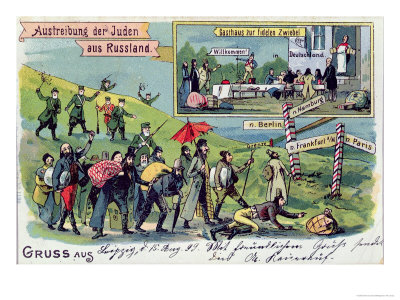
Postcard depicting the Expulsion of the Jews from Russia and their welcome into Germany. 1899 |
September 10, 1900, New York Times, New York, New York, U.S.A.
Swift Deutschland First to Signal
Kaiser Wilhelm der Grosse Beaten by Over Five Hours
A Record-Breaking Voyage
Hamburg-American Liner, Going at Nearly 24 Knots,
Makes Plymouth in 5 Days 7 Hours and 38 Minutes.
Memorable in the history of ocean voyages will be the runs of the great German liners Deutschland and Kaiser Wilhelm der Grosse from this port to the Lizard, where both were reported last night. They left New York last Tuesday morning in close company, and for a considerable portion of their voyage were in plain sight of each other.
It would be hardly fair to call it a race, because the officials of both lines, the Hamburg-American and the North German Lloyd, to which the vessels belong, deny that it was, but when the Deutschland, belonging to the former line, stopped at Cawsand Bay at 2:30 o'clock this morning she had broken the record from this port to Plymouth by a wide margin and had beaten her rival by several hours.
Beach Terrace. Strandterrasse. 
1913. |

Site Search


The Vanished Kingdom: Travels Through The History Of Prussia
James Charles Roy.
what was once Prussia is now a significant portion of Eastern Europe, a contested homeland first won by Christian knights of the Teutonic Order. For centuries thereafter its terrain has been crisscrossed by war and partitioned by barbed wire.


Imperial Requiem: Four Royal Women and the Fall of the Age of Empires
Justin C. Vovk.


Harmonious Triads: Physicists, Musicians, and Instrument Makers in Nineteenth-Century Germany
Transformations: Studies in the History of Science and Technology.
Myles W. Jackson


Literature on Trial: The Emergence of Critical Discourse in Germany, Poland & Russia, 1700-1800
S. D. Chrostowska




 Copyright ~ 1998-2018.