San Francisco News and Stories: 1800s
The High Cost of Passage
Daily Alta California, San Francisco, March 15, 1853
MINERS' MEETING ON THE PLAZA. ? ?A large number of miners, nearly three hundred, met on the Plaza yesterday to take into consideration the most feasible means to be adopted by them to reach the Atlantic States. It appeared that these men had come in from the mines anxious to return to their homes and families after a long absence, in consequence of an advertised reduction in prices by the different steamship companies in this city.
They had incurred a considerable expense in getting here, and on their arrival found that the different lines, instead of taking them for $100 each, as advertised a short time since, had put their prices up to $325 for the first class cabin passage, and the steerage passages $110, in the P.M. Steamship Company's ships, and $200 on the Vanderbilt line.?
|
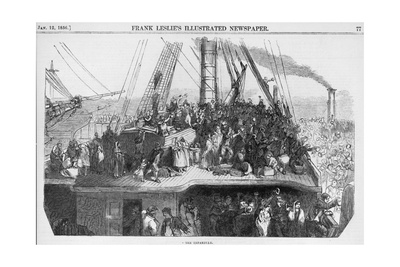
It was resolved amongst them, that rather than submit to pay their prices taking into consideration the fact that no pains had been taken by means of advertising or otherwise, to inform the mining public regarding the subsequent raising of the price ? that such raising was inconsistent with the principles of common justice and fairness ? and that it would be better for them to associate together and either charter a clipper ship or go home across the Plains. Over two hundred men signed their names to these resolutions.?
Without a wish to censure the different steamship companies, we must remark that there is certainly much truth in the complaints of injustice, unburthened at this meetings of miners. Not two weeks ago the rates of passage were published throughout the country, at such reductions from regular prices as encouraged men of small means, desirous to return to their old homes, to make the arrangements for their departure. They accordingly relinquish their mining interests, and come forthwith to this city, prepared to take passage, when lo! the steamers on both lines are announced to have gone back to their old rates of fares; and thus many a poor man is disappointed, and his situation made truly perplexing.?
|

It shows the necessity for a fixed and (as near as can be) standard rate of passage, from which there shall be no deviating; and as California owes its prosperity to the immigration that has occurred and is still occurring, it is a matter of vital importance to have some criterion by which such immigration shall know how to guide its movement.
|
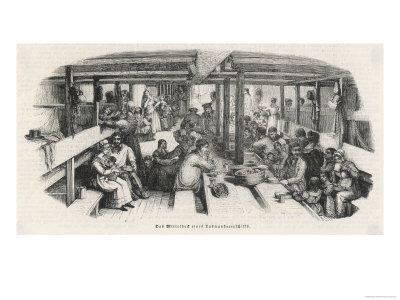
October 19, 1854, Sacramento Daily Union
The New Arrangement
In speaking of the late combination of the steamship lines between San Francisco and New York, the Times and Transcript adds: It will appear to many that the prices of passage are fixed at too high a rate, but on the other hand it should be remembered that the two companies will be now enabled to meet the most essential wants of the community in furnishing safe, frequent, speedy and certain transportation on both routes, and that the difficulties and disappointments which have hitherto been experienced are not at all likely to recur.
It is due to both these lines that their endeavors heretofore to meet the frequent trying emergencies of the service should be properly appreciated. Under their present management there has been evinced a proper desire to deal justly and liberally with all who have had transactions with them. The Agents are identified with the interests of California, and occupy a position as representatives of well established and permanent companies, which enables them to comply with every requisition upon their resources. Supplied with a large reserve fleet of steamers on both sides, no accident can occur which will place it out of their power to remedy in the most expeditious manner.
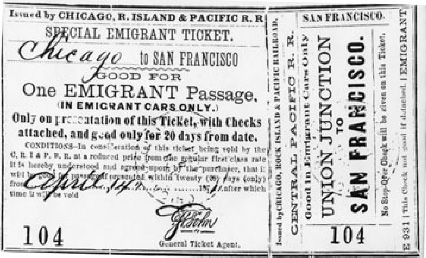
Three-fourths of the travel between California and the Atlantic States is in the steerage, the inducement of low fares making this the preferred portion of the steamer, and the price of through tickets, including the Isthmus transit, placed at $150, has been settled upon as the lowest rate at which the business of transportation could be sustained on a remunerative basis. The impartial and unprejudiced will be led to conclude that health and security are considerations of quite as much magnitude as would be measured by the difference in the cost of travel between the present scale and that which has recently led to so much embarrassment and confusion.
We do not regard the new arrangements of the two steamship companies as dictated by a spirit of monopoly, but rather as a necessary measure of self preservation, and should it prove that they can reduce the rates and still sustain themselves by the increase of travel, we believe that they would unhesitatingly make such a change. A combination is necessarily a monopoly, and it is preposterous to suppose that prices of passage by long and expensive routes, such as those between San Francisco and New York, can be maintained at anything like the rates which have recently ruled.
The Times and Transcript does not regard the new arrangement as dictated by the spirit of monopoly; we deem it the legitimate result of that spirit. Every such combination is essentially and absolutely a monopoly. They are combinations of capitalists to protect themselves and insure a positive return of so much per cent, monthly upon the money invested. We admit that monopolies are not necessarily injurious to the communities in which they may be located; but the history of associated capital, the world over, proves that the tendency of all combinations to monopolize, is, to wring as much profit as possible from the necessities of those who are compelled to apply to them for accommodations.
The stockholders in these two famous steamship lines expect to be benefited by this combination. Are we asked how? Does it not give them the absolute control of the passenger travel from San Francisco to New York? Does it not enable them to fix the prices at such figures as will insure them a fine profit on their capital? Do they not own all the lines between California and New York? Did they not buy the Independent line of boats at an enormous price, and pay Mr. Vanderbilt $100,000 as a consideration for his not putting on another opposition line? Did not the combination intend when this was done to compel the traveling community to and from California to pay back this $100,000? Does not the fact that the companies possess the absolute power to do this, prove that they do possess as naked a monopoly as ever was created?
If the two companies were to buy up all the flour and wheat in the State, and fix upon the price of its sale to the hungry people, would it not be rightly called a monopoly? Where is the difference in principle between buying up all the flour to control its prices, and buying up independent opposition lines to control the price of tickets to New York? The only distinction we can see is in degree; in one case we should be urged by hunger to buy the flour, in the other, we might refuse to buy tickets, and remain in or out of the State.
Capital invested in steamships should pay to its owners a good interest; this we grant, it is no more than justice. Abstractly, its owners possess the right to combine for the purpose of making it pay five to ten percent, per month ? provided they can find a community willing or obliged to bleed thus freely. But we insist that capital in steamboat lines should take its chances for profit an it does in other branches of human enterprises. It will hardly do to say that these companies have not made money by the hundreds of thousands. The Nicaragua line was sold by Vanderbilt to the present company, before he went to Europe for some $300,000, and in less than one year it was advertised that the profits of the line had paid this enormous sum of money, and that, too, against an active competition. In fact, these two steamship lines have been and arc now the best paying of any in existence . . .
Dispatching a steamer weekly will prove advantageous to the State ? a plan which should have been adopted long since; but, as an offset, we pay a half per cent, advance on exchange and nearly or quite fifty percent, advance on passage. It will be seen at a glance that California is to be the sufferer. Her citizens pay the advance on exchange, most of the advance on passage, and, in addition, numerous families will be prevented from coming to the state, which is more to be regretted than either of the other considerations. Men in the State who were striving to earn means to send for their wives and children, will now give up in despair, and, as the only chance left them, will take a steerage passage, return to their families and abandon the State. As a matter of policy, we are confident the combination will find it for their interest to reduce the fare from New York to California. We are confident they would realize more money by adopting such a policy, and we know such a change would be greatly beneficial to California.
|
Out on the Deep Blue: True Stories of Daring, Persistence, and Survival from the Nation's Most Dangerous Profession

The first collection of first-person accounts of commercial fishing written by the men and women who work in the nation's most dangerous occupation. Nineteen diverse fisher-writers, from the famous to the unknown, take the reader swordfish harpooning on the Georges Banks, winter crabbing in the Bering Sea, sea-urchin diving off Maine, herring fishing in Alaska, shark-harpooning off Scotland and points between. Fine writing on commercial fishing, blending the voices of such well-known writers as Peter Mathiessen, Gavin Maxwell, Linda Greenlaw, Spike Walker, and John Cole, together with experienced and emerging writers, many of whom have spent much of their lives on the water.

The Mammoth Book of Life Before the Mast:
Sailors' Eyewitness Stories from the Age of Fighting Ships
Jon E. Lewis, Editor
Firsthand accounts of the real-life naval adventures behind the popular historical sagas of Patrick O'Brian and C. F. Forester. Twenty true-life adventures capture the glory and gore of the great age of naval warfare from the late eighteenth to the early nineteenth century -- the age of the French Revolutionary War, the Napoleonic Wars, and the War of 1812 -- when combat at sea was won by sheer human wit, courage, and endurance. Culled from memoirs, diaries, and letters of celebrated officers as well as sailors, the collection includes accounts of such decisive naval engagements as Admiral Horatio Nelson's on the Battle of the Nile in 1798 or Midshipman Roberts' on the Battle of Trafalgar in 1805 and also offers glimpses into daily hardships aboard a man-of-war: scurvy, whippings, storms, piracy, press gangs, drudgery, boredom, and cannibalism.
Sweatshops at Sea: Merchant Seamen in the World's First Globalized Industry, from 1812 to the Present

Leon Fink
As the main artery of international commerce, merchant shipping was the world's first globalized industry, often serving as a vanguard for issues touching on labor recruiting, the employment relationship, and regulatory enforcement that crossed national borders. Historian Leon Fink examines the evolution of laws and labor relations governing ordinary seamen over the past two centuries.
The merchant marine offers an ideal setting for examining the changing regulatory regimes applied to workers by the United States, Great Britain, and, ultimately, an organized world community. Fink explores both how political and economic ends are reflected in maritime labor regulations and how agents of reform--including governments, trade unions, and global standard-setting authorities--grappled with the problems of applying land-based, national principles and regulations of labor discipline and management to the sea-going labor force. With the rise of powerful nation-states in a global marketplace in the nineteenth century, recruitment and regulation of a mercantile labor force emerged as a high priority and as a vexing problem for Western powers. The history of exploitation, reform, and the evolving international governance of sea labor offers a compelling precedent in an age of more universal globalization of production and services.
Life of a Sailor (Seafarers' Voices)
Frederick Chamier
Chamier went to sea in 1809 as an officer in the Royal Navy. Like his contemporary, Captain Frederick Marryat, he enjoyed a successful literary career and is remembered for his naval novels. This book, his first, is usually catalogued as fiction, although it is an exact account of his naval experiences, with every individual, ship, and event he described corroborated by his service records. Told with humor and insight, it is considered an authentic account of a young officer's service. From anti-slavery patrols off Africa to punitive raids on the American coast during the War of 1812, Chamier provides details of many lesser-known campaigns. His descriptions of British naval operations in America, which reflected his objection to bringing the war to the civilian population, were highly criticized by his seniors.

The Nagle Journal: A Diary of the Life of Jacob Nagle, Sailor, from the Year 1775 to 1841
John C. Dann

Great Stories of the Sea & Ships
N. C. Wyeth


The Rebel Raiders
The Astonishing History of the Confederacy's Secret Navy
James T. deKay

This true story of the Anglo-Confederate alliance that led to the creation of a Southern navy illuminates the dramatic and crucial global impact of the American Civil War. Like most things in the War between the States, it started over cotton: Lincoln’s naval blockade prevented the South from exporting their prize commodity to England. In response, the Confederacy came up with a plan to divert the North’s vessels and open the waterways–a plan that would mean covertly building a navy in Britain, a strategy that involved a cast of clandestine characters.

Site Search
Gold Rush Saints
California Mormons and the Great Rush for Riches
Kingdom in the West: The Mormons and the American Frontier)
Kenneth N. Owens, Will Bagley


Wild Women: Crusaders, Curmudgeons, and Completely Corsetless Ladies in the Otherwise Virtuous Victorian Era
Autumn Stephens

America 1844
Religious Fervor, Westward Expansion, and the Presidential Election That Transformed the Nation
John Bickness

The Life of Bret Harte With Some Account of the California Pioneers
Henry Childs Merwin


Women Trailblazers of California: Pioneers to the Present
Gloria G. Harris

A Frontier Lady
Recollections of the Gold Rush and Early California
Sarah Royce
Words West: Voices of Young Pioneers
Ginger Wadsworth


 Copyright ~ 1998-2018.