Passengers at the Port of San Francisco: 1800s

Ben Holladay
Born 1819 in Kentucky; Died 1887 in Portland
Ben Holladay was characterized as a devoted, diligent, enterprising man and a transportation magnate. He speculated in gold and silver mines, distilleries, general stores and slaughter houses, but he was said to have made a great deal of money selling supplies to the U. S. Government during the Mexican War, but is best known for making his name and fortune in transportation.
 He started the Concord Stagecoach to the West, in the 1860s and established his headquarters in an office at the corner of California and Liedesdorff streets in San Francisco to run his California, Oregon & Mexico Steamship Company.
His vessels sailed between Francisco to the Southern states, and to Canada, Alaska, Mexico, Hawaii, and the Orient.
Around 1861, Holladay took over steamers from Pacific Mail Line; this included the Cortez, Oregon, Sierra Nevada, Republic, Panama.
His cabin fares between San Francisco and Portland were $45.00 and passengers unconcerned about food and accommodations could travel in steerage for $25.00.
Daily Alta California, December 11, 1866, San Francisco, California, U.S.A.
Judgment Against Holladay.
New York, December 9th - The United States Circuit Court, Judge Smally presiding, gave a verdict of $10,000 against Ben Holladay, for the loss of a money package near Julesburg, two years ago, when the Indians destroyed the Overland coach. The defence claimed that the loss was by an act of the public enemy, and so he was not liable; but the Court ruled otherwise.
At one point in his shipping career, it was said he owned all shipping in Oregon.
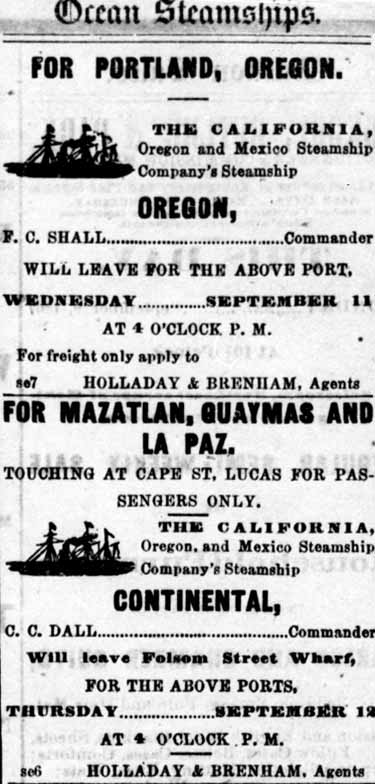
Competition was such that he established the North Pacific Transportation Company, which was comprised of his own shipping company and a Maine Yankee named Patton's Anchor Line and the California Steam Navigation Company.
By 1869, this collaboration was operating ten side-wheelers and six propeller steamers north from San Francisco. The ships included Active, John L. Stephens, Moses Taylor, Oriflamme, Orizaba, Pacific, Panama, Senator, Sierra Nevada, Ajaz, California, Continental, Gussie Telfair, Idaho, Montana, Pelican.
Purportedly, Holladay's favorite ship, the Oriflamme, was built in 1864 as a fast naval gunboat and had engaged in China coastal trade. Holladay used this ship for private parties, some of which lasted all the way from San Francisco to Alaska.
In 1862, Holladay was the sole owner of the Overland Mail and Express Company and he is credited with introducing the Concord Stagecoach to the West. With Ben Holladay 's acquisition of the Butterfield Overland Dispatch in 1866, the name changed to Holladay Overland Mail and Express Company. He became known as the Stagecoach King.
Combative and ruthless, he expanded and modernized; his Overland Mail & Express Company, running regular services across more than 3,000 miles (4,800km) of stage and freight lines from St. Louis to Salt Lake City and Oregon, was the biggest and most successful operation of its kind ever mounted.
He was also the sole owner of some 20,000 vehicles, with more than 15,000 employees; passenger revenues often totalled $60,000 a month - the fare from Atchison, Kansas, to Salt Lake City was $350 - and over five years the US Post Office paid him nearly two million dollars.
Holladay moved from San Francisco to Oregon in 1868 in order to get involved in the railroad business. He stirred things up wherever he went and was decribed as "a bit of a dandy," dressing like a riverboat gambler. He was said to be "wholly destitute of fixed principles of honesty, morality, or common decency." Holladay's goal was to build a rail line to California along the east side of the Willamette River. In order to do so, he spent a total of $55,000 in bribe money to help secure his company's endorsement. He also built two large hotels in the area where the park bearing his name is now located.
The enterprising Holladay established Portland's first horse car line to connect the ferry at Front and F streets with downtown Portland. It was a muledrawn car, worn out from long usage in San Francisco before Holladay brought it to Portland, and it was pulled over iron rails from the turntable at Front and G streets down through town to Carruthers street, in South Portland, where another turntable was located. On November 1, 1866, Ben Holladay sold his stagecoach company to Wells Fargo.
In January 1872, Holladay and servants boarded the steamship Oriflamme for San Francisco, returning to Portland in March.
Ben Holladay lost his fortune in the stock market crash on September 18, 1873. In 1875, the bankrupt Holladay sold out to Goodall, Nelson & Perkins Steamship Company which reorganized the company as the Pacific Coast Steamship Company. He outlived his two wives and two daughters and died in Portland in 1887 at the age of 68.
The Annals of San Francisco
Frank Soule, John H. Gihon, Jim Nisbet. 1855.
Written by three journalists who were witnesses to and participants in the extraordinary events they describe. The Annals of San Francisco is both an essential record for historians and a fascinating narrative for general readers. Over 100 historical engravings are included. Partial Contents: Expeditions of Viscaino; Conduct of the Fathers towards the natives; Pious Fund of California; Colonel John C. Fremont; Insurrection of the Californians; Description of the Golden Gate; The Presidio of San Francisco; Removal of the Hudson's Bay Company; Resolutions concerning gambling; General Effects of the Gold Discoveries; Third Great Fire; Immigration diminished; The Chinese in California; Clipper Ships; Increase of population; and Commercial depression.


Jean Gilbertson.
Crowley Maritime started as a one-man operation, with nothing more than one 18-foot Whitehall rowboat to provide transportation of personnel and stores to ships anchored on San Francisco Bay. In the mid-1800s, the business was incorporated under the name Thomas Crowley and Brothers. Withing a few years, services grew to include bay towing and ship-assist services. By the turn of the century, Crowley's expansion continued by operating small barges to transport steel to Oakland and barrels of oil, ice, and other supplies to ships in San Francisco Bay. In July 1902, the San Francisco Call reported "The new launch Guide, owned by Thomas Crowley & Bros., made her first trip yesterday to the Farallon Islands and carried out her builders' highest anticipations. By 1912, Crowley had built a marine railway, dock and woodworking mill. Growth continues to this day.
A History of California
Franklin Tuthill.
This comprehensive 19th century history of California, from its early times up to the Gold Rush was written "because there seemed to be a demand for a History of California which should sketch the main events of the country from its discovery to the present time. Beginning with Spanish priests, who enslaved indigenous tribes, millions rushed in and claimed the land after the Gold Rush. The material is abundant: log-books of ancient mariners; archives of the Government while the territory was under Spanish or Mexican rule; official reports and Congressional documents about the transfer to the United States; files of newspapers; scores of books of intelligent travellers; the oral evidence of natives, and early immigrants." These sources were the base materials for this publication.
When America First Met China:
An Exotic History of Tea, Drugs, and Money in the Age of Sail
Eric Jay Dolin.


Atlantis: The Antediluvian World
Ignatius Donnelly.
The author and politician Ignatius Donnelly was born in Philadelphia on 3 November 1831. He was educated in the public schools of his native city, studied law, was admitted to the bar, and practiced. He went to Minnesota in 1857, was elected lieutenant governor in 1859, and again in 1861, and was then elected to Congress as a Republican, serving from 7 December 1863 until 3 March 1869. Besides doing journalistic work he has written an Essay on the Sonnets of Shakespeare, and his most enduring work, Atlantis, the Antediluvian World (New York, 1882), in which he attempts to demonstrate that there once existed in the Atlantic Ocean, opposite the straits of Gibraltar, a large island, known to the ancients as "Atlantis"; and Ragnarok (1883), in which he tries to prove that the deposits of clay, gravel, and decomposed rocks, characteristic of the drift age, were the result of contact between the earth and a comet.

Site Search
The Saga of Ben Holladay
Giant of the Old West
Ellis Lucia

Ben Holladay
The Stagecoach King
J. V. Frederick


The Modern World-System III The Second Era of Great Expansion of the Capitalist World-Economy, 1730s-1840s
Immanuel Wallerstein


Imperial San Francisco:
Urban Power, Earthly Ruin
(California Studies in
Critical Human Geography)
Gray Brechin


Mud, Blood, and Gold:
San Francisco in 1849
Rand Richards


The World Rushed In:
The California
Gold Rush Experience
J. S. Holliday


Translating Property:
The Maxwell Land Grant and the Conflict over Land in the American West, 1840-1900
Maria E. Montoya


 Copyright ~ 1998-2018.