Clipper Ships
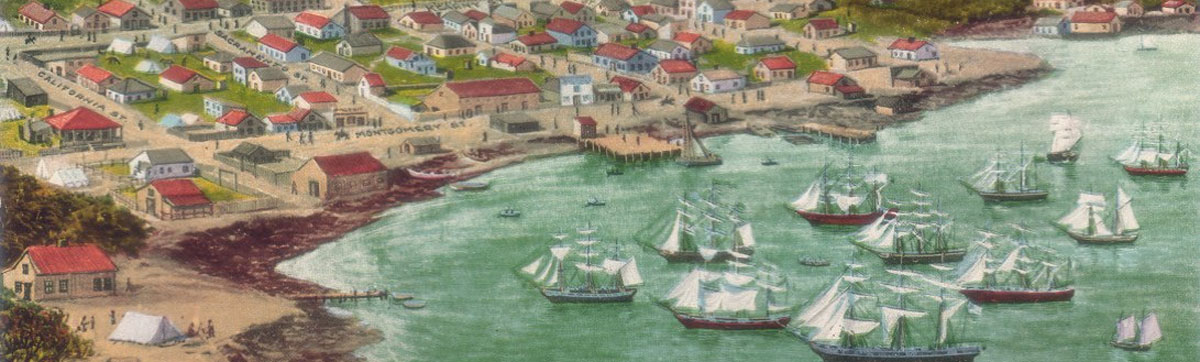
The Deep Sea Derby
Seventeen of them made the passage in less than 110 days. Clipper captains raced; this became "The Deep Sea Derby." Clippers taking part in this "Deep Sea Derby" included theآ Flying Dutchman, Dauntless, Westward Ho, Northern Light, Queen of the Seas, Grey Feather, Whirlwind, Telegraph, Contest, Game Cock, Meteor, Winged Racer, Golden Eagle, Fleetwood, Jacob Bell, Flying Childers, Golden West, Red Rover, Peerless,آ andآ Bald Eagle.
 This remarkable contest has been described by the historian Carl C. Cutler inآ Greyhounds of the Sea. the Story of the American Clipper Ship
Theآ Flying Fishآ entered the Golden Gate on January 31, 1853, with the winning Deep Sea Derby passage of 92 days, 4 hours, anchor to anchor.
There to greet her in San Francisco Harbor, was theآ Westward Ho,آ another McKay clipper that had been launched on September 24, 1852. Theآ Westward Hoآ had entered the Deep Sea Derby sailing from Boston twenty-two days after her launching on October 16, 1852, fifteen days before theآ Flying Fish;آ to chase after theآ Dauntlessآ that had cleared Boston Harbor the day before on her maiden run to the Golden Gate, the same day theآ Flying Dutchmanآ departed New York.
Theآ Westward Hoآ had sailed around the Horn in 107 days arriving at the Golden Gate only a few hours before theآ Flying Fish,آ and her crew was rolling up her canvas as theآ Flying Fishآ arrived.
October 12, 1852, New York Herald, New York City, New York
Yesterday the beautiful clipper shipآ Wild Pigeon, Captain Putnam, hauled out of her berth, at the foot of Wall Street, and sailed for California. The barkآ Salem, Captain Millet, also cleared yesterday for the same destination. Both vessels have large and valuable cargoes. The agent of the first named vessel had to refuse some one thousand barrels, for want of room. TheWild Pigeonآ has only been in port twenty-nine days, and in the short space of twenty-eight working days discharged and received cargo, and is now again on her way to the Pacific.
On the other side of the slip, just evacuated by theآ Wild Pigeon, lies the Boston Clipper ship Flying Fish, Captain Nickels, also taking cargo for San Francisco. She arrived here some three weeks back, from Manila, and it is her first appearance in this port. She is of a similar model to the celebrated clipper shipآ Flying Cloud, and both constructed by the same builder (Mr. Donald McKay of East Boston) but has sharper ends, and is stated to be the sharpest vessel he ever launched. Like all clipper ships, she is filling fast, and will leave on or about the 23rd inst.
Independent of the above, there are seventeen other vessels up for the same port. Among these are the following beautiful new clippers yet untried: Theآ Flying Dutchman, Contest, John Gilpinآ andآ Tinqua. The first two were built in this city قآ The Flying Dutchmanآ by Mr. W. H. Webb, the other by Messrs. Westervelt & Sons; theآ John Gilpin, by Mr. Samuel Hall, of East Boston. Theآ Tinquaآ was constructed by Mr. George Raynes, of Portsmouth, N. H.. She had not yet arrived here, but will make her appearance shortly, to commence loading in Mr. John Ogden's line of clippers, to which theآ Wild Pigeonآ and theآ Flying Fishآ also belong.
The other clippers also loading here for San Francisco are theآ Game Cock, Grey Featherآ andTradewind,آ all first class vessels. The freighting business for California is at present very active, several of the new clippers having had a portion of their cargo engaged before they appeared at their berths. The clearances at this port for San Francisco, during the month of October, give one for every alternative day; ad from the first of last month up to the present date, the number amounts to twenty, including the clipperآ Comet, and other first class ships. The whole number from all our Atlantic ports during that period is thirty-six; which shows the great preponderating commercial enterprise of New York, over all the other commercial cities of the Union combined.
March 14, 1853, Daily Alta California, San Francisco
The passages of our clipper ships have got to be so regular, that if the day of their departure from either Boston or New York be known here, their arrival can be calculated at this season of the year with a good deal of precision.
This fact is fully illustrated by the last passages of theآ Game Cock, 115 days from New York, theآ Telegraph, 115 days from Boston, theآ Meteorآ 100, and theآ Whirlwindآ 111 from the same place. Two of these ships came around by the new route, and laid down by Lieut. Maury, of the observatory at Washington, and tends greatly to recommend the adoption of that course instead of the old fashioned way of forelaying the northeast and southeast trades in the Atlantic ocean. In times gone by, when ships sailed about as fast as one could "whip a bug over a tarry shingle," it was very necessary to forelay, and if possible, get so far over to the European and African shores as to make sure of getting the wind abaft the beam after passing the latitude of 22 degrees north, and keeping it to 26 degrees south of the line, but now, since the introduction of improvements in ship building, and sparring, that a ship can make nearly as much headway close-hauled as she can on any other tack, and sail much faster with a beam wind, hundreds if not thousands of miles are saved by the direct course. It also exhibits a great amount of nautical skill and capacity to perform these voyages with such extraordinary regularity; for it proves that it is the result of science put into practice, and not of chance. It is highly probable that both of the other ships above mentioned took the same course.
Clippers taking part inآ The Deep Sea Derby and arriving in San Francisco included:
Bald Eagle (extreme clipper)
- Built by Donald McKay, 1852
- Arrived SF April 4, 1853
- 107 days
- Captain Phillip Dumaresq
Competitor
- Arrived San Francisco July 19, 1853
- 114 days from Boston
- Captain Howes
Contest
- Designed by David D. Westervelt
- Arrived SF February 24, 1853
- 100 days from New York (and returned to New York in 80 days)
- Captain William Brewster
Dauntless
- Built by Benjamin F. Delano, 1852
- Arrived SF February 12, 1853
- from Boston
Fleetwood
- George Raynes Shipyard, 1852
- Arrived SF April 13, 1853
- 130 days from Boston
Flying Childers
- Samuel Hall, Boston, 1852
- Arrived SF April 7, 1853
- 113 days from Boston
- Captain Jeremiah D. White
Flying Dutchman (extreme clipper)
- Built by William Webb, 1852
- Captain Ashbel Hubbard
Flying Fish
- Arrived SF January 31, 1853
- 92 days/4 hours from New York
- Captain Nickels
Game Cock
- Pook design, Samuel Hall Boston Shipyard
- March 10, 1853
- 115 days from New York
- Captain Hollis
Grey Feather
- Arrived SF March 15, 1853
- 126 days from New York
- Captain Daniel McLaughlan
Golden Eagle
- Hayden & Cudworth Shipyard
- 110 days from Boston (lost time due to high seas past Rio De Janeiro)
- Captain Samuel L. Fabens
Golden West (extreme clipper)
- Paul Curtis, Boston, 1852
- Arrived SF
- 124 days from Boston
- Captain Samuel R. Curwen
Jacob Bell
- Jacob and Abraham Bell, 1852
- Arrived SF April 10, 1853
- 122 days from New York
Meteor
- E. & H.O. Briggs Boston shipyard, 1852
- March 10, 1853
- 113 days
Northern Light
- Designed by Samuel Harte Pook, H.O. Briggs Boston Shipyard, 1851
- 1853, 117 days from Boston
- Her first passage around the Horn was 109 days under Captain Bailey Loring; this was her second passage at 117 days; she was taken back to Boston by Captain Hatch in 76 days, 8 hours.
Ocean Spray
- Arrived San Francisco July 19, 1853
- 143 days from Boston
- Captain McLellan
Peerless
- Arrived San Francisco July 19, 1853
- 212 days from Boston
- Captain Bascom
Queen of the Seas
- Arrived SF March 11, 1853
- 119 days from Boston (with heavy battering at Cape Horn)
- Captain Elias D. Knight
Red Rover
- Fernald & Pettigrew, 1852
- Arrived SF April 19, 1853
- 117 days from New York (stormy passage; lost masts, yards and canvas)
- Captain W. O. Putnam
Sovereign of the Seas
- Extreme clipper built on speculation by Donald McKay, East Boston, MA
- Launched June 19 1852
- August 4, 1852 left for San Francisco; Arrived November 15, 1852, 103 days out from New York. The best day's run was 368 miles.
- Captainآ Lauchlan McKayآ(Brother to Donald McKay)
Telegraph
- Pook design, J.O. Curtis Medford shipyard, 1852
- March 10, 1853, 114 days
- Captain C.W. Pousland
Trade Wind
- Jacob Bell's Shipyard
- Arrived SF February 24, 1853
- 103 days from New York
Westward Ho (extreme clipper)
- Donald McKay, 1852
- Arrived SF January 31, 1853
- 107 days from Boston
- Captain Johnson
Whirlwind
- James O. Curtis Shipyard, 1852
- Arrived SF March 11, 1853
- 128 days from Boston
- Passenger List
Winged Racer
- Pook design
- March 30, 1853
- 108 days (105 days to the bar off of San Francisco; waited 3 days to enter the harbor)
- Captain William Homen
The Cutty Sark and Thermoplye
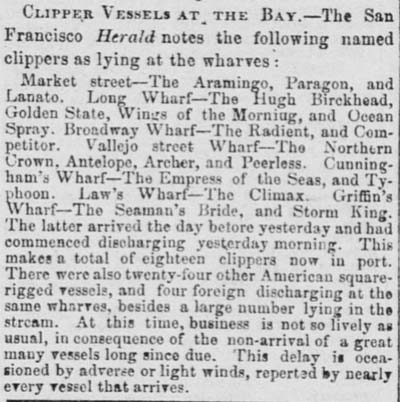 Clippers were built for speed. This was not the only time they raced. Theآ Cutty Sarkآ andThermoplyeآ raced from the docks of Hongkew at Shanghai with 1,196,400 and 1,303,000 pounds of tea respectively. These were lighter loads than they would normally carry as "the race was on."
"As soon as the cargo came down, each ship became surrounded by tea lighters, for they were loaded in the stream. Sweating coolies, standing on stages, rigged along theآ Cutty Sark'sآ black and the Thermopyle'sآ green sides, hove the chests aboard to their mates in the holds amidst a continual sing-song of guttural Chinese chanting.
It was hot, steamy, S.W. monsoon weather, with sharp bursts of rain alternating with a damp fog, so that sail bending was left to the very last moment.
Cutty Sarkآ was the first to finish loading, the last chest being hurled aboard on the afternoon of June 17th. She got under way at 7 p.m. and dropped down as far as Halfway Point, where she had to bring up for the night.
Thermopyleآ put the tarpaulins on her hatches some time after dark that same night. The Woosung bar was crossed by both vessels the following morning, Cutty Sark being in the lead, and the beautifulآ Sir Lancelot, on her way to load at Foochow, was also in company.
The two clippers raced through nights at sea in monsoon weather and did not see each other again until July 15 off the coast of Borneo.آ Cutty Sarkآ had the lead, but on July 19th,آ Thermopyleآ had gained a lead of 1-1/5 miles. From July 26, off of Keeling Cocos Island, they did not see each other again.آ Cutty Sarkآ passedآ Thermopyleآ in the Indian Ocean.آ Cutty Sarkآ had lost her rudder on August 15th,آ Thermopyleآ took the lead and was towed up the Thames to unload on October 18th, only one week ahead of her rival.
If you cannot find your preferred books locally, please consider utilizing links provided to Amazon.com, which has proven to be reliable on service and delivery.
Beyond the Golden Gate: A Maritime History of California 
Timothy G. Lynch
Beyond the Golden Gate: A Maritime History of Californiaآ is the first book-length treatment of California's connection to the sea. Noted maritime historian Timothy Lynch looks at the history of the Golden State through the prism of the maritime world: how the region developed and how indigenous people interacted with the marine ecosystem. And how they and others - Spanish, English, Russian, American - interpreted and constructed the oceans, lakes and river networks of the region.

The waterways served as highways, protective barriers, invasion routes, cultural inspiration, zones of recreation, sources of sustenance: much as they do today. He presents how the Gold Rush transformed the region, wreaking havoc on the marine environment, and how the scale and scope of maritime operations waxed and waned in the decades after that event. In all, the delicate balance between protection and utilization is paramount.
Written as part of a project with the National Park Service and the Organization of American Historians, Beyond the Golden Gateآ is an immersive look at the maritime history of California that will inspire additional scholarship in this overlooked but critically important field. Benefitting from hundreds of primary sources, dozens of captivating images and reflective of the latest trends in the field, Beyond the Golden Gate is sure to satisfy the curious reader, the serious historian, and the maritime aficionado.
Encyclopedia of Underwater and Maritime Archaeology
Executive Director James P. Delgado, Editor
This comprehensive reference book on the discovery and recovery of underwater archaeological remains around the world was directed by noted author and diver James Delgado, along with archaeologists and scientists who have made the discoveries.


It offers a wealth of authoritative and accessible information on shipwrecks, drowned cities, ritual deposits, and other relics of our submerged past. Published in association with the British Museum Press.
X Marks the Spot: The Archaeology of Piracy
(New Perspectives on Maritime History and Nautical Archaeology)
Prof. Rusell K. Skowronek, Editor, Charles R. Ewen, Editor
A collection with historical evidence about the actual exploits of pirates as revealed in archaeological records. The recent discovery of the wreck of Blackbeard'sآ Queen Anne’s Revenge, off Beaufort Inlet, North Carolina, has provoked scientists to ask, "What is a pirate?

Were pirates sea-going terrorists, lawless rogues who plundered, smuggled, and illegally transported slaves, or legitimate corsairs and privateers?" Highlighting such pirate vessels as theآ Speaker, which sailed in the Indian Ocean, and theآ Whydah,آ the first pirate ship discovered in North America (near the tip of Cape Cod), the contributors analyze what constitutes a pirate ship and how it is different from a contemporary merchant or naval vessel.
Maritime History as World History
(New Perspectives on Maritime History and Nautical Archaeology)
Daniel Finamore


Essays by leading scholars present an up-to-date assessment of the field of maritime history in the early 21st century, offering fresh insights into the impact of seaborne exploration, warfare, and commerce on the course of history, from the independent traditions of ancient Japanese, Arab, and Mediterranean seafarers to the rapid European expansion around the globe from the 16th century onward.
Author Daniel Finamore is Russell W. Knight Curator at the Peabody Essex Museum in Salem, Massachusetts.
The Oxford Handbook of Maritime Archaeology
(Oxford Handbooks)
Alexis Catsambis
A comprehensive survey of the field as seen through the eyes of nearly fifty scholars at a time when maritime archaeology has established itself as a mature branch of archaeology. This volume draws on many distinct and universal aspects of maritime archaeology, bringing them together under four main themes: research process, ships and shipwrecks, maritime and nautical culture, and issues of preservation and management.

The Naval Order of the United States has a history dating from 1890. Membership includes a wide range of individuals, many with highly distinguished career paths.
The San Francisco Commandery meets the first Monday of each month at the San Francisco Italian Athletic Club in San Francisco, California and holds two formal dinners each year.

 Copyright ~ 1998-2018.