Passengers, Seaports, Captains
Ships and Shipping
West Coast Clippers (Built in San Francisco)Annals of San Francisco 1852: Clipper shipsThe Deep Sea Derby, 1852The Fleet of 1857 |
May 26, 1851, Daily Alta California, San Francisco
Clipper Ships at Anchor.
  | The Clipper Ship "Flying Cloud" Currier and Ives. 1852. |
In the tremendous wind of yesterday, which made the whole bay white with foam, and caused sizeable brigs and schooners to pitch and roll, as they lay at anchor, like chips pawing over rapids, it was a study to mark the difference between the sharp clippers and the old fashioned, tub-prowed ships, as they lay at anchor, facing the tide and wind. One of the large, sharp ocean giants lay directly in the full range of the gale as it swept up from the Golden Gate, yet there was not a ripple at her bows. A number of the full built ships lay near her, and at their bows it was all "feather white," like the waves as they dash down over a cataract. She had not even a "white bone in her mouth,'' while the rest of the fleet had whole skeletons. She lay at her anchor as quietly as if on a summer lake, and did not seem to give anchor or chain any trouble. There were ships of five hundred tons which gave their ground tackle more strain than did that immense ship of three or four times the tonnage. This shows how much more safe such ships would be on a lee shore, or in a gale of wind anywhere at anchor, than those of the former usual construction. Their length also, as well as their sharp model, giving them less motion, renders the chances of dragging anchors and parting chains much less. The clippers will prove one of the greatest improvements of the age.
The Annals of the City of San Francisco, June 1852
It appears from records kept by the late harbor master, Captain King, that seventy-four vessels claiming and entitled to be called clipper ships, and averaging rather more than 1000 tons burden, had arrived in the port of San Francisco during the last three years. These records commence with the well known brig Col. Fremont, in May, 1849, and include the Aramingo, which arrived in May, 1852. The average passage was one hundred and twenty-five days. Some of the fleet, however, made much more speedy voyages.
The Flying Cloud

Because San Francisco was so susceptible to becoming overstocked with goods from around the world, it was necessary to deliver merchandise as speedily as possible to her shores. Competition forced merchants and ship-builders interested in the California trade to invent new and superior models of vessels. Hence the clipper with her great length, sharp lines of entrance and clearance, and flat bottom.
"These magnificent vessels now perform the longest regular voyage known in commerce, running along both coasts of the Americas, in about four months; while the ordinary ships of older models used to take seven and eight months to accomplish the same distance. The contrast is very striking between the short, clumsy vessels, of a few hundred tons burden, which brought the early European navigators to the coast of California, and the large and beautifully lined marine palaces, often of two thousand tons, that are now continually gliding through the Golden Gate. These are like the white-winged masses of cloud that majestically soar upon the summer breeze.
In another part of this work we have given an illustration of the galleon, or sea-going armed merchantman of Drake s day; here we lay before the reader a representation of one of the finest modern California traders, a clipper ship bound for San Francisco. While these noble vessels have revolutionized, in every maritime country, the model and style of long-voyage ships, they have also introduced a much happier marine nomenclature. The old-fashioned, humdrum Julias and Mary Anns, the Trusties and Actives are fast disappearing. The very names of our modern clippers have poetry and music in them, and convey a wonderful sense of swiftness. They confer even dignity on the dry details of the 'marine reporter,' where simple words shine like golden particles in the Californian miner s sands."
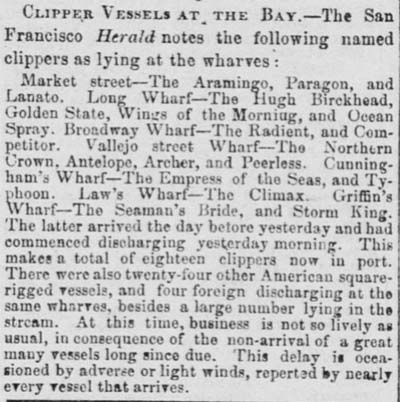 During 1852, 95 clipper ships along with ten clipper barques sailed from northeastern ports around the Horn for San Francisco and 17 of them made the passage in less than 110 days. This remarkable contest has been described by the historian Carl C. Cutler in Greyhounds of the Sea, as representing "the very crest of the clipper wave."
This was the crest of the era of the clipper ships that reached its apex with the rounding of the Horn of those 15 ships. The economic boom that had brought these magnificent ships into existence and around the Horn in the first place was about to go through some changes and eventually go bust. With glutted markets, falling freight rates, played out mines, and too many clippers rising on the stocks in eastern shipyards.
January 16, 1853, Daily Alta California, San Francisco
Clipper Ships.
It was for a long time the conviction of the maritime community, that what was gained in point of speed, by making ships of sharp models, was sacrificed in point of burden; that the average difference between the two was not sufficient to warrant the sacrifice. That the port duties, pilotage and other expenses incident to greater custom house measurement and draught of water, would more than counterbalance the profit that would accrue from quickness of passage. It then became a desideratum to build ships that would combine these different excellences; in consequence vessels were constructed that were not exactly "clipper," neither did they exhibit that rotund model usually seen in the Dutch galliot, and which were invariably distinguished in the sea-faring community by the euphonious soubriquet of "Cotton Boxes."


The ship builders of New York were appealed to by the different owners of the Liverpool, London and Havre lines, and presto! we had such ships as the Siddons, Garrick, Rochester, Henry Clay, Stephen Whitney, Louis Philippe, Ville de Lyons, and a host of others which, both in Europe and America, were the admiration of all nautical men. Their models were sought after with avidity, and copies of them taken in various shipbuilding ports of our country and Europe. To Bremen, however, belongs the credit of the nearest approximation, for a long time, to the New York style. All efforts appeared vain the bow, run, shear and general appearance seemed unattainable, and a New York ship could be picked out of a fleet with unerring certainty by a good sailor.
Capt. Stevens of Boston, declared that the ship builders of that place could put as fine a craft on the ocean, as ever was launched from a New York yard. He ordered and superintended the construction of the Martha Washington on the best New York model, and so determined was he to make her equal to anything afloat, that he even went to the expense of putting down the deck plugs with brass instead of yellow pine. She was finished, launched and taken to New York, where she was hauled into dock alongside the finest packet ships. The comparison proved victorious to the New York builders. On the death of Mr. Isaac McKim, of Baltimore, his clipper ship the Ann McKim, was purchased of New York merchants, and put into the Canton trade. The ship, it is said, was bogged, but her superiority in point of speed was soon profitably manifest, over the other vessels then engaged in that line of trade. This instituted competition, and we saw such vessels as the Witch of the Wave and others, built expressly to beat the Ann McKim, and they did it.
It soon became apparent to ship builders that the old idea, that a ship could not be made a clipper and be at the same time as profitable as a carrier, was a fallacy; and improvement on improvement followed with a rapidity illustrative of skill and mechanical knowledge, that has elicited the approbation and admiration of the whole world. The whole ship building fraternity, throughout the length and breadth of our land, seemed to have wakened up from a sort of Hip Van Winkle sleep, and we are every day astonished at the productions of these great men's minds and hands, that are constantly entering and clearing from our port whose broad and glistening canvas now whitens every sea, are the theme of praise and wonder to the very country from which we sprung, (the most commercial on the globe), and a subject of remark and awe even to the barbarians of farthest "Indiana. "
Another source of pleasure is the happy appositeness of the names bestowed on these magnificent proofs of our commercial greatness The Flying Cloud, the White Squall, the Trade Wind, the Hurricane, the Sea Witch, the Southern Cross, and a host of others equally expressive, evince the taste and judgment of those who presided over the baptism of their entrance on the bosom of the great deep. Many of these beautiful creations are the product of Boston builders. The precise medium seems to be at length attained. They carry enormous cargoes, and the speed of these Leviathans, when sporting with the winds and the waves, is almost terrific, it is in fact so great, that could power enough be brought to bear on the hull of an old fashioned ship, as to force her through the water at the same rate, it would crush her to pieces. Would that the shade of Christopher Columbus could gaze on the immense forest of tall masts to such craft as now environ the Beele Bay City, on the Western verge of that great continent of which he saw the first and long anxiously hoped for realization from the forecastle on the little Pinta.
May 13, 1854, Sacramento Daily Union, Sacramento, California, U.S.A.
American Clipper Ships and Steamers
The Boston correspondent of the Times and Transcript thus writes of American clipper ships and steamers. The superiority of American clippers is conceded by British merchants, when they buy them in preference to English built vessels:
Our clipper ships are now attracting considerable attention on the Atlantic race course. A large number of them, owing to the dullness of the California trade, are loading for Great Britain at the principal ports. The extraordinary passage of the Lightning from this city to Liverpool, in a little more than thirteen days, has caused quite a sensation. Her log shows that she run from Boston Light to Eagle Island, on the coast of Ireland, in ten day. On the first of March she made the extraordinary run of four hundred and thirty-six miles in twenty four hours, going through the water at an average speed of over eighteen miles per hour on that day.
The American clipper ship Red Jacket, that also made the run to Liverpool in less than fourteen days, has been purchased for about 30,000, by Messrs. Pilhington & Wilson, of Liverpool. Both the Red Jacket and the Lightning are now owned by English houses, and have been placed on the berth for Australia. At the last accounts the admirers of the two respective vessels were betting heavily on their passages.

The admirers of the clipper ship Nightingale, now loading at New York for Melbourne, are also determined to match her against either the Lightning or the Red Jacket In fact a bet has been made that she will make a quicker passage from New York to Melbourne than the Lightning will make from Liverpool to same port. The proceeds of the bet will be applied to having pictures of the two ships painted on the wall of Father Taylor's' Bethel, the winning ship ahead with all colors flying, the vanquished ship astern with colors struck, and below them a record of their performances. A part of the bet will also be applied for the purchase and outfit of a pew in the Bethel for the use of clipper captains. Capt. Forbes, the commander of the Lightning, has made 11 some remarkable passages to Australia in the English ship Palo Alta, and while here was converted by the preaching of Father Taylor, which explains the singular, disposition to be made of the bet.
May 1, 1855, Daily Alta California, San Francisco, California
Naval Architecture.
In no science is there so great a diversity in theory, and so wide a difference in practice, as in the science of modern marine and naval architecture. Our sturdy old ancestors of Britain were content to build and sail their ships as their fathers and fathers' fathers had done before them. Improvements were slowly and cautiously introduced, and it was not until the last American war had opened the eyes of oar complacent progenitors across the water, that improvements and modifications in the British navy and commercial marine were seriously entertained. The success of our heavy and fast sailing frigates, sloops of war and clipper built privateers at last forced upon the English the necessity of building ships that would cope with our own, both in size and speed; and although a decided improvement has been remarked in English built ships during the last thirty years, yet it is a difficult thing to convince an English ship-builder that his model can be improved upon. The building of ships has been almost entirely left in the hands of master carpenters, who, although competent and excellent workmen, have no theoretical knowledge of their business.
Since the advent of ocean steamers, ship-building, especially in America, has received a new impetus; a spirited contest was waged between the ocean steamers and the heavy, fast-sailing packet ships As the steamship became to be a fixed fact, and made regular voyages across the Atlantic, faster ships were brought in requisition to maintain their relative supremacy.
The trade between the United States and China had also fostered a large and constantly increasing fleet of fast -sailing vessels, and the success of such ships as the Samuel Ward, Samuel Russell, Rainbow and others, induced ship-owners to venture upon building vessels more exclusively for speed. The California Market opened a wider field for clipper built vessels, and in 1850 the clipper ship Staghound was launched at Boston, and was the first very sharp ship built in America. Many doubts were expressed by nautical men as they surveyed her sharp bows and heavy spars many predicted that she would not survive the first heavy gale, and old tars would shake their wise heads as they surveyed the "diving bell." Nevertheless her success was complete, and she remains to this day a monument of the triumph of her builder.
The triumph of the yacht America, over the Royal Yacht Squadron at Cowe, in 1851, gave an additional impulse to ship building both in America and Europe, and the victor vessel became at once a matter of attraction to the English public and pride to the American.
English builders and nautical men studied their model and rig with great care. The public journals were filled with criticisms and praise, and the America well deserves the victory and the praise. Her name will be passed down in history as the victor of the "Mistress of the Seas," and her advent as the dawning of a new era in ship building. It was supposed that a model designed so exclusively for speed, could never be made profitable as a carrier, and yet there is at present in our harbor, a ship designed and built by the name builder, Mr. Geo. Steers upon the same model as the famous America.
A brief description of the Sunny South may not be uninteresting to our readers, the was built at the foot of Eleventh street, New York City, by Geo end James Steers, and launched in September last and is owned by Wm. A. Sale, Esq. of New York. Cost about $70,000. Compared with such ships as the Tornado, Water Witch and Sovereign of the Seas, she is a small ship, registering only 745 tons. Her carrying capacity is about 1000 tons measurement goods. Her extreme length at the load-line is 154 feet. Extreme breadth of beam at the load line 31 feet 3 inches. Breadth on deck 28-1/2 feet. Depth of hold is 15-1/2 feet. Main yard 66-1/2 feet. Main sky-sail yard 24 feet. She draws 16-1/2 feet when loaded one foot more than her depth of hold. She has 28 inches dead rise.
A handsome sheer gives a light and fancy appearance to the long and sharp bow, which is ornaments with a scaly monster as a figure head, with a long and very crooked tail. The lines of the bow an slightly concave, and the greatest breadth of beam is abreast the main hatchway. The run is a fine one but why Mr. Steers put such an ugly stern, upon an otherwise beautiful vessel, we cannot surmise. She is built entirely of white oak, with locust trenails. She is lightly and neatly sparred, and for speed we would pit her against any vessel that ever entered San Francisco harbor. Capt. Gregory gives her all praise as a sea boat good on all tacks.
She was so deeply loaded on her passage out, that no opportunity was offered for testing her sailing qualities. She will sail for Hong Kong soon, and we expect to hear a good report from Capt. Gregory, on his arrival in New York.
There are many other fine clippers now in port among them, the Neptune's Car, Westward Ho. Charmer, Saracen, Telegraph, Western Continent, Boston Light, and others, that might fling down the gauntlet for speed and sea-going qualities.

Montague Dawson, the painter of Ariel and Taeping (above), was the son of a keen yachtsman and the grandson of the marine painter Henry Dawson (1811 1878). Dawson was born in Chiswick, London in 1895. Much of his childhood was spent on Southampton Water where he was able to indulge his interest in the study of ships. For a brief period around 1910 Dawson worked for a commercial art studio in Bedford Row, London, but with the outbreak of the First World War he joined the Royal Navy. While serving with the Navy in Falmouth he met Charles Napier Hemy (1841 1917), who considerably influenced his work. In 1924 Dawson was the official artist for an Expedition to the South Seas by the steam yacht St. George. During the expedition he provided illustrated reports to the Graphic magazine. Dawson's paintings are included throughout this site to illustrate these exquisite ladies of the sea. |


Snow Squall: The Last American Clipper Ship
Nicholas Dean's book is a series of volunteer archaeological expeditions in the aftermath of the Falkland War.
Snow Squall's story is pieced together with information gleaned from shipping lists, newspaper accounts, disaster books, and diaries.
Her world turns out to be a fascinating one, from the laying of her keel to her captain's heroic efforts to repair his badly damaged ship after going aground near Cape Horn in 1864.
 Copyright ~ 1998-2018.