United States Seaports
Astoria
° Astoria ° Coos Bay ° Hollering Place ° Portland
Astoria is the oldest American settlement west of the Rockies. It was first visited by Captain Robert Gray in 1792, by the Lewis & Clark Corps of Discovery in 1805, and followed by adventuresome pioneers by the thousands. Mt. Hood came into view shortly after the Lewis and Clark party began traveling on the Columbia River, confirming that they would soon be back in charted territory and eventually reach the Pacific Ocean. As they travelled, the explorers recorded in details their scientific observations of fish, wildlife, plants and people.
As they proceeded west, the arid landscape transformed into a moist environment filled with ancient trees, mosses, ferns, and waterfalls. They encountered Indian villages all along the river. Lewis and Clark reached Grays Bay, a wide point in the Columbia River estuary, on November 7, 1805.
Lewis and Clark on the Lower Columbia  Charles Marion Russell, 1905 In 1904, Charles Russell and his wife Nancy traveled to St. Louis to visit his family and attend the Louisiana Purchase Exposition. The largest world s fair up to that time, the exposition commemorated the centennial of Lewis and Clark s epic journey of exploration across the continent, which was commissioned by President Thomas Jefferson. This watercolor was one of a number of works Russell later produced of the subject. Here, the red-haired William Clark stands in his canoe with a flintlock rifle cradled in his arms, while the Shoshone guide, Sacagawea, communicates with a group of Columbia River Indians. |
Astoria had its share of problems throughout the years. It went from a money making powerhouse through profitable waterfront businesses to a city in need of building updates. Initially, with the influx of Europeans, the large male population of seamen, fishermen and loggers, generally rough in nature, were handling grain, shanghaiing unsuspecting young men and fleecing residents.
Daily Alta California, October 19, 1878, San Francisco, California, U.S.A.
The British Ship "City of Dublin" Wrecked on the Columbia River Bar- A Total Loss


PORTLAND, October 18th. The British ship City of Dublin, while attempting to cross the Columbia River Bar this forenoon, ran on the middle sands and stuck fast. Several tugs were despatched at once from Astoria to the assistance of the vessel. After working some time unsuccessfully, the tugs were forced to abandon the ship to her fate, and the latest news from Astoria is to the effect that she was going to pieces. She will prove a total wreck. The Captain and crew were all rescued. This vessel came from Wellington, New Zealand, in ballast. She was consigned to James Laidlaw. The City of Dublin is an iron vessel of 814 tons register. This is her third voyage to this port. There is probably no insurance on the vessel. The cause of the disaster is mainly attributable to the attempt on the part of the Master to cross the Bar without having a Pilot on board. The vessel is comparatively new. Loss, from $60,000 to $70,000.
Daily Alta California, May 3, 1879, San Francisco, California, U.S.A.
The "Great Republic"
PORTLAND, May 2d. The Board of United States Inspectors of Steam Vessels for the District of Portland, Oregon, met this morning for the purpose of investigating the loss of the steamship Great Republic at or near the sand island between the Columbia River Bar and Astoria. There were present George H. Flanders, Inspector of Hulls, and James Lotan, Inspector of Boilers. The investigation has been in progress all day. Several witnesses have been examined, including Captain James Carroll, Pilot Dolg, Purser Peck, Commissary Cummings, and others. Thus far nothing new has been developed. Captain Carroll and Pilot Doig have both made statements, but they are substantially the same as those already published. The enquiry will be concluded tomorrow.
The waterfront empire had crumbled and the shipping of the 1870's and 80's was gone. Work in the canneries had tapered off, leaving the Chinese and Hindus who were employed in the canneries and mills to abandon Astoria.
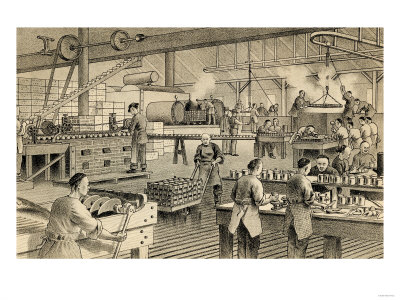 |
Chinese-Americans Working at the Kinney Salmon Cannery in Astoria, Oregon. c. 1880s. |
Because of the abundance of lumber during Oregon's early days, Astoria included shacks built on wood piling foundations which were not the most appropriate material for permanent construction. The light frame buildings were a great fire hazard. The city council proposed an ordinance requiring property owners to install fire stops, but the taxpayers objected to the expense. Insurance rates had skyrocketed so high that less than 50% of $18,000,000 in real estate was insured, and only 20% of personal property. Astoria was destined to go up in flames, the question was when.
At 1 a.m., December 8, 1922, the Astoria business district burned to the ground.
Thirty-two acres of buildings were leveled. Of those, 90% were of light frame
construction and supported by wood piling.
June 9, 1877, Pacific Rural Press
The Salmon Fisheries on the Columbia


To Editors Press: I doubt if the extent of the salmon fisheries on the Columbia river, or the magnitude of this suddenly developed interest to our-State, is generally understood.
To visit some friends engaged in this business I last week went down the river to Brookfield, W. T., the site of one of our largest canneries, and on this trip learned much of this industry that was a surprise to me. Owing the Press a great good will, I will tender for the benefit of its readers, some of my observations.
To make my statements more easily understood by all, I will observe, in the outstart, that much the greater part of the fish taken here are put up in tin cans of one pound weight, and that each establishment manufactures its own cans; hence they are spoken of and known as "canneries." The most approved and quite expensive machinery is employed, with Chinese labor, in making these cans, which are produced with great facility - the establishment at Brookfield turning out fully 25,000 cans per day. The proprietors of the several canneries are not fishermen, but rather contractors and packers. They furnish the fishing boats, nets, etc., and hire experts to take the fish, paying them this season 50 cents for each fish delivered at the cannery. The fishermen are mostly sailors, and are of almost every known nationality. Not all of them are complete models of purity and sound morals.
The waters of the Columbia, habitually limpid, are remarkably clear this spring, compelling fishermen to do their work at night. The character of this work is indicated by the following: A fishing boat (or smack) is put in charge of each fisherman, who employs an oarsman to manage it for him. To each boat is attached one net (or seine); these are variable in size, the average being 200 fathoms (1,200 feet) in length, by 18 feet in depth. The meshes of these nets are large enough to admit the head of the fish to a point behind the gills, but too small to allow his body to pass through. It is suspended between two lines, the upper supported by corks or floats, while the bottom line is provided with leads to sink and hold the net in perpendicular position. The boat being provided with oarsman, sail, anchor, line, net and ballast, the fisherman, about sunset, moves out into the river and drops his net on a line across the current, by which it is borne down many miles, as is often happens, before the coming morn. The fisherman during the night passes back and forth along the line to release his net from snags and remove to his boat the fish he may find entangled in its meshes. At day light the nets are hauled aboard, and all the boats belonging to each cannery assembly and, with their bowlines attached to a steamer, are towed up to their respective quarters, where they now discharge the catch of the night. The fish, on reaching the cannery, are, by a process of butchery and cooking, which I shall not now attempt to describe, quickly transferred to cans, hermetically sealed, and packed in four dozen can cases, ready for shipment to any part of the globe.
Wheat has been the great staple of Oregon, and the main dependence of her people for revenue, but the salmon fisheries on the Columbia, it is shown, in product, last year, exceeded in value, by far, her entire wheat crop. So large has the demand abroad for Oregon salmon become to be, and be profitable its supply, that not a few of the men engaged in the business found themselves suddenly worth hundreds of thousands. The discovery of this fact has served to so stimulate the business, that the run of 1877 finds the facilities for taking fish in the Columbia nearly, if not quite, double. No less than 1,000 fishing smacks are now on its waters, and the river from the lower cascades to the bar at its mouth, a distance of 150 miles, is said to be a maze of floating nets. The amount of capital required to prosecute this business on the scale attempted this year, is immense, which, to make appear, I will give a few figures kindly furnished by my friend Mr. Truman Tyrrel, Superintendent of the Brookfield cannery.
Salmon Cannery. The largest plant on the Pacific Coast. Astoria, Oregon.


The cost of buildings and machinery was not given, but I think it cannot fall short of $70,000; 50 fishing-smacks, rigged complete, $300 each; 50 nets, costing the sum total, boats and nets, $30,000; steam tug Edna, of Brookfield, just built, $18,000. Then passing over the heavy outlay for plate-tin, packing-cases, salt, etc., we note the wages, at $1 per day, of 55 Chinamen can-makers, 250 Chinamen, employed in the packing-house, at $2.50 per day; also 100 white laborers employed, including fishermen. The above relates to but one establishment of the 29 on the river, a carefully prepared statement of the working capacity of each of which I will now give. The capacity of each cannery is measured by the number of cases they are prepared to pack this season, if the fish can be taken. It must be remembered a case, as here given, comprises 48 one-pound cans:
| Proprietors and Locations | Capacity (in cases) |
|---|---|
| F. M. Warren & Co., Cascades | 20,000 |
| Jackson, Myns & Co.,Rainier | 20,000 |
| Quinn & Co., Quinns | 15,000 |
| John West, Westport | 30,000 |
| Watson & Bannon, Manhattan | 25,000 |
| J. W. & V. Cook Clinton | 50,000 |
| Hepburn & Co., Tongue Point | 20,000 |
| Bradly, Davis & Co., Upper Astoria | 25,000 |
| Anglo-American Packing Co., Upper Astoria | 25,000 |
| J. A. Hawthorn & Co., Upper Astoria | 25,000 |
| Fisherman's Packing Company, Upper Astoria | 20,000 |
| Bradolit & Co., Upper Astoria | 35,000 |
| A. Booth & Co., Upper Astoria | 50,00 |
| John A. Delsin & Co., Astoria | 30,000 |
| Geo. W. Hume, Astoria | 25,000 |
| Sternberger & Co., Astoria | 20,000 |
| Kinney & Co., Astoria | 50,000 |
| T. M. Warren & Co., Brownsport | 20,000 |
WASHINGTON SIDE |
|
| Wm. Hume, Eagle Cliff | 20,000 |
| Cuttinng & Co., Eagle Cliff | 35,000 |
| Joseph Hume, Eagle Cliff | 50,000 |
| Hapgood & Co., Waterford | 25,000 |
| Warren & Co., Cathlamet | 30,000 |
| Leuridge & Princle, Bay View | 30,000 |
| Columbia River Salmon Company, Glen Ella | 20,000 |
| Fitzpatrick, Davis & Co., Fisherton | 30,000 |
| J. G. Megler & Co., Brookfield | 50,000 |
| Pillar Rock Packing Company, Pillar Rock | 20,000 |
| Total, in cases | 1,135,000 |
Should the catch of salmon this year enable all of these establishments to run to the full limit of their capacity, as above given, 1,135,000 cases, or 54,480,000 cans, of fish will be the product, aside from barreled fish, which are put up in considerable quantity. These canned goods, at $6 per case, (the price generally obtained last year), will represent $6,810,000 in gold coin, quite a clever sum for an infant industry, and a handsome fruitage for our beautiful Columbia. It is estimated that an average fish will fill 16 cans; hence, to meet this year's lay-out of these canneries, 378,333 salmon will be required, and the pay to the fishermen, for catching them, will be $189,166. The fishing season is now fairly in, and will probably continue till about the 15th of August.
I want to say, in conclusion, to your readers, that for many facts in this brief of our piscatorial bonanza up here, they are indebted to Mr. Truman Tyrrel, of Brookfield, a gentleman every way trustworthy, and to him and his talented lady, the writer is under obligations for the cordial hospitality of their pleasant home during his sojourn in that place.
N. W. Garretson., Albany, Oregon, May 1st, 1877.
1899. World's Fleet. Boston Daily Globe
Lloyds Register of Shipping gives the entire fleet of the world as 28,180 steamers and sailing vessels, with a total tonnage of 27,673,628, of which 39 perent are British.
| Great Britain | 10,990 vessels, total tonnage of 10,792,714 |
| United States | 3,010 vessels, total tonnage of 2,405,887 |
| Norway | 2,528 vessels, tonnage of 1,604,230 |
| Germany | 1,676 vessels, with a tonnage of 2,453,334, in which are included her particularly large ships. |
| Sweden | 1,408 vessels with a tonnage of 643, 527 |
| Italy | 1,150 vessels |
| France | 1,182 vessels |
For Historical Comparison
Top 10 Maritime Nations Ranked by Value (2017)
| Country | # of Vessels | Gross Tonnage (m) |
Total Value (USDbn) |
|
|---|---|---|---|---|
| 1 | Greece | 4,453 | 206.47 | $88.0 |
| 2 | Japan | 4,317 | 150.26 | $79.8 |
| 3 | China | 4,938 | 159.71 | $71.7 |
| 4 | USA | 2,399 | 55.92 | $46.5 |
| 5 | Singapore | 2,662 | 64.03 | $41.7 |
| 6 | Norway | 1,668 | 39.68 | $41.1 |
| 7 | Germany | 2,923 | 81.17 | $30.3 |
| 8 | UK | 883 | 28.78 | $24.3 |
| 9 | Denmark | 1,040 | 36.17 | $23.4 |
| 10 | South Korea | 1,484 | 49.88 | $20.1 |
| Total | 26,767 | 87.21 | $466.9 | |

Site Search

Great and Minor Moments in Oregon History
Dick Pintarich
The history of Oregon is filled with a fascinating array of facts both expected and surprising. Great and Minor Moments in Oregon History highlights the significant and the unexpected, from the prehistoric to the present with in-depth, and often humorous glimpses of the personalities and peculiarities that inhabit Oregon's past. Learn about the forces of nature that created Oregon, the natural gifts that inspired the mythic world of its natives, and what it was like for Lewis and Clark to spend a winter on Oregon's cold and wet north coast.


The Mapmaker's Eye
David Thompson on the Columbia Plateau
Jack Nisbet
David Thompson was a fur trader, explorer, and meticulous geographic surveyor. He was, and is, the English and Canadian counterpart of Lewis and Clark. He visited the Mandan villages on the Missouri River in 1798. He crossed the Continental Divide in 1807 and spent five winters on the west side of the divide trading with the Indians. He explored the Columbia River from its origin to the Pacific Ocean. He kept complete journals. He was a better writer than Meriwether Lewis, although not Lewis' equal as a naturalist. He took astronomical readings and did his own computations of both latitude and longitude. Because of this, his maps were much more accurate than those of William Clark. Later in his life, Thompson helped survey the boundary between Canada and the United States.

Portland Then and Now
Linda Dodds
"In 1894 Portland was a bustling port city, whose two halves were connected by four bridges.
Historical Atlas of the Pacific Northwest
Maps of Exploration and Discovery: British Columbia, Washi
Derek Hayes


 Copyright ~ 1998-2018.