South America
° Arica ° Concepcion ° Coquimbo ° Easter Island ° Juan Fernandez Islands ° Punta Arenas ° San Antonio ° Santiago ° Talcahuano ° Valparaiso
Chile


Distance between San Francisco and:
- Cape Horn, Chile: 7,000+ Nautical Miles
- Magallenes, Chile: 7,135 Nautical Miles
- Strait of Magellan, Chile: 7,000+ Nautical Miles
- Valparaiso, Chile: 5,300 Nautical Miles
Arica
Archaeological evidence suggests that humans have inhabited the site of the Port of Arica for more than ten thousand years before Europeans arrived. Captain Lucas Martinez de Begazo from Spain founded a city there in 1541, and from 1545, it was used as a port for exporting silver from Potosi. In 1570, it received the name of the “Very Illustrious and Royal City of San Marcos of Arica” (La Muy Ilustre y Real Ciudad San Marcos de Arica).
July 17, 1860, Sacramento Daily Union, Sacramento, California, U.S.A.
Dates from Callao and Lima reach to June 14th. It is said that an English subject was turned out of his store in Arica because the authorities wanted the ground for enlarging the Custom House, and that, after long negotiations and delays, the Peruvian Government had agreed at last to pay an indemnity of $7,000. The decree was signed by Castilla and countersigned by the Minister of Foreign Affairs, Mr. Carpio, but it was not yet published, when, two days afterwards, Castilla retracted his engagement and refused to pay. Mr. Clay, the American Plenipotentiary, will in all probability have to depart soon from Lima, as he has received orders from hia Government to leave immediately, if the American claims are not satisfied forthwith. Until now the Government has not shown any inclination to cede, for they always wait in such cases until the last moment.
Arica, Chile


Until 1879 when the Chileans captured the city during the War of the Pacific, the Port of Arica belonged to Peru.
The Battle of Arica is one of the most famous of the war, with hundreds of Peruvian and Chilean casualties in a matter of hours. The Port of Arica was destroyed by a tsunami following a large earthquake in 1868 off the coast in the Peru-Chile Trench. The Port of Arica’s status remained at issue until 1929 when it was formally incorporated into Chile.
August 21, 1909, Lompoc Journal, Lompoc, California, U.S.A.
Rushing Tunnel Through Mountains. Arica, Chile.—The work of piercing the Andes mountains with a tunnel from Arica, Chile, to La Paz, Bolivia, is progressing fast, and trains will be running through it by January Ist.
Coquimbo
Coquimbo means “Place of Still Waters,” and the name came from the beautiful quiet bay upon which the city rests. Indigenous peoples used the natural harbor as a port long before the Spanish conquerors arrived. Spain’s Pedro de Valdivia took the harbor in 1550. During the 1840s, mining made the Port of Coquimbo an important export center for gold and copper, and many Europeans (particularly the English) settled there. Today, the city boasts many buildings in English architectural styles and an English graveyard. It was officially recognized as a town in 1867. The area is full of stories about pirates and corsairs that plundered the coast, and rumors of buried treasure abound. The area was visited by privateers like Francis Drake, Davies, and Sharp.
Valparaiso Bay
James McNeill Whistler Nocturne in Blue and Gold


The Juan Fernandez Archipelago consists of three islands, Isla Robinson Crusoe (M s a Tierra, 48 km ), Isla Santa Clara (2.2 km ) and Isla Alejandro Selkirk (M s Afuera, 50 km ), located in the southeastern Pacific Ocean, 670 km off the coast of central Chile to which they belong politically. Frequently referred to as a temperate counterpart of the Gal pagos Islands (but far less well-known or visited), both of these island groups are characterized by isolated floral and faunal communities that exhibit high degrees of endemism. The flora and fauna of the Juan Fernandez Islands have declined drastically owing to the effects of two waves of introduced animals: goats, rats, cats and dogs introduced by the first colonists in the 1600s (though the dogs died out in the early 1800s), and then cattle, sheep, rabbits Oryctolagus cuniculus and coatis Nasua nasuaintroduced in the 1800s.
Crusoe's Island.
Reported Destruction of Juan Fernandez.
(From Our Own Correspondent.)
MADRID, August 30, 1896
In consequence of the violent earthquakes that occurred in the centre of Chili, Santiago, and Valparaiso on March 13 and 14 last, a notice has appeared in Santiago, uncontradicted up to the present, that these seismatical disturbances have destroyed the island of Juan Fernandez, off the coast of Chili, to which the group of islands belongs. It is believed that these islands have disappeared. The island of Juan Fernandez, it will be remembered, is celebrated as having been the residence for four years of the shipwrecked sailor Alexander Selkirk, whose adventures inspired Daniel Defoe to write "Robinson Crusoe." A merchant vessel has seen, in the direction of these islands, enormous flames which shot out of the sea, causing a violent disturbance. The Government of Chili has sent a vessel to ascertain whether the islands are still in existence. The inhabitants are said to be about a hundred fishermen.
Punta Arenas
Punta Arenas is the southernmost city on the planet. was originally inhabited by four different groups of people who spoke different languages and settled in different areas. The tall Aonikenk or Tehuelches were nomad and terrestrial hunters. They devoted to cattle grazing and hunting guanacos and ñandúes in the valleys of the precordillera. They had domesticated horses in the 18thcentury, which enabled travel to the Atlantic Ocean along the rivers.
The Onas or Selknam were terrestrial hunters who lived in the pampa of Tierra del Fuego, and sometimes travelled to other regions to barter with the Aonikenk.
The Yamanas or Yaganes lived around the Beagle Channel, from Isla Clarence to Cape Horn. They were sea hunters; their extintion was due to diseases, alcoholism, and venerial diseases introduced by whalers came during the late 19th century.
The Qawasqar or Alakalufes were nomad connected to the sea. They travelled around the Golfo de Penas to the north of the region up to the Strait.


Hernando de Magallanes sailed into Magellan Strait in 1520; the Strait eventually became the main navigation route between Europe and the coasts of the Pacific. This long-rumored sailing route connects the Atlantic with the Pacific without going through the treacherous seas of Drake Passage. For Magellan and those funding this expedition, it promised a faster route between Europe and the Spice Islands. That competitive advantage meant more spices could be imported to sell to Europe’s booming appetite for spices.
In 1843, the Chilean government sent a colonizing expedition to the region, which founded Fuerte Bulnes on a rock in the Magellanic forest. This site wasn't sufficient, and in 1848, Governor José Santos Mardones founded the city in its present location. The city was originally a penitentiary colony for relapsing criminals and military, who caused disturbances such as the mutiny of Cambiaso in 1851. That mutiny destroyed the church and the hospital. After sacking the buildings and assasinating governor Muñoz Gamero and his loyals, the priest, and sailors in port, the buildings were also destroyed.
In 1852 the new governor sent by the Chilean government, Mr. Bernardo E. Philippi, brought sheep from Chile. In 1877, another governor, Don Diego Dublé Almeyda, authorized by the government, travelled to the Falkland Islands in the cravette Chacabuco of the Chilean Navy, where he acquired 300 sheep that he sold in Punta Arenas. these sheep became the base of wealth of Magella and were called the white gold of Magellan.
In 1867, president José Joaquín Pérez promoted a colonizing policy for foreign immigrants and declared Punta Arenas a "free port." The arrival of foreign colonists laid the base for growth by establishing commercial businesses.
San Antonio
Before Europeans discovered the area, the site of Puerto San Antonio was home to Huechun Cacique and his people, who were fishers and farmers. In 1590, Portuguese Don Antonio Nunez de Fonseca received a grant of the lands. Nunez de Fonseca built warehouses there to store agricultural produce and seafood from the region for export to Santiago. In 1873, the Society of the Bodegas constructed wharves and warehouses there. Construction of the modern port began in 1910.
Santiago
Santiago was founded in 1541 by Spanish conquistadors who chose the location for its proximity to high ground and the Mapocho River. The conquistadores were met with great resistance from the Incas and Mapuche people who resisted the Spanish and fought back for decades.
By the 1600s, Santiago was taking shape however, and the expansion was rapid. However, earthquakes damaged the city repeatedly. In 1770, the governor commissioned the Metropolitan Cathedral and La Moneda presidential palace to be built.
Rio Mabooba, Santiago, Chile


In 1810 first National Government Junta was created, with which the process of emancipation was begun. Santiago became the capital of the young nation in 1818, the year of definitive independence. At the time the city had 45,000 inhabitants.
The Battle of Chacabuco on February 12, 1817 was a key moment in Chilean history. José de San Martín and Bernardo O’Higgins led the resistance army to victory against Spanish royalists and on the same day Chilean independence was proclaimed.
Growth continued throughout the Republican era and an ambitious plan of civic building was formed, leading to the development of the education system and the forward-thinking landscaping of Cerro Santa Lucía.
The railway arrived in 1857. Santiago became a modern and reasonably wealthy city with trams and paved streets.
Talcahuano
When Captain Juan Bautista Pastene discovered the mouth of the river of Bio-Bio in 1544, he wrote about Talcahuano. Antonio Guill y Gonzaga declared the Port of Talcahuano an official port in 1764. The Port of Talcahuano was named for Talcahuenu, an Araucanian chief who lived there when the Spanish arrived. In the language of the indigenous Mapuches, it means “Thundering Sky.” American whalers were familiar with the Port of Talcahuano in the 19th Century, as it was a favorite stopping point for food, fresh water, and entertainment for their crews.
The port was legalized by Guill y Gonzaga by decree in 1764, making the port of registry for Chile’s interior and the most important port for ships travelling the Strait of Magellan. Located at what is known today as “Acanale la Nariz,” several precarious wharves were built that year. The new wharves brought increasing ocean-going traffic to the port. In 1915, construction began on the modern Port of Talcahuano.
 
|
The Church of San Francisco, Valparaiso. c. 1834 |
Valparaiso
Muelle Villaurrutia, Chile's first cargo dock, was constructed in Valpara so during the colony period in the early 1800s. From then until 1831, a series of wharves were built in response to growing international trade, which was consolidated in 1832, when the first duty-free warehouses to receive cargo from Europe and Asia were built.
This infrastructure turned the port into a thriving commercial emporium for the South Pacific. During much of the Nineteenth Century, shipping was so intense that eventually three duty-free warehouse companies were active in Valparaiso. During that time, building out into the sea expanded the port and ships sailing from America's Eastern Seaboard and from Europe made Valparaiso a regular stopping site for re-provisioning.
October 14, 1853, Daily Alta California, San Francisco, California
Foreign Markets
VALPARAISO, 31 August 1853. -- Notwithstanding the many interesiing arrivals of valuable cargoes during the past fortnight, there is still a general dullness prevailing in the market lor most descriptions ot dry goods. Assortments of fresh goods, for the proximate season are very full, and we expect greater activity in the ensuing month. There has been considerable business done in rough goods, though an evident tendency to a decline in prices is manifest in many articles recently in active request.
General View of the Port of Valparaiso.


SILKS - Imports large and varied, from France, Germany and China, dresses and shawls of desirable style are in season and saleable. Chinese embroidered goods are dull at scarcely remunerating prices.
LINENS - Assortment full, sales very limited.
SPIRITS - In brisk demand at full rates, for brandies, French and Spanish, Gin in cases very scarce.
OLIVE OILS - In request at quotations, other oils abundant and dull.
ALE AND PORTER - Current sale.
METALS - A parcel of American sheathing sold at 38c. and some parcels to arrive at 36c. Demand very active. Other metals are quiet.
RICE - Although imports have been very large from Peru, Calcutta, Batavia and U.S., prices have been well sustained. We not sales of 900 bag Peruvian, a 4.73. 700 bags Manila, a 3.75 1200 bags Calcutta a 3.75 qtl.
SUGAR - 500 bbs American refined sold at 16-3/4 reals arrobe. For a cargo of 30,000 arrobes Pernambuco Sugars, just arrived, 14-1/2 rls offered, and 15 reals asked. 10,000 qtls Peruvian Chancara changed hands at $3 40 qtl. The Calcutta Sugar, ex ship sold at 8 rls, 10-1/2, 11 and as high as 15 rls for fine christalized quality.
COFFEE Steady demand and sales at quotations
COALS Welsh Coals wanted for export. The two cargoes of New Castle Coals on sale per last issue, were taken at $14. delivered in Caldera. The cargo of Welsh went out of the market. Of Chilean Coals, one cargo has been sold for local consumption at $9 75 ton; 20 qtls on board.
LUMBER - In brisk demand. Sales of 100,000 feet Am., part dressed; at $65, to arrive soon
LARD - Becoming abundand and of rather dull sale.
TALLOW - Wanted. Sales are $16 to arrive.
ROSIN - In brisk demand at quotations.
BEEF and PORK - Abundant and declining.
HAMS - American plenty. English and German scarce.
RAISINS - Scarce and wanted for export. No foreigh in the market.
ALMONDS - Scarce - Saleable at $28.
CORDAGE - Both tarred and Manila become abundant and declining. A considerable parcel of Coir and similar Rope and Canvas, imported from Calcutta, still unsold.
GUNNY BAGS - Very abundant and dull at 11, 14 and 16c, according to size.
EXPORTS-FLOUR - Was quiet until the arrival af the mails from California, when a sudden animation burst upon the market, and in the course of a few hours about 30,000 qtls. changed hands at full rates, say dollars 8.50 for bags of all sizes. Considerable sales have likewise been made for delivery at Talcahuano and some cargoes expected soon, are engaged at same price. At least seven eights of the purchases have been by speculators for San Francisco. We look for a continuance of present ruling rate, and see no reason at present for any material alteration in the price.
WHEAT - We hear of no transactions whatever nominal price 3.50 per fanega.
BARLEY - Anticipations of a rise in this grain received a sudden check the day after the sailing of the last Packet by the return shipment of some 2,000 fan. from Melbourne, causing the price to recede again to 23 rls. fan. which it at present maintains; though transactions during the past fortnight have been trifling. Holders however are firm, and some sales have been effected at quotations.
DRIED PEACHES - (Mendozo) - A sale of some 1,500 qtls. descarosa los has been effected at about 14 dollars qtl (not strictly prime). A superior article cannot be bought at less than 16-1/2 17 dolls.
BEANS -- Of all classes are exceedingly scarce and much sought after for home consumption. Bayos none are offering. Last sales small parcels 5.6 cash. White Beans worth 4.4 cash.
MAIZ - Limited demand. Market supplied. Small sales at $2.90@ $3 per fan.
BRAN - Abundant at $1.10 fan. 81 lbs bagged.
NUTS - Stationary. We report an isolated sale of about 800 fan. at $5.25 @ 5.50, six months for export.
COPPER - We have heard of no transactions, holders refusing to meet purchasers at the price of $19 on board.
HIDES - Nominal - None in market, being out of season.
LIMA WOOD - $3500 qtts prime - ex ship sold at $2.50 qtt. 6 mos - very abundant.
NITRATE - We are not aware of any transactions during the part fortnight.
MONEY - Hard dollars 7-1/2 @ 7-3/4 premium; bar silver, pure, 10, 12 per marc; gold, ley 18 @ 19-1/4 rls per cast - none. Exchange on London 46-1/2 @ 46d; on Paris 4.90; United States par, sales.
FREIGHTS AND CHARTERS - There has been renewed activity
in Freights since our last. The subjoined list comprises the charters effected. England-Huano: orders to a port in G.B., Br bqes Barbadian and Lord Metcalf at 4:5; to London direct, Br barque Glenburvie 4; Nitrate; to London direct, Br. bque Walten Muncaster 4:5; Ores to Swansea, Br bqes Esther Francis and Acacio and ship Burns at £4:15. Continent - Huano orders, Hamb bque Fortunata, £4:10; Nitrate to Hamburg, Hamb barque Cristiane, owner's acct. United States - Huano orders, ships John Marshall (Am), Amelia (Br) $19; Ores for Boston, Am clip ship Rattler $20, Buenos Ayres, assorted produce, Dan brig Adeline, 200 t C $2700. California - Ham bques Anador and Elizabeth and brig Emma, all at $20 per ton, to load principally flour. Valp. Echo.
January 11, 1855, New York Daily-Times, New York, New York
Fire At Valparaiso
Gold Discoveries by Americans


A destructive fire broke out at Valparaiso on the morning of the 23d ult., in front of the Custom House. Ten buildings were destroyed and one life lost. The loss is estimated at $150,000. Only one of the sufferers was insured. The valuable documents of the Custom-House were saved. Had it not been for the active exertions of the Fire Companies, the destruction of property would have been far greater. The vessels of war in port sent detachments of men on shore, who rendered efficient service.
The Corro del Sur says that rich gold washings have been discovered by a part of five Americans in the Cordillera of Autuco, in the province of Auraco. They procured a large quantity, and others who followed after were also very successful. A party of twenty-five Americans, well armed and provided with the necessary tools, provisions, etc., were preparing to start for the vicinity.
The English vessels of war Dido and Rattlesnake, and the United States frigate St. Lawrence, were the only vessels of war in port.
Thursday Morning, January 10, 1856, Daily Alta California, San Francisco, California, U.S.A.
Five Days Later From Valparaiso
MORE GOLD DISCOVERED.
By the arrival of the Emily Miner, Capt Metzger, fifty days from Valparaiso, we have dates from there to the 20th of November, five days later than were previously received.
We learn from Dr. D.W. Young, a passenger on board of the Emily Miner, that gold had been discovered at a place called Quipul, about 8 miles from Vina Del Mar and some 18 miles from Valparaiso. Considerablr excitement was caused by the discovery. Capt. Metzger of the Emily Miner has a specimen on board which looks to be very fine; several Captains and mates of vessels in port had left their vessels for the mines -- the workmen in the factory and in fact many of the citizens had left for the mines, which are supposed to be very rich.
The Mercurio says its editor has conversed with a person who had been to the new mines, but had made nothing, who says that at present nothing can be made, but that in the winter during the rainy season they promise well. The Mercurio does not consider the mines particularly rich.
Miss Mary St. Clair, "the bright Queen of Magic," is still performing in Valparaiso.
A correspondence from Santiago, states that an extra session of Congress was about being called, and that among the subjects which would occupy attention, would be the increase of the salaries of the President of the Republic and the Ministers of State.
On the 19th of November, a grand banquet to honor the success of the allies, was given at Santiago.
In Valparaiso, a meeting of French and English residents was held on the 19th, and a committee appointed to arrange for a banquet.
From 1870 to 1876, the Port underwent modernization, with the building of the State Wharf. This L-shaped dock equipped with a 35-ton capacity crane was the Chile's first major port facility and could handle two modern ships of the period. It operated until 1919, when the works of the new port absorbed it.
With the completion of the State Wharf (1883), the construction for a passenger wharf began named Prat Wharf, which was completed in 1884, behind the "Heroes of Iquique Monument" (in memory of a major naval battle in this northern city). This generously sized wooden dock stretched tens of meters into the sea and was a popular walkway for city residents of the period, and was also replaced, like the state wharf, by the construction of the new port.
January 31, 1857, Daily Alta California, San Francisco, California, U.S.A.
SOUTH AMERICAN NEWS
A floating dock has been erected in the harbor of Valparaiso, capable fo admitting ships of 800 tons. It belongs to a private company. It will doubtless prove of great value ot that port.
December 3, 1906, San Francisco Call, San Francisco, California, U.S.A.
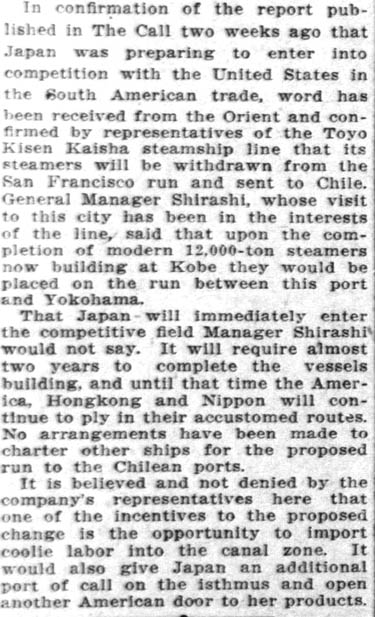
JAPAN TO ENTER SOUTH AMERICA
Between 1910 and 1930, part of the current port infrastructure is built, claiming more land from the sea, that added up to 2005 linear meters that belong to the berthing areas, 13 warehouses with a covered area of 114,595 square meters, 72,295 square meters of yards and a dangerous cargo warehouse, along with a 1000-meter long breakwater.
1899. World's Fleet. Boston Daily Globe
Lloyds Register of Shipping gives the entire fleet of the world as 28,180 steamers and sailing vessels, with a total tonnage of 27,673,628, of which 39 perent are British.
| Great Britain | 10,990 vessels, total tonnage of 10,792,714 |
| United States | 3,010 vessels, total tonnage of 2,405,887 |
| Norway | 2,528 vessels, tonnage of 1,604,230 |
| Germany | 1,676 vessels, with a tonnage of 2,453,334, in which are included her particularly large ships. |
| Sweden | 1,408 vessels with a tonnage of 643, 527 |
| Italy | 1,150 vessels |
| France | 1,182 vessels |
For Historical Comparison
Top 10 Maritime Nations Ranked by Value (2017)
| Country | # of Vessels | Gross Tonnage (m) |
Total Value (USDbn) |
|
|---|---|---|---|---|
| 1 | Greece | 4,453 | 206.47 | $88.0 |
| 2 | Japan | 4,317 | 150.26 | $79.8 |
| 3 | China | 4,938 | 159.71 | $71.7 |
| 4 | USA | 2,399 | 55.92 | $46.5 |
| 5 | Singapore | 2,662 | 64.03 | $41.7 |
| 6 | Norway | 1,668 | 39.68 | $41.1 |
| 7 | Germany | 2,923 | 81.17 | $30.3 |
| 8 | UK | 883 | 28.78 | $24.3 |
| 9 | Denmark | 1,040 | 36.17 | $23.4 |
| 10 | South Korea | 1,484 | 49.88 | $20.1 |
| Total | 26,767 | 87.21 | $466.9 | |

Site Search
Ploughing the South Sea: A History of Merchant Shipping on the West Coast of South America
E. John McGarry


The Gold Rush Diary of
Ramon Gil Navarro

Patagonia: A Forgotten Land: From Magellan to Peron
C.A. Brebbia
WIT Press (UK)
A history of Patagonia from its discovery by Magellan to recent times. Patagonia has been associated with conditions of extreme hardship and suffering. Men and ships were lost in the dangerous waters of the Straits of Tierra del Fuego, giving rise to tales of mysterious cities populated by the shipwrecked sailors, survivors of failed expeditions. Early Spanish attempts to colonize Patagonia ended in failure and the region remained largely uninhabited until the arrival of the Welsh in 1865. Their peaceful coexistence with the natives ended abruptly when the Argentine Army entered Patagonia and took over the Indian lands, which were promptly distributed to new settlers. As a new frontier society, Patagonia could not fail to attract its share of desperadoes and adventurers, the most notorious of whom are described in the book, including gold prospectors, hunters and bandits such as Butch Cassidy and the Sundance Kid.

The Americas: A Hemispheric History
(Modern Library Chronicles)
Felipe Fernandez-Armesto


The History of Latin America: Collision of Cultures
(Palgrave Essential Histories)
Marshall C. Eakin
This narrative history of Latin America surveys five centuries in less than five hundred pages. The first third of the book moves from the Americas before Columbus to the wars for independence in the early nineteenth century. The construction of new nations and peoples in the nineteenth century forms the middle third, and the final section analyzes economic development, rising political participation, and the search of identity over the last century. The collision of peoples and cultures - Native Americans, Europeans, Africans - that defines Latin America, and gives it both its unity and diversity, provides the central theme of this concise, synthetic history.


1491: New Revelations of the Americas Before Columbus
Charles C. Mann


The Penguin History of Latin America
Edwin Williamson
From Columbus to Chavez.


Born in Blood & Fire:
A Concise History of Latin America
(Third Edition)
John Charles Chasteen



A Brief Political and Geographic History of Latin America: Where Are Gran Colombia, La Plata, and Dutch Guiana?
(Places in Time/a Kid's Historic Guide)
Earle Rice, Jr.
For young readers with maps, timelines, Web addresses for additional study.
Black in Latin America
Henry Louis Gates, Jr.


Tropical Nature
Life and Death in the Rain Forests of Central and South America
Adrian Forsyth, Ken Miyata,
Dr. Thomas Lovejoy


Ursua (Spanish Edition)
William Ospina
Con solo quince anos de edad, Ursua se embarca hacia America en busca de fortuna y de gloria, llega primero a Peru donde la insurreccion de Pizarro, la confusion general y un tesoro que ya se encuentra en manos de otros espanoles, le hacen dudar de continuar en esas tierras. Sin embargo, estando alli una carta de un tio le devuelve la esperanza; Miguel Diaz de Armendariz, nombrado juez de la Nueva Granada, invita a Ursua a Cartagena. El joven acude en el acto y a partir de alli se puede decir que comienzan sus aventuras y desventuras en el Nuevo Mundo. Guerras sangrientas y crueles contra indigenas y negros libertos, enganos y traiciones, un amor por una india y un hijo con una blanca al que jamas conocio, y atravesando todo esto, constante, como grabado sobre piedra, la leyenda de El Dorado, la maxima quimera de todas sus ambiciones.
Young Ursua embarks in a voyage to America in search of fortune and glory. He arrives in Peru, where Pizarro's uprising, the general upheaval and the riches now in hands of other Spaniards, make him question his plans to stay. He receives an unexpected letter from his uncle, the judge of Nueva Granada, inviting him to Cartagena, where his adventures, fortunes, and misfortunes begin. Ospina presents a dramatic testimony of the Spanish conquest of America.


 Copyright ~ 1998-2018.