Seaport
° Andaman and Nicobar Islands ° Bengal ° Bombay (Mumbai) ° Calcutta ° Cawnpore ° Delhi ° Gujarat ° Indore ° Jodhpur ° The Konkan Coast (Goa) ° Madras (now Chennai) ° Patna (Bihar) ° Tellicherry ° Varkala
International Harbors
The Fortunes of Africa: A 5000-Year History of Wealth, Greed, and Endeavor
Africa has been coveted for its riches ever since the era of the Pharaohs. In past centuries, it was the lure of gold, ivory, and slaves that drew fortune-seekers, merchant-adventurers, and conquerors from afar. In modern times, the focus of attention is on oil, diamonds, and other valuable minerals. He traces the rise and fall of ancient kingdoms and empires; the spread of Christianity and Islam; the enduring quest for gold and other riches; the exploits of explorers and missionaries; and the impact of European colonization.


The Diary of Antera Duke: An Eighteenth-Century African Slave Trader
In his diary, Antera Duke (ca.1735-ca.1809) wrote an eyewitness account of the slave trade by an African merchant. A leader in late eighteenth-century Old Calabar, a cluster of Efik-speaking communities in the Cross River region, he resided in Duke Town, forty-five miles from the Atlantic Ocean in what is now southeast Nigeria. His diary, written in trade English from 1785 to 1788, is a candid account of daily life in an African community at the height of Calabar's overseas commerce. It provides valuable information on economic activity with other African businessmen and with European ship captains who arrived to trade for slaves, produce, and provisions.

Basil Davidson states that by examining three important areas of Africa in the history of slavery against a general background of their time and circumstance he was taking "a fresh look at the overseas slave trade, the steady year-by-year export of African labour to the West Indies and the Americas that marked the era of forced migration." (Africans were joined in forced camps by abused laborers from China, "indentured servants" from Ireland, and Britain's hideous prison hulks.)
The Middle Passage: White Ships/Black Cargo
Tom Feelings
Alex Haley's Roots awakened many Americans to the cruelty of slavery. The Middle Passage focuses attention on the torturous journey which brought slaves from Africa to the Americas, allowing readers to bear witness to the sufferings of an entire people. 64 paintings.

The Counter-Revolution of 1776: Slave Resistance and the Origins of the United States of America
Gerald Home
The successful 1776 revolt against British rule in North America has been hailed almost universally as a great step forward for humanity. But the Africans then residing in the colonies overwhelmingly sided with London. Gerald Horne complements his earlier celebrated Negro Comrades of the Crown, by showing that in the prelude to 1776, the abolition of slavery seemed all but inevitable in London, delighting Africans as much as it outraged slaveholders, and sparking the colonial revolt.

Middle Passages: African American Journeys to Africa, 1787-2005
James T. Campbell
Many works of history deal with the journeys of blacks in bondage from Africa to the United States along the middle passage, but there is also a rich history of African Americans traveling in the opposite direction. In Middle Passages, award-winning historian James T. Campbell recounts more than two centuries of African American journeys to Africa, including the experiences of such extraordinary figures as Langston Hughes, W.E.B. DuBois, Richard Wright, Malcolm X, and Maya Angelou. This series is under presiding editor Arthur Schlesinger, Jr.

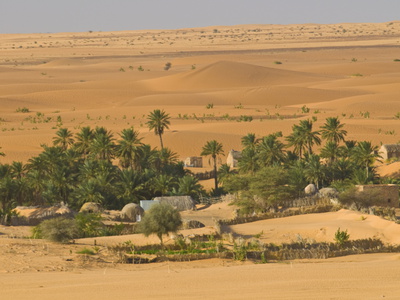
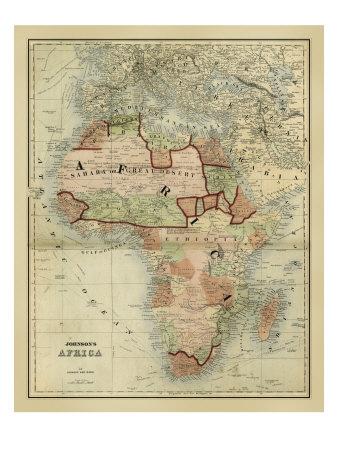
The oldest traces of settlement in Mauritania date back to 5000 B.E.C. The people were blacks who formed hunter-gather communities in the grasslands of Mauritania. Mauritania encompasses 400,385 square miles (1,037,000 square kilometers), more than three quarters of which is now made up of the Sahara desert and the semiarid Sahelian zone.
|

Tens of thousands of years ago, the Sahara was both lush and filled with game. Desiccation eventually forced the inhabitants southward, a process that in the 3rd and 4th centuries ad was speeded by the Berbers, who had domesticated the camel. As the Berbers pressed down from the north toward the Senegal River valley, black Africans who lived in the path of the invaders moved further to the south. From the 9th century, a Berber tribe, the Lamtuna, and two other Berber groups cooperated in the control of a thriving caravan trade in gold, slaves, and ivory from the south. They took desert salt and north African goods in exchange.
Mauritania's position provided a link between North Africa and West Africa. Yet although the country served as a geographical bridge, crisscrossed by merchants transporting gold, salt, and slaves between the northern and southern edges of the Sahara, it also marked a cultural boundary between sedentary farmers of sub-Saharan Africa and the nomadic Arab-Berber herders from the Maghrib. Throughout Mauritania's history, the interaction between the two cultures has been charged with social and political conflict that has defined and will continue to define Mauritanian politics. Even Islam, to which virtually the entire population adhered after the ninth century, provided but a veneer of unity.
During the 14th and 15th centuries, nomadic Arab tribes of Yemeni extraction, the Banu Maqil, moved into Mauritania. By the 17th century, they had been able to establish complete dominance over the Berbers. They called themselves the Awlad-Banu Hassan. The Arabs and Berbers in Mauritania have since thoroughly intermingled with an Arabized Mauritania.
|
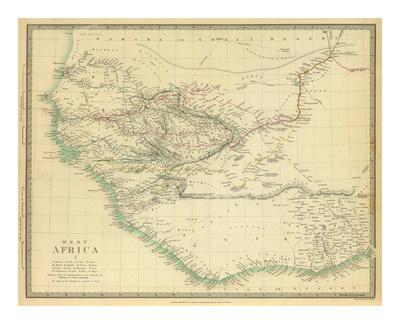
In 1445, this area's first contact with Europeans began when Portuguese traders set up a base on Arguin Island in northern Mauritania to trade in gold and slaves and eventually the acacia gum tree.
Northern Mauritania was conquered by the Beni Hassan Arabs and the Berber language and identity was eventually replaced. Since 1677, the Arabs won a battle with the Berbers, putting Arabs in control, with Berbers in the middle (divided into 2 groups: religious scholars called zawiyas and farmers and herders called znaga), and the blacks on the bottom (also divided into 2 groups: former slaves called haratani and slaves, abid).
Other Europeans became interested in Mauritania only in the second half of the sixteenth century. French traders at Saint Louis in what is now Senegal purchased gum arabic from producers in southern Mauritania. Until the mid-nineteenth century, and then for only a short period when French forces occupied the Trarza and Brakna regions in southern Mauritania, Arabs and Berbers paid little heed to the Europeans. The French, English and Dutch traders fought for control over the gum trade, while the Portuguese were losing their influence. Soon the slave trade also became very important to the French, and for the Mauritanians as it developed into an important source of income: they sold black slaves to the French in exchange for firearms, cloth and sugar. Dutch traders pulled out by 1727. During the 19th century, the French explored the inland regions and signed treaties with Moorish chieftains. During the early 19th Century, civil war broke out between the emirates, with France playing an important part in strengthening tensions and, in 1814, with the Treaty of Paris, France obtained territorial rights over Mauritania, as part of an agreement with other European states and, of course, without any agreement from the Mauritanians.
The official name of Mauritania is "Islamic Republic of Mauritania," and it lies at the crossroads of the Arab North and sub-Saharan Africa. Mauritania is a vast but sparsely populated country of some 3 million inhabitants whose capital Nouakchott (population: approximately 1 million) is on the Atlantic coast of Africa.
|
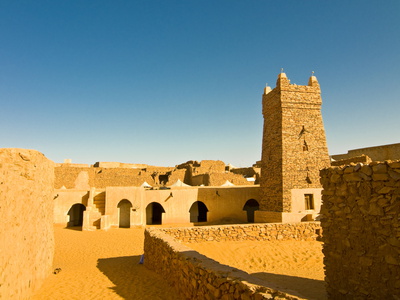
Ancient cities in the interior were important Saharan trade centers from the Ghana Empire through the expansion of Arab civilization and into modern times. The largest of these, Chinguetti, is the seventh-holiest site in Islam.
Weekly News and Chronicle, March 11, 1854
London, United Kingdom
The Mediterranean cruiser that sails along the coasts of Mauritania and Numidia hails the classic kingdoms of larba, of Dido, of Juba, of Jugurtha, of Siphax, and of Massinissa. The traveller while pacing its sunny shore recalls the glories and the heresies of the North-African church; its Cyprian, its Augustine, its Hippo Regius, and its Cirta. Passing the supposed site of the ruins of Utica, his mind dwells on the heroic death of Cato, the last Republican, whose lofty spirit preferred a violent death, rather than bend to the general oppression ol the empire; standing on the ruins of Carthage, he reflects on the revolutions of empires, the Scipios, Hannibal, and llegulus. The image of the gentle, saintly king of France floats before him, as he lies on his couch of ashes on that pestilential shore. Crossing to Goletta, the fort of Tunis, he sees the walls and towers that be ir witness to the Christian zeal and valour of a Spanish emperor and a British admiral. In one place he crosses a river in whose turbid stream the veteran Massinissa found his last home; farther on, he reaches the spot where Genseric and his Vandal host, descending from Spain on the devoted land, proceeded to convert the granary of Rome into a howling wilderness. Not far hence he views the plain where the Greek army of the gallant Belisarius levelled the Vandal pride with the dust. Or if he visits the crumbling battlements of Kairwan, Tlemsen, or Fez, his mind reverts to the days of Arab glory, when the gallant hand of Islam flashed like a meteor over the valleys and plains of Mauritania, and plunging on their fiery chargers into the Western Ocean, threatened to reduce the stormy sea into subjection to the Crescent. A melancholy grandeur hovers over this historical land, and the shades of might; hosts and nations long since gathered to their fathers seem still to linger and haunt its spectral cities.
By 1857, after commercial slavery had officially been abolished (1820), but not necessary honored by all nations, British traders pulled out of Mauritania and established themselves in Gambia, leaving Mauritania in the hands of the French. The French occupied the country in close cooperation with Maur religious leaders. Mauritania became a nation after the destruction of the kingdoms of Fouta Toro and Walo Walo and the Arab-Berber emirats of Trarza, Brakna, Taganet, and Adrar. The most important common denominator has become Sunni Islam.
The New York Times, March 19, 1882
New York, New York
ENTIRE RACES EXTINCT
Animals That Have Disappeared in Recent Times
THE EXIT OF THE GREAT AUK--
THE LAST OF A RACE AND HOW HE WAS TREATED--
THE MOA, THE DODO, THE MAMMOTH AND THE REST.
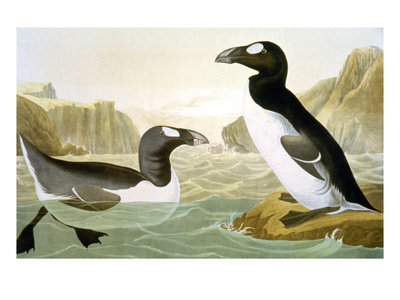
. . . One of the moat interesting of recent cases is that of the Great auk, or Alca-impennis. Tbe skins or bones are so rare that each individual has its history and price; the latter might be quoted at $1,000 or more, as only 60 specimens are known in the world. No living specimen has been obtained for 40 years. In 1860 tbe Museum of Natural History at Central Park purchased one in London for $750, and the bird and egg, both fine specimens, can be seen there.
The auk was about three feet in height, its wings only three or four inches long. It was an inhabitant of the very highest latitudes, and at one time extremely common in the Arctic seas. The ancient shell-heaps on the Atlantic coast show abundant remains of this bird as far south as tbe New-England coast. Vuttall, in 1834, records the birds as then breeding in great numbers. "As a diver he is unrivaled," he says," having almost the velocity of birds of the air. They breed in the Faroe Islands and in Iceland, Greenland and Newfoundland, nesting among tbe cliffs, laying but one egg each. They are so unprolific that if this egg is destroyed no other is laid during the season. It is sometimes known to lay at St. Kilda and in Papa Wastra." The last seen alive were at the Funks, a small island off the coast of Newfoundland. In 1844 the last known to be alive on the eastern continent were seen at Iceland. In 1870 a dead, frozen specimen was found at Labrador, which, though in poor condition, was sold in London for $1200. The only specimens in this country are one at Central Park, Vassar College, Philadelphia Academy of Sciences, Cambridge University, and the National Museum. The single egg that the great auk yearly deposited was evidently not enough to insure its preservation, and year after year it became less abundant, perhaps killed by the Indians along our coast. Finally, the last one was destroyed, and in 200 years more its existence will be a legend, and the steel engravings of the present specimens the only reminders of the giant of the auks.
. . . Two hundred and fifty years ago, a number of curious birds abounded in the Island of Mauritius, and were so common that sailors killed them in wanton sport; while to-day a good specimen would bring several thousands of dollars. In 1612 they were found in great numbers, but in 1712, when the French took possession of the island, not a dodo was round. This and the Solitaire have totally disappeared In this brief period. The former waa a sluggish bird weighing about 50 pounds a gigantic pigeon. It is evident that the dodo was not killed to eat, and, indeed, some of the old works state that the sailors destroyed them for the curious polished stone found In their crops. At this, or probably an earlier time, there lived in tbe Island of Madagascar a race of gigantic ostrich-like birds known as the Epinornis. In a report to tbe French Academy of Sciences M. St Hillaire described some of their eggs. The Captain of a merchant vessel trading to Madagascar one day observed a native using for domestic purposes a vane, which much resembled an auck and, upon examination proved to be one. The native stated many such could be obtained in the interior of the island and eventually procured the bones and eggs exhibited by M. St. Hillaire before the Academy. The bird was about 19 feet in height, judging by its bones, and the eggs were 18 inches or 12,000 hummingbirds' eggs, and holding by actual measurement two gallons of water.
|
|
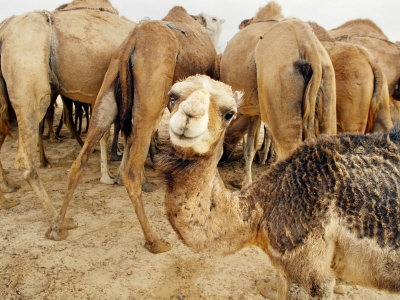
Traditional slavery was formally abolished in 1980. As a result of centuries of this practice, Mauritanian society is characterized by former slave-owning groups of Arab-Berber origin, known as White Moors, and the Black Moor descendants of their liberated slaves who generally lived in the northern and eastern regions. Black African communities, also marked by slavery, traditionally resided in the southern part of the country near the Senegal River.
|
1899. World's Fleet. Boston Daily Globe
Lloyds Register of Shipping gives the entire fleet of the world as 28,180 steamers and sailing vessels, with a total tonnage of 27,673,628, of which 39 perent are British.
| Great Britain | 10,990 vessels, total tonnage of 10,792,714 |
| United States | 3,010 vessels, total tonnage of 2,405,887 |
| Norway | 2,528 vessels, tonnage of 1,604,230 |
| Germany | 1,676 vessels, with a tonnage of 2,453,334, in which are included her particularly large ships. |
| Sweden | 1,408 vessels with a tonnage of 643, 527 |
| Italy | 1,150 vessels |
| France | 1,182 vessels |
For Historical Comparison
Top 10 Maritime Nations Ranked by Value (2017)
| Country | # of Vessels | Gross Tonnage (m) |
Total Value (USDbn) |
|
|---|---|---|---|---|
| 1 | Greece | 4,453 | 206.47 | $88.0 |
| 2 | Japan | 4,317 | 150.26 | $79.8 |
| 3 | China | 4,938 | 159.71 | $71.7 |
| 4 | USA | 2,399 | 55.92 | $46.5 |
| 5 | Singapore | 2,662 | 64.03 | $41.7 |
| 6 | Norway | 1,668 | 39.68 | $41.1 |
| 7 | Germany | 2,923 | 81.17 | $30.3 |
| 8 | UK | 883 | 28.78 | $24.3 |
| 9 | Denmark | 1,040 | 36.17 | $23.4 |
| 10 | South Korea | 1,484 | 49.88 | $20.1 |
| Total | 26,767 | 87.21 | $466.9 | |

Site Search

Travels in Mauritania
(Flamingo)
Peter Hudson
When Peter Hudson set off for Mauritania, he knew it only as a big blank space on a map of Africa. Travelling from the capital, Nouakchott, hardly more than a desert encampment, he found among the oases and ancient caravan towns a people in harmony with their harsh surroundings, and began to understand something of the emerging nation's confrontation with the This book describes Hudson's travels as he progressed by foot, canal and donkey. Peter Hudson's book "A Leaf in the Wind" was shortlisted for the 1988 Thomas Cook Travel Book Award.


Moorish Music from Mauritania
Dimi Mint Abba is one of the few artists from the northwest African country of Mauritania to have an album released internationally and is widely regarded as Mauritania's best-loved female singer and folklorist. Respected musicians such as Ali Farka Toure and Youssou N'Dour have openly expressed their admiration for her talents.

World Music From Mauritania With Ooleya Mint Amartichitt
(Non-Profit)

Paths of Accommodation: Muslim Societies and French Colonial Authorities in Senegal and Mauritania, 1880
(Western African Studies)
David Robinson

Historical Dictionary of Mauritania (Historical Dictionaries of Africa)


Morocco Handbook:
With Mauritania
(Footprint Handbooks Series)
A. McALachlan


 Copyright ~ 1998-2018.