Italy
° Ancona ° Bologna ° Catania ° Civitanova ° Como ° Firenze ° Florence
° Genoa ° Lucca ° Milan ° Modena ° Naples ° Palermo ° Prato
° Salerno (Amalfi ) ° Torino ° Trieste ° Venice ° Verona
Italian Maritime City States
During the 9th and 10th Centuries AD, the coasts of Mediterranean Europe, in particular Italy, were under constant attack from Muslim raiders and pirates. In order to defend themselves from these threats, the cities of Italy began to develop powerful navies. By the 11th Century, the fleets of these Italian city-states had overcome those of the Muslims, and began to go on to the offensive, taking control of many of the maritime trade routes in the Mediterranean.


In the 19th Century, Italy was one of the most overcrowded countries in Europe. Many Italians began considering the possibility of leaving Italy to escape low wages and high taxes. Most of these immigrants were from rural communities with very little education. From 1890 to 1900, 655,888 arrived in the United States, of whom two-thirds were men.1850 to 1930 is a significant period because this was a peak time for Italian immigration to the United States. 17 million immigrants had their first contact with the United States on Ellis Island. Many Italians who came to America settled on the East Coast where they opened stores and restaurants featuring foods from home, their neighborhoods often called "Little Italy."
Note: This was also true of San Francisco, California, where the Italian community established restaurants and farmer's markets in the North Beach area of the City in the 1800s. They prospered.
On October 31, 1854, the Cortes steamed into San Francisco with Signora Barili Thorn, Miss P. Patti, and other members of the Italian Opera Troupe. They made their first appearance in Ernani. Madame Barili Thorn, assisted by Signora Becherini, Signs. Leonardi, Lanzoni, Scola and Laglaise, performed the principal parts. Barili was enthusiastically received, and the representation was highly successful.
Amalfi
The four most successful Maritime city-states were Amalfi, Pisa, Genoa, and Venice. Amalfi was perhaps the first to establish itself, but it was also the most short-lived, being conquered by the Normans in 11th Century.
Ancona
In III and I centuries B.C. Romans went to the Marche area with an interest in controlling the territory and opening access to the Adriatic. They built two important roads -- Salaria and Flaminia -- which would connect Tyrrhenian and Adriatic seas.
The city prospered under the Romans, and its harbor was enlarged (2d cent. A.D.) by Emperor Trajan. In the 9th century , Ancona became a semi-independent maritime republic under the nominal rule of the popes, to whose direct control it passed in 1532.
The port of Ancona eventually became of one the most important seaside trading centers facing the East, with commercial and cultural links with the Near East . . . in addition to people and goods filling the quay along the shoreline, early paintings show forests of masts.
April 6, 1891, Los Angeles Herald, Los Angeles, California, U.S.A.
ITALIAN FAILURES
The Collapse of Big Concerns in Leghorn and Genoa.
The Harbour at Ancona, Adriatic Coast


Paris, April 5. The failures of Corradini, of Leghorn, the Anacona Sugar refinery company, and the Laverello Steamship company of Genoa, have not affected French houses. The deficit of Corradini and the Anacona Sugar refiners represented a total of 1,000,000, part of which consists of uncovered balances amounting to 200,000, due to London firms. Two of the Leghorn firms involved, those of Mavrocordato and Rodocanachi, will obtain a private settlement. The Laverellos have obtained an extension of time in which to recover. The Bank of Leghorn has been shaken, and its position is doubtful. A general acute financial crisis in Italy can only be avoided by an economy of property within and without, for a prolonged period to come.
For a long period of time the coastal region was threaten by the Saracen pirates. Residents fled inland and growth slowed along the coastline.
Genoa
With Norman control over Southern Italy firmly established, Mediterranean trade began to be controlled by the city-states of Northern Italy. The city-state of Pisa rose to prominence in the Western Mediterranean and the city-state of Venice developed into a superpower in the Adriatic. (See map 1 - 1090 AD) Pisa took control of the islands of Corsica and Sardinia, and took a lead role in many successful raiding expeditions against Muslim cities in Tunisia and the Balearic Islands. Meanwhile, Venice began to acquire many of the islands in the Adriatic as important stepping stones along the trade route to the Eastern Mediterranean.
Towards the end of the 13th Century, the power of Pisa began to be supplanted by that of Genoa. Genoa had originally collaborated with Pisa in driving the Saracens out of the Mediterranean, but soon they became rivals for control over the islands of Corsica and Sardinia. Genoa entered into a shrewd alliance with the Crown of Aragon. This meant that when Aragon conquered the island of Sicily in 1282, Genoa was granted free trading rights. The contest between Genoa and Pisa for the island of Corsica culminated in the naval battle of Meloria in 1284. Pisa was decisively defeated, resulting in Genoa being the major naval power in the Western Mediterranean.
Genoa also began to rival Venice for control of trade routes in the Eastern Mediterranean. After Venice had assisted the Crusaders in sacking the Byzantine capital and establishing the Latin Empire, Genoa opted to ally with the Byzantine successor states. When the Byzantines recaptured Constantinople in 1261, they granted Genoa free trade rights and a number of important trading posts and islands in the Aegean, such as Chios and Lesbos. Genoa then expanded her influence into the Black Sea, conquering important trading cities in the Crimea connecting the Mediterranean World with Russia, such as Caffa and Cembalo.
As the power of the Byzantine Empire began to be supplanted by that of the Ottoman Turks, the Genoese lost their main ally in the Eastern Mediterranean.
A long war with Venice culminated in the Battle of Chiogga in 1380, the Genoese Fleet was destroyed and, thereafter, Genoa went into a slow decline.
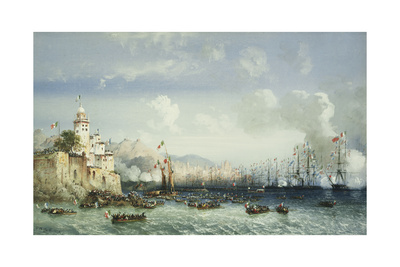 |
| The War in Italy: Genoa the arrival of Emperor Napoleon III, 1859 |
Early Atlantic explorations from Italy's seaports were strongly influenced by the entrepreneurial spirit of the Italian city-states. There is some debate as to the true origin of explorer Christopher Colombus, most accept that he was from Genoa. Amerigo Vespucci, the explorer for whom the continent of America is named after, was also Italian: from the Republic of Florence. But most importantly, it was the Genoese bankers that financed many of Spain's early expeditions across the Atlantic to the Americas. Fernand Braudel called the period 1557 to 1627 the "age of the Genoese".
Naples
April 1, 1822, Courier, London, Middlesex, United Kingdom
Eruption Of Mount Vesuvius.
Mount Vesuvius, which had been for several months in a state of total inaction, on Friday, the 22d February, showed signs of renewed vigour; on the following night it was in a very great activity, and on Sunday night (the 24th Feb.), the volcano exhibited a very grand eruption. A broad stream of lava descended the cone, and seemed to turn off in an angle, and run down the mountain towards Rosina and Portici; the flames above the crater were lofty and continued; an unremitting discharge of fiery masses, which were thrown up in the air to a great height, issued from the mouth, and the groans of the mountain were heard in Naples, like distant thunder.
Naples with
Mt. Vesuvius in the Background
Antonio Joli


About ten o'clock on that evening the view from the city was particularly striking the wide river of fire ran on in majestic slowness; innumerable pale torches were seen coasting its sides, on which some bold and curious persons seemed every now and then to be treading ; the flames were reflected across the bay, and threw a strong glare on the buildings and on the faces of thousands of spectators, who had gathered on the Molo, Santa Lucia, and other open places, to gaze at the magnificent conflagration.


On Monday, the eruption was much less considerable; in the evening, the Princess of Partano, the King's wife, ascended to the hermitage of San Salvattore. On Tuesday (26th) loud rumbling noises were heard in Naples, at very short intervals, during all the day.
The quantity of smoke which issued from the volcano was so great that the sun was quite discoloured; its reflex was of a murky red tint, and the atmosphere was heavily clouded. Religious processions were made in the little towns at the foot of the mountain, which have so often suffered from their dangerous neighbour. Towards evening, as appearances promised a good night's work, we sat off from Naples to view the operations nearer; the road to Resina was covered with people going and returning, like a fair; when we reached the spot where strangers are, on common occasions surrounded by guides, and asses and mules, to conduct them up the mountain, we found that no animals were to be procured, and it was with difficulty we could get a stupid old man for a cicerone, who rendered us no other service than carrying a torch. The ascent was thronged with people, some pushing on eagerly to the objects of their curiosity, and others returning and discussing what they had seen; far below San Salvatore we saw the stream of fire rolling along a wide hollow, and approaching the path by which we were going up : it was then, however, at a considerable distance, and its course was very slow.
On reaching the hermitage we refreshed ourselves as well as the crowd there assembled could permit; we then continued, and for shortness traversed the lava chiefly formed by the eruption of January, 1821; we reached the foot of the cone just where the stream was descending; we found it about thirty feet wide; it was not liquid lava, but composed of ashes, ignited stones, and old masses of volcanic ejections, swept away in its course and heated again; these lumps rolled over each other, producing a strange clinking noise; some of them were of very great size, and the whole stream, though descending a steep cone, moved but slowly.
Beyond this principal stream, midway u up the cone, was an opening, whence very large stones and other burning matter were continually thrust out ; this mouth fed a scattered stream, beyond which was another narrow stream, proceeding (like the principal one) from the crater; they both united with the main body in the deep hollow below, and rolled on towards the road which leads from Silesia up to the hermitage. The quantity of spectators standing by the sides of this burning river was astonishing: we, with great many of the more adventurous, determined to ascend the cone; we therefore passed a little to the left of the great stream, and began to scramble through the deep loose cinders and ashes which cover this part of the mountain, and render it at all times a most fatiguing climb. A little path or tract formerly existed, in which the guides hud laid masses of lava to facilitate the mounting, but it was just in that line that the present eruption descended, and we were in consequence obliged to go up over the sand and cinders in which we stuck up to our knees, and at every three steps lost one on an average.
After a most breathing toil of an hour and a half, we found ourselves, with a few others, on the edge of the grand crater; hence the coup-d 'ail was terrifically sublime; the flames rushed out of the mouth and threw themselves in the air in a broad body to the elevation of at least a hundred feet, whilst many of the fiery stones flew up twice that height; the flames fell back into the mouth and then burst out again, as though impelled by a fresh impulse, like the blast of a bellows; in the descent some of the stones and lumps of cinder returned into the mouth, but the greater part fell outside of the flames like the jets of a fountain.
While we were standing on the exposed side of the crater, very intent in observation, all of a sudden the volcano gave a tremendous roar; it was like the crash of a long line of artillery, and was instantly succeeded by such a discharge of stones as we had never before seen, at the same moment the wind, which was very high, gave an irregular gust, which directed a good part of the stones towards where we were posted; our situation was for a minute or two very perilous, but there was no shelter near, and we stood still, looking at the descending shower which fell around us; we, however, happily sustained no other injury than a short alarm, and having some ashes dashed in our faces by stones which fell near us. Two or three gentlemen who were ascending the cone after us, were not quite so fortunate, for many of the stones failing outside of the ridge, rolled down the side with great velocity, loosening and carrying with them lumps of cold lava, & c , some of which struck those persons on the legs with great violence, and nearly precipitated one of them headlong to the foot of the cone.
After this, we thought we had seen enough, and turned to go down; the descent is as easy as the ascent is difficult; the cinders and ashes slide away beneath the feet; nothing is necessary but to step out (the quicker the better) to keep one's equilibrium and to avoid the fixed or large stones and pieces of lava we were not more than ten minutes in reaching the point, whence it had taken us an hour and a half to mount. In coming down we were struck with the strange appearance of the torches of companies ascending and descending; they formed a pale wavering line from Resina to the hermitage, and thence to the cone they were scattered about in thick and fantastic groups. On reaching the hermitage we found it so crowded that we could not enter; the large flat around was covered like a crowded fair by people of all nations and of all ranks from the beautiful and accomplished Countess of Fiquelmont, wife of the Austrian Ambassador, to the Austrian sergeant and his wife who bad come to see the blasting mountain; numbers of people had come from the towns and villages below with bread and wine, and fruit and aqua-vita, all of which articles seemed in very great demand. The motley scene was light by the bright silvery moon, and the red towering flames at the summit of the volcano.
We took some slight refreshment, and repaired homewards in the midst of as gay groups as ever returned from scenes of festivity and joy. When we got lower down, we found that the lava had approached very near to the road, and had already seized upon a fine vineyard, which was blazing very brilliantly. After our retreat, we learned that the lava traversed the road. On Wednesday, the 27th, the eruption was in a great measure; tranquillized; still, however, crowds of people continued going up the mountain, and an Austrian Officer, who bad come from Capua to see it, was unfortunately killed on the ridge of the cone, by a large stone striking him on his head. On Thursday scarcely anything but smoke issued from the crater, and it has continued in this peaceful state ever since.
The news of the eruption reaching Rome, induced crowds of Englishmen to set off immediately for Naples; on Saturday and Sunday above 20 carriages arrived here, where, to the no small mortification of the travellers, all the business was finished.
Salerno
September 29, 1870, California Farmer and Journal of Useful Sciences
The Grape Crop.
Mr. C. D. Champlin, Secretary and Treasurer of of the Pleasant Valley Wine Company, Hammondsport, Stuben County, N. Y. writes us:
The present vintage bids fair to be the best we have had for some years, both as to quality and quantity. The early varieties, are Hartfords, Delawares and Concords, are now being gathered and prepared for market. The later kinds are well colored, and will follow very soon. It is estimated that the present vintage in Pleasant Valley and vicinity will yield about 7,000 tons of grapes. The Pleasant Valley Wine Company are intending to make 100,000 gallons of wine this fall.
Grape Crop in Italy and Sicily.
All reports from the Southern part of the peninsula state unanimously, that the condition of the vineyards justifies the most exalted hopes of a fine crop. Principally in Calabria and in the province of Salerno an extraordinary, rich vintage is expected. Grape disease has appeared only in some localities, as for instance on the hlls in the vicinity of Naepel, where the oidium has done some damage. The coast of Sicily, at Palermo, Syracuse and Marsala, which had some rain, will produce an enormous quantity of grapes it is stated, that consequently, although the production of the interior of the Island, on account of the dry weather, will be limited, the price of the wine will come down considerably.
Bay of Salerno. Albert Bierstadt. 1858.


As Goths and Ostrogoths drove through Italy in the 5th and 6th centuries, the people of Veneto took shelter on the islands off their coast, then began building houses on the lagoon-like islands, developing the boats known as gondolas in the process. From these desperate beginnings, Venice grew to become a great maritime power, both in terms of military might and in its commercial trading with Byzantium and Constantinople.
The Venetians participated in and profited off of the Crusades by supporting both sides in trade. While the Venetians are acquiring islands on the route to the Middle East, they also gained control of a large part of the Italian mainland. The first territory to be won was the region adjacent to the Veneto (like Venice itself, named from an Indo-European tribe, the Veneti, who migrated in about 1000 BCE).
More than 3,000 Venetian merchant ships were in operation by the year 1450. The trading empire of the Republic of Venice lasted longer than any other in history, and even merchants vessels were required to carry weapons and passengers were expected to be armed and ready to fight. From the beginning of the 13th century until the end of the 18th century, the Republic ruled the Adriatic, the Aegean and the Black Seas. The Republic of Genoa was Venice s main rival, and many wars were fought between them. In 1298 the Genoese destroyed the Venetian fleet at Curzola, but were themselves defeated in 1354 at Sapienza in Greece.
The Grand Canal looking towards the Dogana William Turner


Venice reached the height of its power in the 15th century, but declined after the 16th century. At its height, it controlled much of what is now Greece, as well as a large chunk of Italy. However, plagues fostered by the stagnant water greatly hurt the city and eventually led to its downfall. The Turks took advantage of this weakness by encroaching on the Venetian empire gradually, by way of its Grecian territories.
Grand Canal at San Vio. Canaletto


Also, when the Portuguese discovered the Cape Route to India and the East, Venice's shipping monopoly was rendered far less relevant. Venice fell to Napoleon in 1797, and eventually became part of the unified Italy in 1866.
Christian Slaves, Muslim Masters: White Slavery in the Mediterranean, the Barbary Coast and Italy, 1500-1800 (Early Modern History)
Robert C. Davis.


1899. World's Fleet. Boston Daily Globe
Lloyds Register of Shipping gives the entire fleet of the world as 28,180 steamers and sailing vessels, with a total tonnage of 27,673,628, of which 39 perent are British.
| Great Britain | 10,990 vessels, total tonnage of 10,792,714 |
| United States | 3,010 vessels, total tonnage of 2,405,887 |
| Norway | 2,528 vessels, tonnage of 1,604,230 |
| Germany | 1,676 vessels, with a tonnage of 2,453,334, in which are included her particularly large ships. |
| Sweden | 1,408 vessels with a tonnage of 643, 527 |
| Italy | 1,150 vessels |
| France | 1,182 vessels |
For Historical Comparison
Top 10 Maritime Nations Ranked by Value (2017)
| Country | # of Vessels | Gross Tonnage (m) |
Total Value (USDbn) |
|
|---|---|---|---|---|
| 1 | Greece | 4,453 | 206.47 | $88.0 |
| 2 | Japan | 4,317 | 150.26 | $79.8 |
| 3 | China | 4,938 | 159.71 | $71.7 |
| 4 | USA | 2,399 | 55.92 | $46.5 |
| 5 | Singapore | 2,662 | 64.03 | $41.7 |
| 6 | Norway | 1,668 | 39.68 | $41.1 |
| 7 | Germany | 2,923 | 81.17 | $30.3 |
| 8 | UK | 883 | 28.78 | $24.3 |
| 9 | Denmark | 1,040 | 36.17 | $23.4 |
| 10 | South Korea | 1,484 | 49.88 | $20.1 |
| Total | 26,767 | 87.21 | $466.9 | |

Site Search

The Pursuit of Italy:
A History of a Land, Its Regions, and Their Peoples
David Gilmour


Venice: A New History


The Letter to the Romans
(The Bible in Medieval Tradition)
Ian Christopher Levy, Philip D. W. Krey,
Thomas Ryan
"This book is a labor of love by three of the world s leading interpreters and translators of medieval biblical exegesis. . . The chronological span taken on is breathtaking, with translations from late antiquity to the dawn of the Reformation. . . This work successfully defies the stereotype that medieval interpretation was simply parasitic upon patristic exegesis. It will be extremely valuable as a teaching tool." --Harvard Divinity School



 Copyright ~ 1998-2018.