Australia
Australia: ° Adelaide ° Brisbane ° Darwin ° Fremantle ° Hunter Islands ° Lord Howe Island ° Melbourne ° Perth ° New South Wales (Sydney) ° Norfolk Island ° Van Dieman's Land: Tasmania (Hobart Town, Port Arthur)
Seaports, Captains, Merchants, Immigration
The first inhabitants of Australia were the Aboriginal people whose history, though unrecorded, is now believed to date back to before the Ice Age.
Evidence from Tasmania indicates some Aborigines survived the Ice Age by living in caves. Aboriginal history began in a time they call the Dreaming, when the Ancestor Spirits emerged from the earth and gave form to the landscape.
Anthropologists believe that Aboriginal peoples reached Sydney Harbour at least 40,000 years ago. Tribes lived in the area now known as Sydney until the English arrived and caused violent disruption to their lives.
In 1606, the small Dutch ship Duyfken (owned by the Dutch East India Company) sailed from the Indonesian island of Banda in search of gold and trade opportunities on the fabled island of Nova Guinea. Under the command of Willem Janszoon, Duyfken and her crew sailed south-east, beyond Os Papuas (Papua New Guinea) and charted part of the coast of Nova Guinea. They did not find gold, but they did find the northern coast of a huge continent: Australia. Captain Janszoon was the first European to map and record in Australia.
Captain James Cook in Australia
While sailing along the Eastern Australian coast on the 10th of June 1770, the Endeavour struck an outcrop of the Great Barrier Reef and stuck fast.
The ship was severely damaged and it took the crew 23 hours before they could haul her off at high tide. Everything that was heavy was thrown overboard – the six guns and their carriages, iron and stone ballast, casks, decayed stores and a general miscellany of 50 tons or more.
After having heaved the ship off the reef, it became apparent she was taking on heavy water and that the crew’s lives were in danger. There were not enough lifeboats for all men and most of them could not swim. Everyone on board, including Cook and Banks, took their turn at the pumps, fifteen minutes at a time.
Eventually, the midshipman came up with the solution of ‘fothering’ the ship. A sail was covered in oakum, dung and sheep’s wool and drawn under Endeavour’s belly. This slowed the intake of water by so much that the leak became manageable with only one pump.
It would be another week before the Endeavour could find a safe haven to be repaired. After offloading most of the stores and ballast, she was beached on the shore further up the Endeavour River, near Bicentennial Park. The repairs of the ship were quickly completed but the wind and tides made it difficult to refloat her, delaying her departure further.
National Trust, Australia.
July 17, 1852, Daily Alta California, San Francisco, California, U.S.A.
Americans in Australia.
Emigrant Ship to Australia. 1852
The ship Europe, which left this port about the 1st instant for Australia, had on board a large number of passengers, among whom we are informed, were fifty or sixty native-born American s, who were going to try their fortunes in the diggings of the British South Sea Colonies.
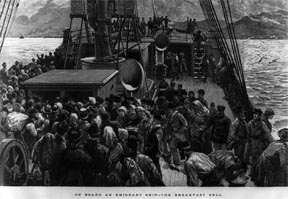 We received, about the period of her departure, a somewhat curious document, dated on board and handed to the pilot for delivery. It was written for publication, and is intended as a remonstrance against the treatment to which foreigners are subjected in our mines. The author, who subscribes himself Australiensis, is evidently an Englishman who has lived some time among us, and who confesses a predilection for American laws, faithfully administered, and feels a warm interest and sympathy for the affairs of California. And it is not in behalf of the rights of his own countrymen on her soil, nor those of any distinct and separate body of foreign miners that he makes his appeal, but to protect all classes of aliens among us from the jealous rivalry and prejudicial spirit which exists among a large body of American miners against the laborers from other shores, and, moreover, to prevent, as far as possible, the consequences of this intolerant and unlegalized action from being re-visited upon the heads of our countrymen, who are even now departing in considerable numbers, from various parts of the United States, for the shores of South Australia.
The views of the writer are exceedingly fair, and it is not necessary that we should publish his communication entire to illustrate the friendly and courteous spirit in which it was conceived. His opinions on the subject of international rights, and the relations which are doubtless not long hence to exist between this country and the flourishing British Colonies of the South sea, are not dissimilar to those which have been freely expressed in the editorial columns of this paper from time to time. Respecting the treatment of foreigners in the mines, we also would probably not be found widely at variance with the views of Australiensis, but the propriety and force of the argument which he advances out of consideration for the safety and success of a class, of emigrating Americans on foreign shores, may be questioned.
In the first place, it is not at all likely that the gold mines of South Australia offer sufficient inducement to our countrymen to forsake the mineral fields and the thousand other fruitful resources of California, and perform a pilgrimage to that far-off country in quest of riches which are quite as abundantly supplied at home.
And though Australiensis may have properly stated that some fifty or sixty Americans accompany him in this trip to the Colonies, adventurers from their own shores, we do not infer that there is to be a decided movement of any class of our people in that direction. It is, moreover, the opinion of this gentleman that over two thousand Americans are, to use his own words, "engaged in mining pursuits in that country at this moment, whose treatment in no respect differs from the English or native born citizens being all equally taxed and protected," which opinion is also unstrengthened by facts that have recently come to light respecting the state of the British Colonies. The best-accredited reports from that region represent the feeling against Americans, and particularly Californians, among all the laboring classes, to be one of decided bitterness and animosity.
There are not, we can state with some degree of confidence, over five hundred native born Americans scattered throughout the Australian colonies, irrespective of the crews of American vessels. And as for the prospect of an emigration of adventurers from the Atlantic States to the colonies, we attach no importance whatever to the conjecture. It is true a few vessels were laid on for their ports at the date of last advices from New York, but all accounts represented the indications of passenger loads being found, to be extremely feeble. Regarding, therefore, the well-meant apprehensions of our correspondent for the prospects of Americans in Australia, we might exclaim with Roderick Dhu, "Is nought but retribution due Seek other cause."
We have no fears of serious disturbances between British and American miners in the gold fields of South Australia. Nevertheless we are fully as sensitive to the wrongs inflicted upon strangers on our own shores by a reckless and disorderly class of our countrymen, as though we had interests to harmonize and protect on foreign shores. Americans can well afford to be thus disinterested and unselfish in their foreign relations.
July 9, 1853, Daily Alta California, San Francisco, California, U.S.A.
Later From Australia
The Empire denounced in severe terms the deceptions practiced in England to induce emigration to the colonies. With regard to the misrepresentations of the value of the stock of the Australian Company, it says:
It is stated that the Australian Agricultural Company's purchase of 300,000 acres is an immense gold field, and that the leasing of this land to diggers is even better than digging. On the faith of this representation it appears that the shares of the Company have suddenly taken a most extraordinary leap. These shares rose in two or three days from a nominal 65 pounds to a real 250 pounds, sine which it has been said they have reached 300 pounds. A short time ago they were in effect worthless. Now it is not the legitimate purpose of the Company's establishment -- if it ever had legitimate purposes -- which have caused this immense rise, but a notion which will not bear the test of Australian scrutiny. How many persons may be ruined by these absurdities we can scarcely conjecture, but we protest against the true character of the colony bearing the penalty of fictions of this sort.
In view of these and similar misrepresentations, the Empire calls upon government to interpose in behalf of deluded emigrants as well as of the Colonies.
An escort arrived at Sydney from the "Owens" on the 29th of March, bringing down 8,564 ounces of gold dust and 7,564 pounds in cash.
The papers are filled in a measure with accounts of assaults, thefts, robberies, and other crimes.
During the week ending on the 1st of April 12, 770 ounces of gold dust arrived at Sydney, supposed to be about the amount of the products of the month.
Eighteen Mormon missionaries had arrived in Australia. An official estimate gives the following as the mining population of Australia: 15,000 at Mount Alexander, 15,000 at Bendigo, 1,500 at Korong, 1,500 at Daisy Hill, 1,000 at Ballarat, and 3,000 at the Ovens, making 46,000 in the aggregate.
October 31, 1854, Daily Alta California, San Francisco
The Red Jacket
Clipper Ship Red Jacket in the ice off
Cape Horn on her passage from Australia to Liverpool. c. 1854
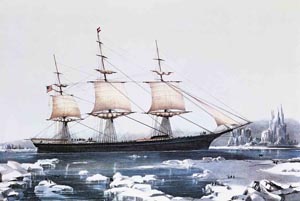 Considerable interest has been excited in consequence of the appearance in our bay of one of the finest clipper ships the world has ever produced. The Red Jacket, under the command of Capt. Reed, has performed the passage from Liverpool to Port Philip, in the astonishing short period of 67 days 10 hours -- a passage unparalleled in the history of sailing ships. The greatest speed attained during her run from England to Australia in the 24 hours was 402 miles, being a little over 17 knots an hour! From the light winds under which the ship has labored, her passage has been astonishingly rapid, thus preventing the possibility of adhering strictly to the priniciple of great circular sailing. As a proof of the admirable qualities of this ornament to our sailing ships, it is recorded by Capt. Reed's log, that in her passage from the longitude of the Cape, taking it at 21 east, she occupied the short time of 17 days 10 hours. ~~ Melbourne Morning Herald, July 17

November 30, 1854, Daily Alta California, San Francisco, California
Editor: I noticed that your correspondent "Canada." at Melbourne, whose letter was published in your yesterday's issue, stated that the world renowned clipper ship Red Jacket was built in New York. I will merely state that I was present on the day that this noble craft for the first time touched the water it was in Kockland. Maine.
She was built by Geo. Thomas, Esq., and is owned by Messrs. Secomb & Taylor, of Boston, and Mr. Thomas, the builder. The Red Jacket is admitted to be the fleetest craft afloat. On her first voyage, which was from New York to Liverpool, for seven days the averaged eighteen knots an hour; while her greatest run in the 234 hours was four hundred and thirteen geographical miles, being about eighteen knots an hour! ~ W.
June 8, 1890, Daily Alta California, San Francisco, California, U.S.A.
THE LARGEST GRAVING DOCK.
Opening of a New Blarlne Convenience at
Port Jackson.
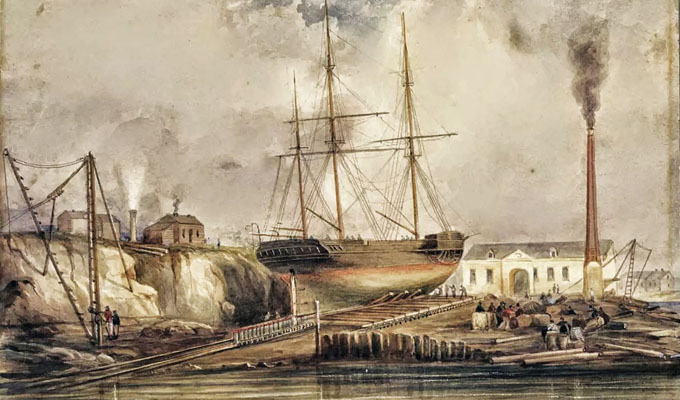
It is not generally known that the largest single dock in the world was opened on March 12th last to the waters of Port Jackson. This marine convenience is the huge graving dock at Cockatoo Island, in Sydney harbor. On the day the dock was opened for use, the R. M. S. Mariposa, with a tonnage of 3200 tons, was docked, since which date she has been followed by the steamship Port Jackson of 2644 tone, the steamship Kaiser Wilhelm II of 6990 tons, the R. M.S. Zealandia of 3200 tons, and the Messageries Maritimes steamer Australien of 5385 tons and 502 feet long, all of which vessels were docked and undocked without the slightest hitch or difficulty. The Kaiser Wilhhelm II had the largest tonnage and the Australien , the greatest length of any vessels which have entered Port Jackson. Yet neither of these vessels took up all the accommodation the dock affords. The length of blocks laid on the floor of the dock is 556 feet; the length of the dock from the caisson when in inner berth to the head of the dock is 608 feet, and when the caisson is in the outer berth the length is 638 feet. The width of the dock at the broad alters and between the pierheads is 84 feet. The depth of water on the sill at high water spring tides is 32 feet; at high water neap tides, 29 feet 6 inches; at low water spring tides, 26 feet, and at low water neap tides, 27 feet. Steam traveling cranes for the quick handling of shores, the electric light, and sundry other conveniences are also being added, so that, in addition to the dock's capacity, it will be surrounded with the most modern appliances for the speedy docking and dealing with large vessels.
Chinese in Australia's Gold Fields
The number of Chinese people that came to Australia in the 1800's Gold Rush is open to speculation. It is believed about 7000 Chinese worked in the Araluen gold fields in Southern NSW.
Australia first became multi-cultural during the gold rush period with mass international immigration to Australia. The lure of gold however often took a personal toll on individuals of all persuasions, particularly those who did not speak English.


The Chinese faced the same exclusionary measures in Australia as had been faced in the United States. On March 19, 1891, London papers reported that The Judicial Committee of the Privy Council on the appeal from Viotoria, Australia confirmed the right of colonial governments to prevent the landing of Chinese immigrants.
On March 22, 1891, a dispatch from Sydney, New South Wales, says that permission has been given by the Privy Council, which provides a way by which the British colonies may restrict Chinese immigration. The exclusion of Chinese will be made under cover of a general law by which the customs officers are permitted to reject any immigrant, though tendering his poll-tax. This is not a manly way of keeping Chinese out, but it is as much as the British Government can be expected to do in the face of protests of the Chinese Government. In this case, as in many others, the interests of the colonies and of the mother country conflict. England wants to maintain friendly relations with China in the interests of commerce, while tbe colonies realize the necessity of restricting Chinese immigration in ths interests of their own people.
By June 1892, a large proportion of the Chinese population of South Australia began migrating to otber colonies and many went to the Queensland border with the view of settling there, The Government has directed the border police to be re-enforced, and the Chinese influx prevention act will be strictly carried out.
The Chinese were particularly industrious, with techniques that differed widely from the Europeans. This and their physical appearance and fear of the unknown led to them to being persecuted in a racist way that would be regarded as untenable today.
The Chinese miners used different mining methods to the Europeans. They are said to have seldom tackled new ground, preferring to go over ground abandoned by the Europeans. It is thought that they found much gold which had been missed by Caucasian miners in their haste.
On those occasions when the Chinese did dig for gold, it is commonly believed that they constructed round shafts rather than square or rectangular ones. This is both sound engineering, as a cylindrical shaft has better structural integrity than a square one which needs a great deal of shoring-up, and a likely deference to the Chinese superstition that evil spirits hide in corners, and they would not want to turn their back on such spirits. Similarly, they had curves on their Joss house roofs and portals so that the evil spirits would slide down and then swoop upwards away from them.
May 27, 1899, Sausalito News, Sausalito, California, U.S.A.
CHINESE FORM A BIG TRUST.
Oriental Merchants at Work on the Scheme.
Vancouver, B. C. Some of the most influential Oriental merchants are now working on a scheme which is simply gigantic in its scope and one which undoubtedly will attract attention in all parts of the American continent. It is to form companies in every city of consequence in the United States, Canada and Australia, which will attempt to oontrol Chinese capital in order to promote and control Oriental industries.
When Kang, the Chinese reformer, was in Vancouver, he outlined the scheme to a number of prominent Chinese and his ideas were quickly acted upon. Interpreter Cum Yow, who is in the scheme, said in regard to it:
"We have no doubts about its success. Our plan is to give the Chinese a chance to invest their money in this country and to further all Chinese industries. There are at present 5,000,000 Chinese in Canada, Australia and the United States, and they will all, we think, go into the scheme. As soon as our company is formed there we will send out our agents and form companies in every city of any size in Canada, the United States and Australia. We expect to issue altogether about $60,000,000 worth of stock. With the formation of the companies accomplished and the stock issued they will be brought under one management with headquarters possibly in Vancouver. Then a Banking institution will be formed and investments in Chinese Industries will be made on an immense scale. Shares of the immense trust will sell at $1 each, and already several thousand dollars' worth have been bought here by men who are making only $1 a day."
The promoters, who are nearly all Wealthy men, are: Yip Sang, Hip Tuck Lung, Charlie Yip Yen, Sum Kee, Dr. Lui, Lee Yuen and W. A. Cum Yow.
Kang, the Chinese reformer and refugee, who originated the scheme, is said to have invented a quarter of a million in it.
Chinatown is much excited over the project and every Celestial in the city is said to be eager to purchase stock. The whole concern is simply an immense trust, although the promoters are loth to acknowledge it.
Operations of the trust will not be confined to Chinese Industries, as it proposed to build steamers to run to China and possibly construct a railway line in Mexico.
Adelaide and Port Adelaide
September 12, 1849, British Banner, London, United Kingdom
...In reference to one of these Colonies, that is, South Australia, I have lately received much information, which, in a condensed form, may be interesting to your readers. Adelaide and Port Adelaide, which are the chief towns of the province, now contain, together, about 12,000 inhabitants. The harbour at Port Adelaide is land-locked, perfectly safe, with warehouses, wharfs, powerful cranes for landing the heaviest goods, and other suitable powerful steam-tug, sent, from England expressly for the purpose of towing vessels up and down the river, has just arrived; besides which, there are suitable lighthouses, buoys, and pilots, that render the navigation as safe as that of any of our British ports.
Adelaide, containing at least 10,000 inhabitants, is situated about seven miles inland, on ground on the banks of the Torrens, which river intersects it. Adelaide is the seat of Government and is a bustling, flourishing city. It contains fourteen churches and chapels belonging to various Christian denominations, several good schools, a mechanics' institute and a public library, and many benefit-clubs and institutions. The chief feature observable in Adelaide, by a stranger, is the vast number of buildings in progress, chiefly of stone and brick, displaying a superior and more substantial architecture than those of an date.
The total population of the Colony is about 40,000 souls of European birth or extraction, besides few hundred natives, the latter of whom are remarkably quiet and inoffensive. These are provided for by the Government, and their children are supported and educated in the native schools. The whole arrangements are under the Protector of the Aborigines, who is a Government Officer . . .
February 2, 1864, Daily Alta California, San Francisco, California, U.S.A.
AUSTRALIAN MARKETS.
Adelaide, October 22, 1863.
The aspect of matters is completely chanced since our last week's report. No business whatever is new doing. The arrival of the Panama to Sydney from California with breadstuffs, and the news that several other vessels are loading for the Australian colonies, have had a very depressing influence. Holders of wheat and flour are now anxious to ret rid of their stocks, and are endeavoring to obtain offers for the same, but at present without effect. The arrival of this vessel with only 300 tons of wheat and flower has had more effect than if ten times the quantity had been shipped from hence. Stocks on hand in all the colonies are, however, known to be small, and prices cannot in consequence go very much lower.
Flour Although stocks on hands are light, yet many holders are anxious to realize. A small sale or two for home consumption has been made at 13. but parcels could be purchased considerably under this figure. -- Adelaide Observer
A despatch to the Observer, from Sydney, dated October 21, says the Panama had been ordered to Melbourne, with her entire cargo.
February 4, 1887, Colonies and India, London, United Kingdom
Under the name of the "Australian Wine Importers (Limited)," a company has been formed for the purpose of introducing improvements in the cultivation and management of Australian wines, and placing them upon the English market. The capital is 150,000£. in 51£ shares, of which 10,000 will be first issued.
September 3, 1890, Colonies and India, London, United Kingdom
Many of the shareholders in the Commercial Bank of South Australia, which failed some time ago, have been reduced to conditions of the greatest distress, and, when the last mail left Adelaide, an appeal was being made to the public to form a fund with a view to affording relief to to the most necessitous cases. An influential committee was formed in Adelaide for the purpose, and it was proposed to disburse relief to the unfortunate shareholders after they are discharged from further liability by the liquidators of the broken Bank.
December 12, 1884, Anglo American Times, London, United Kingdom
The American Exporter notices that "the Stephenson Company's cars are found almost the world over. China is one of the countries which have withstood this nineteenth century innovation. In England and Europe generally top seat cars are in high favor. In England they remind John Bull of his old coaching days. The west side of London has been almost entirely supplied with cars by the Stephenson Company. In September a hundred cars were shipped from the works to Melbourne, Australia. Adelaide has also been supplied by the company, which is now filling an order for Brisbane, Australia, another for Buenos Ayres, and still another for Santiago.
All these are "top seat" cars, though the Santiago cars are closed in front. Not long ago the company made some cars for Calcutta.

The inscription on these cars was in Hindustanee. Stephenson cars are also to be found in Lima, Valparaiso and other cities in South America; and in Berlin, Brussels and nearly all the capitals in Europe. Russia has not yet been supplied, as its application called for iron bottom frames. Omnibuses are also sent to many parts of the world by the company, which is engaged on orders for grip cars for Kansas City, Chicago and Milwaukee. John Stephenson, the head of the company, a white haired, bright eyed old man, has been in the business since 1831. The company makes about 6OO cars annually. They range in price from $950 to $1,200 each." The tram-cars made by this Company as can be seen in London are singularly adapted for the work, requiring no effort to keep them clean and well ventilated.
December 17, 1892, Evening Times, Monroe, Wisconsin, U.S.A.
CUP DAY IN VICTORIA
The Grand Event in the Calendar of the City of Melbourne
No one who has not visited Australia can have any conception of the interest which attaches to such a race as the Melbourne cup, which, with its sweepstakes from the one hundred and forty nine entries that were made in 1890, its trophy of 150 value, and its added money of 10,000, amounting altogether to $13,080, is the most important money contest in the world, says Sidney Dickinson in Scribner's Magazine. On the day of its occurrence all business is suspended by mutual consent throughout Victoria, the banks and government offices are all closed, and by twelve o'clock the streets of Melbourne are as silent and deserted as if the city were stricken with a plague. For a week before the event, the railway trains from Sidney, to the number of seven or eight in a day, and all the inter-colonial and mail steamers from that city and Adelaide, are taxed to their utmost capacity, and the accommodations of Melbourne, as well as all the neighboring towns, are taken up by the immense concourse of visitors. The facilities for reaching Flemington are so good, however, and the course itself so spacious that even at the great race of the centennial year, when more than 140,000 persons were upon the grounds, one saw the event with perfect comfort, and was transported to and from the course without five minutes, waiting at either end of the line. The admirable temper and sobriety of the great assembly are largely responsible for such a result. During the four days' meeting of 1888 only five arrests were made on the grounds, and none of these was for serious offenses. The crowd at an Australian race meeting is often rough in appearance, but in orderliness and good nature can hardly be excelled.
The Platypus
February 2, 1883, Colonies and India
An Australian Natural History Puzzle
Platypus: The Extraordinary Story of How a Curious Creature Baffled the World

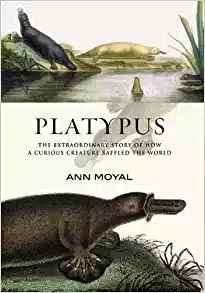
It may be doubted whether any zoological discovery ever exceeded in interest the discovery in Australia of those two animals, the duck billed platypus (or ornithorhyuchus) and the echidna, or spiny Australian ant-eater. Long as these creatures have now been known, and carefully as they have been studied by Meckel, Owen, and other distinguished anatomists, they still continue and will long continue to offer fresh fields of research to the zealous biologist. Many other beasts are divergent enough; between the bat and the sloth, or between the whale and the antelope, not a few differences may be found; but all these added together are simply nothing to the differences which exist between the platypus and echidna on the one hand, and all other beasts taken together upon the other. By their bony breasts, their brains, small ear bones, and many other characters these two forms, which are together spoken of as monotremes,, stand alone in their class; but to the interest which such peculiarities naturally excite is now added the interest to be derived from their contemplation in the light of the theory of evolution. The question now arises, how has it been that these two isolated forms have come to exist in a remote part of the world, not only quite without any existing ally (for we count the New Guinea species as an echidna), but without a trace having been found of any fossil relative? Are these monotremes to be regarded as the last survivors of a once very numerous and generally diffused kind of animal life, or as specimens of a small and comparatively modern local offshoot a sport?
Their peculiarities differ from the structure of all ordinary beasts in such a way as to approximate towards that found among different birds and reptiles; but to which of these do they approach the nearer? Investigations recently made by Professor Lankester seem decidedly to indicate their greater affinity to birds in at least one point of their structure. In a very interesting paper read before the Zoological Society the Professor points out, as the result of a number of careful dissections, that the structure of the heart, and especially that of the valve of its right side, is (as Professor Oen sagaciously divined), bird-like, rather than (as Professors Huxley and Gegenbaur suspected) formed like that of crocodiles. The anatomical details on which this judgement rests are too technical for reproduction here, but it may interest some of our readers to know that while the structure of the heart of the platypus is very bird-like, that of the echidna is less so, so that if in the latter a few perforations in a piece of membrane were to appear so as to reduce the fibrous membrane into fibrous cords, it would thereby clearly approximate to the form of the heart found in all other beasts. Thus the platypus, by its innermost structure, only makes more and more plain that bird-like nature which its duck's bill caused its first observers to suspect. -- Times.

Site Search
John Devoy's Catalpa Expedition
Ireland House.
Philip Fennell, Marie King, Terry Golway.
The story of John Devoy's 1876 Catalpa rescue is a tale of heroism, creativity, and the triumph of independent spirit in pursuit of freedom. The daily log on board the whaling ship Catalpa begins with the typical recount of a crew intact and a spirit unfettered, but such quiet words deceive the truth of the audacious enterprise that came to be known as one of the most important rescues in Irish American history. John Devoy's men rescued six Irish political prisoners from the Australian coast, allowing millions of fellow Irishmen and American-Fenians, many of whom secretly financed the dangerous plot, to draw courage from the newly exiled prisoners.



Warships of the World to 1900
Lincoln P. Paine.

True Yankees: The South Seas and the Discovery of American Identity
(Johns Hopkins University Studies in Historical and Political Science)
Dane A. Morrison
Stephan Talty

Navigation Rules and Regulations Handbook
U.S. Coast Guard
The Navigation Rules & Regulations Handbook supersedes Commandant Instruction M16672.2D This edition includes LNM 39-15 and NTM 41-15 33 CFR 83.01(g) requires: "The operator of each self-propelled vessel 12 meters or more in length shall carry, on board and maintain for ready reference, a copy of these Rules."


American Merchant Ships
1850-1900
Frederick C. Matthews



 Copyright ~ 1998-2018.