News & Tall Tales. 1800s.
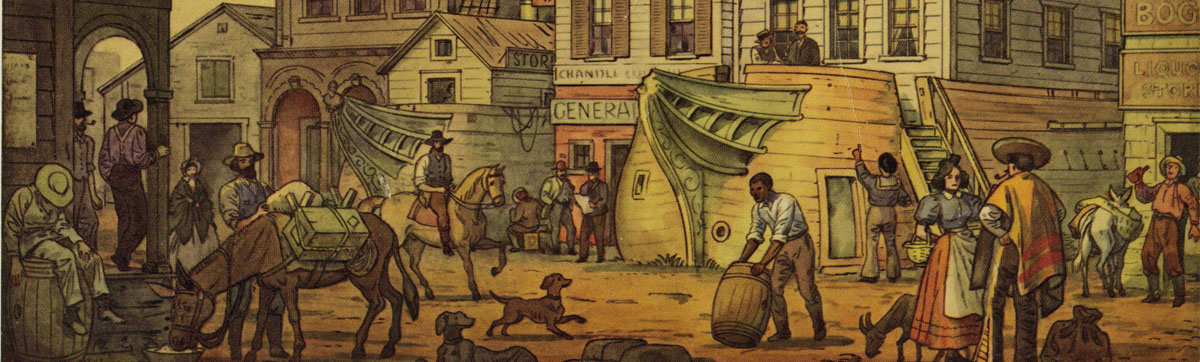
"Steam, Steam, Nothing But Steam..."
Friday Morning, January 4, 1850, Tri-Weekly Alta California, San Francisco
Steam Travel.
If there is one event of the year gone by deserving of commemoration as productive of the greatest possible good to the greatest portion of the community; then we are constrained to believe the introduction of steam facilities of communication between the cities and towns of California, the agent of that better and more abundant good, and an "at all events" of the first magnitude.
The history of steam is a volume of wonders, and this is a tolerably well established fact. There is no recourse to disputation to be had in the premises, and we might go on until the train of life reached its journey’s end, in expatiation of the might of its main propellant, which is universally conceded in this age of enlightenment, to be "steam steam nothing but steam." But we have nomotive and, certes, we are not in the mood.
Well do we remember the early days of inland navigation the tedious days and sleepless hours (there were mosquitoes in those times) passed in sailing up the Sacramento, the San Joaquin, or at a later period, the Feather and Yuba rivers. The torments of those trips, (pleasant little passage of two and three weeks duration), we shall ever plead as we bled then, freely, distinctly, agonizingly, -- stamped on memory with unfading freshness, with indelible firmness. Shall we ever forget them?
Three years since, and the Sacramento boated but one "fast boat." The reader will understand us to speak in the language of departed days. This was the purchase effected by Capt. Sutter, of a Russian schooner, drawing about four feet water, of twenty tons burthen, and which was certainly the safest, with the advantages of possessing the best accommodations and a fame for speed "unsurpassed by any boat on the river."
Indeed, launches plied between the two great cities of San Francisco and Sacramento only when freights of wheat, hides and tallow were ready for the market. The first steamboat sent up the Sacramento was the property of a very enterprising gentleman of the city, now deceased, and was of pigmy dimensions with a pocket engine, and not adapted to the purposes for which she was procured. Not of superior speed, either, if our recollection serves us; it lives a matter of history that in the month of January, two years ago, the steamboat started from Sacramento and was distanced four days into Benecia, by an ox team, which had rolled out of the former place by the great road leading south, on the same day that witnessed the steamboat s departure. From this time, "no ponderous wheels dashed the brine," until the fall of 1849.
 
|
| Delta King Riverboat - Sacramento River Lantern Press |
The new year dawns upon the navigation by steam of all the navigable waters in the State. The transition from the sluggish method of travel, antecedent to the discovery of gold, to the swift-gliding and agreeable conveyance by steam now afforded, has been sudden, but perfectly in character with the main features of Californian improvement. Last spring it was considered an extraordinary achievement to sail a vessel of 300 tons, drawing 8 feet of water, up to "Sutter's Embarcadero;" and when the barkWhiton arrived at that point on the River Sacramento, with her royal yards crossed, the newspapers said it was an astonishing feat. The white sail of the laggard launch is fast disappearing from our rivers; the wooded shores give back the din of splashing paddles, and the scream of the seam-alarm, startles the solitary haunts of wild bird and beast, while its piercing cadence floats along the night air, awakening the lone Indian from his sad reverie, to contemplate that which before him glides phantom-like, as shadows in a fearful dream to that which he feels to be the notes of exulting triumph of a mysterious being, foretelling even the doom of his rapidly declining people in our proud prowess.
The power of steam holds this place in daily communication with the important and flourishing cities of the North, and even beyond these, lines of smaller steamers extend, conveying passengers and freight almost into the heart of the gold region. On the bays, from point to point, steam urges the crowded passenger craft along; and as we trace the course which it has shaped by lengthened clouds of smoke, or listen to the burr of paddles, the music of the warning bell, the rush of escaping steam, more than ever do we find it in our hearts to exclaim, truly this is more than American!
And this is indeed the "age of steam!"
January 10, 1852, Daily Alta California, San Francisco
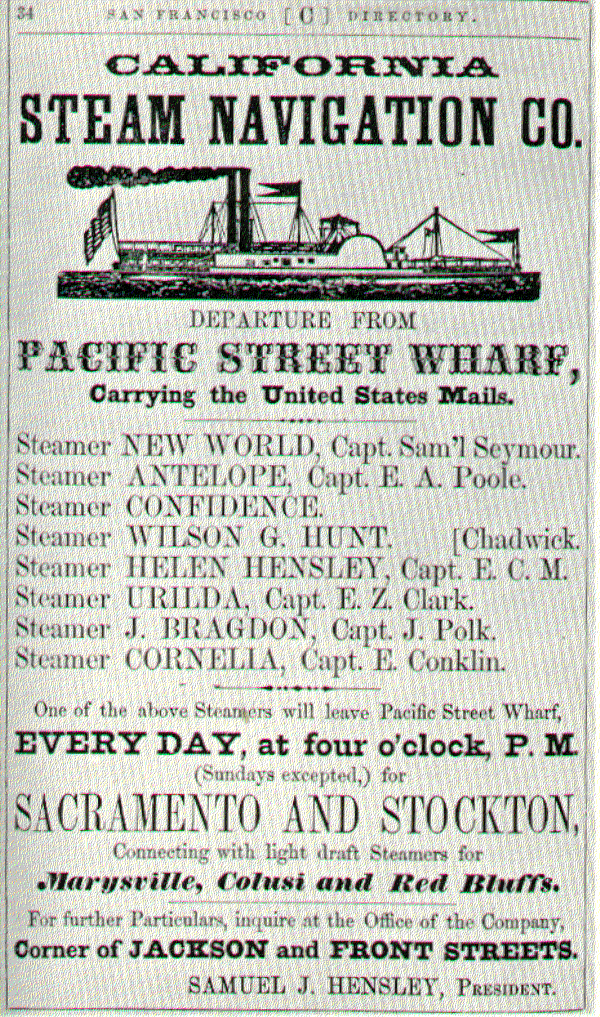
Notice --To take effect on the 8th inst. We the undersigned, Agents, and Owners of Steamers trading between San Francisco, Benicia, and Sacramento cities, have this day, in answer to a petition from the Merchants of Sacramento, agreed to establish the following rates of Freight and Passage on board all the Steamers which we represent,viz;
Rates of Freight on all goods and merchandise, paying either by weight or measurement, to be, without distinction, Ten Dollars per ton. Shippers in all cases to pay lighterage.
A Tariff of Rates for price freight bills, etc., to be found on each of the Steamers represented in this advertisement, -- uniform in price, and conforming as nearly as practicable to the tonnage rates.
RATES OF PASSAGE |
||
| CABIN PASSAGE | DECK PASSAGE | |
| From San Francisco to Sacramento | $10.00 | $5.00 |
| From San Francisco to Benicia | $5.00 | $3.00 |
| From Benicia to Sacramento | $8.00 | $4.00 |
| From Sacramento to San Francisco | $10.00 | $3.00 |
| From Sacramento to Benicia | $8.00 | $4.00 |
| From Benicia to San Francisco | $5.00 | $3.00 |
From and after this date, the system of employing Runners will be abolished by all the Steamers here represented.
From and after this date the custom of free passages to shippers will be discontinued.
SIGNED:
CHARLES MINTURN, Agent for steamers Senator and New World
T. CANURE & GANNATT, Agt. for steamers Confidence and W.G. Hunt
P.A. CHAZEL, Agt., steamer American Eagle
F.P. GREEN, Agt., steamer Hartford
R.R. FAISBIE, Agt., steamer Urilda
HORACE MORRISON, Agt, steamer Major Tompkins
J.J. SOUTH & Co., Agt., steamer Camanche
JNO. H. BOSWORTH, Agt., steamer J. Bragdon
San Francisco, Jan. 6th, 1852
  |
Immigration Station. Angel Island. 1901In 1905, construction of the Immigration Station began in the area then known as North Garrison. Surrounded by public controversy from its inception, the station was finally put into partial operation in 1910. It was designed to process Chinese immigrants whose entry was restricted by the Chinese Exclusion Law of 1882. A rush of immigrants from Europe were expected with the opening of the Panama Canal, but international events after 1914, including the outbreak of World War I, cancelled the expected rush, but Asians continued to arrive on the West Coast and to go through immigration procedures. Though most immigrants processed through the Immigration Station on Angel Island were Chinese, over 80 countries were represented by the influx of immigrants. |
Immigration at the Golden Gate: Passenger Ships, Exclusion, and Angel Island
Robert Eric Barde
Perhaps 200,000 immigrants passed through the Angel Island Immigration Station during its lifetime, a tiny number compared to the 17 million who entered through New York's Ellis Island.

Nonetheless, Angel Island's place in the consciousness of Americans on the West Coast is large and out of proportion to the numerical record. Angel Island's Immigration Station was not, as some have called it, the Ellis Island of the West, built to facilitate the processing and entry of those welcomed as new Americans. Its role was less benign: to facilitate the exclusion of Asians, starting with the Chinese, then Japanese, Koreans, Indians, and all other Asians.
The Children of Chinatown: Growing Up Chinese American in San Francisco, 1850-1920
Wendy Rouse Jorae
Family Skeletons: Exploring the Lives of our Disreputable Ancestors.

Simon Fowler, Ruth Paley
Most families have a skeleton. You may have already discovered yours via the grapevine or your own research. Or you may simply be intrigued by the dark side of our past. This popular history explores the behaviour of our disreputable ancestors from the unfortunate to the criminal, and introduces a host of colourful characters including 17th century witches, 18th century 'mollies' and Victorian baby farmers. Thematically arranged by skeleton, the text also describes how society punished and provided for its 'offenders' - as well as the changing attitudes that could ultimately bring acceptance.
Italy on the Pacific: San Francisco's Italian Americans (Italian and Italian American Studies)
Palgrave Hardcover)
Sebastian Fichera
San Francisco’s Italian immigrant experience is shown to be the polar opposite of Chicago’s. San Francisco’s Italian immigrants are shown as reintegrating into the host society fairly smoothly, whereas the Chicago group’s assimilation process broke down in dramatic ways.


(Themes in World History)
Patrick Manning
Drawing on examples from a wide range of geographical regions and thematic areas, noted world historian Patrick Manning guides the reader through trade patterns, including the early Silk Road and maritime trade, effect of migration on empire and industry, earliest human migrations, major language groups, various leading theories around migration.
Russian San Francisco (Images of America)
Lydia B. Zaverukha, Nina Bogdan, Foreward by Ludmila Ershova, PhD.
Even before San Francisco was founded as a city, Russian visitors, explorers, and scientists sailed to the area and made contact with both the indigenous people and representatives of the Spanish government. Although the Russian commercial colony of Fort Ross closed in 1842, the Russian presence in San Francisco continued and the community expanded to include churches, societies, businesses, and newspapers. Some came seeking opportunity, while others were fleeing religious or political persecution.

The Naval Order of the United States has a history dating from 1890. Membership includes a wide range of individuals, many with highly distinguished career paths.
The San Francisco Commandery meets the first Monday of each month at the San Francisco Italian Athletic Club in San Francisco, California and holds two formal dinners each year.

 Copyright ~ 1998-2018.