News & Tall Tales. 1800s.
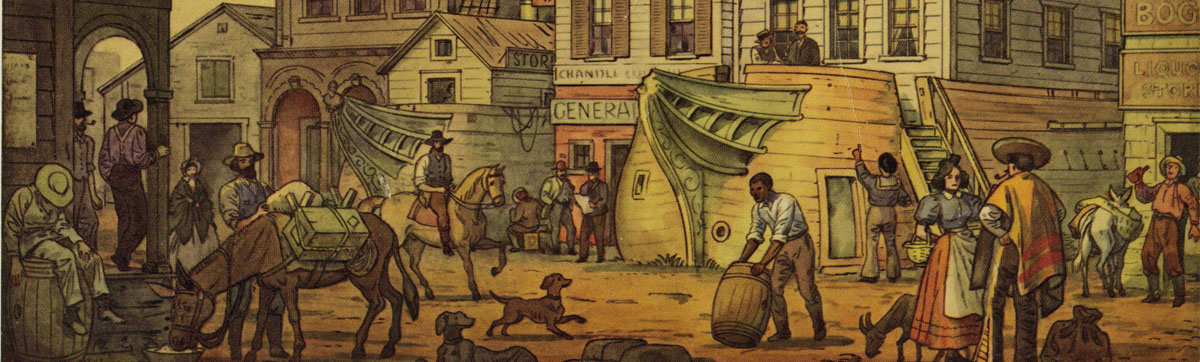
The Streets of San Francisco
March 7, 1853, Daily Alta California, San Francisco
PENCILINGS IN THE STREETS OF SAN FRANCISCO
BY J. ANTHONY.
Perhaps no other place in the world presents so varied a panorama, so much that is at once striking and uncommon, as the busy thoroughfares of our young city that giant sprung to life, as we think our metropolis, considering its age, may be not inaptly designated. The uncouth Chinaman, the showy and tawdry Mexican, the tawdry Mexican, the jabbering Frenchman, the hirsute miner, the rough backwoodsman and the elaborately got up gent jostle each other on the footway, whilst the languages of nearly all known nations may be heard on every side.
Faces in which eventful histories are written, heroes who seem just to have walked out of story books, meet you at every step "thick as leaves in Vallambrosa." Here is, indeed, the romance of reality illustrated. There are probably but few amongst us that have sojourned a decade of months in the place, but to whose ears eventful narratives are familiar as household worlds; few but have listened to the adventures, hair breadth escapes by flood and field of some acquaintance, compared to which imagination's fictitious relations are vapid, the manufactured startling effects of the most popular romances spiritless and insane.
The battle of life is or has indeed been here. How many in this arena have succumbed to that black despair which waged dread warfare beneath banners of fire, owning themselves vanquished when seeking in the bottle the appalling consolation of temporary obliviousness? How many again giants in spirit the true heroes of the world, who, worsted in the battle, fight on still, undismayed, unconquerable? What histories are unwritten! What biographies, teeming with rich teaching could our young city furnish!
For men of broken fortunes, California would seem to have been peculiarly a place of refuge. We have seen a waiter at one of the leading restaurants, who was at one time a colonel in the Austrian service; another earning his livelihood as a paper-hanger, who had been an aid de camp to Gen. Larmorcier; a doctor of great ability, once eminent in his profession, driving a dray; and another, an Emeralder, a good classic, educated at Trinity, Dublin, in the situation of a barman at a rial drinking house; and doubtless there are amongst us numbers who have passed through even greater changes. Shakespeare, who has something applicable to all classes and conditions, may be supposed to have had such battlers with adversity especially those whose reverses have been self-entailed in his mind's eye when he wrote, "There's a divinity doth share our ends,
Rough hew them as we will." And to them this quotation we would commend to all the practice of that cheering philosophy which is embodied in the belief that "all's for the best."
The frequent alterations which take place in the stores of our busiest thoroughfares present a striking characteristic of San francisco, effected as they are only less rapidly than the changes in a Pantomime. Indeed, to observe the celerity with which some of these transmutations are accomplished, one might naturally look out in the expectation of seeing Harlequin and Columbine flitting around the shifting scene. On the stage, beneath a single stroke, we see a butcher's changed into a barber's store, and here, where in the morning you may have purchased pastry, in the evening shall be in the hands of one who offers physic. In the same space of time, to a discerning public, liquor shall be submitted in the place of literature.
And then the Chinese, with their frontispieces baffling all metoscopy whose nomenclature in its strangeness harmonizes well with their very uncouth and grotesque looking selves. In one place we find a descendant subject of the great Fohi, rejoicing under the appleation of Sing rep another Tong Sing (we suspect these Sings are the Smiths of China) another more altisonant whose sign of Kin Zee at the first glance you might take for King Lear, announcing washing at so much per dozen, and last not least we have a celestial, the sign over whose door declares him to belong to no less a body than the well known legion of the Smiths! Yes, a veritable John Smith.
Early California: Rulers and Rebels, Chronicles (1535-1846), Destiny's Children, Killing for Land, The Forty-niners. . .

Black Fire: The True Story of the Original Tom Sawyer--and of the Mysterious Fires That Baptized Gold Rush-Era San Francisco
Robert Graysmith
The first biography of the little-known real-life Tom Sawyer (a friend of Mark Twain during his brief tenure as a California newspaper reporter), told through a harrowing account of Sawyer's involvement in the hunt for a serial arsonist who terrorized mid-nineteenth century San Francisco. hen 28-year-old San Francisco Daily Morning Call reporter Mark Twain met Tom Sawyer at a local bathhouse in 1863, he was seeking a subject for his first novel. As Twain steamed, played cards, and drank beer with Sawyer (a volunteer firefighter, customs inspector, and local hero responsible for having saved ninety lives at sea), he had second thoughts about Shirley Tempest, his proposed book about a local girl firefighter, and began to envision a novel of wider scope. Author Robert Graysmith worked as an artist at The San Francisco Chronicle during the years of the Zodiac Killer; he wrote "Zodiac" and "Zodiac Unmasked" about those murders.


Isthmus of Panama Then and Now: Ship Canal, Cruising Panama, Panama Fever, A Year in Panama, History of the Railroad, Trees of Panama and Costa Rica
David McCullough
The History of the Gold Discoveries of the Northern Mines of California's Mother Lode Gold Belt As Told By The Newspapers and Miners 1848-1875
Lewis J. Swindle
While in the U.S. Military stationed in Turkey in the eary 1970s, Swindle became interested in minerals and geology. In returning to the U.S. and during the 26 years he lived in Colorado, he spent countless hours in the mountainous terrain looking for, digging and collecting the minerals known to exist in the Pikes Peak Region. In moving to the California and the Gold Belt Region, he searched out the history of the gold in the region.

Rooted in Barbarous Soil:
People, Culture, and Community in Gold Rush California
(California History Series)
Kevin Starr
A mercurial economy swung from boom to bust, and back again, rendering everyone's fortunes ephemeral. Competition, jealousy, and racism fueled individual and mass violence. Yet, in the very midst of this turbulence, social and cultural forms emerged, gained strength, spread, and took hold. Rooted in Barbarous Soil examines gold rush society and culture.

The Age of Gold:
The California Gold Rush and the New American Dream
H. W. Brands


San Francisco Memoirs:
1835-1851: Eyewitness Accounts of the Birth of a City
Malcolm E. Barker
In July 1846 San Francisco was a tranquil settlement of about 150 inhabitants. Three years later it was an international metropolis with more than 30,000 people thronging its streets. Recalled in this intriguing collection of personal anecdotes from those tumultuous times are the days when San Francisco Bay extended inland to Montgomery Street. Bears, wolves, and coyotes roamed the shore. The arrival of 238 Mormons more than doubled the town's population.


Skull in the Ashes: Murder, a Gold Rush Manhunt, and the Birth of Circumstantial Evidence in America
Peter Kaufman
More San Francisco Memoirs 1852-1899: The Ripening Years
Malcolm E. Barker

Gold Dust and Gunsmoke
Tales of Gold Rush Outlaws, Gunfighters, Lawmen, and Vigilantes
John Boessenecker
A collection of true tales of villainy and violence during the California Gold Rush. How gold fever ignited a rush of families, but also prostitutes, feuds, lynchings, duels, bare-knuckle prizefights, and vigilantes.

The Trials of Laura Fair: Sex, Murder, and Insanity in the Victorian West
Carole Haber

Embarcadero: Sea Adventures from 1849 to 1906
Richard Dillon
Tales of the colorful characters who went down to the sea in ships to and from the port of San Francisco.

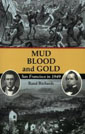

Rand Richards
A year in the life of San Francisco: 1849.
Based on eyewitness accounts and previously overlooked official records, Richards chronicles the explosive growth of a wide-open town rife with violence, gambling, and prostitution, all of it fueled by unbridled greed.


The Naval Order of the United States has a history dating from 1890. Membership includes a wide range of individuals, many with highly distinguished career paths.
The San Francisco Commandery meets the first Monday of each month at the San Francisco Italian Athletic Club in San Francisco, California and holds two formal dinners each year.
 Copyright ~ 1998-2018.