News & Tall Tales. 1800s.
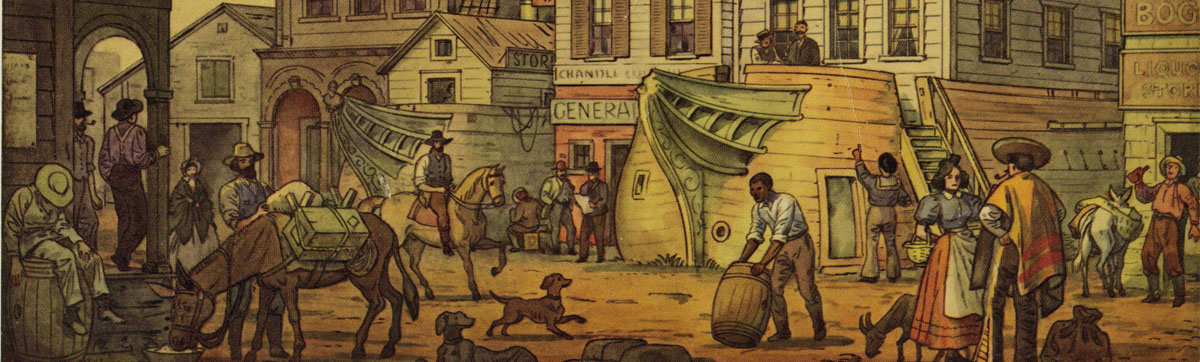
Sailor vs. Captain
San Francisco, June 3, 1876, Daily Alta California, San Francisco


The Captain of a vessel is usually a man who, by diligence, experience, the study of navigation and some executive ability, attains his position as a reward of merit and a recognition of his fitness.
A crew of sailors is made up of motley material. In many cases, they are fugitives from justice, and are usually dissolute men. They almost uniformly go aboard ship for the cruise in a state of thorough intoxication, so that frequently out of a crew of twenty-five there are but ten men upon whom the captain can depend when he gets out to sea, until the effects of the debauch have worn off.
Notwithstanding that these facts are so universally known and recognized as scarcely need a statement of them, such a cry has risen against the captains within a year or two as to make them seem unto the public like a parcel of malignant brutes.
An ordinary captain sailing into port lives in dread of the reputation he may bear away with him. The sailor having found a willing ear lent to his story, tells it often, enlarges it, embellishes it, and repeats it until it has b.orge a nuisance.


To such an extent is this carried on that there were no less than two cases of cruelty in Court in one day last week, while a third had been disposed of only the day before. It is true that the absolute authority a Captain holds aboard ship is apt to invest him with an imperative will and a tyrannical manner, but it does not follow that he should be a monster of cruelty.
Enough sympathy has been expended upon the sailor who enjoys his position of martyr all too well. It is time to transfer a little feeling to the case of Captains, several of whom have left and many of whom have left other harbors, branded with an irremediable and undeserved mark. Mr. Plimsell's friendship for the sailor has given that gentleman a very.orgfortable hobby to ride, but has stirred Jack Tar into a state of chronic dissatisfaction and.orgplaint. Every one believed and sympathized at first, but the cases are b.orging so frequent as to exhaust sympathy.
Surely some method might be pursued of privately examining the captain who is accused, sometimes by a conspiracy of seamen without giving his name to infamy till it is certain he deserves it.
The Mammoth Book of Life Before the Mast:
Sailors' Eyewitness Stories from the Age of Fighting Ships
Jon E. Lewis, Editor
Firsthand accounts of the real-life naval adventures behind the popular historical sagas of Patrick O'Brian and C. F. Forester. Twenty true-life adventures capture the glory and gore of the great age of naval warfare from the late eighteenth to the early nineteenth century -- the age of the French Revolutionary War, the Napoleonic Wars, and the War of 1812 -- when combat at sea was won by sheer human wit, courage, and endurance. Culled from memoirs, diaries, and letters of celebrated officers as well as sailors, the collection includes accounts of such decisive naval engagements as Admiral Horatio Nelson's on the Battle of the Nile in 1798 or Midshipman Roberts' on the Battle of Trafalgar in 1805 and also offers glimpses into daily hardships aboard a man-of-war: scurvy, whippings, storms, piracy, press gangs, drudgery, boredom, and cannibalism.
Life of a Sailor (Seafarers' Voices)
Frederick Chamier
Chamier went to sea in 1809 as an officer in the Royal Navy. Like his contemporary, Captain Frederick Marryat, he enjoyed a successful literary career and is remembered for his naval novels. This book, his first, is usually catalogued as fiction, although it is an exact account of his naval experiences, with every individual, ship, and event he described corroborated by his service records. Told with humor and insight, it is considered an authentic account of a young officer's service. From anti-slavery patrols off Africa to punitive raids on the American coast during the War of 1812, Chamier provides details of many lesser-known campaigns. His descriptions of British naval operations in America, which reflected his objection to bringing the war to the civilian population, were highly criticized by his seniors.


The Nagle Journal: A Diary of the Life of Jacob Nagle, Sailor, from the Year 1775 to 1841
John C. Dann

Great Stories of the Sea & Ships
N. C. Wyeth


The Rebel Raiders
The Astonishing History of the Confederacy's Secret Navy
James T. deKay


This true story of the Anglo-Confederate alliance that led to the creation of a Southern navy illuminates the dramatic and crucial global impact of the American Civil War. Like most things in the War between the States, it started over cotton: Lincoln’s naval blockade prevented the South from exporting their prize commodity to England. In response, the Confederacy came up with a plan to divert the North’s vessels and open the waterways–a plan that would mean covertly building a navy in Britain, a strategy that involved a cast of clandestine characters.
The Naval Order of the United States has a history dating from 1890. Membership includes a wide range of individuals, many with highly distinguished career paths.
The San Francisco Commandery meets the first Monday of each month at the San Francisco Italian Athletic Club in San Francisco, California and holds two formal dinners each year.
 Copyright ~ 1998-2018.