Sea Captains: San Francisco 1800s
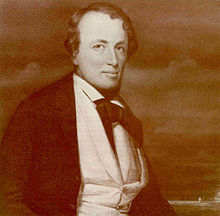
Robert "Bully" Waterman
March 4, 1808 to August 4, 1887
 Captain Robert "Bully" Waterman was born at Hudson New York on March 4, 1808, the son of a Nantucket whaling captain. His father died when Robert Waterman was eight and the family moved to Fairfield Connecticut.
(eBook available by clicking on the image.)
He went to sea age 12 aboard a China trader. By 1829, Robert Waterman was said to be the youngest First Mate on record. By the age of 21, he had been promoted to first mate of the Black Ball packet Britannia, which ultimately was his first command during a trip to South America. Once, Waterman was told to climb the mast to look for land. The winds were strong that day and were blowing off the mast. He managed to quickly grab on to a rope but he ripped out all of his fingernails!
In 1836, Waterman accepted command of the cotton freighter Natchez, owned by Howland & Aspinwall, a Manhattan merchant company. He guided the Natchez on several voyages around Cape Horn to Valparaiso. In 1842, Howland & Aspinwall switched the Natchez to the China trade, and Waterman sailed her to Macao. His return trip from Macao to New York took only 78 days, a new record.
Waterman was the first to sail Howland & Aspinwall’s opium running clippership Sea Witch; he was responsible for her sail plan. Under his direction she spread more canvas for her size than many of the later clippers. Sea Witch departed on her maiden voyage December 23rd, 1846, arriving in Hong Kong 104 days out. Her return was a record 81 days against the monsoon. On her second voyage she bettered this run, establishing one of her permanent records, when Captain Waterman brought her into New York March 15th, 1848, 77 days out from Canton. Yet her third voyage beat even this record with the time of 74 days 14 hours, Canton to New York, arriving March 25th, 1849. Her run of 14,255 miles from Canton to New York was more than a thousand miles shorter than the recommended sailing route in the Northeast Monsoon, illustrating the uncanny genius Waterman had for finding shorter routes and favorable winds.
In 1850 he briefly retired from seafaring and moved to Suisun Valley in California, northeast of San Francisco, where he raised cattle and grew lima beans to sell to Gold Rush miners.
The American Clipper Ship "Challenge"
New York. Artist: Lebreton


In 1851 he invited to sail a new clipper ship christened the Challenge.
Because so many sailors jumped ship for the gold mines, his crew, like many other crews of the day, was comprised of criminals, sick men, and shanghaied men enlisted while they were drunk in a waterfront bar. Waterman was optimistic that he would have a swift passage, but he hit fierce gale winds of 80 to 90 knots during his passage around the Horn. Ship owners back in New York gave this fact little thought in their mad rush to get their precious goods around the Horn to San Francisco and expected much from their captains to make the passage regardless of the weather. Also, to collect his $10,000 bonus he had to bring the Challenge through the Golden Gate by October 11, 1851.
In an attempt to spill wind from the sails, two men fell and died. Many were also injured from being battered about aloft with broken arms and legs, ribs, or worse. The sick bay of the ship was filled up with 17 men with many more crewmen feigning illness and injury, by then more than willing to shirk their duties to keep out of the treacherous rigging.
 Waterman was outraged at the conduct shown by the malingering crew. So with First Mate James Douglas ("Black Douglas"), he begin a reign of terror. Soon, they went after the most useless member of the crew, George Lessing. Pleading dysentery, Lessing refused to climb the rigging and Douglas screamed at him "Go aft!" The captain will cure you," and shoved Lessing toward the ratline.
Waterman joined in the bullying, "I think we'll baptize him," as he grabbed Lessing and tossed him over into the lee scuppers where the frigid waters sloshed around. The sadistic Douglass jumped the fallen man and held his head under water as Lessing thrashed about. Until Douglas yanked him up and marched him over to the weather rail and tied him to the rail and left him there in the freezing wind for close to an hour before cutting him free. The shivering sickly man then went below to his bunk. A few days later he had all the signs of acute dysentery, and twelve days later he was dead.
Even though Douglass was evidently out of control with his frequent berserk outbursts of sadism, Waterman let it go on and Douglass soon went after another malingerer who complained of chilblains legs and gave him a similar baptism in the freezing slush. Second Mate Coghill was also becoming increasingly more violent. Waterman did nothing to reign him in either. For the next eighteen days, the brutality continued as Waterman continued tacking north and south trying to progress to the west, but the westerlies continued to push him back. The sky was filled with dark foreboding clouds so Waterman could not fix his position and he had no way of knowing where he was.
By the time the storm broke, a mutiny had been squashed and the Challenge was 66 days out of New York and they had not yet reached the equator in the Pacific. While his chances of setting a record passage had slipped away from him, Waterman was still determined to set a good one. His fierce pride dictated that and he was soon again taking out his frustrations on his crew, even though two more men had died of dysentery in the sick bay.
Entrance to San Francisco Bay
c. 1859


The storm wreckage was cleared away and two weeks later she was off the California coast, where she found another patch of airless sea and drifted around for four days, dead in the water again. Waterman nearly went berserk. The Challenge's last day's run was but 35 miles and the ship did not reach the Farallons until October 29, 1851, and sailed through the Golden Gate into San Francisco harbor flying her distress flag from her mast upon completion of her 108-day passage from New York.
The Challenge had hardly anchored in the harbor off Clark's Point when the U.S. revenue cutter Lawrence came out to meet her. Eight of the mutinous crewmen were already in handcuffs lined up on deck, and First Mate Douglass herded them off the ship to the cutter; all charged with mutiny.
Soon, sailors from the Challenge made their way through the saloons, telling their tales to all . . . In twenty-four hours the stories had taken on a life of their own with the hotheads fanning the flames. San Francisco Newspapers quickly picked up on the growing story and in the rush to print took little time to check out the facts carefully and get them straight and that fanned the flames even higher. Angry men were lurked about the Pacific Street wharf, and aboard the skiffs and Whitehalls nearby in the harbor.
From the California Courier, November 1
The ship Challenge has arrived, and Capt. Waterman, her commander, has also-but where are nine of his crew? And where is he and his guilty mate? The accounts given of Captain Waterman towards his men, if true, make him one of the most inhumane monsters of this age.
If they are true, he should be burned alive-he should never leave this city a live man. Nine of his men are missing, and the sailors who are here declare that four were shaken from the mizzen-topsail yard into the sea, where they were drowned, and five of them died from the effects of wounds and ill treatment.
The scene at this time on board of the ship beggars all description. Five of them are mangled and bruised in the most shocking manner. One poor fellow died today, and five others, it is expected, will soon be in the embrace of death. One of the men now lying on his deathbed has been severely injured in his genitals, by a kick from this brute in human form. Had these poor men been put in a den with bears and panthers, they could not have been much more inhumanely and shockingly maimed. they are all now lying in the forecastle of the ship. The captain, the vile monster, has made his escape, and so has his brutal mate.
It is an infamous outrage to have such a bloody murderer to command a ship. He is noted for his cruelty everywhere, and in the streets of New York he dare not show himself, nor dare he hereafter show himself in this city. We hope that the respectable house to which he is consigned here will not only disavow his conduct, but if they have the power, remove him from command. If he is not removed, we hope this community will not permit such a monster t o sail out of this port as captain of any vessel. In all sincerity, we hope the monster may be caught, and dealt with in the severest manner.
We did hear last night, that the mate had been taken, and now we trust that all humane men will turn out and pursue the captain until he is captured and punished.
Soon after the Courier editorial hit the streets, a mob surged into the Alsop Building on California Street insisting that Captain Waterman be handed over to them. Charles Brenham, San Francisco's mayor and a former sea captain, arrived. The mayor called for order from the Alsop Building steps, but the mob paid no attention to his pleas. Soon, a rope appeared and one of the mob started to fashion a noose. Suddenly, two loud clangs rang out and members of the Committee of Vigilance began arriving on the run, all of them armed with guns. Mayor Brenham told the mob to leave. When no one moved to leave, Brenham pulled out his gold watch and shouted, "I shall now give you just ten minutes to disperse, and if you fail to comply, I shall order every last one of you to be incarcerated in the city Bastille. In other words, I will put every damned one of you in jail."
Everyone who had sailed aboard the Challenge started suing everyone else. The Grand Jury handed down many indictments. Waterman insisted on a trial to clear his and Douglass' names and to quiet attacks upon his character. Waterman and Douglass' trial dragged on and the recriminations continued to fly among all the parties as they all testified against one another. Upon the testimony of the crew, it came to light that a large number of those who had shipped aboard the Challenge as able seamen were deemed incompetent and mutinous. The food had been of the best quality as were the living accommodations. The punishment meted out by the officers to maintain proper discipline aboard the ship in the adverse circumstances that they faced over the course of the voyage was deemed no more than necessary to maintain the safety of the ship and her cargo.
The eventual sentences handed out in the end were lenient all around. The mutineers were freed and Waterman and Douglass got off with light sentences. Waterman held strong to his convictions and never showed the slightest remorse concerning his conduct and treatment of the crew over the voyage.
Waterman moved back to Suisun Valley with his wife, Cordelia, in 1853. In 1856 Fairfield, California was named Fairfield after the town where Waterman grew up.
On August 8th, 1884 Captain Waterman died at his Suisun Valley home.
Daily Alta California, August 9, 1884
Death of Captain Bob Waterman.
Captain Robert Waterman, one of the most famous commanders in the American merchant marine, died at his home near Fairfield, Solano county, yesterday, aged 76 years. Captain Waterman had an adventurous life on every sea, bat some score of years ago he left the ocean and settled in California, for a long time acting as Marine Surveyor in this city. He was sometimes known as " Bully " Waterman.
Daily Alta California, August 11, 1884, San Francisco, California, U.S.A.
Capt. Robert H. Waterman's Funeral
Funeral services were held yesterday afternoon at Fairfield, near Suisun, over the remains of Capt. Robert H. Waterman. They have been forwarded to San Francisco, and will arrive at the Oakland Ferry-slip, foot of Market street, at 11:10 this forenoon, whence the- funeral cortege will be joined by his numerous friends here, and proceed directly to the cemetery.
For several years, it has been a goal to begin publishing small books on notable sea captain who brought passengers and merchandise into San Francisco during the 1800s on clipper ships and on steamships. We have found a near-perfect method . . . Kindle eBooks. The first of the publications is online and available now just by clicking here: Captain Robert (Bully) Waterman
This is a small book with news of Captain Waterman's sailing life; this Captain set sailing records in the Sea Witch and Challenge which have still not been bested.
The ePublication contains several images and news stories of his sailing adventures and misadventures. Copies are available by clicking on The Captain's name:
Captain Robert (Bully) Waterman

Site Search


The American-Built Clipper Ship, 1850-1856: Characteristics, Construction, and Details
William L. Crothers
Sea Captains: Books

Shanghaiing Days: The Thrilling account of 19th Century Hell-Ships, Bucko Mates and Masters, and Dangerous Ports-of-Call from San Francisco to Singapore
Richard H. Dillon

Rounding the Horn
Being the Story of Williwaws and Windjammers, Drake, Darwin, Murdered Missionaries and Naked Natives.
A Deck's-eye View of Cape Horn
Dallas Murphy
Fifty-five degrees 59 minutes South by 67 degrees 16 minutes West: Cape Horn, situated at the bottom of South America, is a place of forlorn and foreboding beauty that has captured the dark imaginations of explorers and writers from Francis Drake to Joseph Conrad. For centuries, the small stretch of water between Cape Horn and the Antarctic Peninsula was the only gateway between the Atlantic and Pacific oceans. Storms are bigger, winds stronger, and the seas rougher than anywhere else on earth. In Rounding the Horn, author Dallas Murphy undertakes the ultimate maritime rite of passage weaving together stories of his own nautical adventures with tales of those who braved the Cape before him from indigenous tribes to Spanish missionaries to Captain Cook and interspersing them with breathtaking descriptions of the surrounding wilderness.


 Copyright ~ 1998-2018.