Sea Captains: San Francisco 1800s
William E. Mighell
The California Shipping Co. was organized by William E. Mighell of San Francisco, who became president and manager of the firm.
In 1863, Mighell purchased the first Monterey, a steam screw tug, which was built as Monitor in 1862 by Eden Landing, San Francisco, Calif.; purchased by the Navy from William Mighell 20 April 1863; renamed Monterey 18 May 1863: and placed in service the same day.
May 27, 1870, Daily Alta California, San Francisco, California, U.S.A.
IMPORTATIONS.
TOMALES - Per Wm. Mighell - 6 tons paper, 185 cheese, 15 bxs butter, 19 do eggs.
February 1, 1887, Daily Alta California, San Francisco, California, U.S.A.
THE LADY BOWEN
Sold at the Merchants' Exchange Yesterday for $2,400
At 1:80 P. M. yesterday the British bark Lady Bowen was sold by auction at the Merchants' Exchange by S. L. Jones & Co. The sale was made by order of the captain for account of whom it may concern. The bark put into this port in distress on the 3d of January, being bound from Port Townsend to Brisbane, Australia, with lumber. She sprung a leak and was obliged to put in here for repairs, but she was found to be so strained as to prevent anything like ordinary repairs. The sale began promptly and T. P. H. Whitelaw opened with a bid of $1,000. This offer was quickly raised to $2,000 by William Mighell, and Whitelaw bid $2,200; Mighell finally offered $2,400 and no one else bidding the vessel was knocked down to him. The cargo of lumber will be sold separately. The buyer : intends to break up the vessel.
August 17, 1887, Daily Alta California, San Francisco, California, U.S.A.
AFLOAT AND ASHORE
The Fleet of Steamers Flying Along the Mexican Coast.
The ship Oregon has been purchased by William Mighell and others for $27,500. She will go in the coast coal trade.
In 1900, The California Shipping Co. was rated as the most extensive owner of sailing vessels in the world.
Other principal stockholders included W. J. Gray, Roth, Blum & Co., Charles Boudrow, John Dolbeer, Bennett & Goodall, E. Kentfield, and Pope & Talbot.
February 25, 1890, Daily Alta California, San Francisco, California, U.S.A.
CONDITION OF THE FAIRCHILD
The bark General Fairchild, which went ashore Sunday night inside Fort Point, docked at Pacific street yesterday to discharge her cargo of coal. In appearance the Fairchild is but little damaged by her rough experience on the rocks. What the damage really is to her bottom cannot, however, be ascertained until she is put on the dry-dock. 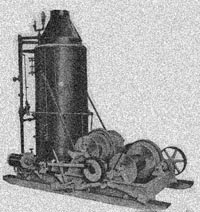 While lying on Mission mad flats the pumps were kept at work constantly by the donkey engine, which was supplied with steam from the tug Wizard, which remained alongside all the time. Early in the morning there were nine feet of water in the bark's hold, but by the afternoon, when she was alongside Pacific street wharf, this was reduced to 6 feet 7 inches.
The owners do not apprehend that any great damage has been done. After striking the rock the bark swung off and remained broadside on. There was but little swell on at the time, and there was no hole made in the vessel, although several seams must have been opened. William Mighell, managing owner of the craft, stated yesterday that $1000 would repair her. There will, he said, be $500 and over for putting her on the dock, and another $500 for fixing her up."
San Francisco Bay. 1899.


As to the insurance on the General Fairchild, it appears that only two-sixteenths of her is insured, and that is in the Fireman's Fund. There is not likely, however, to be any great amount of salvage, if any. The fault, as far as can be learned preceding an official investigation, seems to lie entirely with the tug Sea Queen. Other vessels were being towed in, and, therefore, to get in ahead, it was necessary to get an inshore course. On rounding the point the bark was oaught in the terrible eddy there, and of course went on the rocks. Three tugs could hardly have prevented the accident when the tide once caught her broadside.
Besides all this, Mr. Mighell, who is managing owner of the General Fairchild, is also a director of the Shipowners and Merchants' Tugboat Company. This gentleman himself states that he does not think that the towboat people will put in a claim for salvage.
November 9, 1899, San Francisco Call, San Francisco, California
New Shipping Company
Local Business Men Will Compete for Trade of the Orient.
The California Shipping Company incorporated yesterday with a capital stock of $1,000,000, of which $800,000 has been subscribed. The subscribers are: W. E. Mighell, $34,000; Charles Boudrow. $17,000; John Dolbeer, $18,000; G. M. Josselyn & Co., $7000; Edward W. Kentfleld. $68,000: William Babcock, $50,000; Emma I. York. $8,000; Louis Schwabacker, $10,000; Sigmund Schwabacker, $10,000; Roth, Blum & Co., $21,000; George Jennings, $17,000; Kirkham Wright, $17,000; W. J. Gray, $17,000; Antone Borel & Co., $25,000; N. D. Rideout. $25,000; Arthur L. Black, $5,000; Charles Nelson, $5,000; Henry F. Allen, $25,000; Hind, Rolph & Co $10,000; Moses Blum, $10,000; Bennett & Goodall, $17,000; F. W. Zeile, $10,000; H. L. E. Meyer, $25,000; Pope & Talbot, $25,000; William Haas, $10,000; John C. & E. Coleman, $25,000: J. G. Lavensaler, $,5000; Austin C. Tubbs, $17,000; Fireman's Fund Insurance Company, $25,000; Oliver R. Chapman, $20,000; Carter P. Pomeroy, $3,000; George H. Foster, $2,000; W. S. Jones, $5,000; A. Himmelman, $2,000, and W. E. Mighell, trustee, $10,000.
The Great Ocean: Pacific Worlds from Captain Cook to the Gold Rush
David Igler



Site Search

Merchants of Grain:
The Power and Profits of the Five Giant Companies at the Center of the World's Food Supply
Dan Morgan
Details how a handful of families have controlled the worlds grain trade for centuries. A great piece for families that till the soil, but one that is even more important to the people who live in the city; and have no idea of the power and control that these families wield.
From Captain John R. Sutton:
"I am a captain on Mississippi River towboats. I have pushed millions of tons of grain down the Mississippi River for years. But I never really understood the gobal impact of the world's grain company's until I read this book."


Spanish Pirate Coins

Shanghaiing Days: The Thrilling Account of 19th Century Hell-Ships, Bucko Mates and Masters, and Dangerous Ports-Of-Call from San Francisco
Richard H. Dillon
D. Michael Abrashoff
Merchant Kings: When Companies Ruled the World, 1600--1900
Stephen R. Brown

American Merchant Ships
1850-1900
Frederick C. Matthews



Flying Cloud
The True Story of America's Most Famous Clipper Ship and the Woman who Guided Her
David W. Shaw
Through a study of a record-breaking 89-day voyage from New York to San Francisco, the author recreates life aboard a 19th-century clipper ship. He tells of the role of the ship's navigator, Eleanor Creesy -- who was married to the captain and who helped chart a safe voyage through dangerous seas. Much of this book is based on primary source material: diaries, letters, and ship's logs.


California's Frontier Naturalists
Richard G. Beidleman.


Breverton's Nautical Curiosities:
A Book of the Sea
Terry Breverton
The Clipper Ship Era
An Epitome of Famous American and British Clipper Ships, Their Owners, Builders, Commanders, and Crews, 1843-1869
Arthur Hamilton Clark

 Copyright ~ 1998-2018.